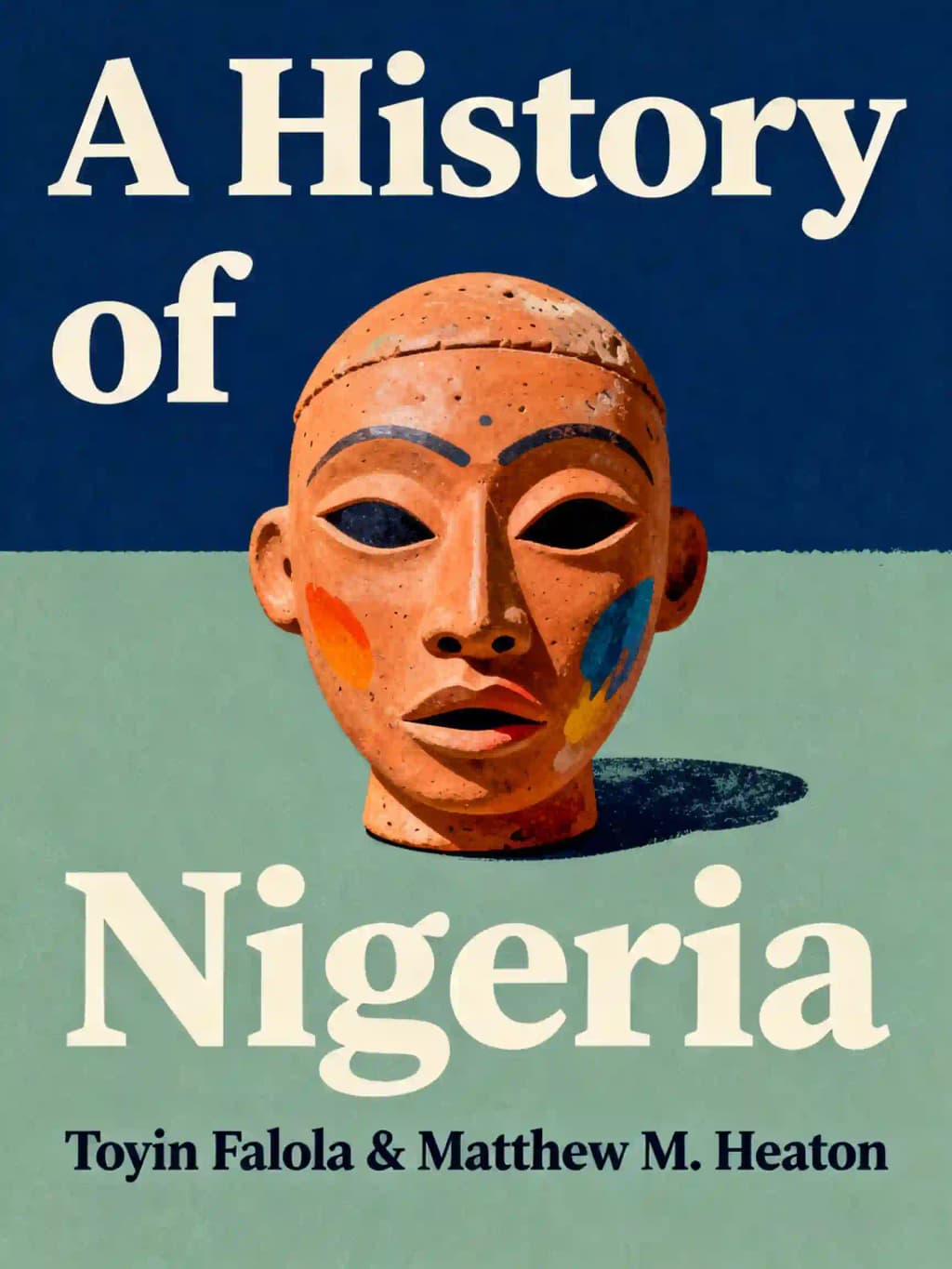
Journey through 10,000 years of Nigerian resilience in this landmark academic text spanning ancient settlements to modern challenges. Praised for filling crucial gaps in West African scholarship, it reveals how Nigeria's complex ethnic and religious tapestry continues to shape global politics today.
Toyin Falola and Matthew M. Heaton, co-authors of A History of Nigeria, are distinguished scholars in African studies and historical analysis.
Falola, a Nigerian historian and the Frances Higginbotham Nalle Centennial Professor at the University of Texas at Austin, is renowned for his expertise in African cultures and postcolonial development. With over 100 publications, including The Power of African Cultures (2003) and Economic Reforms and Modernization in Nigeria (2004), his work emphasizes Nigeria’s social, political, and economic evolution.
Heaton, an Associate Professor at Virginia Tech, specializes in African health and science history, co-editing volumes like HIV/AIDS, Illness and African Well-Being (2007) with Falola. Their collaboration merges deep cultural insight with rigorous academic analysis, addressing themes like colonialism, nationalism, and Nigeria’s complex post-independence challenges.
Published by Cambridge University Press, A History of Nigeria has become a foundational text, cited over 240 times in scholarly works and widely used in academic curricula. Falola’s leadership as president of the African Studies Association (2014–2015) further underscores the book’s authoritative standing in understanding Africa’s most populous nation.
A History of Nigeria provides a comprehensive exploration of Nigeria’s past, from 9000 BCE to the 21st century. It examines pre-colonial societies, colonial rule, independence struggles, and modern challenges like political instability and oil-driven economics. The book emphasizes social, cultural, and religious dynamics alongside political and economic themes, offering a balanced view of the nation’s resilience and unrealized potential.
Toyin Falola is a Nigerian historian and Distinguished Teaching Professor at the University of Texas at Austin. A Fellow of the Nigerian Academy of Letters, he has authored over 150 books on African history, including works on nationalism, colonialism, and intellectual traditions. His research spans state formation, diaspora studies, and globalization.
This book is ideal for students, scholars, and readers interested in African history, postcolonial studies, or Nigeria’s socio-political evolution. Its blend of political, economic, and cultural analysis appeals to those seeking a nuanced understanding of Nigeria’s historical complexities and contemporary challenges.
Yes. The book is praised for its thorough research, chronological breadth, and integration of underrepresented social themes. Falola’s accessible yet scholarly approach makes it a vital resource for understanding Nigeria’s past and present.
The book details how British colonial rule (1884–1960) disrupted indigenous systems, imposed exploitative economic policies, and entrenched ethnic divisions. It highlights Nigerian resilience through localized resistance and adaptation to colonial institutions.
Oil discovery in the 1950s transformed Nigeria’s economy but fueled corruption, environmental degradation, and regional inequities. Falola critiques over-reliance on oil revenues, linking it to political instability and missed diversification opportunities.
The book traces these conflicts to colonial-era divisions and post-independence power struggles. It analyzes how ethnicity and religion have been weaponized in politics, undermining national unity.
Some note its dense academic style may challenge casual readers. While lauded for scope, critics suggest deeper analysis of certain 20th-century events, like the Biafra War, could enhance its narrative.
Unlike works focusing narrowly on politics, Falola balances social, cultural, and economic themes across millennia. This holistic approach distinguishes it from 20th-century-centric histories.
Key themes include state formation, slavery, colonialism, nationalism, religious identity, and globalization. The book also emphasizes urbanization, education, and Nigeria’s role in the African diaspora.
Pre-colonial societies (e.g., Hausa states, Yoruba kingdoms) laid foundations for governance, trade, and culture. Falola argues this era’s legacy influences modern Nigeria’s ethnic diversity and resilience.
The book details nationalist movements’ rise against colonial rule, culminating in 1960 independence. It also critiques post-independence leaders for perpetuating colonial-era divisions, hindering national cohesion.
저자의 목소리로 책을 느껴보세요
지식을 흥미롭고 예시가 풍부한 인사이트로 전환
핵심 아이디어를 빠르게 캡처하여 신속하게 학습
재미있고 매력적인 방식으로 책을 즐기세요
Nigeria's journey represents one of history's most fascinating experiments.
Slavery in the Nigerian region differed significantly from American chattel slavery.
While surrounding communities feared the oracle, the Aro themselves knew it was a fraud.
A history of Nigeria의 핵심 아이디어를 이해하기 쉬운 포인트로 분해하여 혁신적인 팀이 어떻게 창조하고, 협력하고, 성장하는지 이해합니다.
A history of Nigeria을 빠른 기억 단서로 압축하여 솔직함, 팀워크, 창의적 회복력의 핵심 원칙을 강조합니다.

생생한 스토리텔링을 통해 A history of Nigeria을 경험하고, 혁신 교훈을 기억에 남고 적용할 수 있는 순간으로 바꿉니다.
무엇이든 물어보고, 목소리를 선택하고, 진정으로 공감되는 인사이트를 함께 만들어보세요.

샌프란시스코에서 컬럼비아 대학교 동문들이 만들었습니다
"Instead of endless scrolling, I just hit play on BeFreed. It saves me so much time."
"I never knew where to start with nonfiction—BeFreed’s book lists turned into podcasts gave me a clear path."
"Perfect balance between learning and entertainment. Finished ‘Thinking, Fast and Slow’ on my commute this week."
"Crazy how much I learned while walking the dog. BeFreed = small habits → big gains."
"Reading used to feel like a chore. Now it’s just part of my lifestyle."
"Feels effortless compared to reading. I’ve finished 6 books this month already."
"BeFreed turned my guilty doomscrolling into something that feels productive and inspiring."
"BeFreed turned my commute into learning time. 20-min podcasts are perfect for finishing books I never had time for."
"BeFreed replaced my podcast queue. Imagine Spotify for books — that’s it. 🙌"
"It is great for me to learn something from the book without reading it."
"The themed book list podcasts help me connect ideas across authors—like a guided audio journey."
"Makes me feel smarter every time before going to work"
샌프란시스코에서 컬럼비아 대학교 동문들이 만들었습니다

A history of Nigeria 요약을 무료 PDF 또는 EPUB으로 받으세요. 인쇄하거나 오프라인에서 언제든 읽을 수 있습니다.
What if I told you that one of the world's most complex nations-home to over 200 ethnic groups and 500 languages-was never meant to exist at all? Nigeria's story begins not with colonial mapmakers in 1914, but thousands of years earlier, when sophisticated civilizations flourished across West Africa's forests and savannas. Archaeological evidence reveals continuous human habitation dating back to 9000 BCE, with communities developing pottery, agriculture, and eventually powerful kingdoms that rivaled any in medieval Europe. The Yoruba spiritual center of Ile-Ife produced bronze sculptures so exquisite they still astonish art historians today. The kingdom of Benin built an empire through tribute and trade, its artisan guilds creating masterpieces that would later fill European museums. Meanwhile, the Kanem empire in the northeast established trans-Saharan trade routes that connected West Africa to the Mediterranean world. These weren't primitive societies waiting for European "civilization"-they were dynamic, self-governing states with their own systems of law, commerce, and cultural expression.