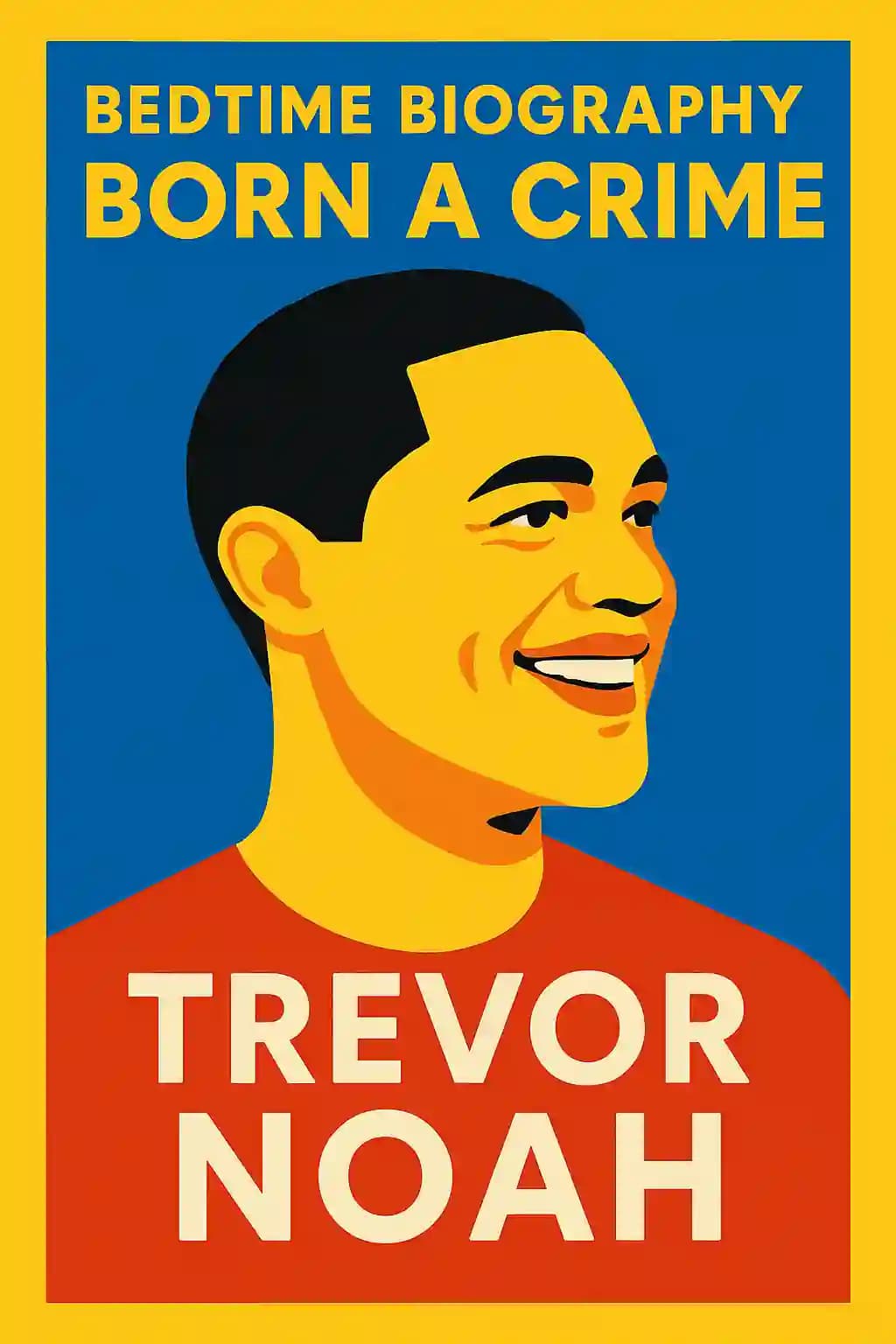
Trevor Noah's #1 NYT bestseller unveils his extraordinary childhood under apartheid, where his very existence was illegal. Jill Biden made it required college reading, while Lupita Nyong'o is set to star in the film adaptation of this darkly funny, deeply moving memoir.
Trevor Noah is the bestselling author of Born a Crime: Stories from a South African Childhood. He is also an Emmy-winning comedian, political commentator, and former host of The Daily Show.
Born in Johannesburg in 1984 to a Black South African mother and white European father during apartheid, Noah's memoir blends humor and raw honesty. It explores themes of race, identity, and survival in a divided society.
Noah's career includes nine comedy specials, such as Trevor Noah: Afraid of the Dark (Netflix) and Lost in Translation (Comedy Central). Additionally, he has hosted five consecutive Grammy Awards and the 2022 White House Correspondents’ Dinner.
The Audible edition of Born a Crime, narrated by Noah, was the platform’s highest-rated audiobook of 2016 and has sold millions of copies globally. It won two NAACP Image Awards and remains a staple in discussions about systemic oppression and resilience.
Born a Crime is Trevor Noah’s memoir about growing up mixed-race in apartheid South Africa, where his birth was literally illegal. It explores his tumultuous childhood, his fiercely independent mother’s influence, and his journey navigating racial identity, poverty, and systemic injustice with humor and resilience.
This book appeals to readers interested in memoirs, South African history, or social justice. It’s ideal for fans of Noah’s comedy, those exploring biracial identity, or anyone seeking insights into apartheid’s legacy through a personal lens.
Yes. Noah balances raw honesty with sharp wit, offering both a gripping personal story and a nuanced critique of systemic racism. Its blend of humor and heartbreak makes it accessible while tackling heavy themes like violence, inequality, and survival.
Noah details his struggle to belong in a racially stratified society, using language and cultural fluency to bridge groups. His “colored” identity forces him to code-switch constantly, highlighting apartheid’s absurdity and the resilience required to navigate it.
Trevor’s mother, Patricia, is portrayed as a defiant, resourceful figure who challenges apartheid’s rules. Her unshakable faith and tough love shape Trevor’s worldview, culminating in her surviving a gunshot to the head—a testament to her resilience.
Noah illustrates how systemic inequality traps communities like Alexandra in cycles of crime and deprivation. His teenage hustling ventures reveal how poverty forces ingenuity but rarely leads to escape, underscoring structural barriers.
Noah shows how apartheid’s racial categories distorted personal and communal identities long after its end. His anecdotes about police brutality and economic disparity underscore systemic racism’s lingering effects.
Noah uses comedy to soften harsh truths, making apartheid’s horrors accessible without trivializing them. His focus on his mother’s influence and his hybrid identity offers a fresh perspective on resilience.
The book’s themes—racial injustice, economic inequality, and identity fluidity—resonate in global discussions about systemic racism. Noah’s storytelling humanizes issues often reduced to statistics.
Unlike typical memoirs, it prioritizes sociohistorical analysis over fame-focused anecdotes. Its depth places it closer to Ta-Nehisi Coates’ Between the World and Me than conventional celebrity life stories.
Some argue Noah’s comedic tone occasionally overshadows apartheid’s brutality. However, most praise his ability to balance levity with gravity, ensuring the narrative remains engaging yet impactful.
Fans may enjoy The Glass Castle (resilient parenting), Educated (escaping hardship through education), or Between the World and Me (race and identity). All blend personal stories with broader social commentary.
저자의 목소리로 책을 느껴보세요
핵심 아이디어를 빠르게 캡처하여 신속하게 학습
I was born a crime. Not figuratively, but literally.
"Trevor," she would say, "you need to learn how to think."
Education is the only thing they can't take away from you.
My mother taught me that love is not just an emotion - it's an action.
I was too light to be considered black, but not light enough to be white.
Bedtime Biography의 핵심 아이디어를 이해하기 쉬운 포인트로 분해하여 혁신적인 팀이 어떻게 창조하고, 협력하고, 성장하는지 이해합니다.
Bedtime Biography을 빠른 기억 단서로 압축하여 솔직함, 팀워크, 창의적 회복력의 핵심 원칙을 강조합니다.

무엇이든 물어보고, 목소리를 선택하고, 진정으로 공감되는 인사이트를 함께 만들어보세요.

샌프란시스코에서 컬럼비아 대학교 동문들이 만들었습니다
"Instead of endless scrolling, I just hit play on BeFreed. It saves me so much time."
"I never knew where to start with nonfiction—BeFreed’s book lists turned into podcasts gave me a clear path."
"Perfect balance between learning and entertainment. Finished ‘Thinking, Fast and Slow’ on my commute this week."
"Crazy how much I learned while walking the dog. BeFreed = small habits → big gains."
"Reading used to feel like a chore. Now it’s just part of my lifestyle."
"Feels effortless compared to reading. I’ve finished 6 books this month already."
"BeFreed turned my guilty doomscrolling into something that feels productive and inspiring."
"BeFreed turned my commute into learning time. 20-min podcasts are perfect for finishing books I never had time for."
"BeFreed replaced my podcast queue. Imagine Spotify for books — that’s it. 🙌"
"It is great for me to learn something from the book without reading it."
"The themed book list podcasts help me connect ideas across authors—like a guided audio journey."
"Makes me feel smarter every time before going to work"
샌프란시스코에서 컬럼비아 대학교 동문들이 만들었습니다

Bedtime Biography 요약을 무료 PDF 또는 EPUB으로 받으세요. 인쇄하거나 오프라인에서 언제든 읽을 수 있습니다.
I was born a crime. Not figuratively, but literally. My very existence was illegal under apartheid law in South Africa. You see, I'm what's known as "colored" - mixed race. My mother is a black South African woman, and my father is a white Swiss-German man. Their union was forbidden. Growing up, I lived a life of contradictions. I was too light to be considered black, but not light enough to be white. I didn't fit neatly into any of apartheid's racial categories. As a result, I spent much of my childhood hidden away, isolated from the outside world. My mother couldn't be seen with me in public without risking arrest. But my mother was a rebel at heart. She refused to let the oppressive system dictate how she lived her life or raised her child. She taught me to question everything, to think for myself, and to never accept artificial limitations placed on me by others. "Trevor," she would say, "you need to learn how to think." It was her way of teaching me to see beyond the surface, to understand the complex realities beneath.