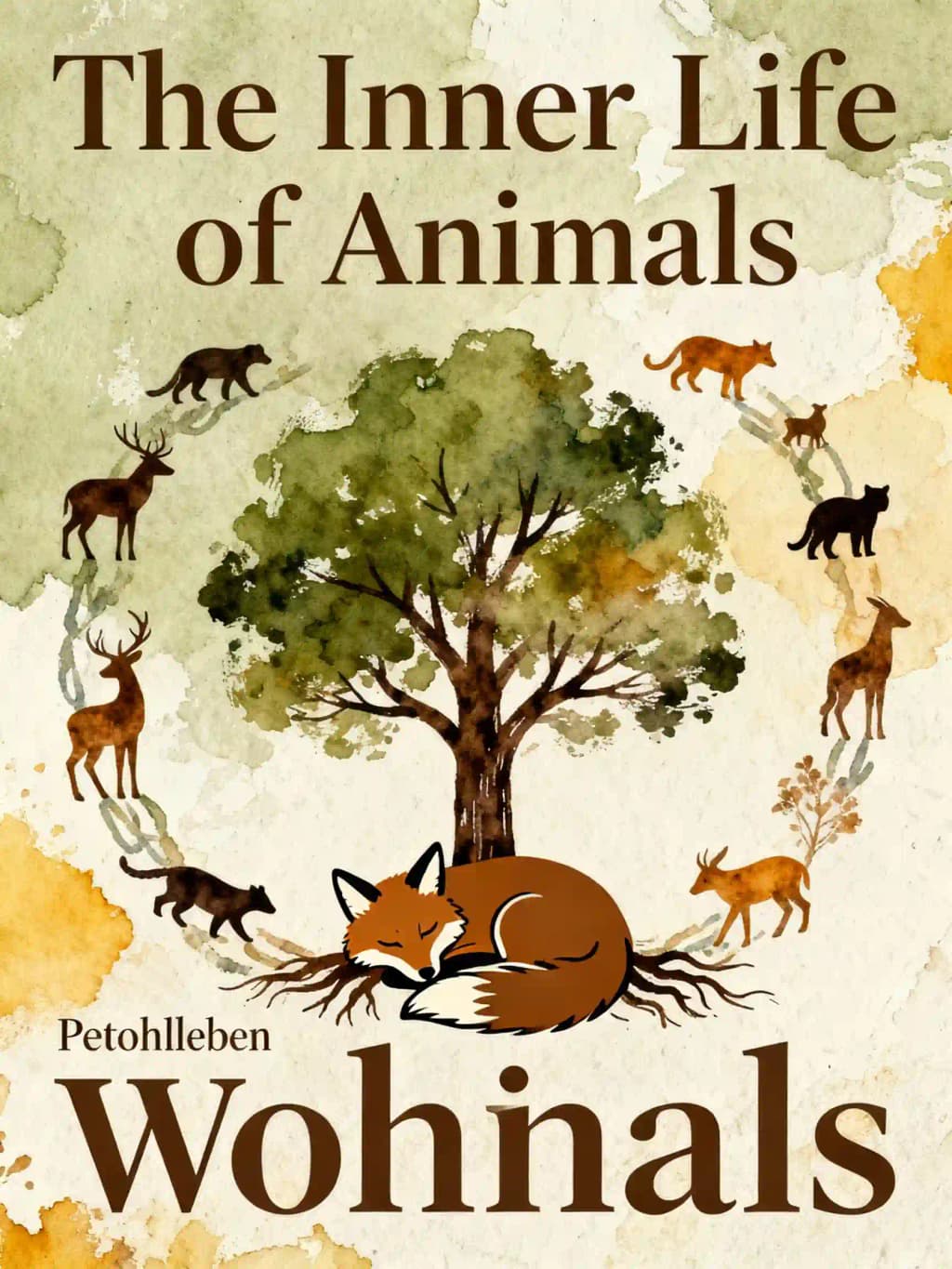
Discover how horses feel shame and deer grieve in Wohlleben's eye-opening journey into animal consciousness. Praised by Sy Montgomery and The Guardian as "wry and kind," this starred-review bestseller reveals the startling truth: animals think and feel just like us.
Peter Wohlleben, bestselling author of The Inner Life of Animals, is a German forester and ecological advocate renowned for blending scientific rigor with accessible storytelling about nature’s mysteries.
Specializing in popular science and environmental nonfiction, his work explores themes of animal cognition, forest ecosystems, and humanity’s relationship with the natural world—topics informed by his 20+ years managing woodlands and founding the Forest Academy in Hümmel, Germany.
Wohlleben’s groundbreaking The Hidden Life of Trees (translated into over 40 languages and adapted into a graphic novel) established his signature approach to revealing nature’s hidden networks. A frequent media commentator and international speaker, he extends his insights through magazines like Wohlleben’s World and lectures promoting sustainable forestry.
His books, including The Secret Wisdom of Nature and Can You Hear the Trees Talking?, have collectively sold millions of copies worldwide, cementing his status as a leading voice in contemporary nature writing.
The Inner Life of Animals explores the emotional and cognitive complexities of animals, arguing they experience love, grief, empathy, and regret. Peter Wohlleben combines scientific research, field observations, and engaging storytelling to reveal how animals like pigs, magpies, and deer display intelligence and social bonds, challenging human-centric views of animal behavior.
Animal lovers, nature enthusiasts, and readers interested in ethology or ecology will find this book compelling. It’s ideal for fans of Wohlleben’s The Hidden Life of Trees and those curious about animal sentience. The accessible, non-technical style appeals to casual readers and science-minded audiences alike.
Yes—Wohlleben’s blend of humor, scientific insight, and vivid anecdotes makes complex concepts accessible. Critics praise its ability to reshape perceptions of animal intelligence, though some debate its anthropomorphic tone. The 50 concise chapters offer digestible insights, ideal for readers seeking a thought-provoking yet approachable read.
Key ideas include:
Wohlleben cites studies on oxytocin in fish, raven communication, and rodent regret, alongside his forestry observations. While some critics note his informal tone, he grounds claims in biology and ecology, making scientific concepts relatable without oversimplification.
Both books anthropomorphize nature, but The Inner Life of Animals focuses on behavioral parallels between humans and animals, whereas Trees examines plant communication. Critics note a stronger emphasis on ethics here, urging readers to reconsider humanity’s relationship with wildlife.
Notable quotes include:
Some scientists argue Wohlleben oversimplifies emotions or conflates instinct with conscious intent. However, most praise his ability to spark dialogue about animal rights and ecological ethics, even if interpretations differ.
It disputes the idea that animals act purely on instinct, showcasing examples like scheming roosters and empathetic deer. Wohlleben argues that recognizing animal sentience should influence conservation policies and dietary choices.
The book encourages greater empathy toward wildlife, ethical consumption, and habitat preservation. It also offers insights into animal behavior for farmers, pet owners, and outdoor enthusiasts.
Yes—Wohlleben examines pigs forming friendships, magpies “cheating” mates, and rats regretting decisions. These stories illustrate broader themes of emotion and cognition across the animal kingdom.
As debates about animal rights and climate action intensify, the book provides a framework for understanding non-human perspectives. Its themes align with movements advocating sustainable coexistence and wildlife protection.
저자의 목소리로 책을 느껴보세요
지식을 흥미롭고 예시가 풍부한 인사이트로 전환
핵심 아이디어를 빠르게 캡처하여 신속하게 학습
재미있고 매력적인 방식으로 책을 즐기세요
Nature is remarkably efficient in its designs.
Emotions aren't uniquely human inventions.
Animal social lives reveal remarkable complexity.
Emotions are the language of the unconscious.
What if that squirrel in your backyard experiences grief as deeply as you do?
Inner Life of Animals의 핵심 아이디어를 이해하기 쉬운 포인트로 분해하여 혁신적인 팀이 어떻게 창조하고, 협력하고, 성장하는지 이해합니다.
Inner Life of Animals을 빠른 기억 단서로 압축하여 솔직함, 팀워크, 창의적 회복력의 핵심 원칙을 강조합니다.

생생한 스토리텔링을 통해 Inner Life of Animals을 경험하고, 혁신 교훈을 기억에 남고 적용할 수 있는 순간으로 바꿉니다.
무엇이든 물어보고, 목소리를 선택하고, 진정으로 공감되는 인사이트를 함께 만들어보세요.

샌프란시스코에서 컬럼비아 대학교 동문들이 만들었습니다
"Instead of endless scrolling, I just hit play on BeFreed. It saves me so much time."
"I never knew where to start with nonfiction—BeFreed’s book lists turned into podcasts gave me a clear path."
"Perfect balance between learning and entertainment. Finished ‘Thinking, Fast and Slow’ on my commute this week."
"Crazy how much I learned while walking the dog. BeFreed = small habits → big gains."
"Reading used to feel like a chore. Now it’s just part of my lifestyle."
"Feels effortless compared to reading. I’ve finished 6 books this month already."
"BeFreed turned my guilty doomscrolling into something that feels productive and inspiring."
"BeFreed turned my commute into learning time. 20-min podcasts are perfect for finishing books I never had time for."
"BeFreed replaced my podcast queue. Imagine Spotify for books — that’s it. 🙌"
"It is great for me to learn something from the book without reading it."
"The themed book list podcasts help me connect ideas across authors—like a guided audio journey."
"Makes me feel smarter every time before going to work"
샌프란시스코에서 컬럼비아 대학교 동문들이 만들었습니다

Inner Life of Animals 요약을 무료 PDF 또는 EPUB으로 받으세요. 인쇄하거나 오프라인에서 언제든 읽을 수 있습니다.
Imagine walking through a forest and realizing that every creature you pass-the squirrel pausing mid-acorn, the crow watching from above, the deer freezing in the distance-experiences emotions as rich and complex as your own. This isn't fantasy; it's the frontier of modern animal behavior research. The emotional lives of animals aren't pale imitations of human feelings but sophisticated adaptations shaped by evolution to help them navigate their worlds. From the grieving elephant to the playful raven, animals experience joy, fear, love, and loss with remarkable depth. Their emotions aren't primitive precursors to ours but parallel developments, each perfectly suited to their species' needs and social structures. The boundary we've drawn between human and animal consciousness is increasingly revealed as an artificial one-a convenient fiction that's helped us justify our dominance but fails to reflect biological reality.