1장
The Emotional Lives of Animals: A Journey Into Their Hearts and Minds
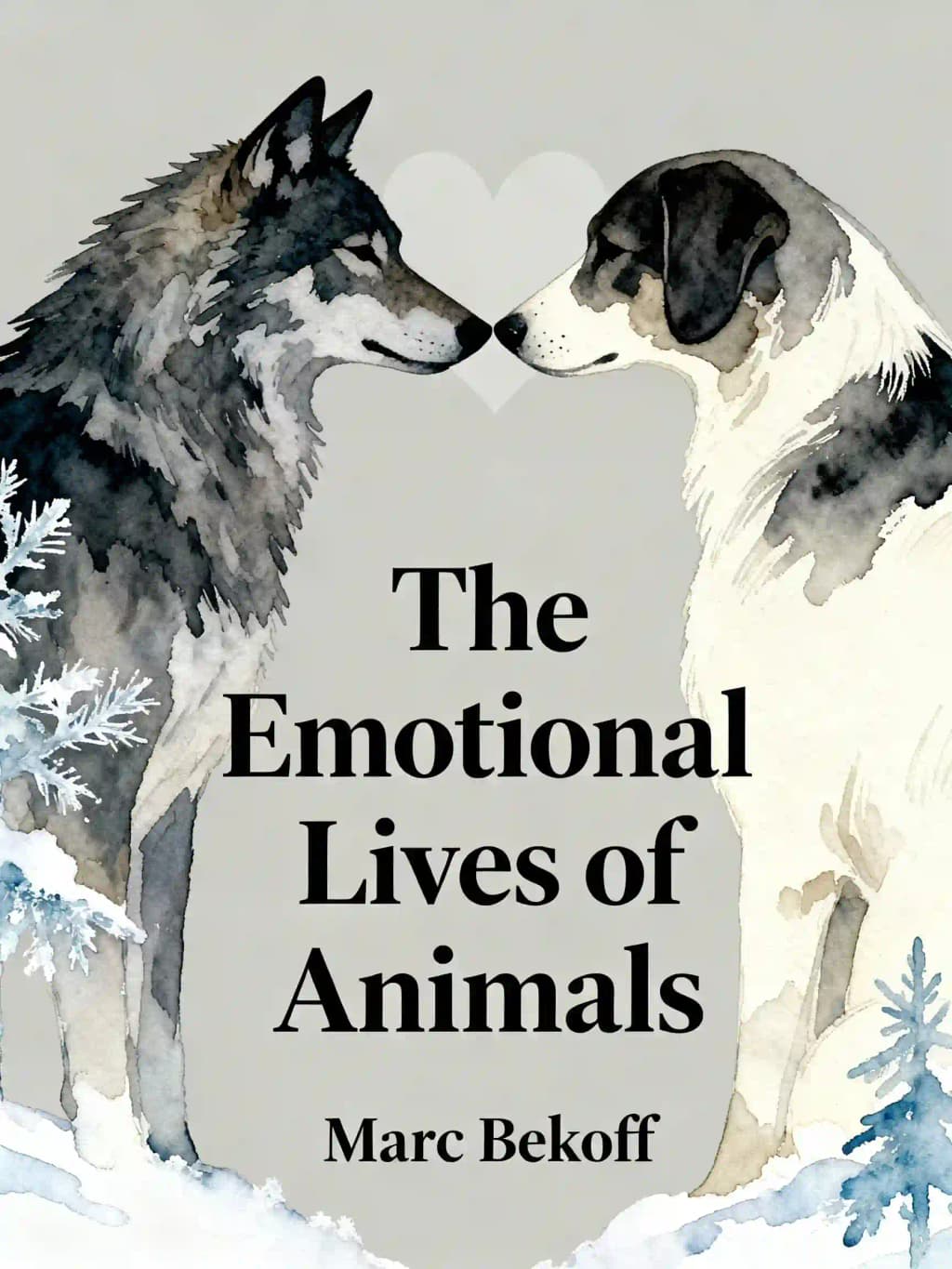
When Jane Goodall first suggested that chimpanzees have personalities, emotions, and minds capable of rational thought, the scientific establishment scoffed. Today, the idea that animals experience rich emotional lives has moved from heresy to scientific mainstream. Marc Bekoff's groundbreaking book "The Emotional Lives of Animals" arrived at a pivotal moment in this paradigm shift, helping to legitimize the scientific study of animal emotions. The book has since influenced countless animal welfare policies and changed how millions view their relationship with other species. Even celebrities like Ellen DeGeneres and Joaquin Phoenix have cited it as transformative to their understanding of animal consciousness. What makes this work so powerful is not just its scientific rigor but its ability to bridge the gap between objective research and the undeniable emotional experiences we witness in animals every day.
2장
When Animals Say Goodbye: The Evidence for Emotional Lives
One crisp Colorado morning, Marc Bekoff and his friend Rod witnessed something remarkable. Five magpies had gathered around the body of a fallen companion. Four of the birds gently pecked at the corpse before two flew off, returning with grass they placed beside the body. After standing vigil briefly, the birds flew away. This wasn't random behavior-it appeared to be a deliberate farewell ceremony.
Such observations aren't mere anthropomorphism but part of a growing body of evidence that animals experience complex emotions. In Kenya's Samburu Reserve, Bekoff observed an elephant named Babyl who walked slowly due to being crippled. Rather than abandoning her as natural selection might predict, the herd consistently waited for her, adjusting their pace to accommodate her disability. Their guide, elephant expert Iain Douglas-Hamilton, explained this behavior had continued for years.
The scientific evidence for animal emotions comes from multiple disciplines: evolutionary biology, neuroscience, endocrinology, and behavioral studies. Charles Darwin's concept of evolutionary continuity-that differences between species are of degree rather than kind-provides the theoretical foundation. If humans evolved from other animals, our emotions must have evolutionary precursors in other species. The limbic system, which processes emotions, is one of the brain's oldest structures, shared across mammals and even some reptiles.
Neurochemical studies further support this continuity. Mice used in depression studies respond to the same antidepressants humans take. The brain chemicals associated with pleasure, fear, and attachment-dopamine, adrenaline, oxytocin-function similarly across species. When we see a dog wagging its tail wildly during play or an elephant touching the bones of a deceased herd member, we're witnessing the external manifestations of internal emotional states processed through neural pathways remarkably similar to our own.
Skeptics once argued that attributing emotions to animals was unscientific anthropomorphism. But as primatologist Frans de Waal notes, "the real question is not whether animals have emotions, but how science could have overlooked them for so long." The burden of proof has shifted: those claiming animals lack emotions must explain why evolution would have created emotional capacities in humans alone, despite our shared biology with other species.
What's particularly striking is how emotions serve similar functions across species-they're not mere luxuries but essential survival tools. Fear motivates escape from danger, attachment bonds social groups, play builds skills and relationships. These aren't simply mechanistic responses but genuine experiences that matter deeply to the animals themselves.
3장
The Science of Animal Feelings: How We Know What They Experience
Cognitive ethology-the study of animal minds-has evolved from a fringe discipline to a respected scientific field. When Donald Griffin published "The Question of Animal Awareness" in 1976, suggesting animals might have conscious experiences, many scientists dismissed him. Today, journals regularly publish studies on joy in rats and grief in elephants without controversy.
How do scientists study something as seemingly subjective as emotions? They use multiple converging lines of evidence. Behavioral observations document how animals respond to situations that typically evoke emotions in humans. Physiological measurements track changes in heart rate, stress hormones, and brain activity. Neurobiological studies examine the brain structures and chemicals involved in emotional processing.
Charles Darwin pioneered this approach in his 1872 book "The Expression of the Emotions in Man and Animals," meticulously documenting how emotions manifest across species. He observed his dog's emotional states with remarkable insight, noting how the animal displayed pleasure through high steps and raised head during walks, and dejection through drooping posture when walks were uncertain.
Modern researchers use more sophisticated tools but follow similar principles. When studying play in rats, neuroscientist Jaak Panksepp discovered that they emit ultrasonic "chirps" analogous to human laughter when tickled. These vocalizations correlate with increased dopamine activity in brain regions associated with pleasure. The rats actively seek out tickling and show "anticipatory joy" before play sessions-strong evidence they genuinely enjoy the experience.
Scientists also make arguments from analogy, comparing humans and other animals to find similarities in brain structure, hormones, physiology, genetics, behavior, and expressions. These analogies are reasonable because of evolutionary continuity. As elephant researcher Joyce Poole asks: if animals are mere automatons without real emotions, where did human emotions come from? There must be evolutionary precursors to human emotions in other animals.
Field research provides particularly valuable insights because animals express emotions most naturally in their native environments. Laboratory studies, while more controlled, often fail to capture the full range of animal emotional expression. A caged wolf may never display the exuberant greeting ceremony observed when pack members reunite in the wild. This is why cognitive ethologists prefer studying animals in natural settings whenever possible.
Even untrained observers can accurately identify animal emotions. Researcher Francoise Wemelsfelder developed a "Free-Choice-Profiling" method showing that people from diverse backgrounds-students, scientists, farmers, veterinarians-consistently agree when judging animals' emotional states. This suggests either that animal emotions are readily apparent or that humans possess a natural ability to interpret them across species.
4장
The Joy of Being Alive: How Animals Experience Happiness
While scientific research has often focused on negative emotions like fear and distress, animals clearly experience immense joy in play, greeting friends, being freed, and even watching others having fun. This joy manifests in relaxed movements, as if limbs are attached by rubber bands, and through species-specific vocalizations-purring, barking, squealing, or dolphins' chuckling.
Play provides perhaps the clearest window into animal joy. When coyotes or wolves reunite, they gallop toward each other whining and smiling with wildly wagging tails. Elephants celebrate reunions with ear-flapping, spinning, and "greeting rumbles." Even farm animals experience joy-chickens play and form friendships, while cows play games and develop lifelong bonds.
The neurochemistry of play reveals why it feels so good. Neuroscientist Steve Siviy has shown that dopamine (and possibly serotonin and norepinephrine) regulates play, with large brain regions activated during play sessions. Rats show increased dopamine activity just anticipating play opportunities. These findings demonstrate that when a boy and his dog wrestle in the yard, they're not only both playing-they both understand they're playing and experience the same pleasurable neurochemical responses.
Laughter isn't uniquely human either. Scientific research confirms that dogs laugh with what researcher Patricia Simonet calls "a breathy, pronounced, forced exhalation" during excitement and play. These sounds can even soothe other dogs who hear them. Rats chirp with joy, and future research will likely identify laughter in many other animals.
Beyond just experiencing joy, many animals display deliberate humor and playfulness. Jethro, the author's dog, would run frantically with his stuffed rabbit toy, checking if anyone was watching and continuing his performance when they laughed-seemingly his desired reward. Beautiful Jim Key, "the world's smartest horse," demonstrated humor by pretending to go lame when his owner considered selling him, and spelling "FRUITLESS" when a reporter forgot to bring him a treat.
Animals may even experience awe and wonder at their surroundings. Jane Goodall documented chimpanzees performing "waterfall dances"-magnificent displays where they sway rhythmically, stamp in shallow water, hurl rocks, and swing on vines into the spray, sometimes sitting afterward watching the falling water contemplatively. Goodall wonders if these displays reflect feelings of wonder and awe, possibly precursors to ritualized religious behavior.
5장
When Hearts Break: Grief and Sadness in the Animal Kingdom
Animals undeniably experience grief, particularly when losing mates, family members, or friends. Like humans, grieving animals may withdraw, become motionless, stop eating, lose interest in sex, or obsess over the deceased's body. Scientists have identified neural pathways shared between humans and animals during suffering, with elephant grief resembling post-traumatic stress disorder.
When a mountain lion killed a red fox near Bekoff's home, he observed a female fox deliberately covering the carcass with debris by orienting her body to kick material over her dead companion. She moved around the body with her tail down, displaying what appeared to be sadness. Hours later, the carcass was completely buried-a "fox funeral" offering a rare glimpse into the complex emotional lives of animals.
Gorillas hold formal wakes for deceased companions, as witnessed at Boston's Franklin Park Zoo when a female gorilla named Babs died of cancer. Her mate howled, banged his chest, and placed her favorite food in her hand, trying to wake her. Family members filed in one by one to sniff their beloved leader's body.
Elephants show remarkable concern for their dead, touching corpses gently and attempting burial rituals. Cynthia Moss observed elephants trying to dig earth despite rocky ground, breaking branches to place over a dead elephant named Tina, and standing vigil through the night. When wounded, elephants frantically try to help fallen companions, lifting them with tusks and even attempting to feed them, demonstrating profound grief and care.
Louis Dorfman witnessed his Canadian timber wolf express profound grief when her German shepherd companion died-she sniffed the body and released a uniquely soulful howl never heard before or after. The Dutchers documented similar grief in a wolf pack after losing Motaki to a mountain lion. The pack became depressed, walking slowly with lowered heads and tails, no longer howling as a group but singing alone in mournful cries.
In Alaska, Betsy Webb witnessed profound grief among her llamas. When the oldest llama, Boone, died at twenty-seven, his lifelong partner Bridger died the next day in the same manner beside him. After their burial, the remaining pair grieved distinctly according to their personalities: stoic Taffy stood at the grave staring for two days, while excitable Pumpernickel stayed in his barn wailing.
Though grief seems to have no obvious evolutionary advantage, it may strengthen social bonds among survivors. Grief represents the price of commitment-the wellspring of both happiness and sorrow.
6장
Love Beyond Instinct: The Bonds That Connect Animal Lives
Love, though mysterious and complex, exists powerfully in animals as it does in humans. Animals experience diverse forms of love-romantic, parental, filial-expressing it through friendship, loyalty, affection, and compassion. Science increasingly confirms what intuition suggests: many species possess the neuroanatomy and neurochemistry for love identical to humans.
Romantic love isn't uniquely human, as extensive research on animal mating habits confirms. Animals develop bonds slowly through elaborate courtship rituals that require time, energy and sometimes physical risk. Male marmosets carefully evaluate potential mates, as shown by fMRI studies. Southern right whales engage in touching courtship rituals, caressing flippers in "hugs" before swimming in unison. Even fish make conscious mating choices-male guppies become bolder around predators when females are present, as females find courage attractive.
Maternal love in animals manifests dramatically when offspring are threatened. Mothers across species will fight to death to protect their young and display profound grief when children are hurt or killed. Sea lion mothers squeal pitifully watching their babies being eaten by killer whales, while dolphins struggle to save dead infants. Most remarkable is Echo the elephant, who stayed with her son Ely when he couldn't stand due to rigid carpal joints, refusing to leave for food or water. Years later when Ely was wounded by a spear, Echo and her daughters remained by his side despite gunshots fired to disperse them, demonstrating lifelong maternal devotion.
Animal love extends beyond biological imperatives to remarkable acts of devotion with no evolutionary advantage. Two Jack Russell terriers were found on a street-one blinded from stab wounds, the other acting as his protector. After treatment, the sighted dog (Bill) became the blind one's (Ben) guide, teaching him to navigate by holding onto his neck scruff. Similarly, a steer named Charlie became guide and companion to Annie, a blind mule at Colorado's Black Forest Animal Sanctuary, leading her to water and helping her avoid fences.
Dogs show profound devotion not just to humans but to each other. Malamutes Tika and Kobuk, who'd raised eight litters together, demonstrated this when Tika developed cancer. Normally bossy Kobuk, who would shove Tika aside and dominate food and attention, transformed when she became ill. After Tika's leg amputation, Kobuk remained constantly by her side. When Tika later developed life-threatening complications, Kobuk woke their owner Anne in the middle of night and led her to Tika, who was going into shock. This timely intervention saved Tika's life.
7장
Moral Minds: Justice, Fairness, and Empathy Among Animals
Do animals have a sense of fairness, justice, and morality? After years studying play behavior in social carnivores like wolves, coyotes, and dogs, Bekoff found compelling evidence that animals do display moral behaviors. When animals play, they follow rules of engagement that require cooperation, trust, and fairness. They negotiate agreements, apologize when breaking rules, and show displeasure when treated unfairly.
It's important to clarify that while animals have moral codes of behavior, they likely don't have ethics-the philosophical contemplation of why fairness exists or why certain actions are considered fair. Animals may have morality-prosocial behavior promoting others' welfare-without engaging in ethical contemplation.
Social play requires a "foundation of fairness" where animals agree to cooperate and temporarily set aside inequalities in size and rank. This makes play uniquely egalitarian-large and small animals can play together, as can high and low-ranking individuals, but only if neither takes advantage of their superior strength or status. This neutralizing of differences to maintain group harmony mirrors basic definitions of justice and morality.
Animals use specific signals to initiate and maintain play. The play bow is crucial for dogs and other canids, serving multiple purposes: "I want to play," "This is still play no matter what I do next," and "Sorry about that rough move, but we're still playing." Through careful video analysis, Bekoff discovered bows aren't random but strategically placed before potentially confusing actions (like hard bites with head-shaking) or after accidentally rough play.
Role-reversing and self-handicapping are also crucial play signals that reduce inequalities between players and promote reciprocity. Self-handicapping occurs when animals deliberately restrain their strength-like a coyote or wolf not biting as hard as possible. Role-reversing happens when dominant animals perform actions during play they'd never do during real aggression, like a dominant wolf rolling over on its back.
Animals won't play when they're not having fun, and those who can't play properly become socially isolated. Dogs don't tolerate cheaters, who may be avoided or chased from play groups. More significantly, differences in play behavior affect reproductive success. Bekoff's research on coyotes showed that pups who play less are less bonded to their group and more likely to leave. In a seven-year study in Grand Teton National Park, 55 percent of these lone drifters died, compared to just 20 percent of their stay-at-home peers.
The idea that morality evolved over millions of years isn't new-Darwin proposed that human moral sentiments were products of evolution and speculated about moral sentiments in animals. Research increasingly supports the Dalai Lama's view that cooperation, not conflict, lies at the heart of existence. Among primates, the vast majority of social interactions are affiliative rather than agonistic-93.2% for prosimians, 86.1% for New World monkeys, 84.8% for Old World monkeys, and 95.7% for gorillas.
8장
The Ethics of Knowledge: How Understanding Animal Emotions Changes Everything
Our extensive knowledge of animal emotions demands action. While we have more to learn, what we already know should inspire changes in how we treat animals across all contexts: as companions, food, zoo exhibits, research subjects, and wildlife. Often, our care falls short, and we routinely disregard animal sentience.
Scientific consensus acknowledges that most, if not all, animals we use for food, entertainment, or research are sentient beings with "feelings that matter." Yet science rarely provides complete, unequivocal answers. This uncertainty shouldn't prevent ethical action. The precautionary principle maintains that lack of certainty should not excuse inaction. We know enough about animal emotions to change how we treat them now.
American laboratories use millions of animals annually-including 690,800 guinea pigs, rabbits and hamsters, 161,700 farm animals, 70,000 dogs, 49,400 primates, and 80 million mice and rats. Most live in small cages and die in labs. Despite the Animal Welfare Act, only about 1% of research animals are protected, with birds, rats and mice specifically excluded from the definition of "animal."
Captive animals develop disturbing behaviors from boredom and confinement. Primates masturbate excessively, rock, or eat their feces; rats chase their tails; sows chew air; and animals may progress to self-mutilation-monkeys gnawing limbs or genitals, parrots plucking all feathers. These aren't abnormal behaviors but normal responses to barren environments.
The scale of animal suffering in food production dwarfs all other industries. In 1998 alone, the United States killed over 26.8 billion animals for food-735,440 per day, 8.5 per second. Factory farm conditions are abysmal: animals crowded in tiny spaces, standing in their own waste, with mortality rates reaching 12-14% before slaughter from stress, injury or disease.
Zoos justify their existence through two primary missions: educating the public about conservation and helping preserve endangered species. Yet both premises are questionable. Even the Association of Zoos and Aquariums (AZA) admits there's "little to no systematic research" on whether zoo visits actually increase conservation knowledge or behavior.
Our relationship with wilderness remains troubled and contradictory. Human expansion shrinks wild habitats, creating inevitable conflicts. When wild animals encroach on our territory, we often respond with lethal force-the U.S. Fish and Wildlife Service eliminated 2.7 million animals in 2004 alone, including 83,000 mammalian carnivores through trapping, snaring, poisoning, and aerial shooting.
Individual responsibility is crucial when facing overwhelming animal welfare issues. Bekoff's guiding principle is simple: make kind choices that increase compassion and reduce cruelty. He challenges others by asking "Would you do it to your dog?"-invoking the Golden Rule to treat every being as having an equal right to life.
9장
The Path Forward: Finding Our Place in the Community of Beings
Human interests cannot always trump those of other animals if we hope to solve our complex environmental problems. The false dichotomy between "us" and "them" creates distance that erodes potential relationships among all animal life. What befalls animals ultimately befalls us-our connection with nature is critical for both our wellbeing and theirs.
When we damage these relationships, we experience what Glenn Albrecht calls "solastalgia"-distress from the transformation of our sense of belonging. Theologian Stephen Scharper offers an "anthro-harmonic" approach that acknowledges humans as fundamental but not focal, while Thomas Berry sees all beings as part of a "communion of subjects" connected through shared passions and sentience.
The scientific evidence for animal emotions should inspire a paradigm shift in how we treat other beings. This shift would reverse the burden of proof, requiring skeptics to prove animals don't have emotions rather than assuming they don't. Assuming animals experience rich emotions will never cause harm, but assuming the contrary opens the door to unlimited cruelties.
The emotional lives of animals matter not only for their own sake but because animals are vital to human wellbeing. Emotions serve as our most effective means of cross-species communication in the absence of shared language. They form the glue that binds us together, catalyzing and regulating social interactions across species boundaries.
Research consistently demonstrates animals' healing power. Veterinarian Marty Becker's work shows how pets keep people healthy and happy in nursing homes, hospitals, and schools. Allen Schoen identifies fourteen ways animal companionship reduces stress, including lowering blood pressure, increasing self-esteem in children, improving heart attack survival rates, and reducing loneliness.
Children form particularly powerful bonds with animals. Over 75 percent of American children live with pets-more likely to grow up with a pet than with both parents. Most refer to their pets as "family" or "special friends," and more than 80 percent consider themselves their pet's mother or father. These relationships benefit children's development, helping them understand that others have different needs and perspectives.
We need animals in our lives as much as we need air to breathe. In our wounded, alienated world, animals are our consummate companions who help us daily. Without close relationships with other animal beings, we're cut off from the rich, diverse world in which we live.
Animals' emotions pour out unfiltered and uncontrolled-their joy is the purest and most contagious, their grief the deepest. This emotional transparency explains why we're drawn to them and why they matter so deeply to us. By acknowledging and respecting their emotional lives, we not only improve their welfare but enrich our own humanity. As we learn to see animals as sentient beings with feelings that matter, we take an important step toward creating a more compassionate world for all beings.