1장
The Secret Wisdom of Nature: An Intricate Web Beyond Our Understanding
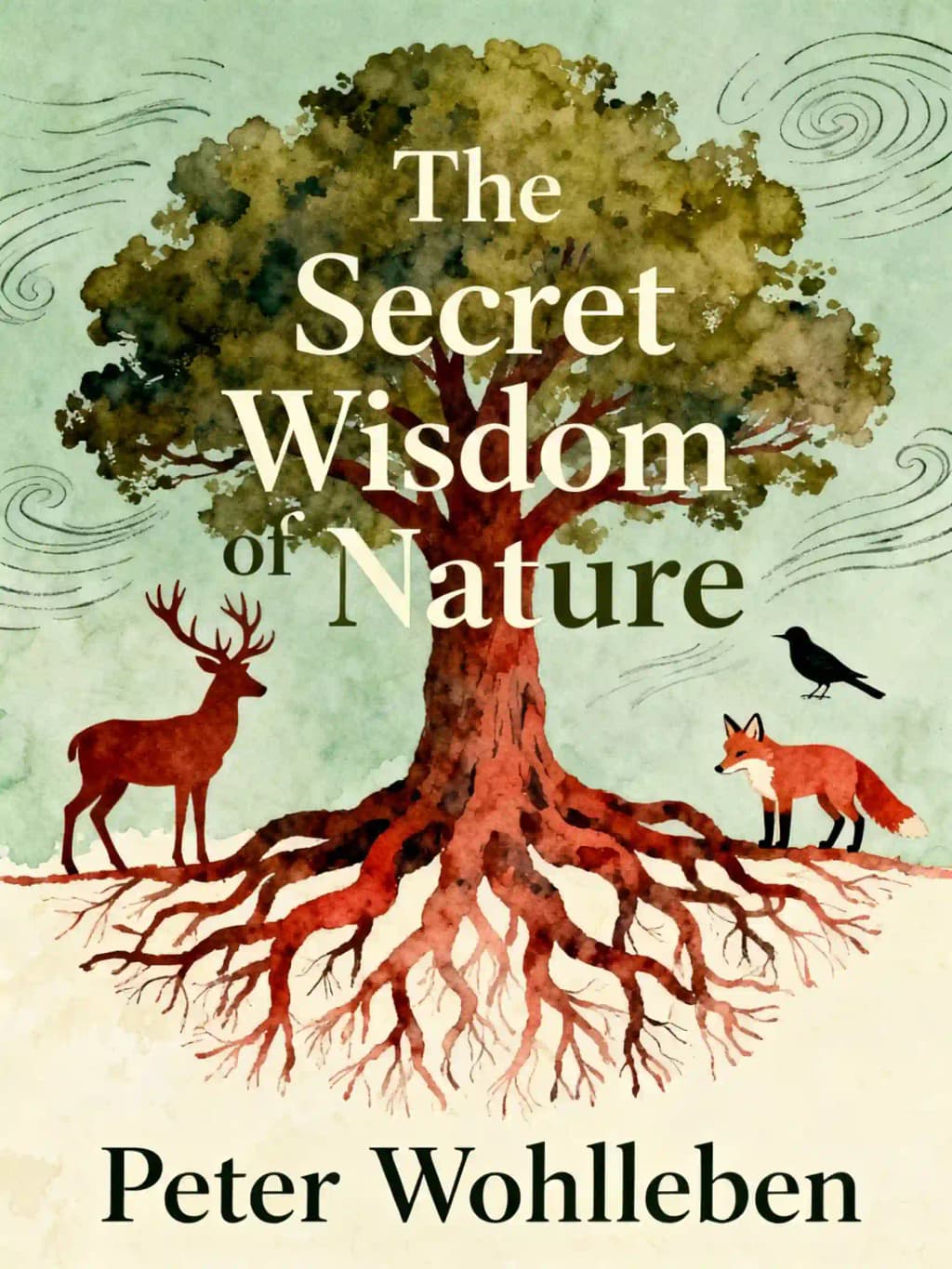
Peter Wohlleben's masterpiece "The Secret Wisdom of Nature" has captivated readers worldwide with its profound exploration of nature's hidden interconnections. This final installment of his acclaimed forest trilogy has been translated into 45 languages and spent months on bestseller lists across Europe and North America. The book's appeal transcends traditional nature writing, attracting environmentalists, casual hikers, and even celebrities like Leonardo DiCaprio, who cited it as inspiration for his climate activism. What makes this work so compelling is Wohlleben's unique ability to reveal the astonishing complexity of ecosystems through accessible storytelling, showing us that every creature-from wolves to beetles-plays a vital role in nature's grand symphony. As climate change threatens these delicate balances, understanding these connections has never been more urgent or more fascinating.
2장
Nature's Clockwork: The Intricate Dance of Ecosystems
Nature operates like an enormous, intricate clock mechanism where every component serves a specific purpose within the larger system. We've become adept at classifying species and understanding their basic ecological roles-wolves regulate deer populations, beavers create wetlands, trees produce oxygen. Yet this orderly view dramatically oversimplifies the true complexity of natural systems.
When we remove or add species to ecosystems, the consequences ripple outward in ways we rarely anticipate. In Yellowstone National Park, the elimination of wolves in the early 20th century set off a cascade of effects that literally changed the course of rivers. Without wolves, elk populations exploded, stripping riverbanks of vegetation. This led to soil erosion, wider river channels, and the disappearance of birds and beavers. The entire landscape transformed because a single "cog" was removed from the mechanism.
Even seemingly beneficial additions can trigger unexpected consequences. Introducing nonnative fish species to lakes can ultimately reduce elk populations through complex food web interactions. Conservation efforts themselves sometimes backfire-protecting crane populations in Europe has affected traditional Iberian ham production as the birds compete with pigs for acorns.
These examples reveal a humbling truth: nature's network is vastly more complex than any clock. The connections between species are so intricate that we'll never fully comprehend them all. Each discovery reveals new layers of complexity, from nocturnal red-headed flies with specialized feeding habits to beetles that depend on specific stages of forest decay.
This complexity isn't something to fear but to marvel at. It's precisely what makes nature so resilient and adaptive. But it should also inspire humility. Our interventions, however well-intentioned, often trigger unintended consequences because we simply cannot predict all the interconnections we're disrupting. The wisest approach may be to minimize our interference and let nature's intricate systems function as they evolved to do.
3장
When Predators Return: Ecological Restoration in Action
The reintroduction of wolves to Yellowstone National Park in 1995 stands as one of conservation's most illuminating success stories, demonstrating how a single species can transform an entire landscape. After wolves were eliminated in the 1920s and 30s, elk populations exploded unchecked, decimating riverside vegetation. Without young willows and poplars to stabilize riverbanks, erosion accelerated, waterways widened, and habitats for countless species disappeared.
When wolves returned, they triggered what ecologists call a "trophic cascade"-changes that ripple throughout the ecosystem. But wolves didn't just reduce elk numbers through predation; they fundamentally altered elk behavior through what scientists call "the ecology of fear." Elk began avoiding open riverbanks and other risky areas, spending less time browsing in any one location. This behavioral shift allowed young trees to flourish along waterways.
As riverside vegetation recovered, riverbanks stabilized, and water flow patterns changed. Returning beavers built dams that created ponds, providing habitat for amphibians, fish, and waterfowl. Bird diversity increased dramatically. Even grizzly bears benefited as elk spent less time competing for berry patches, improving the bears' pre-hibernation nutrition.
What's particularly fascinating is how these effects extend far beyond the obvious predator-prey relationship. The wolves' impact touches species they never directly interact with, demonstrating the profound interconnectedness of natural systems.
Despite these ecological successes, wolves face ongoing challenges. When they venture beyond park boundaries, they often encounter hostile ranchers. Their population in Yellowstone declined from 174 in 2003 to about 100 in 2016, partly due to hunting. Ironically, the radio collars researchers use to study wolves sometimes help hunters track and kill them when they leave protected areas.
Yet there's reason for optimism. Wolves are naturally returning to densely populated areas of Central Europe, where they find abundant prey. European forests now host deer populations fifty times higher than historical levels due to supplemental feeding by hunters and changes in forestry practices. Contrary to popular fears, European wolves primarily prey on wild animals-over 50% roe deer and 40% red deer and wild boar-with livestock accounting for less than 1% of their diet.
The wolf's return brings something intangible but valuable: it restores what some call the "wild soul" of woodlands. Their presence reminds us that forests are not just collections of trees but dynamic, living communities where predator and prey, plant and animal exist in ancient, meaningful relationships.
4장
Nutrients in Motion: How Salmon Feed Forests
One of nature's most remarkable connections occurs between oceans and forests through the humble salmon. In coastal regions of the Pacific Northwest and Alaska, these fish create an extraordinary nutrient pipeline that literally feeds the trees.
Salmon spend most of their lives growing fat in the ocean before making their epic journey back to their natal streams to spawn and die. When they return, they bring with them marine nutrients accumulated during their ocean years. Bears, eagles, and other predators feast on the returning salmon, consuming the fattiest parts like the brains and eggs, and discarding the remains throughout the surrounding forest.
This biological transport system moves ocean nutrients deep into terrestrial ecosystems. Scientists have discovered that up to 70 percent of the nitrogen in vegetation along salmon streams comes from the ocean. Trees growing near salmon-rich waterways can grow three times faster than those without access to this marine fertilizer. Sitka spruce, in particular, show dramatically enhanced growth rates when nourished by salmon nutrients.
The relationship creates a complete ecological cycle. Trees stabilize riverbanks and provide shade that keeps water temperatures cool for salmon eggs. Their roots prevent erosion that would smother spawning beds. When trees eventually die and decompose near streams, some nutrients wash back to the ocean, where they fuel plankton growth-the foundation of marine food chains that ultimately feed the salmon.
This connection isn't limited to the Pacific Northwest. European rivers once teemed with Atlantic salmon amid healthy bear populations, creating similar nutrient cycles. Though European bears were largely eliminated centuries ago, salmon are now returning to cleaned-up rivers like the Rhine. However, dams and hydroelectric plants continue to impede their migration.
Nitrogen plays a central role in this story. Though abundant in our atmosphere, atmospheric nitrogen is mostly unavailable to plants unless transformed into usable compounds. Lightning strikes and specialized plants like alders can convert atmospheric nitrogen, but most trees rely on animal waste for this essential nutrient-unless they grow alongside salmon streams.
Human activity now releases massive amounts of nitrogen-about 220 million tons worldwide annually-equivalent to 750 salmon per European person yearly. This excess nitrogen accelerates tree growth unnaturally, creating weaker wood more susceptible to fungi and disease. Fortunately, soil bacteria can break down excess nitrogen compounds, suggesting ecosystems could recover if emissions decrease.
The salmon-forest connection reveals how seemingly separate worlds-ocean and forest-are intimately linked in ways we're only beginning to understand.
5장
The Hidden Life of Soil: Water's Journey Through Ecosystems
Water doesn't just bring nutrients into forests through salmon; it also carries them away through natural processes governed by gravity. This movement of nutrients shapes entire ecosystems and even human history.
When early Central Europeans cleared forests for settlements, they initially enjoyed abundant harvests as the exposed soil released stored nutrients. But without trees to replenish these nutrients, the soil gradually depleted. Fields became pastures, then heathlands with junipers and heather-landscapes we now find romantic but that signaled destitution to our ancestors. This demonstrated what happens when nutrient cycles are disrupted.
Water's role as a solvent is crucial-it dissolves nutrients and carries them deep underground when it rains. In healthy forests, trees slow rainfall, allowing soil to absorb moisture gradually. The forest canopy intercepts downpours, moss stores excess water, and porous soil acts like a sponge. Without trees, especially on plowed fields, heavy rain causes devastating erosion. Even gentle slopes can lose tons of soil annually, which explains why archaeological artifacts must be dug up rather than found on the surface.
Mountains are constantly eroded by water carrying particles downhill. Extreme weather events reshape landscapes dramatically, depositing fertile sediment in valleys-a process that enabled civilizations like ancient Egypt to flourish. In the forest managed by Wohlleben, one hillside with ancient beech trees has retained six feet of rich soil over thousands of years, while the opposite slope, once used for medieval farming, has been stripped to bare rock in places.
This erosion led to reduced fertility and even famine as recently as 1870. Fortunately, when damaged land is reforested, soil can gradually rebuild as rock slowly weathers into new soil. The process takes centuries, but nature has time if we allow it to work.
The movement of water through ecosystems creates a constant redistribution of nutrients-from mountaintops to valleys, from forests to fields, from land to sea. Understanding these flows helps us recognize why intact forests are so crucial for maintaining soil fertility, preventing floods, and supporting biodiversity. When we disrupt these natural cycles through deforestation or intensive agriculture, we set in motion consequences that can last for generations.
6장
Forest Defenses: The Complex Relationship Between Trees and Herbivores
Deer have a paradoxical relationship with forests-they don't actually prefer them but are found there most often. Like all large herbivores, deer face a fundamental challenge: they can only consume vegetation within reach, and most available plants have evolved defenses against browsing. Yet trees in Central European forests seem to lack obvious protective mechanisms like thorns, toxins, or thick bark.
The forest appears brighter to humans than it actually is to plants. Trees reflect green light (which plants can't use for photosynthesis) while absorbing 97% of other wavelengths. Young beech saplings struggle in this gloom, producing such meager amounts of sugar that their twigs and buds contain minimal nutrients. To prevent starvation, mother trees support their offspring through connected root systems, essentially nursing them with nutrient solutions.
This low-nutrient strategy serves as a defense mechanism. Roe deer find forest edge habitats much more attractive, where sun-drenched plants grow in fertile soil brimming with energy. As "concentrated feeders," they prefer high-energy foods-essentially the fast food and chocolate of the deer world. They're solitary creatures who hide rather than flee when threatened, even leaving their fawns behind temporarily while foraging.
Modern forestry practices have created a paradise for roe deer. Clear-cutting, thinning, and storm damage create light-filled areas where nutrient-rich plants flourish. With these artificial feeding grounds and hunters' supplemental feeding, deer populations have exploded to fifty times their natural levels. This threatens forest regeneration as deer preferentially consume tree saplings, especially defenseless deciduous species like beech and oak.
Recent research reveals that trees aren't as passive as once thought-they can detect roe deer saliva in wounds and produce defensive compounds in response. However, these defenses fail when deer populations reach unnaturally high densities.
The relationship between trees and herbivores illustrates a fundamental ecological principle: natural systems develop complex balances over evolutionary time. When human activities disrupt these balances-whether by eliminating predators, creating artificial forest edges, or supplementally feeding game animals-the consequences ripple throughout the ecosystem. Understanding these relationships helps us recognize why maintaining natural predator-prey dynamics is crucial for forest health.
7장
The Tiny Titans: Ants and Their Ecosystem Impact
The delicate blue forget-me-nots that appear uninvited throughout gardens each summer reveal one of nature's most fascinating partnerships. Their successful conquest of new territory depends on tiny allies: ants. These industrious insects are attracted to the seeds' fleshy elaiosomes-fat and sugar-rich morsels they carry back to their nests. After eating these treats, worker ants discard the seeds up to 200 feet from their colony, effectively planting new forget-me-nots.
With approximately ten thousand species worldwide and a combined weight equivalent to all humans on Earth, ants are formidable ecosystem engineers. Red wood ants build massive hills (up to 16 feet wide) and defend themselves with painful bites and formic acid sprays. Unlike honeybees, related ant colonies tolerate each other while voraciously consuming other insects-including forest pests like bark beetles and caterpillars.
Though often considered forest "public health patrols," their relationship with trees is complex. Ants farm aphids for their sugary excretions (honeydew), which comprise two-thirds of their diet. They protect these aphids-even biting off their wings and using chemical controls to prevent escape-while the aphids damage trees by draining sap and creating entry points for pathogens.
Yet research suggests trees often benefit overall from ant presence, as the ants' predation on leaf-eating insects outweighs aphid damage. Birches with ants suffer six times less leaf loss, while plane trees grow two to three times faster under ant protection. The ecosystem impacts extend further as excess honeydew drips to the forest floor, diverting sugar that would normally feed underground fungal networks.
The relationship between ants, aphids, and trees demonstrates the intricate balance of costs and benefits in natural systems. What might appear detrimental at first glance-ants farming sap-sucking aphids-often provides broader benefits to the ecosystem. These complex relationships have evolved over millions of years, creating interdependencies that maintain forest health.
In the end, commercial forestry practices that replace native forests with monocultures cause more profound disruptions than these complex insect relationships. The ants' story reminds us that even the smallest forest inhabitants play crucial roles in maintaining ecosystem health, often in ways we're only beginning to understand.
8장
Nature's Recyclers: Death and Renewal in the Forest
Dead animals create entire ecosystems, like small planets in nature's universe. In Central Europe alone, millions of roe deer, red deer, and wild boar die each year, both from hunting and natural causes. Their decomposition follows a fascinating sequence, beginning with larger scavengers like bears and wolves who can smell carcasses from miles away.
Ravens-the vultures of the North-patrol territories from above, spotting fresh carcasses. They have a mutually beneficial relationship with wolves, warning them of approaching bears while receiving permission to share in the feast. Wolf pups even learn to treat ravens as community members rather than prey.
The commotion around carcasses disturbs the ground, giving previously stifled seeds their moment in the sun. Meanwhile, the decomposing flesh acts as powerful fertilizer, creating visibly greener, more robust plant growth for about three feet around the site. Surprisingly, despite millions of animal deaths, bones rarely remain visible in forests because mice gnaw them for calcium, bears crack them for marrow, and specialized insects consume the remains.
Among these specialists is the bizarre bone skipper, a fly with an orangey-red head that resembles a fantasy creature. Unlike typical flies, it prefers cold conditions, hunting dead animals and cracked bones during winter nights. The species was declared extinct in 1840 after stricter hygiene rules eliminated open carcasses, only to be rediscovered in 2009.
Beyond large animals, small mammal remains create an enormous decomposition economy. In just one square mile, up to 6.5 million mice might die in a season, weighing approximately 200 tons-equivalent to twelve thousand roe deer. This abundance supports specialized decomposers like the striking black-and-orange sexton beetle, which buries mouse carcasses by digging beneath them, coating them with saliva, and gradually pulling them underground beyond the reach of other scavengers.
Sexton beetles display remarkable parental care. After burying a carcass, the female loses interest in mating and becomes temporarily infertile while caring for her larvae. She feeds her young who beg like baby birds, their mouthparts too weak to chew meat themselves. If some larvae die, the mother's fertility instantly returns, triggering frenzied mating to replace the lost offspring.
When larger scavengers don't claim carcasses, blowflies take over. Germany alone hosts over forty species attracted to fresh carrion. They quickly lay thousands of eggs in exposed areas like eyes, and their fast-developing larvae spread across the entire carcass, leaving little room for other insects.
This complex decomposition network ensures that nothing is wasted in nature. Every death supports new life, and specialized organisms have evolved to utilize every part of a carcass. Supporting this natural decomposition cycle, especially in national parks, would help preserve endangered specialists like the bone skipper while maintaining the nutrient cycles that keep forests healthy.
9장
Light and Darkness: Nature's Rhythm and Human Disruption
Light fundamentally powers nearly all life on Earth through photosynthesis. The struggle for sunlight drives forest architecture-trees grow tall solely to capture light above competing vegetation. A mature beech tree stores approximately 14 tons of wood containing 42 million kilocalories, enough energy to theoretically feed a human for forty years.
Beyond energy storage, light enables vision, transforming waves into information through the retina. Yet forests block up to 97% of light, and nighttime presents additional challenges. Some organisms have adapted by becoming nocturnal specialists, avoiding competition. Certain flowers bloom exclusively at night when most competitors "sleep," attracting specialized nocturnal pollinators like moths rather than competing for daytime honeybees.
Moths differ from their butterfly relatives by flying at night and wearing camouflaged rather than colorful patterns. While butterflies use bright colors to communicate, moths must remain inconspicuous during daylight hours to avoid bird predation. Their drab coloration helps them blend with tree bark where they rest.
Though moths avoid daytime predators, they face specialized nocturnal hunters-bats. These remarkable mammals navigate darkness using ultrasound, emitting calls up to 130 decibels and producing about a hundred sounds per second. Their echolocation system creates detailed mental images, detecting objects as thin as two one-thousandths of an inch.
Moths have evolved sophisticated defenses against bats. Their furry bodies scatter sound waves, preventing clear echolocation returns. Some species like the greater wax moth can hear frequencies up to 300 kilohertz (the highest in the animal kingdom), allowing them to detect approaching bats while still communicating with potential mates. Other moths produce ultrasonic clicks that jam bat sonar or simply drop to the ground when they detect bat calls.
Natural balance between predators and prey can be disrupted by artificial light. Moths navigate by maintaining the moon at a constant angle to their flight path, but artificial lights confuse them, causing them to fly in ever-tightening circles until they crash or die from exhaustion. Bats exploit this confusion, patrolling streetlamps for easy meals.
Nature has its own light sources. Fireflies convert energy to light with remarkable 95% efficiency (better than our best technology at 85%). Some creatures use bioluminescence deceptively-New Zealand gnat larvae spin sticky, glowing threads in caves that attract insects mistaking them for stars, while deep-sea anglerfish dangle bioluminescent lures to attract prey directly to their mouths.
Human light pollution disrupts these natural systems. Satellite images reveal how much of Earth's surface is artificially illuminated, making the Milky Way invisible in many areas. This affects animals like sea turtles, whose hatchlings follow moonlight reflected on water but become disoriented by beachfront lighting. Even weather patterns change as clouds reflect urban light.
We can mitigate these effects by drawing curtains at night, using motion-detector lights instead of constant illumination, and improving streetlamp design. More focused LED streetlamps that shine only downward and turn off after midnight would be significant improvements for both energy efficiency and environmental protection.
10장
Conservation Complexities: Balancing Human Needs and Natural Systems
Every fall, the trumpeting calls of migrating crane flocks signal nature's seasonal rhythms. Thanks to improved environmental protections like wetland reclamation, Eurasian cranes are no longer endangered. These birds migrate to Spain's Extremadura region where they feast on acorns from holm oak woodlands-the same acorns prized by farmers raising Iberian pigs for the famous jamon iberico de Bellota.
This creates a conservation dilemma: the growing crane population (now about 300,000 individuals) means less food for the pigs, affecting ham production. Yet pig farming provides motivation to preserve oak forests that cranes depend on. The solution seems simple: plant more deciduous trees in Spain and Portugal to benefit all parties. Unlike fire-prone eucalyptus plantations that have replaced native forests, oak trees provide timber, pig feed, and reduce fire danger while supporting biodiversity.
This example illustrates the complex balancing act of conservation. Should we feed birds in winter? For fifteen years Wohlleben refused to feed birds at his forest lodge, seeing it as unnatural interference that favors certain species. He eventually relented and built a bird feeder visible from his kitchen window. The most exciting visitor was a middle spotted woodpecker-a rare species associated with ancient deciduous forests, whose presence served as an environmental seal of approval for his woods.
Bird feeding does change natural dynamics, as demonstrated by blackcap warblers that now migrate to the UK instead of Spain because of British bird feeders. These birds have evolved narrower beaks, shorter wings, and are gradually becoming a new species-which could be seen as positive adaptation or problematic interference depending on perspective.
Similar human-influenced genetic changes have nearly eliminated pure wild apple and pear trees through cross-pollination with cultivated varieties, showing how human interventions can permanently alter species. Beyond ecological considerations, there are emotional reasons to feed birds. Wohlleben's crow Koko has shown gratitude by leaving gifts like fruit, stones, or bits of mouse in exchange for the grain provided-similar to a girl named Gabi in Seattle who received trinkets from crows she fed.
Such personal connections foster empathy, which is one of the strongest forces in conservation. The challenge lies in distinguishing between compassionate assistance and harmful interference-a balance that requires understanding natural systems and acknowledging our own impact on them.
11장
Climate and Forests: A Two-Way Relationship
Trees aren't completely at the mercy of climate variations, especially when functioning as forest communities. They can regulate humidity and temperature both within forests and for miles around, creating their own microclimate.
Researchers have discovered significant climate differences between deciduous and coniferous forests. Deciduous trees are lighter in color and transpire more water-ancient beech forests release up to 6,800 cubic yards per square mile on hot summer days, cooling forest air significantly. Conifers' dark green needles absorb more solar radiation, creating warming effects. They're also thriftier with moisture, producing drier, warmer air.
This behavior isn't accidental-in their native taiga habitats, conifers' warming strategy extends the brief summer growing season. Unlike deciduous trees, conifers keep their needles year-round, allowing them to photosynthesize as early as February or March when conditions permit, while deciduous trees remain dormant.
Conifers emit terpenes-aromatic compounds that create the fresh, tangy scent of pine forests. The hotter it gets, the more terpenes they release. These molecules serve a crucial function: they provide particles for water droplets to adhere to, facilitating cloud formation. When cosmic rays interact with terpenes, they become 10-100 times more effective at clumping together and attracting water. Through this process, the vast coniferous forests of Siberia and Canada essentially create their own rainfall.
The seemingly contradictory warming and cooling strategies of conifers make sense when viewed seasonally. In early spring, dark needles absorb warmth, allowing metabolism to begin at just 25F. Terpene production increases with temperature, providing cooling through cloud formation only when needed in summer heat, as conifers suffer damage above 104F. This dual climate control system is particularly valuable in continental interiors like Siberia, where temperatures swing to extremes without the ocean's moderating influence.
During hot summers, trees normally regulate their microclimate through collective transpiration, cooling the air by several degrees. During prolonged drought, however, they communicate water shortages through the wood wide web, advising conservation. If drought persists, trees jettison leaves to reduce water loss, sacrificing sugar production.
Trees face particular challenges with climate change as they move extremely slowly-only about a quarter mile per year. Beech, oak and other species need thousands of years to migrate northward, time they don't currently have. Northern coniferous forests have been compensating by releasing more terpenes to create cooling clouds as temperatures rise, but they cannot react quickly enough to human-caused changes.
Understanding the two-way relationship between forests and climate helps us recognize the vital role intact forest ecosystems play in moderating weather patterns and potentially mitigating climate change impacts. As we face increasing climate instability, preserving and expanding natural forests may be one of our most powerful tools for creating resilience.