1장
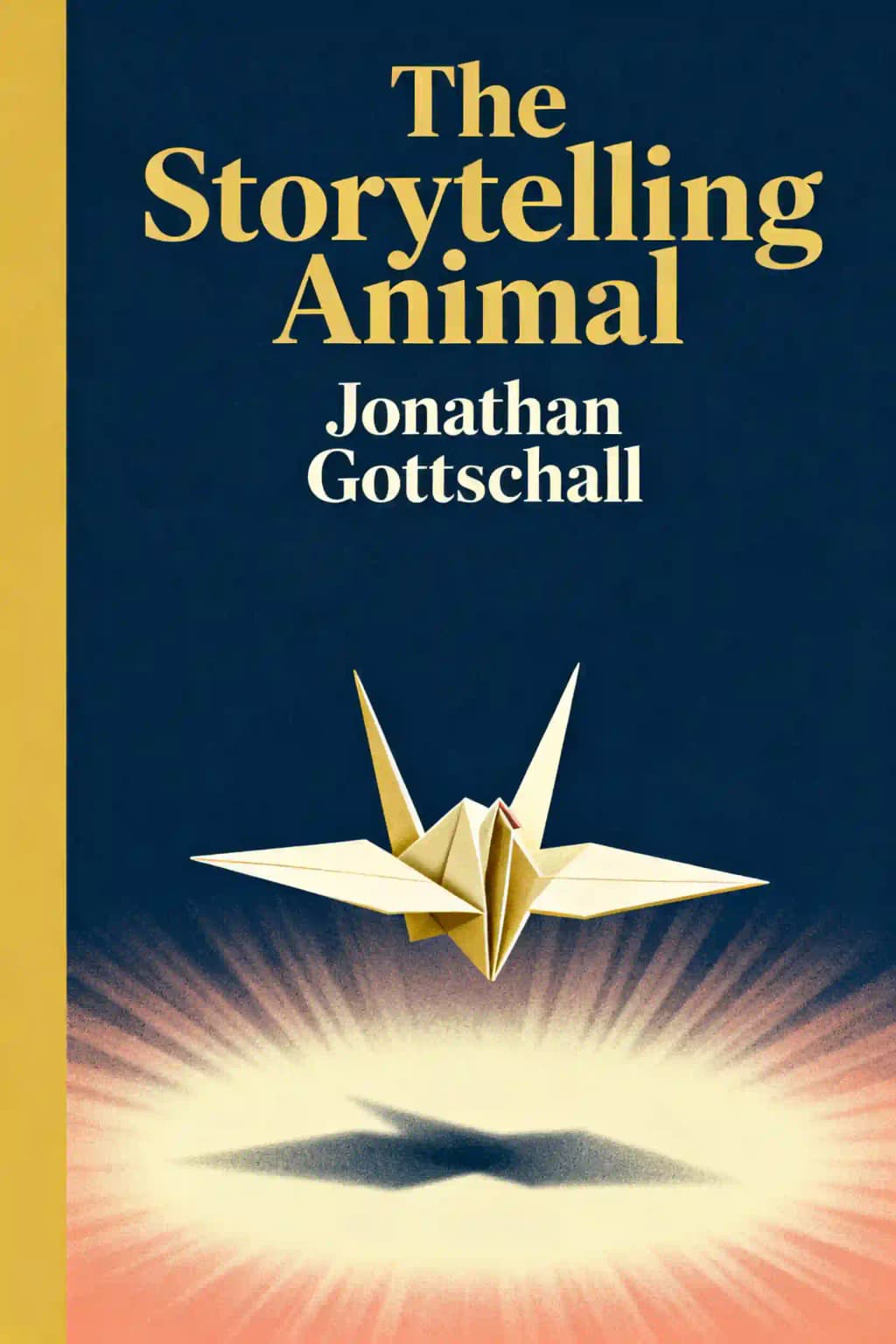
The Storytelling Animal: Why We're Hardwired for Fiction
Have you ever wondered why a simple country song could bring you to tears? Or why you might spend hours immersed in a fictional world when there's laundry to fold and emails to answer? As I discovered while listening to "Stealing Cinderella" one day, stories possess an almost supernatural power to hijack our emotions and transport us far from our physical reality. This phenomenon isn't just a quirk of human behavior-it's fundamental to our species. Jonathan Gottschall's "The Storytelling Animal" has become a cultural touchstone for understanding our narrative obsession, praised by literary giants like Margaret Atwood and scientific luminaries like Steven Pinker. The book reveals how storytelling saturates every aspect of human existence, from our nightly dreams to our personal identities, suggesting that Homo sapiens might better be called Homo fictus-the storytelling animal.
2장
The Witchery of Story: How Fiction Captures Our Minds
Open any compelling book and something magical happens. Your eyes scan black marks on a page, yet suddenly you're transported across time and space. Take Nathaniel Philbrick's "In the Heart of the Sea," which recounts the true story that inspired Moby Dick. As you read about Captain Coffin discovering starving survivors sucking marrow from their shipmates' bones, your mind isn't just processing words-it's creating vivid mental images, complete with sounds, smells, and emotions. You're no longer sitting in your living room; you're aboard a 19th-century whaling ship, witnessing horror firsthand.
This transportation happens because our minds actively collaborate with storytellers. We don't just passively receive information; we co-create these experiences, filling in countless details the author merely suggests. When a character is described as "tall," your mind conjures a specific height, posture, and presence. When a "small cottage" appears in the narrative, you instantly furnish it with details from your own imagination.
Children obviously live in story-watch any five-year-old turn cardboard boxes into spaceships or kitchen utensils into magic wands. But adults never truly leave this realm of imagination behind. We simply change how we pretend. The statistics are staggering: fiction outsells all categories of nonfiction combined; Americans spend roughly five hours daily watching television and films; we listen to story-songs for hours; we dream richly all night; and we daydream approximately two thousand times daily, spending nearly half our waking hours in fantasy.
Even activities seemingly unrelated to fiction are deeply infiltrated by story. Professional wrestling is more theater than sport, with elaborate storylines featuring heroes and villains. Legitimate sports like boxing rely on compelling personalities and backstories-without these narrative elements, even furious action feels hollow. Sports broadcasting elevates games to high drama through narrative shaping, with Olympic coverage featuring emotional docudramas about athletes' struggles. Women increasingly watch sports for what researchers call the "interpersonal drama"-the characters, stories, and rivalries that give meaning to competition.
Commercials are half-minute short stories, rarely stating product benefits directly but showing them through narratives. Story touches nearly every aspect of our lives-from archaeology to business to politics to law, where trials become story contests between opposing narratives of guilt and innocence. Even our personal memories and conversations are boldly fictionalized stories we tell ourselves and others. We are, quite literally, soaked to the bone in story.
This raises an evolutionary puzzle. Imagine two prehistoric tribes competing for resources: the Practical People and the Story People. The Practical People spend all their time on survival activities-hunting, gathering, and resting. Meanwhile, the Story People engage in these same survival activities but also spend precious energy telling stories that "whisk them away and fill them with delight." Logic might suggest the purely practical tribe would outcompete the storytellers, yet history proves otherwise. The Story People prevailed. The Story People are us.
3장
The Riddle of Fiction: Why Evolution Preserved Our Storytelling Instinct
Why has evolution, which ruthlessly eliminates non-useful traits, preserved our seemingly frivolous capacity for fiction? The puzzle begins with children, who are natural storytellers requiring no instruction in make-believe. By age one, babies pretend with objects; by two, they cooperate in simple dramas; by three or four, they enter the golden age of pretend play. Children create art, respond to music, and thrill to fictions instinctively. Even in the most dire circumstances-poverty, squalor, even concentration camps-children engage in pretend play. This universal human tendency toward storytelling demands explanation.
Is fiction merely a pleasurable addiction with no evolutionary purpose? Some evolutionary thinkers argue that storytelling isn't an adaptation but a side effect of our brain's construction-we enjoy fiction not because it serves a biological purpose, but because it hijacks systems designed for other functions. We enjoy stories because they trigger our gossip instincts, flood our brains with pleasurable chemicals, and satisfy our voyeuristic tendencies without risk. However, if fiction were merely frivolous entertainment, natural selection would have eliminated it long ago. The persistence of storytelling across all human cultures suggests it serves some biological purpose.
Children's make-believe isn't the innocent fantasy adults often remember. It's deadly serious play that confronts life's darkest themes. As educator Vivian Paley notes, children's pretend worlds are filled with philosophical position papers on life's enigmas. Their stories consistently focus on trouble: lost babies, dangerous forests, stolen kitties, and bad guys. Even in seemingly innocent play sessions, children create elaborate scenarios involving danger and rescue. One transcript reveals preschoolers creating a "spectacularly convoluted plot involving dynamite and princesses, bad guys and pilfered gold, endangered kitties and bold frog-ninja-dwarfs"-reading like "a page out of Hunter S. Thompson." Far from being escapist, children's play confronts the problems of the human condition head-on.
Gender differences in children's play are striking and consistent across cultures. Boys dominate with battleships and engines of war, while girls gravitate toward dolls and domestic scenarios. Despite cultural shifts in adult gender roles, children's play remains stubbornly stereotypical. Boys engage in rough-and-tumble adventures filled with danger and destruction, while girls focus on nurturing and domestic crises. Yet both genders incorporate trouble into their narratives-girls' play may seem calmer but still features babies nearly poisoned, stolen, or set on fire.
The darkness in children's play partly mirrors the disturbing content of traditional children's stories. Grimms' fairy tales feature cannibal witches, child-eating wolves, and gruesome deaths. Even nursery rhymes contain shocking violence-one critic counted eight murders, two choking deaths, one decapitation, seven severed limbs, and four broken bones among familiar verses. Though modern versions are sanitized, they still contain profound emotional trauma. But this raises a deeper question: why are human stories universally fixated on trouble in the first place?
4장
Hell Is Story-Friendly: The Paradox of Conflict in Fiction
Stories are paradoxically filled with trouble despite our desire for happiness in real life. The gap between what we want in reality (safety, comfort) and what engages us in fiction (danger, conflict) reveals a fundamental truth about storytelling: hell is story-friendly. Fiction isn't merely escapist entertainment-it systematically ensnares us in new troubles rather than offering pure wish fulfillment.
There's a profound disconnect between desirable life experiences (like an uneventful grocery trip) and compelling fiction (a child's abduction at the store). This gap contains clues to fiction's evolutionary purpose. While students often claim stories provide escape from reality, the escapist theory fails to explain why stories consistently feature struggle rather than pure pleasure. Our fictional worlds are largely horrorscapes filled with threats, death and anxiety-a paradox first noted by Aristotle.
Stories that merely reflect mundane reality without conflict fail as much as pure wish fulfillment fantasies. Hyperrealist fiction, which presents life exactly as experienced with all boring parts intact, proves virtually unreadable. Without the essential ingredient of trouble, stories collapse. The accountant staring at his screen with nothing happening illustrates why realistic fiction still requires conflict to engage readers.
Beneath the surface variety of all stories lies a common structure-a skeleton with limited flexibility. Stories worldwide follow a master formula: Character + Predicament + Attempted Extrication. This pattern is strangely universal despite countless possible alternatives. Characters must earn their happy endings by facing thorny predicaments. Modernist writers like Joyce heroically attempted to break free from these constraints with works like Finnegans Wake, but such experimental texts, while intellectually impressive, fail to provide the immersive experience that conventional story structure delivers.
Like flight simulators that train pilots to land on aircraft carriers without risking disaster, stories function as simulators for human social life. They provide low-cost vicarious experiences of complex social situations with potentially high-stakes outcomes. Stories allow us to experience intense emotions-love, hate, dread, hope-without any real-world consequences. We get to confront dangerous men or seduce someone's spouse, and the hero of the story suffers the consequences instead of us.
The simulator model of fiction works through implicit memory-unconscious knowledge that drives skills like driving or social interaction without conscious awareness. When we experience fiction, our minds are "firing and wiring," refining neural pathways that regulate responses to real-life experiences. Research supports this: Keith Oatley and Raymond Mar found that heavy fiction readers had better social and empathic abilities than nonfiction readers, even after controlling for personality traits, gender, age, and IQ. Fiction functions as a powerful virtual reality technology that simulates life's dilemmas. We don't just sympathize with characters; we empathize so deeply that our brains react as though their experiences are happening to us.
5장
Night Story: How Dreams Function as Evolutionary Simulators
Every night in our dreams, we experience intense emotions while our brains improvise original dramas. Dreams are essentially "night stories" with narrative structures focusing on protagonists (usually ourselves) struggling to achieve desires. Throughout history, dreams were interpreted as encrypted messages from spirits or, in Freudian theory, from the id. Modern dream scientists like J. Allan Hobson reject these symbolic interpretations, arguing "the manifest dream is the dream." Competing theories suggest dreams may serve multiple functions: filing memories, providing autotherapy, or even disposing of useless information.
In the 1950s, French scientist Michael Jouvet investigated whether animals actually dream by surgically disabling the brain stem mechanism responsible for sleep paralysis in cats. His results were remarkable: when entering REM sleep, the cats would appear to suddenly wake up with open eyes, yet wouldn't respond to food or flinch when hands moved toward them. They acted out their dreams-stalking, pouncing on invisible prey, and exhibiting defensive behaviors like fleeing or fighting. Rather than dreaming of pleasant experiences, cats seemed to dream primarily about survival problems: how to eat and not be eaten.
Dreamland is far from the dreamy place popular culture suggests. As J. Allan Hobson notes, dreams are dominated by waves of strong negative emotions-fear and anger-urging us to flee or fight imaginary threats. Studies collecting dream reports show Dreamland is rife with emotional and physical peril. Researchers estimate the average person has about 1,200 REM dreams yearly, with approximately 860 featuring threatening events. Over a lifetime, we might experience 120,000 distinct dream threats. The most common dream worldwide is being chased or attacked, followed by falling, drowning, being trapped, public nakedness, injury, illness, and disasters.
The "red thread" connecting pretend play, fiction, and dreams is trouble-giving us practice in dealing with life's major dilemmas. We dream vividly for about two hours nightly, accumulating roughly six years of dreaming over a lifetime. During this time, our brains simulate thousands of responses to various threats and problems, usually experiencing these simulations as real. Even though we rarely remember dreams, this doesn't diminish their value. Like learning to ride a bicycle, dream learning occurs through implicit memory-the brain rewires itself without requiring conscious recall.
6장
The Mind Is a Storyteller: How Our Brains Create Meaning
James Tilly Matthews, confined in Bedlam hospital in the early 1800s, created an elaborate delusion about an "air loom" operated by villains who used magnetized gas to control politicians. Matthews' case, documented by Dr. John Haslam in "Illustrations of Madness," represents the first clear description of paranoid schizophrenia. The connection between creativity and mental illness isn't merely anecdotal-studies show fiction writers are ten times more likely to be bipolar than the general population, while poets are forty times more likely. Research consistently demonstrates extraordinarily high rates of psychiatric disorders among eminent writers compared to high achievers in non-artistic fields.
In 1962, neurosurgeon Joseph Bogen pioneered "split-brain" surgery, severing the corpus callosum connecting the brain's hemispheres. Michael Gazzaniga's subsequent research revealed how the left brain acts as an interpreter, constructing explanatory narratives even with incomplete information. In clever experiments showing different images to each hemisphere, Gazzaniga demonstrated how the verbal left brain confidently fabricates explanations for actions initiated by the mute right brain. The left brain consistently acts as a "know-it-all," creating stories rather than admitting ignorance-a pattern that exists in normal brains too.
Our storytelling mind functions like a homunculus dwelling behind our left eye, resembling Sherlock Holmes in its tendency to construct elaborate narratives from minimal evidence. While Holmes's fictional deductions appear brilliant, his method actually represents our brain's flawed pattern-seeking: arbitrarily selecting one interpretation from countless possibilities, then building an improbable explanatory story. Evolution gave us this "inner Holmes" because detecting patterns and narratives in our environment is adaptive. The storytelling mind makes life coherent and meaningful rather than a "blooming, buzzing confusion."
Our minds are tuned to detect patterns with a bias toward false positives-the same mechanism that helps us recognize faces also makes us see Jesus in toast or animals in clouds. When presented with unrelated sentences or abstract animations, our brains automatically weave narratives to connect them. In Heider and Simmel's famous experiment, 111 of 114 subjects interpreted moving geometric shapes as characters in emotional dramas rather than seeing mere shapes. These experiments reveal our profound unwillingness to exist without narrative structure, even when confronted with meaningless stimuli.
Pathological confabulators demonstrate our mind's storytelling tendency in extreme form. Brain-damaged patients maintain implausible narratives with remarkable tenacity: amnesiacs constantly reinvent their identities, patients with Cotard's syndrome explain why they're actually dead despite appearing alive, and amputees deny missing limbs while inventing reasons they can't move them. Even mentally healthy people confabulate regularly-studies show shoppers invent rational explanations for choosing identical socks, and research subjects create elaborate stories about solving problems when they were actually subtly prompted with solutions.
Our tendency to impose stories where they don't exist reveals its dark side in conspiracy theories-feverishly creative narratives that connect real and imagined data points into emotionally satisfying versions of reality. These theories captivate us precisely because they mirror fiction's structure with vivid plots and sharply defined heroes and villains. What's striking isn't their strangeness but their ordinariness-from JFK assassination theories to 9/11 "truth" movements, these narratives are believed by stunning percentages of Americans across the political spectrum.
7장
The Moral of the Story: How Fiction Shapes Our Values
The three great monotheisms-Judaism, Christianity, and Islam-are fundamentally anthologies of stories. Beyond their commandments and instructions, they contain intense narratives about the biggest themes in human life: a cruel yet merciful God, people suffering and loving, violence and forgiveness. This pattern extends to all religions throughout history, where spiritual truths are conveyed not through lists or essays but through story. Religion represents story's ultimate dominion over our minds, as sacred fiction shapes believers' reality and regulates their daily practices from eating to washing to waging war.
National myths serve the same binding function as supernatural stories. The Columbus story taught in American schools-that he proved the Earth was round and discovered America-is largely fiction. What's omitted is Columbus's brutal subjugation of indigenous peoples, part of centuries-long efforts to strip the continent of Indian life. Revisionist historians argue American history texts are whitewashed to function as unifying patriotic myths, presenting historical figures not as flawed humans but as airbrushed heroes. These sanitized stories aim not to provide objective accounts but to bind communities together-to make "unum" from "pluribus."
Fiction is intensely moralistic despite Plato's fears about its corrupting influence. While evil occurs and antiheroes captivate us, storytellers almost never allow villains to prosper. Most stories follow the pattern of Richardson's novel "Pamela; or, Virtue Rewarded"-they run on poetic justice. Our emotional engagement stems from concern over whether characters get what they deserve. Even amid television's 200,000 violent acts, fiction rarely presents morally neutral violence-it condemns villains' brutality while justifying heroes' necessary force.
Fiction steeps us in shared norms, stigmatizing antisocial behavior while celebrating prosocial actions. This isn't just reflecting our moralistic bias but reinforcing it, as studies show fiction positively affects moral development and empathy. By constantly exposing us to poetic justice, stories may create our overly optimistic sense that the world is just, which helps make human societies work. Story functions as society's binding agent. In movie theaters, films synchronize strangers' emotions, making them respond as one organism. Though we now consume stories individually, millions experience the same narratives, creating a dispersed but communal experience.
8장
Ink People Change the World: Fiction's Real-World Power
Fiction's characters are mere "wiggles of ink" yet they press through the membrane between worlds to wield real power in ours. Studies confirm fiction molds minds systematically-people's deepest moral beliefs are modified by the fiction they consume. White viewers exposed to positive portrayals of black family life show more positive attitudes toward black people generally, while the opposite occurs after watching hard-core rap videos. We are putty in storytellers' hands because fiction bypasses our critical faculties-we consume the "sugary jam" of storytelling without noticing the "powder" of the message.
Research by Green and Brock shows that the more absorbed readers are in stories, the more their beliefs change in "story-consistent" ways. Highly absorbed readers even fail to detect inaccuracies in stories. Unlike with nonfiction where we read with "shields up," fiction drops our intellectual guard, leaving us emotionally moved and defenseless. Studies show that even a single short story can change how people think about sex, race, class, and ethics. As we constantly marinate in fiction, it gradually reshapes us like flowing water reshapes rock.
Hitler exemplifies how story can shape individuals and history disastrously. His beloved musical stories didn't humanize him but fueled his destructive path. Hitler ruled through and for art-his ultimate goals were broadly artistic rather than merely political. As Frederic Spotts notes, "Hitler's interest in the arts was as intense as his racism." Hitler mastered public theater to mesmerize Germany, with David Bowie later describing him as "one of the first great rock stars" who "made an entire country a stage show."
On May 10, 1933, Nazis across Germany burned books by Jews, modernists, socialists and those deemed "un-German in spirit." In Berlin, Propaganda Minister Goebbels shouted against "decadence and moral corruption" as works by Brecht, Hemingway, Mann and others burned. The Nazis, inspired by Wagner, understood ink people's power and committed this holocaust of undesirable fictional characters before proceeding to murder real people. Among the burned books was Heinrich Heine's prophetic line: "Where they burn books, they will also ultimately burn people."
9장
Life Stories: How We Fictionalize Our Own Identities
Our personal narratives are as fictional as published memoirs. Like Santiago and the boy in Hemingway's dialogue who can't distinguish between actual memory and stories told to him, we craft self-serving autobiographies that position us as noble protagonists. David Carr's memoir "The Night of the Gun" demonstrates this vividly-he discovered through reporting on his own life that he had completely inverted a crucial detail, remembering his friend threatening him with a gun when in fact he had been the armed aggressor. "People remember what they can live with more often than how they lived," Carr writes.
A life story is our personal myth about who we are deep down-our origins, development, and meaning. These stories are our identity, but they're not objective accounts. They're carefully shaped narratives with strategic forgetting and skillfully spun meanings. Like published memoirs, our life stories should come with disclaimers: "based on a true story."
Scientific research has repeatedly shown how unreliable memory truly is. From Marie G.'s implanted false memory of witnessing a rape in 1889 to modern studies of "flashbulb memories" of events like JFK's assassination, the Challenger explosion, and 9/11, our most confident memories are often deeply flawed. In one study, 73% of subjects falsely remembered watching the first plane hit the North Tower on 9/11, though no such footage was available that morning.
Memory isn't a perfect recording but a reconstruction. When we recall something, we don't access a complete file but gather scattered fragments that our storytelling mind stitches together into a coherent narrative. The past, like the future, is a mental simulation-not an outright fiction, but certainly a fictionalization.
We build self-images that improve upon reality. Like posing in mirrors to appear more attractive, we construct flattering narratives about ourselves. Research shows this self-deception is nearly universal: 70% of high school seniors believe they have above-average leadership skills, 90% of us think we're above-average drivers, and 94% of professors rate themselves better than average at their jobs.
This "Lake Woebegone effect" makes us believe we're above average in almost every positive quality-even in our immunity to this very effect. We see ourselves as protagonists while everyone else is merely a bit player in our personal drama. Even young children have grandiose self-views, as illustrated by three-year-old Annabel's unshakable belief in her own speed despite consistent losses to her older sister.
Ironically, depressed people have more accurate self-assessments. As psychologist Shelley Taylor notes, a healthy mind tells itself flattering lies to avoid confronting our insignificance and mortality. Psychotherapy works by helping people revise their "incoherent stories" into narratives they can live with-making them protagonists again in their own lives. We are, ultimately, the masterworks of our own storytelling minds, living stories that are more "truthy than true."
10장
The Future of Story: From Pages to Virtual Worlds
Humans are creatures of Neverland-it's our evolutionary niche. Story is the glue of human social life, defining groups and holding them together. We cannot help but live in Neverland; it's our nature as storytelling animals.
Reality shows aren't nonfiction but a new kind of fiction where the lies happen in editing rooms rather than writing rooms. Shows like "The Ultimate Fighter" present real people in extreme conflicts with classic story arcs, while programs like "SuperNanny" dress fiction as reality. Despite technological disruptions in publishing, film, and television, the essence of story remains unchanged: Character + Predicament + Attempted Extrication. The gravitational pull of story will only intensify in our future, not diminish.
In Georgia's Indian Springs State Park, adults like Ethan engage in Live Action Role Playing (LARP), donning medieval costumes and battling imaginary monsters. These players transform ordinary objects into magical artifacts and themselves into heroes from exotic worlds. LARP evolved from tabletop role-playing games like Dungeons & Dragons, representing not just games but interactive storytelling. While often mocked, larpers exemplify humanity's refusal to abandon Neverland-they're simply doing actively what passive audiences admire when watching actors in fantasy films.
Traditional fiction isn't dying, but storytelling will evolve as interactive fiction moves from geek fringe to mainstream. The holodeck from Star Trek represents fiction's likely evolution-a perfect illusion where users become characters in immersive narratives with complete character identification and transportation to alternate universes. We're moving in this direction with MMORPGs (massively multiplayer online role-playing games), where players become characters in vast virtual worlds with their own laws, customs, languages, economies and cultures.
We're witnessing humanity's greatest mass migration-from the real world to the virtual. Economist Edward Castronova argues that human attention is gradually "draining" into virtual worlds, with millions already spending 20-30 hours weekly in online adventures. This exodus is driven not just by the appeal of interactive stories but by the emptiness of modern life. In MMORPGs, isolated individuals find everything missing from their lives: community, competence, meaning, and purpose. These worlds resurrect myths where gods remain potent and alive.
As computing capacity grows exponentially, virtual worlds will increasingly outstrip real life in appeal. Like the holodeck, this technology has destructive potential-if you could always do what you most want, why would you ever stop? Our evolutionary craving for story, once beneficial, might become our weakness in a world where immersive, interactive stories are omnipresent, potentially leading to a "mental diabetes epidemic" where story takes over human life completely.
To avoid being consumed by story, we should follow some guidelines: Read fiction to increase empathy; remember that even pulpy fiction usually reinforces common values; be aware of story's power to manipulate us; allow children time for imaginative play; permit yourself to daydream; recognize when your inner storyteller overdramatizes reality; be tolerant of cultural myths that bind communities; don't worry about the novel's supposed death; and don't fear new storytelling technologies. Most importantly, understanding story's power won't diminish your enjoyment of it-so go lose yourself in a novel.