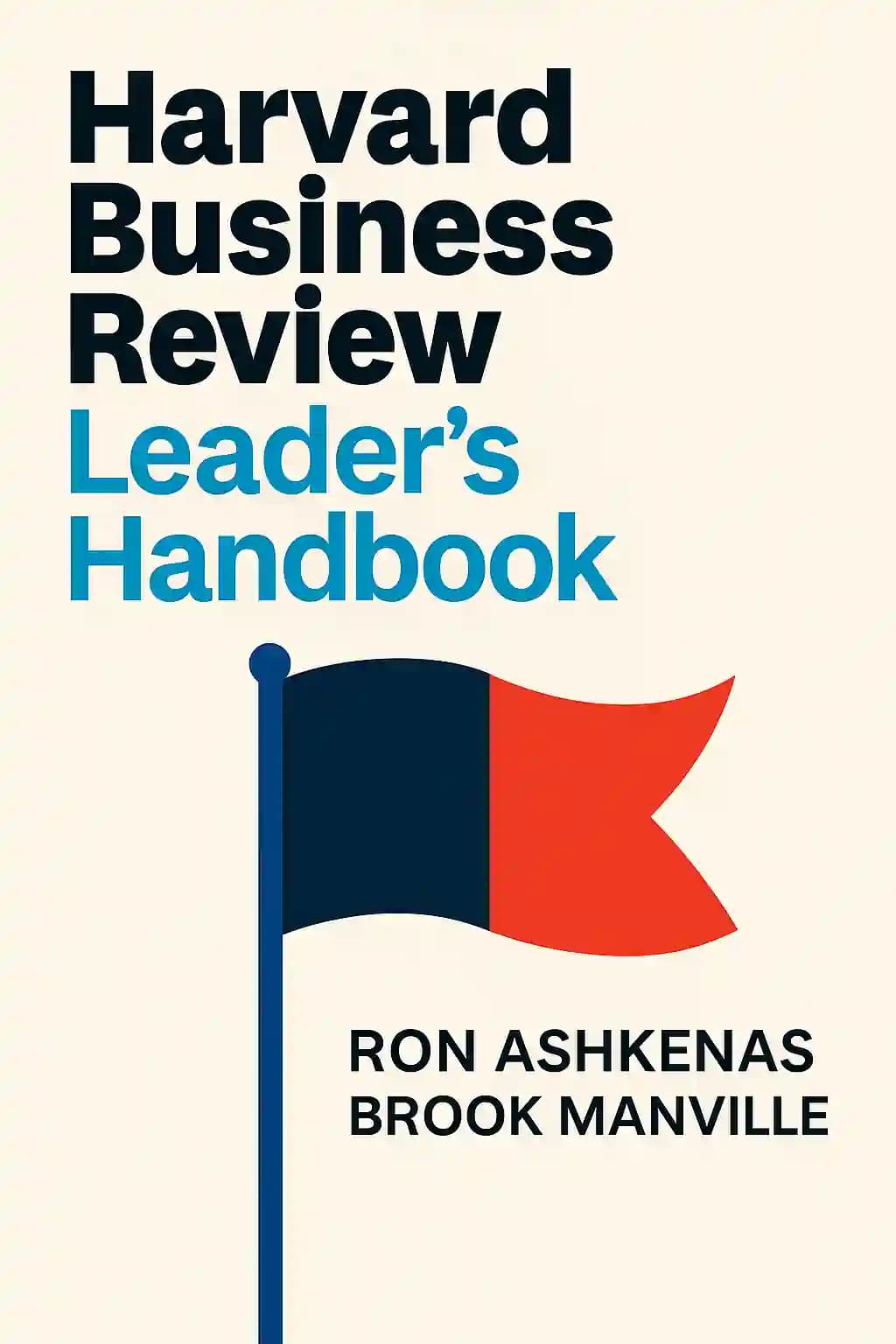
The Harvard Business Review Leader's Handbook distills elite leadership wisdom into six essential practices. Used by global executives across industries, this practical guide answers the question: Why do some leaders inspire extraordinary results while others merely manage? Discover the intentional decisions that transform good managers into legendary leaders.
Ron Ashkenas and Brook Manville, authors of The Harvard Business Review Leader’s Handbook: Make an Impact, Inspire Your Organization, and Get to the Next Level, are acclaimed strategy and organizational change experts.
Ashkenas, a seasoned management consultant and author of Simply Effective, combines decades of advisory work with Fortune 500 companies to distill actionable leadership frameworks.
Manville, a Yale and Oxford-trained historian, merges insights from ancient democracies with modern organizational theory, reflected in his co-authored works like The Civic Bargain and A Company of Citizens.
Their handbook synthesizes proven practices from Harvard Business Review, enriched by case studies of leaders like PBS’s Paula Kerger and the Ford Foundation’s Darren Walker. Both bring elite experience—Ashkenas from McKinsey & Company, Manville from executive roles at CBS and United Way—to address timeless leadership challenges.
The book, part of the trusted HBR Handbooks series, is acclaimed for its "Questions to Consider" sections and remains a go-to resource for executives navigating agile, networked teams. Manville further explores democratic leadership in his Substack newsletter, bridging historical wisdom to contemporary governance.
The Harvard Business Review Leader's Handbook by Ron Ashkenas and Brook Manville distills six proven leadership practices: building a unifying vision, developing strategy, attracting talent, focusing on results, driving innovation, and leading oneself. It combines frameworks from HBR research, case studies (e.g., World Bank, PBS), and actionable steps to help leaders navigate complexity and inspire teams.
Aspiring and current mid-to-senior leaders (director-level and above) in for-profit and nonprofit organizations will benefit most. It’s ideal for those seeking structured guidance on strategy, team-building, and fostering innovation. New leaders gain foundational skills, while experienced executives use it to refine their approach.
Yes—readers praise its practical, research-backed advice and real-world examples. Critics note its academic tone, but its focus on timeless practices (e.g., vision-setting, accountability) makes it valuable for leaders prioritizing long-term impact over trendy frameworks.
These practices create a circular leadership path, starting with vision and ending with self-mastery.
Leaders learn to analyze competitive landscapes, assess organizational capabilities, and align growth paths with their vision. The book emphasizes balancing short-term wins with long-term sustainability, using examples like Jim Smith’s turnaround at Thomson Reuters.
It integrates classics like Michael Porter’s competitive strategy and Clayton Christensen’s innovation theories. Case studies, such as Darren Walker’s work at the Ford Foundation, show how to apply these frameworks to real-world challenges.
Leaders are urged to cultivate agility, creativity, and adaptability by encouraging experimentation. Examples include PBS’s digital transformation under Paula Kerger and Merck’s R&D strategies.
Some find its academic style dry compared to narrative-driven leadership books. However, its structured, step-by-step approach is praised for clarity, particularly in complex organizational settings.
Unlike anecdotal leadership memoirs, this handbook offers a systematic toolkit rooted in HBR research. It’s less philosophical than Stephen Covey’s 7 Habits but more actionable for executives facing operational challenges.
Its focus on agile decision-making, hybrid team management, and sustained innovation aligns with today’s fast-paced, socially conscious business environment. The practices adapt well to remote work and AI-driven markets.
It stresses self-awareness, skill development, and integrity. Leaders learn to align personal values with organizational goals, using reflection exercises and candid feedback loops.
Case studies feature Jim Wolfensohn’s World Bank reforms, Thomson Reuters’ strategic pivots, and the Ford Foundation’s philanthropic leadership. These illustrate applying the six practices across industries.
저자의 목소리로 책을 느껴보세요
지식을 흥미롭고 예시가 풍부한 인사이트로 전환
핵심 아이디어를 빠르게 캡처하여 신속하게 학습
재미있고 매력적인 방식으로 책을 즐기세요
Leadership is about developing people through getting things done.
True leadership capability develops through live practice.
Our dream is a world free of poverty.
Visions need refreshing when environments change significantly.
Strategy is the coordinated set of concrete actions needed to realize that vision.
The Harvard Business Review Leader's Handbook의 핵심 아이디어를 이해하기 쉬운 포인트로 분해하여 혁신적인 팀이 어떻게 창조하고, 협력하고, 성장하는지 이해합니다.
The Harvard Business Review Leader's Handbook을 빠른 기억 단서로 압축하여 솔직함, 팀워크, 창의적 회복력의 핵심 원칙을 강조합니다.

생생한 스토리텔링을 통해 The Harvard Business Review Leader's Handbook을 경험하고, 혁신 교훈을 기억에 남고 적용할 수 있는 순간으로 바꿉니다.
무엇이든 물어보고, 목소리를 선택하고, 진정으로 공감되는 인사이트를 함께 만들어보세요.

샌프란시스코에서 컬럼비아 대학교 동문들이 만들었습니다
"Instead of endless scrolling, I just hit play on BeFreed. It saves me so much time."
"I never knew where to start with nonfiction—BeFreed’s book lists turned into podcasts gave me a clear path."
"Perfect balance between learning and entertainment. Finished ‘Thinking, Fast and Slow’ on my commute this week."
"Crazy how much I learned while walking the dog. BeFreed = small habits → big gains."
"Reading used to feel like a chore. Now it’s just part of my lifestyle."
"Feels effortless compared to reading. I’ve finished 6 books this month already."
"BeFreed turned my guilty doomscrolling into something that feels productive and inspiring."
"BeFreed turned my commute into learning time. 20-min podcasts are perfect for finishing books I never had time for."
"BeFreed replaced my podcast queue. Imagine Spotify for books — that’s it. 🙌"
"It is great for me to learn something from the book without reading it."
"The themed book list podcasts help me connect ideas across authors—like a guided audio journey."
"Makes me feel smarter every time before going to work"
샌프란시스코에서 컬럼비아 대학교 동문들이 만들었습니다

The Harvard Business Review Leader's Handbook 요약을 무료 PDF 또는 EPUB으로 받으세요. 인쇄하거나 오프라인에서 언제든 읽을 수 있습니다.
A troubling statistic haunts corporate boardrooms: 60% of newly promoted executives fail within eighteen months. Not because they lack intelligence or work ethic, but because they've mastered a game that no longer exists. They've climbed the ladder through flawless management-coordinating resources, hitting targets, optimizing processes-only to discover that leadership demands something entirely different. It's the professional equivalent of training for chess only to find yourself in a boxing ring. The Harvard Business Review Leader's Handbook emerged from this painful gap, offering not abstract theory but a practical framework that's reshaped leadership development at Microsoft, where implementation cut executive turnover by 23%. What makes this approach revolutionary? It treats leadership not as an innate gift bestowed upon the chosen few, but as a learnable craft-a set of practices anyone can master through deliberate effort and real-world application. Here's the fundamental shift: management coordinates people to accomplish objectives, while leadership develops people through accomplishing objectives. It's the difference between addition and multiplication. When Anne Mulcahy inherited a dying Xerox, she didn't just manage the financial crisis-she created a vision so compelling that employees fought to save a company many had written off. That's leadership's unique power: inspiring people to achieve what they believed impossible. This isn't semantic hairsplitting. The distinction matters because leadership creates exponential rather than incremental impact. Yet here's the paradox: you can't skip management fundamentals. The most effective leaders master operational excellence while adding something more-practices that multiply their impact across the organization. Think of it as building a second engine while the first one runs. The handbook identifies six interdependent practices: building unifying vision, developing strategy, assembling great teams, focusing on results, fostering innovation, and leading yourself. These aren't sequential steps but instruments in an orchestra-each must be played well individually, but their power emerges from how they harmonize.