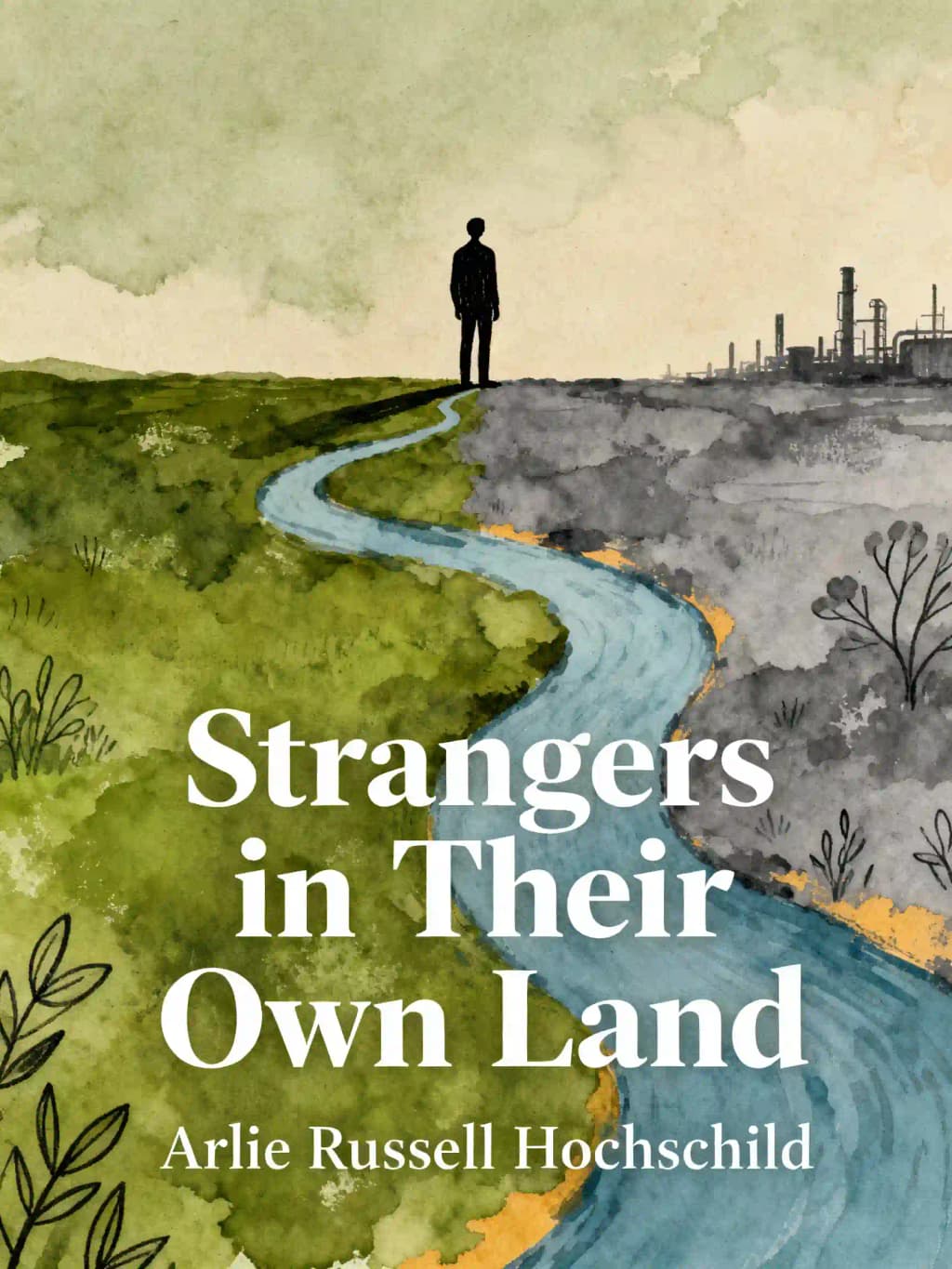
Dive into the emotional landscape of America's deepening divide. Hochschild's National Book Award finalist - endorsed by Noam Chomsky and David Brooks - reveals why Trump voters feel like "strangers in their own land," offering a bridge across our most unbridgeable political canyon.
Arlie Russell Hochschild, acclaimed sociologist and National Book Award finalist, is the author of Strangers in Their Own Land: Anger and Mourning on the American Right, a groundbreaking exploration of political polarization and the emotional roots of modern conservatism.
A professor emeritus at the University of California, Berkeley, Hochschild merges decades of research on emotion, labor, and gender—as seen in her seminal works The Second Shift and The Time Bind—with keen ethnographic insight.
Her latest book, Stolen Pride (2024), examining Appalachia’s “pride paradox,” was named one of Barack Obama’s favorite books of the year. Hochschild’s work, translated into 17 languages, is celebrated for bridging intimate struggles with systemic issues, influenced by C. Wright Mills’ tradition of linking private lives to public conflicts.
Strangers in Their Own Land, a New York Times bestseller, has been hailed as essential reading for understanding contemporary American politics.
Strangers in Their Own Land explores the psychological and political worldviews of Louisiana’s conservative Tea Party supporters. Through interviews and fieldwork, Hochschild investigates the "Great Paradox"—why communities harmed by environmental deregulation oppose government intervention. The book delves into themes of economic anxiety, cultural identity, and the "deep story" shaping conservative voters’ distrust of liberal policies.
This book is essential for readers interested in political polarization, sociology, or environmental policy. It appeals to those seeking to understand rural conservative voters beyond stereotypes, as well as policymakers and educators analyzing the intersection of emotion, ideology, and voting behavior. Hochschild’s empathetic approach makes it accessible to general audiences and academics alike.
Yes—it was a National Book Award finalist and praised as a "Rosetta stone" for understanding populist conservatism. Hochschild’s blend of storytelling and sociological analysis offers nuanced insights into America’s political divide, particularly the conflict between economic survival and environmental protection. Its relevance persists in debates about climate policy and rural-urban divides.
The "Great Paradox" refers to Louisiana communities supporting anti-regulation politicians despite suffering severe environmental harm from industries like oil and petrochemicals. Hochschild argues this stems from a "deep story" of perceived betrayal by elites, prioritizing cultural solidarity and job security over environmental safeguards.
The "empathy wall" is Hochschild’s term for the psychological barrier between liberals and conservatives, rooted in conflicting moral frameworks. She crosses this wall by listening to Tea Party supporters’ narratives of economic decline, perceived unfairness in social programs, and fear of losing traditional values.
The "deep story" symbolizes conservatives’ emotional narrative: waiting in line for the American Dream while others "cut ahead" via affirmative action or welfare. This metaphor captures their resentment toward government and liberals, framing deregulation as reclaiming autonomy.
Notable interviewees include Mike Schaff, a Tea Party member whose town was destroyed by an oil industry sinkhole, and Lee Sherman, a pipefitter who illegally dumped toxins but still opposes regulation. These profiles illustrate the collision of personal hardship and ideological loyalty.
Hochschild critiques Louisiana’s lax regulations, linking them to corporate influence and a "sacrifice zone" mentality. Despite disasters like toxic bayous and sinkholes, residents prioritize oil jobs over environmental health, fearing economic collapse without industry.
Some scholars argue Hochschild overemphasizes cultural factors over structural issues like racism or corporate lobbying. Others note her liberal bias, though she strives for objectivity. Conservatives critique the book for oversimplifying their policy views.
Like The Second Shift and The Time Bind, this book examines societal tensions through emotional labor and identity. However, it shifts focus to political alienation, offering a broader critique of America’s ideological divide.
Key quotes include:
The book remains vital for understanding rising populism, climate policy resistance, and rural-urban divides. Its insights into emotion-driven voting align with ongoing debates about misinformation and polarization in post-Trump America.
저자의 목소리로 책을 느껴보세요
지식을 흥미롭고 예시가 풍부한 인사이트로 전환
핵심 아이디어를 빠르게 캡처하여 신속하게 학습
재미있고 매력적인 방식으로 책을 즐기세요
Their resentment isn't just about economic hardship but about perceived cultural disrespect.
The government, in contrast, represents an intrusive outside force.
We increasingly live in politically homogeneous communities.
Hochschild identifies "empathy walls" as invisible barriers preventing deep understanding across political lines.
Strangers in Their Own Land의 핵심 아이디어를 이해하기 쉬운 포인트로 분해하여 혁신적인 팀이 어떻게 창조하고, 협력하고, 성장하는지 이해합니다.
Strangers in Their Own Land을 빠른 기억 단서로 압축하여 솔직함, 팀워크, 창의적 회복력의 핵심 원칙을 강조합니다.

생생한 스토리텔링을 통해 Strangers in Their Own Land을 경험하고, 혁신 교훈을 기억에 남고 적용할 수 있는 순간으로 바꿉니다.
무엇이든 물어보고, 목소리를 선택하고, 진정으로 공감되는 인사이트를 함께 만들어보세요.

샌프란시스코에서 컬럼비아 대학교 동문들이 만들었습니다
"Instead of endless scrolling, I just hit play on BeFreed. It saves me so much time."
"I never knew where to start with nonfiction—BeFreed’s book lists turned into podcasts gave me a clear path."
"Perfect balance between learning and entertainment. Finished ‘Thinking, Fast and Slow’ on my commute this week."
"Crazy how much I learned while walking the dog. BeFreed = small habits → big gains."
"Reading used to feel like a chore. Now it’s just part of my lifestyle."
"Feels effortless compared to reading. I’ve finished 6 books this month already."
"BeFreed turned my guilty doomscrolling into something that feels productive and inspiring."
"BeFreed turned my commute into learning time. 20-min podcasts are perfect for finishing books I never had time for."
"BeFreed replaced my podcast queue. Imagine Spotify for books — that’s it. 🙌"
"It is great for me to learn something from the book without reading it."
"The themed book list podcasts help me connect ideas across authors—like a guided audio journey."
"Makes me feel smarter every time before going to work"
샌프란시스코에서 컬럼비아 대학교 동문들이 만들었습니다

Strangers in Their Own Land 요약을 무료 PDF 또는 EPUB으로 받으세요. 인쇄하거나 오프라인에서 언제든 읽을 수 있습니다.
Why would people who suffer most from industrial pollution vote against environmental regulations designed to protect them? This question drove sociologist Arlie Russell Hochschild to spend five years immersed in Louisiana's bayou country, listening to the stories of Tea Party supporters whose communities bear the toxic burden of America's petrochemical industry. What she discovered wasn't a simple case of people voting against their interests, but a complex emotional landscape where identity, honor, and belonging trump material concerns. Louisiana presents the perfect laboratory for this investigation-a state ranking near the bottom in health outcomes, education, and environmental quality, yet increasingly voting for politicians who oppose federal assistance and environmental regulation. Through intimate conversations with people like Mike Schaff, who lost his home to an industrial disaster yet opposes government oversight, Hochschild uncovers how emotional self-interest often outweighs economic self-interest in shaping political views. The divide runs deeper than policy disagreements. By 2010, 40% of Republicans and 33% of Democrats reported they'd be disturbed if their child married someone from the opposite political party-up from just 5% in 1960. We've built invisible "empathy walls" that prevent understanding across political lines. Breaking through these barriers requires temporarily setting aside our own perspectives to see the world through others' eyes.