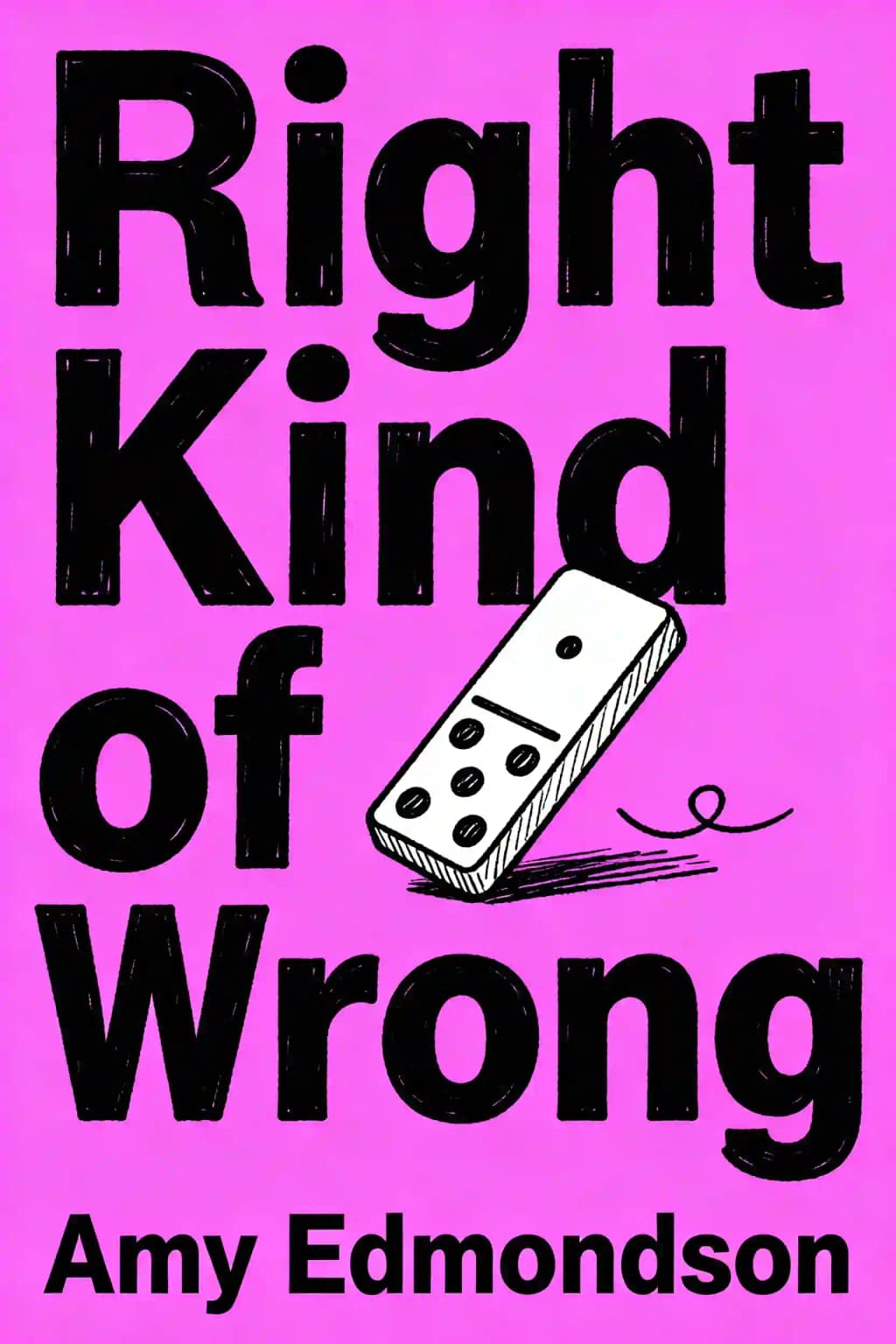
Discover why failure is your greatest asset in Harvard professor Amy Edmondson's award-winning "Right Kind of Wrong." Named Financial Times Business Book of 2023, it reveals three types of failures that drive innovation. Daniel Pink calls it essential: "No skill is more important than learning from failure."
Amy C. Edmondson, author of Right Kind of Wrong: The Science of Failing Well, is a world-renowned organizational leadership expert and the Novartis Professor of Leadership and Management at Harvard Business School. A pioneering researcher in psychological safety and team dynamics, Edmondson’s work explores how organizations can harness failure as a catalyst for innovation—a theme central to this business and self-help genre book.
Her insights stem from decades of studying high-performing teams, notably detailed in her bestselling The Fearless Organization: Creating Psychological Safety in the Workplace and Teaming: How Organizations Learn, Innovate, and Compete in the Knowledge Economy, both widely taught in MBA programs.
Edmondson, ranked #1 on Thinkers50’s 2023 list of top management thinkers, frequently shares her research through TED Talks (4M+ views) and podcasts like Harvard Business Review’s IdeaCast. Her frameworks are adopted by Fortune 500 companies and institutions seeking to build resilient, learning-focused cultures. Right Kind of Wrong distills her groundbreaking research into actionable strategies, cementing her reputation as a leading voice in redefining failure’s role in success.
Right Kind of Wrong explores how to reframe failure as a catalyst for growth, distinguishing between preventable "basic failures," unavoidable "complex failures," and productive "intelligent failures." Amy Edmondson, a Harvard leadership expert, combines research and case studies to teach readers how to embrace uncertainty, learn from mistakes, and build psychological safety in teams. The book emphasizes actionable strategies to fail wisely in careers and organizations.
Leaders, managers, innovators, and anyone navigating high-stakes environments will benefit from this book. It’s particularly relevant for professionals in tech, healthcare, or education seeking to foster cultures of learning and resilience. Edmondson’s insights also resonate with individuals overcoming setbacks or pursuing creative risks.
Yes—critics praise its blend of academic rigor and accessibility, though some note repetitive sections. Readers gain a structured framework to analyze failures, with tools like the "Failure Spectrum" and "Intelligent Failure Checklist." Endorsements from Adam Grant and Daniel Pink highlight its value for personal and professional growth.
Key ideas include:
Intelligent failures occur in novel situations where outcomes are uncertain, involve hypothesis-testing, and produce learnings outweighing costs. Examples include pharmaceutical trials or startups pivoting based on early feedback. Edmondson argues these failures are essential for innovation.
These emphasize embracing vulnerability and honest communication to drive progress.
While The Fearless Organization focuses on psychological safety’s role in team performance, Right Kind of Wrong expands the scope to individual and organizational resilience through failure analysis. Both books interconnect but serve distinct purposes: one builds safe environments, the other leverages those environments for growth.
Some readers find the failure taxonomy overly academic or repetitive if familiar with Carol Dweck’s mindset work. Others note it underemphasizes systemic barriers to failure tolerance in hierarchical organizations.
The book provides tools to reframe career setbacks as learning opportunities, advocating for “small bets” (low-risk experiments) to test new paths. Edmondson’s examples, like entrepreneurs iterating on flawed prototypes, demonstrate resilience-building tactics.
As AI and rapid technological changes increase workplace uncertainty, Edmondson’s strategies for navigating intelligent failures help teams adapt. The book’s emphasis on psychological safety aligns with modern hybrid work challenges, such as fostering trust in dispersed teams.
Edmondson argues complex failures often stem from flawed systems, not individual errors. Solutions require cross-team collaboration and transparent communication to address root causes, such as misaligned incentives or inadequate resources.
저자의 목소리로 책을 느껴보세요
지식을 흥미롭고 예시가 풍부한 인사이트로 전환
핵심 아이디어를 빠르게 캡처하여 신속하게 학습
재미있고 매력적인 방식으로 책을 즐기세요
Not all failures are equal.
Our brains are literally wired against it.
Failure is 'ego threatening, which causes people to tune out.'
Social media exacerbates our reluctance to share failures.
We often bring an execution mindset to learning tasks.
Right Kind of Wrong의 핵심 아이디어를 이해하기 쉬운 포인트로 분해하여 혁신적인 팀이 어떻게 창조하고, 협력하고, 성장하는지 이해합니다.
Right Kind of Wrong을 빠른 기억 단서로 압축하여 솔직함, 팀워크, 창의적 회복력의 핵심 원칙을 강조합니다.

생생한 스토리텔링을 통해 Right Kind of Wrong을 경험하고, 혁신 교훈을 기억에 남고 적용할 수 있는 순간으로 바꿉니다.
무엇이든 물어보고, 목소리를 선택하고, 진정으로 공감되는 인사이트를 함께 만들어보세요.

샌프란시스코에서 컬럼비아 대학교 동문들이 만들었습니다
"Instead of endless scrolling, I just hit play on BeFreed. It saves me so much time."
"I never knew where to start with nonfiction—BeFreed’s book lists turned into podcasts gave me a clear path."
"Perfect balance between learning and entertainment. Finished ‘Thinking, Fast and Slow’ on my commute this week."
"Crazy how much I learned while walking the dog. BeFreed = small habits → big gains."
"Reading used to feel like a chore. Now it’s just part of my lifestyle."
"Feels effortless compared to reading. I’ve finished 6 books this month already."
"BeFreed turned my guilty doomscrolling into something that feels productive and inspiring."
"BeFreed turned my commute into learning time. 20-min podcasts are perfect for finishing books I never had time for."
"BeFreed replaced my podcast queue. Imagine Spotify for books — that’s it. 🙌"
"It is great for me to learn something from the book without reading it."
"The themed book list podcasts help me connect ideas across authors—like a guided audio journey."
"Makes me feel smarter every time before going to work"
샌프란시스코에서 컬럼비아 대학교 동문들이 만들었습니다

Right Kind of Wrong 요약을 무료 PDF 또는 EPUB으로 받으세요. 인쇄하거나 오프라인에서 언제든 읽을 수 있습니다.
A five-year-old girl lies on an operating table in 1951. Dr. Clarence Dennis stands ready with his experimental heart-lung bypass machine, about to attempt what no surgeon has done before. Despite meticulous preparation, the operation reveals an unexpected condition-multiple heart holes rather than one-leading to uncontrollable bleeding and the child's death. A month later, a second attempt fails when human error causes air to enter a two-year-old's blood supply. Two devastating losses. Yet today, millions of successful open-heart surgeries happen annually using descendants of Dennis's machine. These weren't just failures-they were essential stepping stones toward medical progress. This paradox sits at the heart of a revolutionary insight: not all failures deserve blame, and some deserve celebration. The question isn't whether we'll fail, but whether we'll fail intelligently.