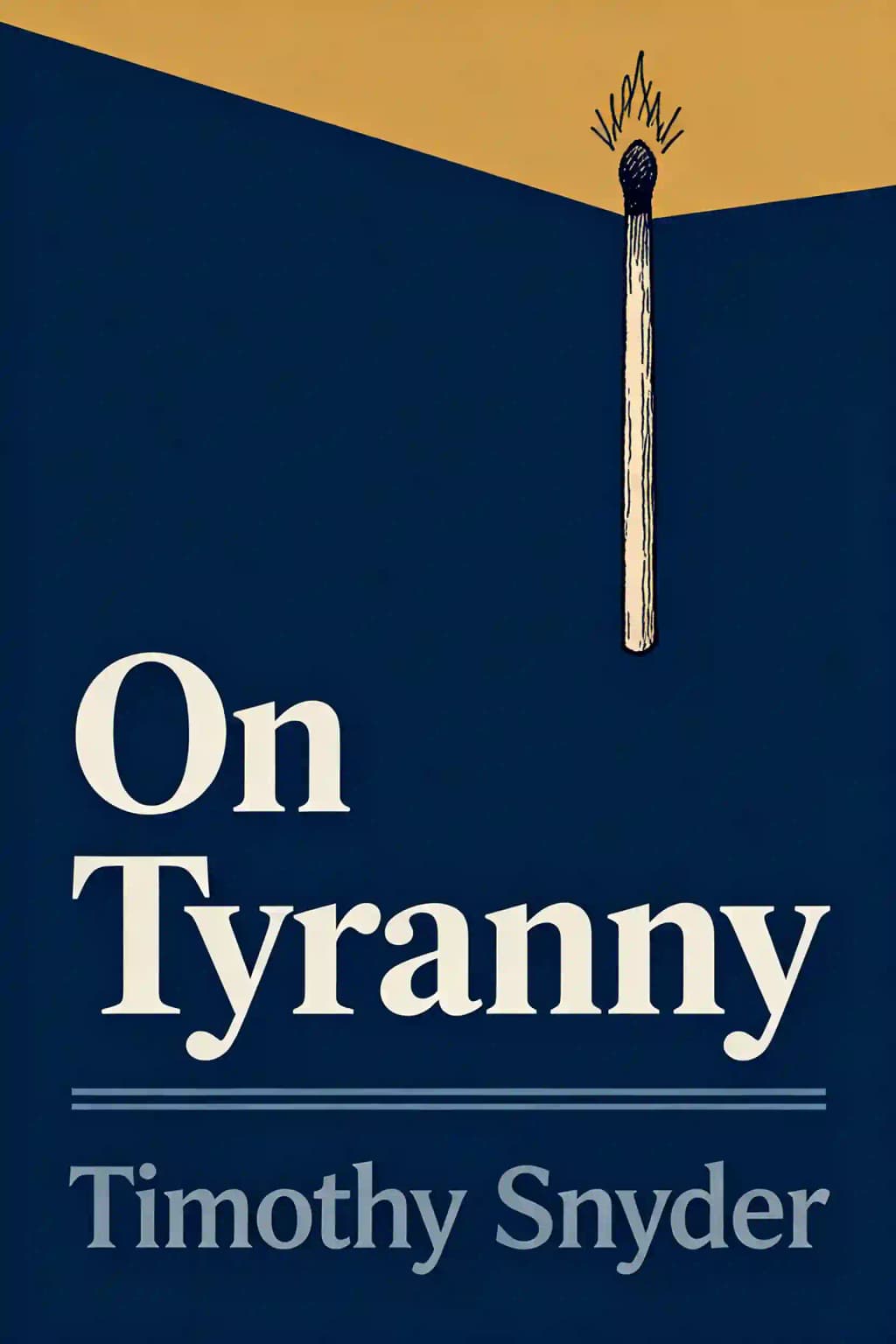
In this urgent 126-page bestseller, historian Timothy Snyder offers twenty lessons to defend democracy against authoritarianism. Topping charts after Trump's inauguration, this "how-to guide for resisting tyranny" became required reading in classrooms nationwide - a stark warning The Washington Post called "clarifying and unnerving."
Timothy David Snyder, renowned historian and bestselling author of On Tyranny: Twenty Lessons from the Twentieth Century, is the Richard C. Levin Professor of History at Yale University and a permanent fellow at the Institute for Human Sciences in Vienna.
A leading authority on Central and Eastern European history, the Holocaust, and modern authoritarianism, Snyder’s work bridges academic rigor with urgent public discourse. On Tyranny, a political manifesto grounded in 20th-century historical analysis, reflects his decades of research into totalitarian regimes and democratic resilience.
His seminal work Bloodlands: Europe Between Hitler and Stalin, a New York Times bestseller translated into over 40 languages, redefined understanding of mass violence in modern Europe. Snyder’s other notable books, including The Road to Unfreedom and Black Earth, examine ideological manipulation and the erosion of truth in politics.
A frequent commentator in global media and documentaries, he serves on the United States Holocaust Memorial Museum’s Committee on Conscience and holds honors from multiple European nations. On Tyranny has become a cultural touchstone, cited in legislative debates and adapted into graphic editions, solidifying Snyder’s influence as a vital voice for democratic vigilance.
On Tyranny outlines 20 historical lessons from 20th-century authoritarian regimes like Nazi Germany and Stalinist Russia, offering actionable strategies to safeguard democracy. Snyder emphasizes resisting complacency, defending institutions, and recognizing manipulative tactics used by tyrannical leaders. The book blends political philosophy with urgent warnings about modern threats to freedom.
This book is essential for politically engaged citizens, activists, and students of history or political science. Its concise format (126 pages) makes it accessible to general readers concerned about democratic erosion. Snyder’s insights resonate with those seeking to understand authoritarian playbooks and counter disinformation tactics.
Yes. Despite being written in 2017, its lessons on media literacy, institutional defense, and civic courage remain critical amid rising global authoritarianism. The short, direct chapters provide timeless guidance, though some critiques note its brevity limits depth.
Key concepts include:
Snyder warns against normalized corruption, distorted language (e.g., “fake news”), and exploitation of crises to suspend rights. He parallels Trump-era rhetoric with historical authoritarian tactics, though some argue this focus risks dating the book.
Unlike his dense historical texts (Bloodlands), On Tyranny is a pragmatic guide. It echoes themes from The Road to Unfreedom but prioritizes brevity over academic rigor, aiming for broad public impact.
With AI-driven disinformation and democratic backsliding, Snyder’s call to “investigate” facts, support journalism, and foster community ties remains urgent. Updated editions address post-2020 challenges, reinforcing its applicability.
A Yale history professor specializing in 20th-century European totalitarianism. His expertise on the Holocaust and Eastern Europe underpins On Tyranny’s historical rigor. Snyder is also a vocal commentator on modern U.S. and global politics.
Some argue its Trump-era references may age poorly, and its concise format oversimplifies complex issues. However, supporters praise its accessibility and actionable advice for non-academic audiences.
저자의 목소리로 책을 느껴보세요
지식을 흥미롭고 예시가 풍부한 인사이트로 전환
핵심 아이디어를 빠르게 캡처하여 신속하게 학습
재미있고 매력적인 방식으로 책을 즐기세요
Democracy is not a given-it's a fragile achievement.
Wait to be asked.
Institutions don't defend themselves-they need us to defend them.
The warning signs are rarely subtle.
The tragedy is that each small step seemed reasonable at the time.
Twenty Lessons from the Twentieth Century의 핵심 아이디어를 이해하기 쉬운 포인트로 분해하여 혁신적인 팀이 어떻게 창조하고, 협력하고, 성장하는지 이해합니다.
Twenty Lessons from the Twentieth Century을 빠른 기억 단서로 압축하여 솔직함, 팀워크, 창의적 회복력의 핵심 원칙을 강조합니다.

생생한 스토리텔링을 통해 Twenty Lessons from the Twentieth Century을 경험하고, 혁신 교훈을 기억에 남고 적용할 수 있는 순간으로 바꿉니다.
무엇이든 물어보고, 목소리를 선택하고, 진정으로 공감되는 인사이트를 함께 만들어보세요.

샌프란시스코에서 컬럼비아 대학교 동문들이 만들었습니다
"Instead of endless scrolling, I just hit play on BeFreed. It saves me so much time."
"I never knew where to start with nonfiction—BeFreed’s book lists turned into podcasts gave me a clear path."
"Perfect balance between learning and entertainment. Finished ‘Thinking, Fast and Slow’ on my commute this week."
"Crazy how much I learned while walking the dog. BeFreed = small habits → big gains."
"Reading used to feel like a chore. Now it’s just part of my lifestyle."
"Feels effortless compared to reading. I’ve finished 6 books this month already."
"BeFreed turned my guilty doomscrolling into something that feels productive and inspiring."
"BeFreed turned my commute into learning time. 20-min podcasts are perfect for finishing books I never had time for."
"BeFreed replaced my podcast queue. Imagine Spotify for books — that’s it. 🙌"
"It is great for me to learn something from the book without reading it."
"The themed book list podcasts help me connect ideas across authors—like a guided audio journey."
"Makes me feel smarter every time before going to work"
샌프란시스코에서 컬럼비아 대학교 동문들이 만들었습니다

Twenty Lessons from the Twentieth Century 요약을 무료 PDF 또는 EPUB으로 받으세요. 인쇄하거나 오프라인에서 언제든 읽을 수 있습니다.
History doesn't repeat, but it rhymes with alarming precision. Democracy isn't our birthright - it's a delicate achievement that can unravel with terrifying speed. When Yale historian Timothy Snyder published "On Tyranny" in 2017, he wasn't offering abstract theory but practical wisdom distilled from studying how European democracies collapsed into fascism and communism. The slim volume became a cultural phenomenon precisely because it tapped into our collective anxiety - that the guardrails protecting our freedoms are more vulnerable than we imagined. The most chilling insight? Democracy rarely dies through dramatic coups. Instead, it erodes through a series of seemingly small compromises until the point of no return has silently passed. The parties that successfully dismantled democracies weren't omnipotent from the start - they exploited historic moments to make political life impossible for their opponents. They followed remarkably similar playbooks: win elections (often with minorities of the vote), create constant crises to justify emergency powers, use those powers to silence opposition, and finally consolidate one-party rule. Many voters never realized they were casting their final meaningful ballot.