1장
The Haunting Confession of a Man Apart
No Longer Human stands as one of the most devastating explorations of alienation in modern literature. Published in 1948, Osamu Dazai's semi-autobiographical masterpiece has become Japan's second best-selling novel of all time, deeply resonating with generations struggling with social disconnection. Kurt Cobain cited it as one of his favorite books, while countless Japanese youth have found their existential struggles mirrored in its pages. The novel's unflinching portrayal of self-destruction has made it controversial yet enduring-a work that transcends cultural boundaries to speak directly to anyone who has felt fundamentally separate from humanity. Through three haunting notebooks and a chilling prologue, we witness the disintegration of a man who, from childhood, never understood how to be human.
2장
A Childhood of Fundamental Alienation
"Mine has been a life of much shame." With this stark confession, Yozo reveals the core of his existence - an unbridgeable gap between himself and humanity. From his earliest memories, he experienced the world differently from others, viewing everyday life through a lens of perpetual incomprehension. Even basic human experiences like hunger remained abstract concepts to him, as though he were observing alien rituals from afar. Family mealtimes were particularly excruciating, filled with gloomy silence that terrified him. The simple act of eating together, a cornerstone of family life, became a daily ordeal of forced performance and hidden panic. He couldn't comprehend why humans needed three meals daily or why people worked "to earn their bread" - these fundamental aspects of human existence seemed to him arbitrary and bewildering customs.
What's most striking about Yozo's childhood alienation is his acute awareness of it, a self-consciousness that only deepened his isolation. He recognized early that he alone seemed "entirely unlike the rest," unable to understand how others managed their troubles without despair. While his wealthy family provided material comfort, this privilege only heightened his sense of disconnection. Other children spoke of dreams and aspirations; Yozo could barely grasp the concept of wanting anything at all. This awareness bred a profound terror of human beings, whom he viewed as unpredictable creatures capable of sudden, incomprehensible anger. When family members criticized him, he accepted all reprimands in terrified silence, seeing in their anger "a wild animal in its true colors." Even gentle corrections from his mother filled him with inexplicable dread.
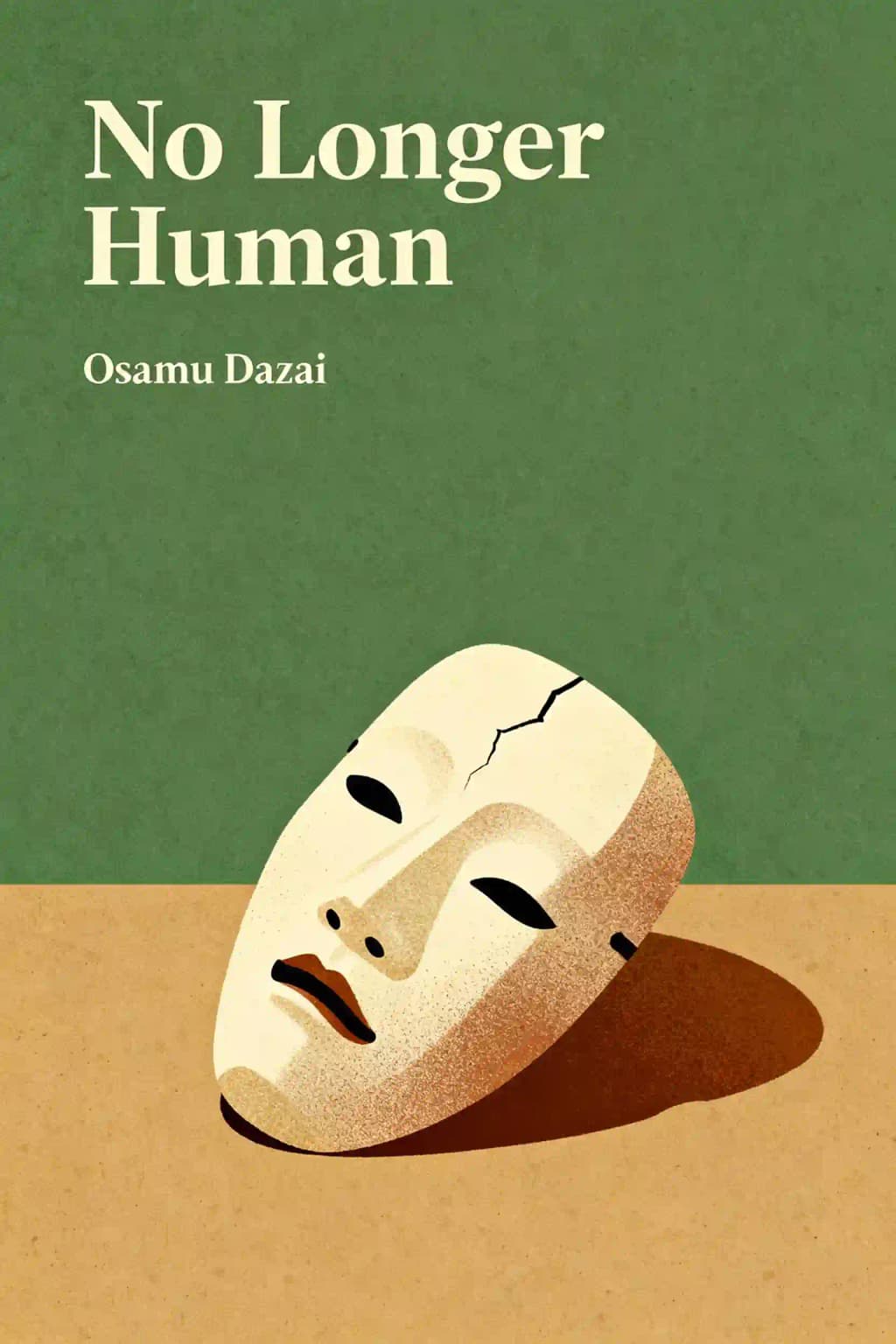
To bridge this gap, young Yozo developed his defining coping mechanism - becoming "the farcical eccentric." Through careful observation, he discovered that making people laugh created a protective barrier between himself and their potential hostility. His antics became increasingly elaborate and calculated: wearing his sister's leggings under his kimono to appear as if wearing a sweater in summer, entertaining servants with wild dances to random piano notes, and developing an extensive repertoire of facial expressions and physical comedy. Even with the household servants, whom he feared more than family members due to their unpredictable nature, he maintained this protective clowning. The intensity of his fear became apparent in small moments, such as when his father asked what present he wanted from Tokyo. His inability to express preferences paralyzed him, later sneaking into his father's notebook to write "LION MASK" though he actually preferred a book - choosing what he thought would seem normal rather than what he desired.
This pattern established Yozo's lifelong strategy - using humor as armor against a world he couldn't understand. His childhood performances evolved into a sophisticated system of social survival, where every interaction became a carefully choreographed dance of deception. By sacrificing authenticity for safety in a desperate bid to survive among creatures fundamentally different from himself, Yozo created a persona that would both protect and imprison him throughout his life. His childhood experiences laid the foundation for a lifetime of elaborate performance, where laughter became both his shield and his chains.
3장
The Performer's Mask: School Years and Artistic Awakening
At school, Yozo's reputation rested on twin pillars: his privileged background as the son of a wealthy landowner and his seemingly effortless academic brilliance. Despite frequent absences due to recurring bouts of illness that kept him bedridden for weeks, he maintained his position at the top of his class without ever opening a textbook at home. Rather than paying attention during lessons, he spent his hours sketching elaborate cartoons in his notebooks and holding court during recess periods, where he would entertain his classmates with theatrical explanations of complex topics, turning dry material into comedy routines.
His composition assignments became carefully orchestrated performances of social subversion. He would craft deliberately provocative stories - tales of urinating in train spittoons or embarrassing encounters with village elders - that forced teachers to suppress their laughter behind closed office doors. Through this calculated buffoonery, he "succeeded in escaping from being respected," cultivating a peculiar academic record marked by perfect A's in subject matter but dismal C's and D's in conduct and deportment.
Yet beneath this meticulously constructed facade of the class clown existed a profoundly traumatized child. Yozo confesses that his authentic nature stood "diametrically opposed to the role of a mischievous imp" he had fabricated. In the family household, he had been "corrupted" by servants in what he terms "the ugliest, vilest, cruelest crime" possible against a child - a trauma he never explicitly details but whose shadows loom over every aspect of his development. This early violation of trust left him fundamentally unable to form genuine connections with others. In response, he refined his comedic performances to near perfection, developing an acute awareness of human nature and a deep-seated conviction that all social interactions were built on layers of mutual deception.
A transformative moment in Yozo's artistic development arrived through his friendship with Takeichi, who showed him Vincent van Gogh's self-portrait. When Takeichi described it as "a picture of a ghost," something profound shifted in Yozo's understanding of art's purpose. He suddenly grasped that great artists didn't simply create beautiful representations of the world - they revealed the haunting, often monstrous realities they perceived beneath surface appearances. This revelation catalyzed his own artistic awakening, leading him to create a series of secret self-portraits that stripped away his clownish exterior to expose the raw, harrowing truth of his inner self. These deeply personal works, shared only with Takeichi, prompted his friend to prophetically declare that Yozo would become "a great painter someday."
The profound tragedy of Yozo's school years lies in this unfulfilled artistic promise - a genuine talent and extraordinary sensitivity that might have offered salvation but was ultimately suffocated by his overwhelming social anxiety and the performative mask he could never fully remove. His remarkable academic achievements and artistic potential pointed toward a future of creative fulfillment that never materialized, making his eventual descent into self-destruction all the more devastating. His school years became not a foundation for future success but rather a period of increasing alienation, where each perfect test score and each laugh he generated only served to deepen his sense of fraudulence and isolation.
4장
Tokyo Nights: Alcohol, Communism, and Tsuneko
Entering college in Tokyo against his wishes (his father wanted him to become a civil servant), Yozo escaped dormitory life by claiming lung problems and moved to his father's town house. There he met Masao Horiki, an older art student who became his guide to Tokyo's underbelly-introducing him to drinking, smoking, prostitutes, and left-wing thought. Though Yozo privately considered Horiki a fool, he valued him for managing money and conversation, sparing Yozo the terror of awkward social interactions.
With prostitutes-whom he viewed not as women but as "imbeciles or lunatics"-Yozo found unexpected security and friendliness "with no ulterior motive." These encounters unwittingly developed in him the aura of a "lady-killer," attracting women who sensed this newly acquired atmosphere. Evidence appeared everywhere: letters from bar girls, the general's daughter hovering by her gate each morning, waitresses' special attentions, passionate letters from relatives, even handmade dolls left anonymously. Though passive in these encounters, this atmosphere clung to him inseparably, drawing women who detected it instinctively.
Horiki also introduced Yozo to a secret Communist "Reading Society." Though he found their Marxist economics lectures exceedingly obvious and insufficient to explain the frightening element lurking in human hearts, he attended every meeting. Using his clowning to lighten the tense atmosphere, he soon became indispensable to the group. These idealistic revolutionaries mistook his participation for ideological conviction, when in truth he sought comfort in irrationality. The world's logic terrified him; he preferred swimming in irrationality's waters "until presently I drowned."
Unlike Horiki, who attended only once, Yozo performed all their "dangerous missions" with such unruffled assurance that police never suspected him. The comrades' excessive precautions reminded him of clumsy detective novels, yet he found their frantic excitement over inconsequential errands oddly comforting, even thinking prison might be pleasanter than his sleepless nights dreading human interaction.
The most significant relationship of this period was with Tsuneko, a hostess with a Kansai accent he met at a Ginza cafe. Her simple presence calmed his perpetual agitation, allowing him to drop his clownish act and show his true taciturn nature. In her rented room above a carpenter's house, he sensed in her a "silent current of misery" that mingled with his own gloom, creating a night of rare liberation and happiness. When Horiki later humiliated her by refusing to kiss her and calling her "poverty-stricken," Yozo experienced his first genuine feelings of love and comradeship for this fellow-sufferer.
Their relationship culminated in a suicide pact at Kamakura. She died; he survived-an outcome that would haunt him forever and mark his first public disgrace.
5장
Descent and Temporary Redemption: Shizuko and Yoshiko
After the failed suicide attempt, Yozo was expelled from college and relegated to a cramped, dimly lit room above "Flatfish's" antique shop in a run-down neighborhood. His family, maintaining their social dignity, formally severed all connections, though his brothers - perhaps moved by lingering familial duty - secretly arranged for small sums to reach him through Flatfish. In this confined space, surrounded by yellowing magazines and the musty scent of old furniture, Yozo existed in a state of perpetual lethargy, lacking even the fundamental drive to contemplate ending his life.
Salvation arrived unexpectedly through Shizuko, a twenty-eight-year-old widow whose gentle demeanor masked her own struggles. When Flatfish's oppressive surveillance and constant moral lectures became unbearable, she offered Yozo refuge in her modest Koenji apartment. Living with her and her precocious five-year-old daughter Shigeko, Yozo found himself in an unconventional domestic arrangement - a kept man who minded the apartment and cared for the child while Shizuko worked long hours at an office. Through her persistent efforts and connections, his cartoons began generating surprising income, though he squandered most of it on cheap liquor and endless cigarettes, his depression deepening like a well with no bottom.
Little Shigeko's immediate acceptance of him as "Daddy" initially provided a glimpse of genuine connection. However, when she innocently mentioned her nightly prayers for her "real Daddy" to return, the revelation hit Yozo like a physical blow. This child, whom he'd thought he understood, suddenly appeared as mysterious and unfathomable as any adult - another being capable of harboring hidden thoughts and secret desires. His subsequent deterioration was swift and dramatic - he began cruelly mocking Shizuko's appearance, stumbling home drunk and singing bawdy songs at midnight, pawning her clothes for drinking money, and adopting increasingly aggressive behavior. The culmination came after a three-day disappearance, when he returned to find Shizuko and Shigeko joyfully playing with a white rabbit they'd purchased as a welcome-home gift. Witnessing their simple, unaffected happiness through the window, he offered up a silent, desperate prayer for just one moment of such contentment in his own lifetime, then walked away without entering - his first truly selfless act.
His next descent led him to become a kept man at a dingy bar near Kyobashi Station. There, amidst the nightly parade of drunks and lost souls, he reached a cynical epiphany about "society" - seeing it as nothing more than an endless series of immediate conflicts between individuals, where each interaction was a contest requiring instant victory or defeat. This revelation temporarily liberated him from his existential terror, though his fundamental fear of human beings remained so intense that he required alcohol before facing even the most basic interactions with bar customers.
The trajectory of his life shifted again upon meeting seventeen-year-old Yoshiko, a tobacco shop girl whose innocent persistence in urging him to stop drinking masked a deeper wisdom. After she saved him from a potentially fatal fall into a manhole and tenderly bandaged his injured arm, he made a half-joking marriage proposal, contingent on his sobriety. Her immediate acceptance, expressed with a casual "Natch" (naturally), struck him with the force of revelation. In her uncorrupted innocence, he recognized something genuinely sacred - not merely the poetic illusion of purity, but its actual embodiment - and made an instant decision to marry her.
With unexpected support from the bar madam, they married and secured a modest room near the Sumida River. Yozo abandoned drinking and recommitted himself to his art, finding unexpected success with his cartoons. Their life together was marked by simple pleasures - afternoon movies, visits to milk bars, spontaneous flower purchases - and he discovered profound joy in his young wife's trusting nature, her unaffected words and graceful movements. For the first time in his troubled existence, he dared to imagine the possibility of genuine humanity and a death that might come peacefully rather than through violence or despair.
6장
Betrayal, Addiction, and Final Exile
Horiki's reappearance shattered Yozo's brief happiness. One hot summer night, after pawning Yoshiko's clothes to lend Horiki money, they drank gin on the apartment roof and played word games that deteriorated into barbed exchanges. Suddenly, Horiki led him downstairs where, through a window, Yozo witnessed Yoshiko with another man-a shopkeeper who bought his cartoons.
Paralyzed with fear rather than fury, Yozo fled to the roof. This betrayal was the decisive incident of his life, splitting him "through the forehead between the eyebrows" with a wound that would throb whenever he encountered other humans. What tormented him wasn't merely Yoshiko's physical betrayal but the defilement of her pure trustfulness-the one virtue he had depended on. From that night, she became anxious and timid around him, jumping at his call and using excessive honorifics.
Yozo surrendered completely to drink. His face coarsened, his teeth fell out, and he began drawing pornographic pictures to sell secretly for gin money. Late one night, drunk and seeking sugar-water, he discovered in their kitchen a box of sleeping pills he'd hidden there himself. Calmly, he swallowed the entire contents and went to bed.
After three unconscious days, he tearfully begged the bar madam to "take me away from Yoshiko," then made the absurd statement that he wanted to go "somewhere where there aren't any women"-a wish that would later be realized in the most ghastly way.
His final descent began with vomiting blood in the Ginza snow-"a rising-sun flag in the white snow." At a pharmacy, he encountered a proprietress-a woman on crutches-who looked at him with recognition of shared suffering. She gave him various medicines and, fatefully, morphine "to use when you need a drink so badly you can't stand it." He injected it without hesitation, delighted to escape alcohol's squalor.
The drug swept away his insecurity and timidity, making him optimistic and energetic. One shot became four daily; he couldn't work without it. He began an "ugly affair" with the crippled pharmacist to obtain more drugs, his debt growing frightening. "Living itself is the source of sin," he thought as he paced frantically between his apartment and the pharmacy.
As a last resort, he wrote a confession to his father, but when no answer came, his anxiety drove him to increase his dosage further. He planned to give himself ten shots and throw himself into the river, but that very afternoon, Flatfish appeared with Horiki, who greeted him with an unexpectedly gentle smile: "I hear you've coughed blood." That smile completely shattered him. He wept helplessly and surrendered his will to them.
7장
No Longer Human: The Final Notebook
Yozo's descent into institutional care marked a cruel irony - his desperate plea for "no women" manifested in the bleakest possible way, landing him not in a peaceful sanatorium but in a stark mental hospital populated exclusively by male patients and staff. Throughout his confinement, he maintains a fierce clarity about his condition: "I wasn't mad," he repeatedly insists, with the same desperate conviction that had characterized his earlier protestations. "I've never been mad for an instant. But I had become disqualified as a human being." This self-assessment reveals both his lucidity and his complete alienation from society.
Three months into his institutionalization, his eldest brother arrived with Flatfish to retrieve him, bearing news that would fundamentally alter Yozo's already fragile existence: his father had succumbed to gastric ulcers. The death of his father - that looming figure who had cast such a long shadow over his life - left Yozo in an unexpected emotional void. His brother offered continued financial support, but with a stark ultimatum: Yozo must abandon Tokyo immediately. The loss of his father created a peculiar emptiness in him; the man whose presence had terrorized him throughout his life had vanished, and with him went Yozo's capacity for suffering itself - as if his pain had lost its primary reference point.
His brother arranged for his exile in an ancient house at a coastal hot spring, a decrepit structure hours from his hometown that seemed to mirror Yozo's own decay. His only companion was Tetsu, an unattractive sixty-year-old woman with rust-colored hair, sent to be his caretaker. The three years that followed became a strange purgatory - Tetsu would occasionally "violate" him in what he describes as curious encounters, their relationship devolving into something resembling a dysfunctional marriage. His physical health continued its steady decline, with a persistent chest ailment that frequently resulted in him coughing blood.
In his final reflection, Yozo reaches a state of complete emotional neutrality: "Now I have neither happiness nor unhappiness," he declares with chilling detachment. "Everything passes - the only truth I've found in this burning hell of human society." At just twenty-seven, his prematurely grey hair made him appear well over forty - a physical manifestation of his spiritual exhaustion. He had become a man who had somehow experienced both too much and too little of life, perpetually trapped in his fundamental inability to understand or participate in the human experience. His final state embodies the ultimate paradox: a being who had spent his entire life performing humanity while never truly understanding what it meant to be human.
8장
The Aftermath: An Epilogue
The narrator who presents these notebooks never personally met Yozo, though he had a passing acquaintance with the bar madam from Kyobashi mentioned throughout the narrative. In February, during an unexpected visit to a friend in Funahashi, he stumbled upon this same woman, now running a modest coffee shop in the quiet coastal town. Upon recognizing him, she eagerly shared stories of her past life in Tokyo, eventually retrieving three well-worn notebooks and a collection of faded photographs from a dusty back room, suggesting they might "make good material for a novel."
The notebooks' pages, filled with Yozo's distinctive handwriting, captured the narrator's attention so completely that he spent the entire night reading them in one sitting. The raw honesty and devastating clarity of Yozo's self-reflection convinced him that any fictional adaptation would only diminish their power - these confessions needed to be published exactly as written. When he asked the madam about her own reaction to the notebooks, particularly whether they had moved her to tears, her response was surprisingly matter-of-fact: "No... I just kept thinking that when human beings get that way, they're no good for anything." She placed the blame squarely on Yozo's father's shoulders, painting a picture of cold parental neglect that she believed shaped Yozo's troubled existence.
The madam's memories of Yozo stood in stark contrast to the tormented soul revealed in the notebooks. "Despite his drinking," she recalled with evident fondness, "the Yozo I knew was so easy-going and amusing... a good boy, an angel." Her words carried a particular weight, coming from someone who had witnessed both his charm and his descent. Even more poignantly, she seemed unaware of how her description perfectly exemplified the very mask Yozo had worked so hard to maintain.
This final assessment crystallizes the novel's central tragic irony - that Yozo's carefully constructed facade of the amusing clown succeeded beyond his wildest fears, hiding his profound suffering so completely that even those who thought they knew him best saw only the performance, never the performer. His notebooks emerge as his sole authentic confession, the only unmasked version of himself he ever shared with the world. To the very end, he remained fundamentally misunderstood, a man who lived his entire life as an observer of humanity rather than a participant, perpetually looking in from the outside at a world that remained tantalizingly visible but eternally inaccessible to him.