1장
The Haunting Journey Between Worlds: Intelligence as Both Gift and Curse
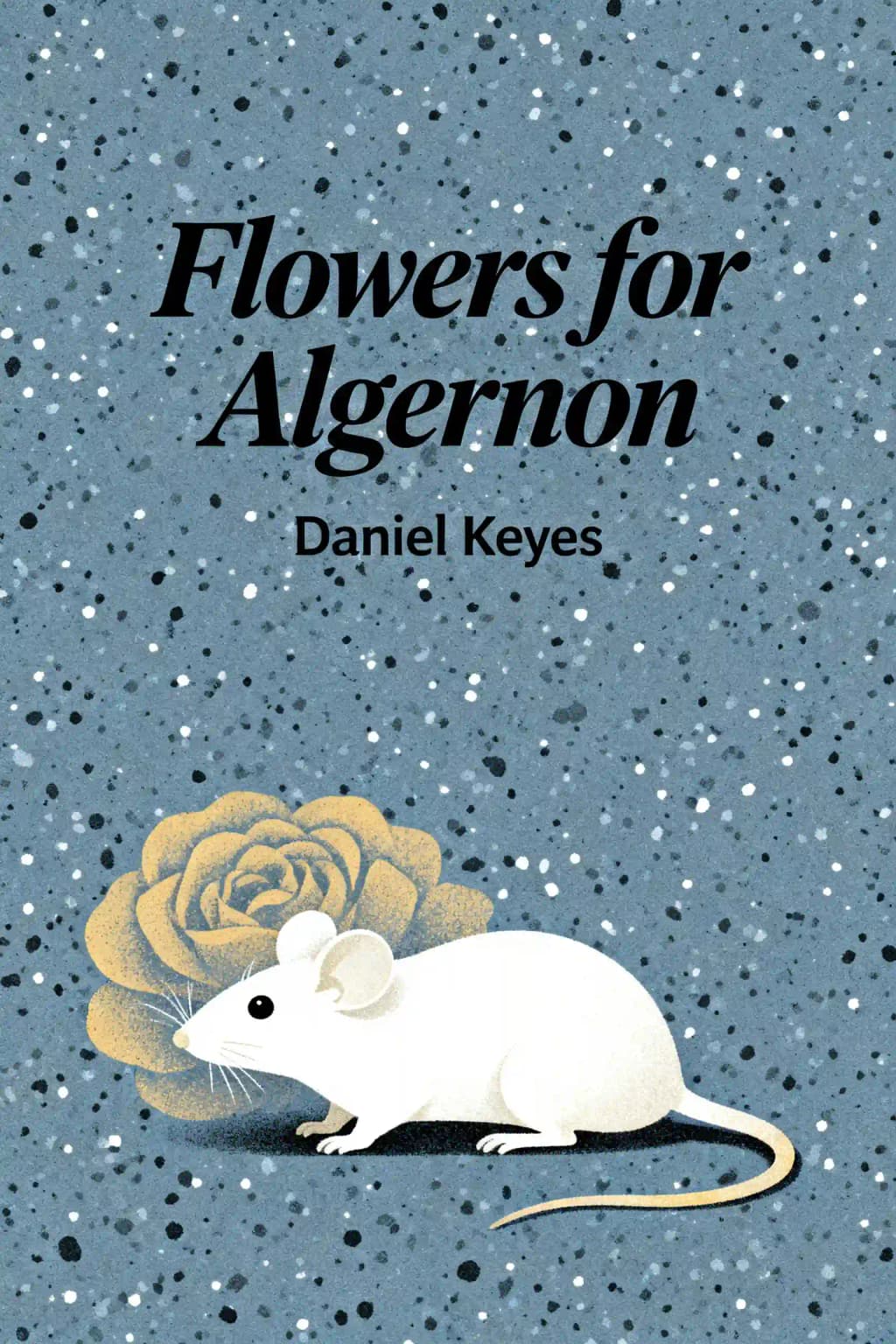
Daniel Keyes' "Flowers for Algernon" has captivated readers since its publication in 1966, winning the Nebula Award and becoming a cultural touchstone. The novel, which began as a Hugo Award-winning short story, explores the profound ethical and philosophical questions surrounding intelligence, human dignity, and the nature of happiness. Stanley Kubrick once considered adapting it before pursuing "2001: A Space Odyssey" instead, and its 1968 film adaptation "Charly" earned Cliff Robertson an Academy Award. Beyond entertainment, the book has become required reading in many schools, praised for its innovative narrative structure and unflinching examination of how society treats those with intellectual disabilities. Through Charlie Gordon's journey, Keyes crafts a story that continues to resonate with readers across generations, challenging us to reconsider our definitions of intelligence and humanity.
2장
The Experiment Begins: Charlie's Innocent Hope
Charlie Gordon is a 32-year-old bakery worker with an IQ of 68 who attends Miss Kinnian's class for "retarded adults" at Beekman College. His world transforms when he's selected for a groundbreaking experimental surgery designed to triple his intelligence - a procedure previously successful only with a white mouse named Algernon. Charlie's early progress reports, written as part of his mandatory documentation, reveal a childlike eagerness to please and a desperate desire to be "smart like other people." His writing, filled with misspellings, grammatical errors, and simple sentence structures, poignantly captures both his limited understanding and his boundless motivation. These reports become increasingly detailed as he progresses, serving as a mirror to his cognitive development.
The scientific team behind the experiment represents contrasting approaches to human research. Professor Nemur, the ambitious lead researcher, embodies the cold, analytical side of science - viewing Charlie primarily as a test subject and potential breakthrough. Dr. Strauss, the more empathetic neurosurgeon, demonstrates genuine concern for Charlie's emotional well-being and psychological adjustment. Miss Kinnian, Charlie's teacher, bridges these two perspectives, supporting both his intellectual growth and emotional needs. Charlie undergoes an extensive battery of tests - Rorschach inkblots, Thematic Apperception Tests, and maze competitions against Algernon - all of which initially frustrate and confuse him. During the maze trials, Charlie consistently loses to Algernon, yet rather than feeling defeated, he develops an almost brotherly admiration for the mouse's abilities.
Charlie's deep-seated motivations for participating in the experiment reveal complex layers of his character. Beyond the simple desire to increase his intelligence, he harbors hopes of reconnecting with his estranged family, developing meaningful friendships, and achieving what he perceives as "normalcy." His coworkers at Donner's Bakery, where he performs menial tasks like cleaning and deliveries, believe he's merely taking time off for illness - unaware that he's about to undergo revolutionary brain surgery. Even before the operation, we witness the casual cruelty Charlie unwittingly faces daily. His supposed friends at the bakery regularly make him the target of their jokes, though his limited comprehension prevents him from recognizing their mockery. When a skeptical nurse suggests that perhaps God didn't intend for Charlie to be smart, we encounter the first of many ethical questions the novel will explore about human enhancement and the nature of intelligence.
Charlie's situation raises profound questions about identity, happiness, and the price of knowledge. His innocent hope to become smart enough to have real friends and earn respect resonates with universal human desires - the longing to belong, to be understood, and to be valued for who we are. The early chapters establish not just Charlie's intellectual limitations but also his fundamental humanity, setting the stage for the dramatic transformation to come.
3장
The Awakening: Intelligence Emerges
Charlie's transformation begins subtly but accelerates with remarkable precision. After the experimental operation, he maintains his position at Donner's Bakery while adhering to a rigorous schedule of laboratory testing and cognitive assessments. The first indicators of change manifest in his written progress reports - his spelling errors diminish, his grammatical structure improves, and his vocabulary expands exponentially. These reports evolve from simple, childlike entries filled with misspellings to increasingly nuanced observations about his environment and internal experiences. One pivotal moment arrives when Charlie successfully navigates a maze faster than Algernon, the laboratory mouse who had previously outperformed him consistently. This victory marks not just a scientific milestone but a profound shift in Charlie's self-perception.
As his intellectual capacity expands, Charlie's understanding of his social world undergoes a painful metamorphosis. His coworkers at the bakery, particularly Frank and Joe, whom he had always considered close friends, appear in a new light. Their laughter, once a source of comfort and belonging, reveals itself as cruel mockery. This revelation reaches its crescendo at a party where they deliberately intoxicate him for their entertainment. Charlie's discovery that the phrase "pulling a Charlie Gordon" has become workplace shorthand for making a foolish mistake represents a particularly bitter awakening - years of supposed camaraderie dissolve into a history of exploitation and ridicule.
The disparity between Charlie's accelerating intelligence and his stunted emotional development creates increasingly complex internal conflicts. While his cognitive abilities soar, allowing him to master multiple languages and complex scientific concepts, his emotional responses remain rooted in his previous experiences of trauma and isolation. He articulates this disconnect with growing sophistication: "Intelligence without the ability to give and receive affection leads to mental and moral breakdown, to neurosis, and possibly even psychosis." This observation becomes prophetic as his journey continues.
His relationship with Alice Kinnian transforms from student-teacher to a more complicated dynamic fraught with intellectual and emotional tension. As Charlie's intelligence surpasses that of his former teacher, their potential for romance emerges, but psychological barriers persist. Attempts at physical intimacy trigger severe panic attacks - his unconscious mind rebels against crossing boundaries with someone who once symbolized the intellectual superiority he could never achieve. These episodes reveal deep-seated trauma related to his mother's treatment of his disability during childhood.
Charlie's psychological development takes on a fascinating dimension as he begins to view his former self as a distinct entity. He refers to his past self as "Charlie," creating a psychological distance between his present and former identities. This splitting manifests in complex ways - he simultaneously feels protective of this past self while harboring resentment toward his own former limitations. His dreams and memories become more vivid and troubling, revealing layers of past experiences he had never fully processed or understood.
The emergence of Charlie's intelligence brings with it an acute awareness of social hierarchies, intellectual distinctions, and the complex web of human relationships he had previously navigated in blissful ignorance. His journey illustrates how knowledge and awareness can be double-edged - bringing both enlightenment and profound discomfort as one's perspective on past experiences shifts dramatically.
4장
The Intellectual Peak: Brilliance and Isolation
As Charlie's intelligence surpasses genius level, his world both expands and contracts. He absorbs knowledge at an astonishing rate-learning multiple languages, mastering complex scientific theories, and developing insights that surpass even those of his creators. His IQ soars beyond 185, placing him among the most intelligent humans on earth. Yet this meteoric rise isolates him further from others.
The scientific team that created him becomes a particular source of frustration. Charlie realizes that Professor Nemur and Dr. Strauss, once godlike figures in his perception, are merely ordinary men with professional ambitions and personal insecurities. He discovers flaws in their research methodology and begins to question the very foundation of the experiment that transformed him. This culminates in a confrontation at a scientific conference in Chicago, where Charlie feels displayed like a laboratory specimen rather than recognized as a human being with dignity.
His workplace becomes unbearable as his intelligence grows. Despite receiving promotions and raises at the bakery, Charlie's relationships with his coworkers deteriorate until they petition to have him fired. Only Fanny Birden defends him, though even she expresses concern that his transformation might be unnatural-comparing his acquisition of knowledge to Adam and Eve's fall from grace. When Mr. Donner reluctantly lets him go, Charlie experiences this as a painful echo of childhood rejection.
Charlie's intellectual pursuits become increasingly solitary. He spends hours in libraries and laboratories, working on complex theories and original research. The university campus becomes his sanctuary, where he lingers among students discussing philosophy, literature, and science. Yet even here, he finds himself beyond the intellectual depth of most conversations, unable to connect meaningfully with others.
In one of the novel's most profound insights, Charlie realizes that extreme intelligence can be as isolating as intellectual disability: "I am just as alone and excluded from fellowship as I was when I was an idiot. I had no real friends then, and I have none now." His unique position-having experienced both ends of the intellectual spectrum-gives him a perspective no one else can share.
Have you ever felt the loneliness of understanding something others couldn't grasp? Charlie's isolation at his intellectual peak reminds us that human connection often depends more on shared experience than raw intelligence-and that being understood may matter more than being brilliant.
5장
The Shadow of the Past: Charlie's Psychological Journey
As Charlie's intelligence grows, so does his ability to access and process childhood memories. Through dreams, therapy sessions with Dr. Strauss, and spontaneous recollections, Charlie begins piecing together his painful past. These memories reveal the trauma that shaped him and the psychological barriers that continue to affect him despite his intellectual transformation.
Charlie's mother, Rose, emerges as a complex, troubled figure. Unable to accept her son's intellectual disability, she alternated between desperate attempts to "fix" him and violent rejections. In one harrowing memory, Charlie recalls being taken to a quack doctor named Guarino who claimed he could increase intelligence through "shortwave encephalo-reconditioning." The terrifying sessions-with Charlie strapped down while mysterious machines flashed lights-accomplished nothing but traumatizing the young boy and draining his parents' limited finances.
The arrival of Charlie's sister Norma created further family tension. Rose became increasingly determined to protect her "normal" daughter from the perceived shame of having a "retarded" brother. Charlie remembers overhearing his parents argue about sending him away, with his mother insisting, "I don't want him in the house any more with her." Despite his father Matt's protests, Charlie was eventually sent to the Warren State Home-a rejection that left deep psychological scars.
These recovered memories help explain Charlie's sexual dysfunction. His mother's warnings about "bad" thoughts and her harsh punishments for natural childhood curiosity created lasting psychological barriers. When Charlie attempts intimacy with Alice, he experiences panic attacks-a physical manifestation of his unresolved trauma. With Fay, a free-spirited artist he meets later, Charlie can maintain a physical relationship only by compartmentalizing and distancing himself emotionally.
Perhaps most significant is Charlie's evolving relationship with his past self. Initially, he views "the old Charlie" with embarrassment and disdain. As his intelligence peaks, he experiences dissociative episodes where he perceives his former self as a separate entity watching him. In one powerful scene, Charlie hallucinates his past self in a mirror, realizing that this part of him wants his life back. This internal conflict intensifies as Charlie begins to recognize that despite his intellectual limitations, the "old Charlie" possessed qualities he has lost-openness, warmth, and an uncomplicated capacity for joy.
Consider how your own past experiences shape your present reactions and relationships. Charlie's psychological journey reminds us that intellectual growth alone cannot heal emotional wounds-that understanding the source of our pain is only the beginning of true healing.
6장
The Algernon-Gordon Effect: The Beginning of the End
The turning point in Charlie's story comes when he notices disturbing changes in Algernon. The once-brilliant mouse begins showing erratic behavior-refusing to run mazes, becoming aggressive, and experiencing tremors. Charlie observes with growing dread as Algernon's performance deteriorates, knowing that the mouse's fate likely foreshadows his own.
Driven by this realization, Charlie throws himself into research, working around the clock to understand what's happening to Algernon and, by extension, to himself. He moves a cot into his laboratory, barely sleeping as he pursues the answer with desperate intensity. This period represents both the pinnacle of Charlie's scientific achievement and the beginning of his decline.
After weeks of relentless work, Charlie makes his breakthrough discovery-what he calls "the Algernon-Gordon Effect." His formula proves that artificially enhanced intelligence deteriorates at a rate proportional to the magnitude of the increase. The implications are devastating: not only will Charlie lose his newly gained intelligence, but he will deteriorate more rapidly and completely than if the experiment had never been performed.
Charlie's report to Professor Nemur is a masterpiece of scientific detachment masking profound personal anguish: "Artificially-induced intelligence deteriorates at a rate of time directly proportional to the quantity of the increase." With clinical precision, he documents the flaws in the experimental procedure and predicts the pattern of his own mental decline.
When Algernon dies, Charlie buries him in the backyard with wildflowers on his grave-a tender gesture that acknowledges their shared fate. The mouse's death makes Charlie's future terrifyingly concrete. He writes: "Dissection shows that my predictions were right. Compared to the normal brain, Algernon's had decreased in weight and there was a general smoothing out of the cerebral convolutions as well as a deepening and broadening of brain fissures."
Charlie's reaction to this knowledge reveals his growth as a person. Rather than becoming bitter or self-pitying, he expresses gratitude for the brief window of awareness he's been granted: "I'm grateful for the chance I had to see and understand the world for a while." He also finds purpose in his tragedy, hoping that his contribution to science might eventually help others like him.
Have you ever faced the certainty of losing something precious? Charlie's response to his inevitable decline challenges us to consider how we might face our own limitations and losses-whether we would choose gratitude for what we've had or bitterness for what we're losing.
7장
The Descent: Charlie's Regression
Charlie's mental deterioration follows the pattern he predicted-rapid and inexorable. His regression begins with subtle signs: forgetfulness, difficulty concentrating, and emotional volatility. He finds himself unable to understand books he recently read with ease. When he picks up Milton's "Paradise Lost," the text that once moved him deeply now appears as incomprehensible symbols. In frustration, he tears the book apart, flinging it to the corner of his room.
The regression affects every aspect of Charlie's life. His coordination deteriorates, making typing impossible and even handwriting difficult. His emotional control weakens, leading to outbursts of anger and childish behavior. Most painfully, his awareness of what's happening remains intact longer than his other faculties, forcing him to witness his own decline with agonizing clarity: "I'm like a man who's been half-asleep all his life, trying to find out what he was like before he woke up, and who now has to fall asleep again."
Charlie's relationships shift during this period. Alice returns to care for him, creating a brief, tender interlude where they finally connect physically and emotionally without the barriers that previously separated them. Yet Charlie, aware of what lies ahead, eventually sends her away: "I don't want you to watch me when I can't think or talk or recognize you anymore." This act of pushing Alice away, though painful, represents a final assertion of dignity and autonomy.
As his regression continues, Charlie returns to his old job at the bakery. Mr. Donner rehires him out of compassion, and his former tormentors Joe and Frank become his protectors against a new worker who tries to bully him. This reversal creates a poignant symmetry-Charlie has come full circle, but with a crucial difference. The people around him now see him as a human being deserving of respect and kindness, not merely an object of ridicule.
In his final progress report, Charlie's writing has returned to its original state-filled with misspellings and grammatical errors. Yet these simple words contain profound insights that the "genius Charlie" might have expressed more eloquently but no more truthfully: "Im glad I got a second chanse to be smart becaus I lerned a lot of things that I never even new were in this world and Im grateful that I saw it all for a little bit."
Think about what would remain if your intellectual abilities were stripped away. Charlie's descent reveals that our core values and character often shine most clearly not at our peak but in how we face our limitations and losses.
8장
Legacy of Flowers: The Novel's Enduring Message
As Charlie prepares to enter Warren State Home, he leaves behind two requests: "please put flowers on Algernon's grave," and "tell Prof Nemur not to be such a grouch when people laugh at him and he would have more friends." These simple wishes encapsulate the novel's central themes-compassion for the vulnerable and recognition that human connection matters more than intellectual achievement.
The title "Flowers for Algernon" takes on multiple layers of meaning throughout the story. Literally, it refers to Charlie's tender gesture of placing wildflowers on the mouse's grave. Symbolically, these flowers represent remembrance and honor for a being whose sacrifice advanced human knowledge. More broadly, they stand for the beauty and fragility of consciousness itself-blooming briefly before inevitably fading.
Keyes' novel challenges conventional notions of intelligence and worth. Through Charlie's unique perspective-having experienced both intellectual disability and genius-we see that IQ alone doesn't determine human value or happiness. The "smart" Charlie gains knowledge but loses the simple joy and openness that characterized his former self. His journey forces us to question whether intelligence should be the primary measure of a person's worth.
The book also serves as a powerful critique of how society treats those with intellectual disabilities. Charlie's coworkers at the bakery initially mock him without remorse, seeing him as less than fully human. Professor Nemur refers to pre-operation Charlie as a "laboratory specimen" rather than a person. Even Charlie's mother cannot accept him as he is, desperately seeking cures or hiding him away. Through these characters, Keyes exposes the dehumanization often experienced by people with intellectual disabilities.
Perhaps most profoundly, "Flowers for Algernon" explores the relationship between intelligence and emotional wisdom. Charlie's intellectual growth outpaces his emotional development, creating painful disconnects in his relationships. He gains knowledge but struggles with empathy and self-awareness. Only when facing his inevitable decline does Charlie achieve a kind of wisdom that transcends pure intellect-an acceptance of his limitations and gratitude for his brief glimpse of a wider world.
The novel's epistolary structure-told entirely through Charlie's progress reports-creates an intimate connection between reader and protagonist. We experience his transformation directly through his own words, from the misspelled entries of his early reports to the sophisticated analyses at his peak and back to simplicity at the end. This narrative technique makes Charlie's journey not just intellectually compelling but emotionally devastating.
What does it mean to be truly human? Charlie's story suggests that our humanity lies not in our intellectual capacity but in our connections to others, our capacity for kindness, and our ability to find meaning in both joy and suffering. In a world increasingly obsessed with intelligence and achievement, "Flowers for Algernon" offers a necessary reminder that wisdom and worth come in many forms.
9장
A Reflection on Human Dignity and Connection
Daniel Keyes' masterpiece transcends simple categorization as science fiction, psychological thriller, or social commentary. At its heart, "Flowers for Algernon" is a deeply humanistic exploration of consciousness and connection. Through Charlie's journey, we confront essential questions about the nature of intelligence, the basis of human dignity, and what truly constitutes a meaningful life.
The novel's lasting power comes from its refusal to offer easy answers. Is Charlie "better off" before the operation, during his peak intelligence, or somewhere in between? The text suggests that each state offers different kinds of awareness and connection, with corresponding losses and gains. Charlie himself recognizes this complexity: "Intelligence without the ability to give and receive affection leads to mental and moral breakdown, to neurosis, and possibly even psychosis."
Charlie's story resonates because it touches on universal human fears-of rejection, of inadequacy, of losing our faculties. His struggle to integrate his past and present selves mirrors our own efforts to reconcile different aspects of our identities. His longing for connection despite barriers reflects our fundamental need for understanding and acceptance.
In our contemporary world, where artificial intelligence advances rapidly and genetic engineering offers possibilities of enhancing human capabilities, the ethical questions raised by "Flowers for Algernon" become increasingly relevant. What are the costs of pursuing intelligence at the expense of other human qualities? Who decides which cognitive differences should be "corrected" and which should be embraced as part of human diversity?
The novel's final message is neither triumphant nor despairing but quietly affirming. Charlie, facing institutional life with diminished capacity, still asserts his personhood: "Im glad I got a second chanse in life." He recognizes that his brief intellectual flowering has given him glimpses of beauty and understanding that most people never experience. Even as he loses his genius, he retains something more essential-his humanity.
As we close Charlie's final progress report, we're left with his simple request to put flowers on Algernon's grave-a gesture of remembrance and respect that transcends intellectual capacity. In this image lies the novel's enduring wisdom: that kindness, connection, and dignity matter more than any measure of intelligence. Perhaps true wisdom lies not in what we know but in how we honor the fragile, temporary miracle of consciousness in ourselves and others.