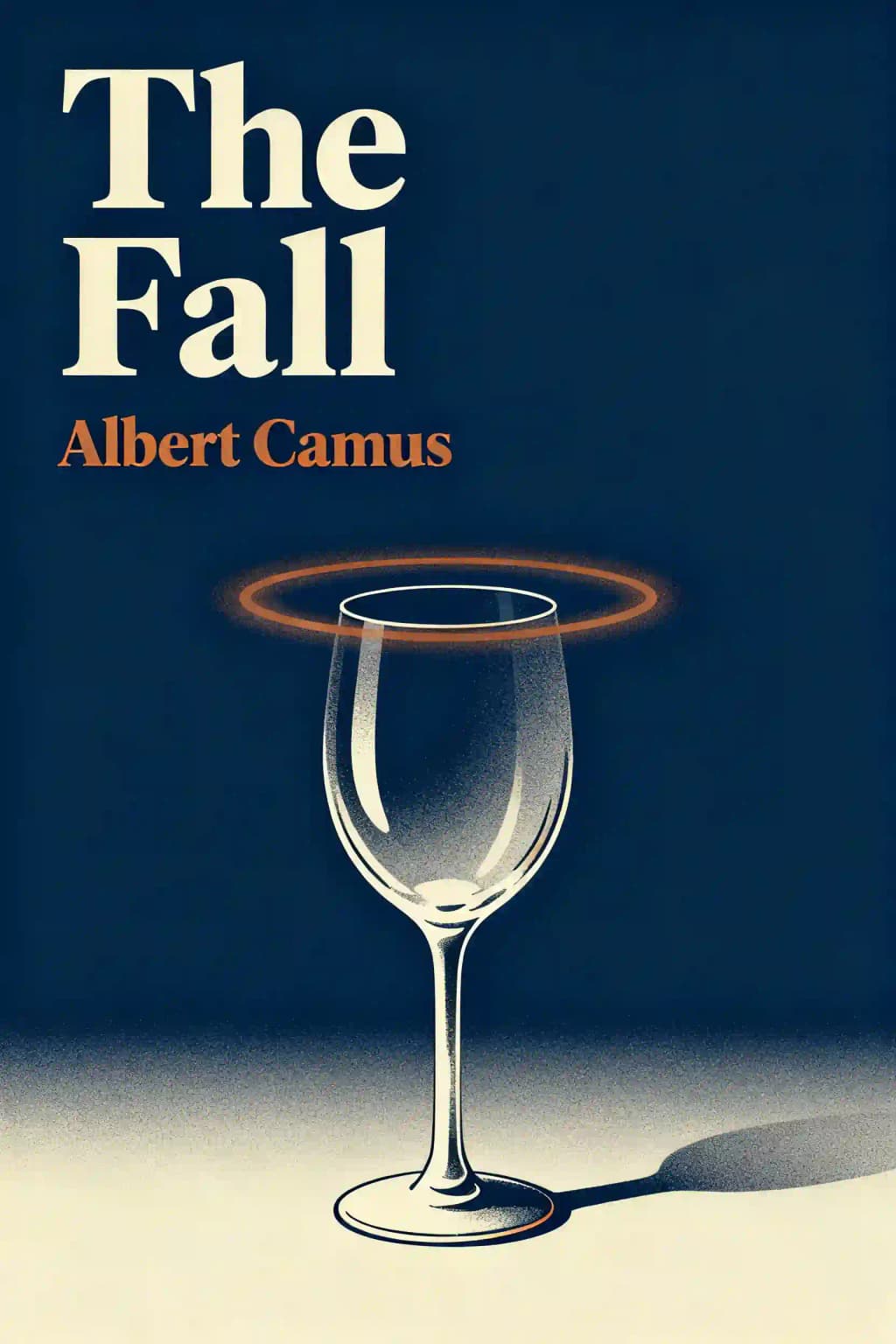
Camus's existential masterpiece explores guilt and judgment through a fallen judge's confession. Jean-Paul Sartre called it "the most beautiful and least understood" of Camus's works, its Amsterdam setting and Holocaust references sparking profound discussions about moral responsibility in post-war Europe.
Albert Camus, Nobel Prize-winning author of The Fall and a leading figure in existential literature, explores themes of guilt, hypocrisy, and moral ambiguity in this philosophical novella.
A French-Algerian philosopher, journalist, and playwright, Camus (1913–1960) studied philosophy at the University of Algiers and later gained prominence through his wartime work with the French Resistance, editing the clandestine newspaper Combat.
His existential and absurdist perspectives, reflected in seminal works like The Stranger and The Plague, challenge conventional notions of morality and human purpose. The Fall epitomizes Camus’s ability to dissect the contradictions of human nature through introspective narratives.
His other acclaimed titles, including The Myth of Sisyphus and The Rebel, further cement his legacy as a visionary thinker. Awarded the 1957 Nobel Prize in Literature for illuminating “the problems of the human conscience,” Camus’s works remain foundational in modern philosophy and continue to be translated globally, resonating with readers grappling with existential and ethical dilemmas.
The Fall explores guilt, hypocrisy, and existential crisis through Jean-Baptiste Clamence, a former lawyer who confesses his moral failures in Amsterdam. After witnessing a woman’s suicide and failing to act, he spirals into self-loathing, adopting the role of “judge-penitent” to critique others’ hypocrisy while masking his own. Themes include the absurdity of existence and the duality of human nature.
This novel suits readers interested in existential philosophy, moral ambiguity, and psychological introspection. Fans of Camus’ The Stranger or Sartre’s works will appreciate its exploration of guilt and self-deception. Its dense, monologue-driven style appeals to those comfortable with philosophical literature.
Yes—it’s a critical work of existentialist literature, offering sharp insights into human morality. Its concise narrative and unreliable narrator make it a compelling study of hypocrisy and existential despair. The book’s themes remain relevant for modern readers grappling with ethical responsibility.
Key themes include guilt and judgment, as Clamence condemns others to avoid self-scrutiny; existential absurdity, highlighting life’s lack of inherent meaning; and hypocrisy, epitomized by Clamence’s “judge-penitent” persona. The novel also examines freedom versus domination and the conflict between ideal and actual selves.
Clamence’s self-proclaimed title reflects his strategy of confessing sins to induce others to judge themselves. By exposing his flaws, he shifts guilt onto listeners, creating a cycle of mutual condemnation. This role underscores Camus’ critique of moral superiority and inauthenticity.
The woman’s death symbolizes Clamence’s moral failure. His inaction shatters his self-image as a virtuous man, triggering his existential crisis. The event exposes his cowardice and hypocrisy, serving as the catalyst for his descent into self-loathing.
Amsterdam’s concentric canals mirror Dante’s circles of hell, symbolizing Clamence’s psychological imprisonment. The post-WWII Jewish Quarter’s emptiness echoes his moral void, while the city’s fog and rain reflect his obscured self-perception.
Both explore existential absurdity, but The Fall delves deeper into moral hypocrisy. While Meursault (The Stranger) embraces indifference, Clamence obsesses over guilt and judgment. The Fall uses a confessional tone, contrasting The Stranger’s detached narration.
Camus critiques Judeo-Christian morality through Clamence’s pseudo-confessions and references to biblical “fall” symbolism. The novel questions religious notions of sin and redemption, framing them as tools for manipulation rather than spiritual growth.
The stolen panel represents Clamence’s belief in universal hypocrisy. By hiding the original, he mocks societal pretenses of justice, suggesting all authority figures are “false judges.” The painting underscores the novel’s theme of moral inauthenticity.
It portrays existence as inherently meaningless, with Clamence’s guilt and self-deception illustrating the human struggle to create purpose. His failure to act heroically mirrors Camus’ view of the absurd hero who confronts life’s futility.
Critics argue its dense monologue lacks plot progression, and Clamence’s nihilism feels oppressive. Some find Camus’ focus on elite hypocrisy narrow compared to his broader societal critiques in The Plague or The Rebel.
저자의 목소리로 책을 느껴보세요
지식을 흥미롭고 예시가 풍부한 인사이트로 전환
핵심 아이디어를 빠르게 캡처하여 신속하게 학습
재미있고 매력적인 방식으로 책을 즐기세요
I have never been really able to believe that human affairs were serious matters.
We cannot assert the innocence of anyone, whereas we can state with certainty the guilt of all.
Society is designed to kill slowly, like Brazilian fish that devour swimmers bite by bite.
I preferred heights in all things.
I rejoiced at their appearance, seeing them as opportunities for virtuous performance rather than human beings in need.
The Fall의 핵심 아이디어를 이해하기 쉬운 포인트로 분해하여 혁신적인 팀이 어떻게 창조하고, 협력하고, 성장하는지 이해합니다.
The Fall을 빠른 기억 단서로 압축하여 솔직함, 팀워크, 창의적 회복력의 핵심 원칙을 강조합니다.

생생한 스토리텔링을 통해 The Fall을 경험하고, 혁신 교훈을 기억에 남고 적용할 수 있는 순간으로 바꿉니다.
무엇이든 물어보고, 목소리를 선택하고, 진정으로 공감되는 인사이트를 함께 만들어보세요.

샌프란시스코에서 컬럼비아 대학교 동문들이 만들었습니다
"Instead of endless scrolling, I just hit play on BeFreed. It saves me so much time."
"I never knew where to start with nonfiction—BeFreed’s book lists turned into podcasts gave me a clear path."
"Perfect balance between learning and entertainment. Finished ‘Thinking, Fast and Slow’ on my commute this week."
"Crazy how much I learned while walking the dog. BeFreed = small habits → big gains."
"Reading used to feel like a chore. Now it’s just part of my lifestyle."
"Feels effortless compared to reading. I’ve finished 6 books this month already."
"BeFreed turned my guilty doomscrolling into something that feels productive and inspiring."
"BeFreed turned my commute into learning time. 20-min podcasts are perfect for finishing books I never had time for."
"BeFreed replaced my podcast queue. Imagine Spotify for books — that’s it. 🙌"
"It is great for me to learn something from the book without reading it."
"The themed book list podcasts help me connect ideas across authors—like a guided audio journey."
"Makes me feel smarter every time before going to work"
샌프란시스코에서 컬럼비아 대학교 동문들이 만들었습니다

The Fall 요약을 무료 PDF 또는 EPUB으로 받으세요. 인쇄하거나 오프라인에서 언제든 읽을 수 있습니다.
Imagine sitting in a dimly lit bar in Amsterdam's red-light district, approached by a stranger who seems to know you better than you know yourself. This is Jean-Baptiste Clamence, a fallen man who has appointed himself judge of all humanity-including you. "The Fall" is a confession that becomes an indictment, delivered in a hypnotic monologue that pulls you deeper into complicity with each passing page. Through Clamence's voice, Camus explores our shared capacity for moral hypocrisy, the fragility of our self-image, and the universal human tendency to judge others while absolving ourselves. What begins as one man's confession gradually transforms into a mirror reflecting our own moral compromises and self-deceptions. As Clamence will make painfully clear, we are all performing virtue while harboring selfishness-and the moment we realize this truth constitutes our own personal fall from grace.