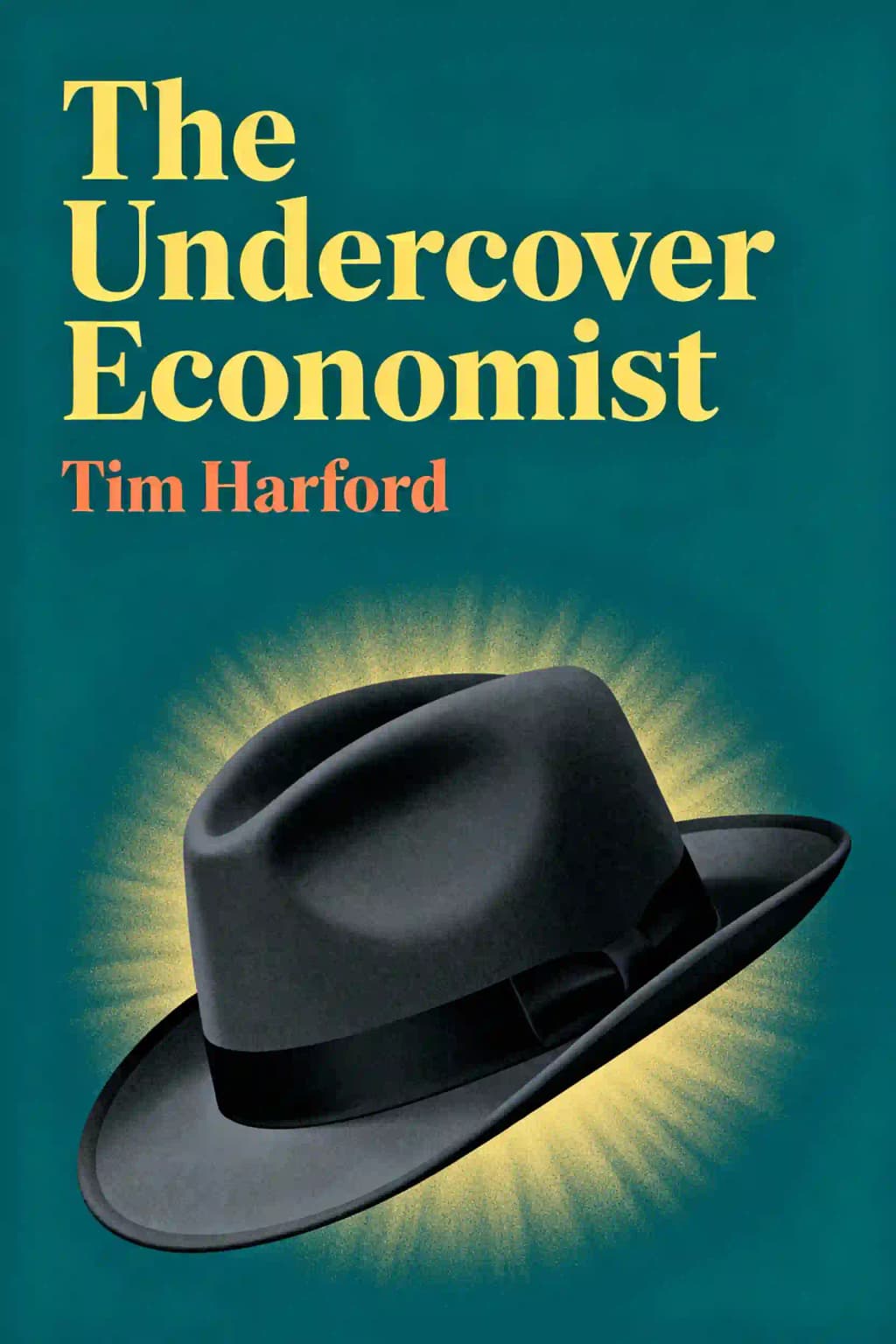
The undercover economist
Overview of The undercover economist
Discover why everyday economics isn't boring with "The Undercover Economist" - the book that transformed economic thinking alongside "Freakonomics." Why does Starbucks price coffee that way? What makes used cars so tricky? Even "Freakonomics" author Steven Levitt calls it "a rare specimen" that "brings economics to life."

Key Themes in The undercover economist
- scarcity power
- price targeting
- market signaling
- information asymmetry
- rent seeking
Quotes from The undercover economist
Free markets force truth-telling like Jim Carrey in "Liar, Liar."
Coffee is expensive because rents are high' reverses causality.
Characters in The undercover economist
- Tim HarfordAuthor and economist who explains market forces
- David Ricardo19th-century economist who identified scarcity
- George Bernard ShawPlaywright who critiqued professional associations
About the Author
About the Author of The undercover economist
Tim Harford, bestselling author of The Undercover Economist and award-winning behavioral economist, merges wit with rigorous analysis to decode everyday economics in this foundational work.
A senior Financial Times columnist and BBC Radio 4 host, Harford explores themes of decision-making, market forces, and statistical literacy—drawing from his Oxford education, World Bank experience, and role as an honorary fellow of the Royal Statistical Society. His other acclaimed books, including Messy and How to Make the World Add Up, further dissect innovation and data storytelling.
Harford’s BBC podcasts More or Less and Cautionary Tales reinforce his reputation for translating complex ideas into engaging narratives, while his TED Talks and global speaking engagements at venues like the Sydney Opera House showcase his cross-disciplinary influence.
Recognized with an OBE for advancing economic understanding, Harford has sold over 1.5 million copies worldwide, with The Undercover Economist translated into 30 languages.
Download Summary of The undercover economist
Get the The undercover economist summary as a free PDF or EPUB. Print it or read offline anytime.
FAQs About This Book
The Undercover Economist explores hidden economic forces shaping everyday life, from coffee pricing to global trade. Tim Harford demystifies concepts like scarcity, externalities, and market failures through relatable examples like Starbucks’ strategies and used-car markets. The book connects microeconomic principles to macro-level issues like globalization, offering a lens to understand how incentives drive decisions in business, policy, and personal choices.
This book suits economics beginners, curious readers, and professionals seeking real-world applications of economic theory. Harford’s humor and clear storytelling make it accessible for students, business strategists, and anyone interested in how markets influence daily decisions—from grocery shopping to understanding international trade dynamics.
Yes—it’s a digestible primer on economics that blends academic rigor with engaging narratives. Harford avoids jargon, using anecdotes like traffic congestion pricing and China’s economic rise to illustrate complex ideas. Readers gain actionable insights into consumer behavior, corporate strategies, and global inequality, making it a valuable resource for informed decision-making.
Harford reveals how businesses like Starbucks use location monopolies and “price discrimination” to charge premium prices. For example, crowded train stations allow coffee chains to exploit scarcity, while loyalty programs target price-sensitive customers. This strategy highlights how companies maximize profits by segmenting markets based on willingness to pay.
- Scarcity: How limited resources (e.g., prime retail space) drive pricing power.
- Externalities: Costs borne by third parties, like pollution or traffic congestion.
- Information asymmetry: Why used-car markets favor sellers over buyers.
- Globalization: Comparative advantage’s role in international trade and wealth disparities.
Harford acknowledges globalization’s dual impact: while it fuels economic growth (e.g., China’s rise), it also exacerbates inequality. He argues that free trade benefits societies overall but stresses the need for policies to mitigate localized harms, such as job displacement in certain industries.
Both use storytelling to explain economics, but Harford focuses more on foundational principles (supply/demand, externalities) and global systems. Freakonomics emphasizes unconventional data analysis (e.g., cheating sumo wrestlers). Harford’s work is often seen as a broader introduction to economic theory.
- “Your cappuccino reflects the outcome of a system of staggering complexity”: Illustrates global supply chains’ role in everyday products.
- “Strength comes from scarcity”: Explains how controlling limited resources (e.g., urban real estate) creates market power.
Yes. The book offers frameworks to analyze pricing strategies, competitive advantages, and consumer psychology. For example, understanding “information asymmetry” can help negotiate salaries or evaluate insurance policies, while lessons on externalities inform sustainable business practices.
Some economists argue Harford oversimplifies complex issues (e.g., healthcare systems) and underemphasizes political factors in globalization. However, these simplifications make the book accessible to non-experts, balancing depth with readability.
He frames traffic as a “negative externality” where individual drivers don’t bear the full cost of road use. Solutions like congestion pricing (e.g., London’s tolls) internalize these costs, reducing gridlock by incentivizing public transport or carpooling.
Its themes—global trade tensions, sustainability challenges, and algorithmic pricing—resonate in an era of AI-driven markets and climate crises. Harford’s emphasis on critical thinking and incentive analysis equips readers to navigate modern economic complexities.