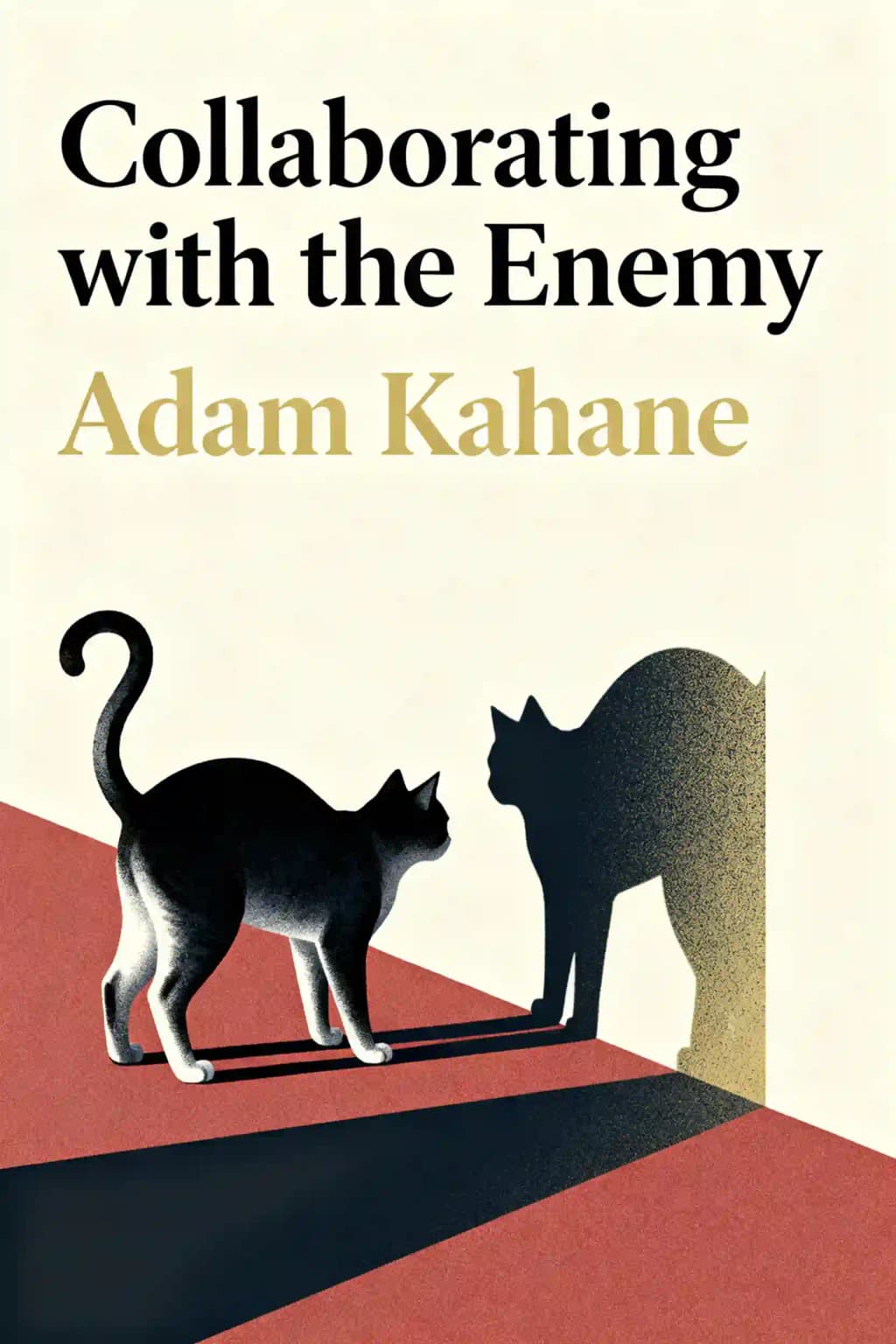
In a world where enemies abound, Adam Kahane offers a radical approach: "stretch collaboration" that embraces conflict. Endorsed by Nelson Mandela and honored at Davos, this framework has transformed thousands of coalitions worldwide. Can you collaborate with those you don't trust? This book shows how.
Adam Kahane, author of Collaborating with the Enemy: How to Work with People You Don’t Agree with or Like or Trust, is a globally recognized expert in conflict resolution and collaborative problem-solving. A director of Reos Partners, Kahane has spent three decades designing transformative processes for leaders across business, government, and civil society to address complex challenges. His work spans over fifty countries, facilitating dialogues among executives, activists, politicians, and grassroots organizers.
The book—rooted in leadership, negotiation, and systems change—reflects Kahane’s expertise in bridging divides, informed by his background in physics, economics, and scenario planning at Shell. His other influential works, including Solving Tough Problems (endorsed by Nelson Mandela) and Transformative Scenario Planning, explore similar themes of dialogue and systemic transformation. Kahane’s methodologies are taught in top MBA programs and applied by organizations like the United Nations.
A Member of the Order of Canada, his books have been translated into twenty languages, underscoring their global relevance. His latest release, Everyday Habits for Transforming Systems (2025), further cements his legacy as a pioneer in practical, large-scale change strategies.
Collaborating with the Enemy explores strategies for working effectively with adversaries in complex, polarized situations. It challenges the myth that collaboration requires agreement, offering frameworks like "stretch collaboration" to transform conflict into productive partnerships. The book draws on real-world examples, including peace processes in South Africa and Colombia, to illustrate how to navigate mistrust and systemic challenges.
Leaders, negotiators, and professionals facing entrenched conflicts or cross-sector collaboration challenges will find this book invaluable. It’s particularly relevant for those in politics, organizational development, or community-building roles seeking practical tools to work with opposing groups without compromising core values.
Yes, for its actionable insights on turning adversarial relationships into opportunities. Kahane’s blend of theory and real-case studies—like Guatemala’s post-civil war efforts—provides a roadmap for navigating today’s polarized environments. Critics praise its pragmatic approach to complex collaboration beyond superficial consensus.
Enemyfying refers to labeling others as adversaries, oversimplifying conflicts into "us vs. them." This mindset escalates tension and stifles problem-solving. Kahane argues overcoming it requires embracing both conflict and connection, focusing on shared goals rather than differences.
Stretch collaboration rejects rigid control, advocating for iterative experimentation amid discord. It combines three shifts: embracing conflict (not avoiding it), testing solutions through action (not over-planning), and engaging fully without domination. This approach is exemplified in Kahane’s work on drug policy reform in the Americas.
Kahane outlines four choices:
The book argues collaboration becomes viable when we abandon illusions of control.
The book advises reframing workplace tensions as shared challenges rather than personal battles. For example, teams can use "stretch" techniques like rotating leadership roles or prototyping solutions incrementally—methods Kahane tested in corporate and NGO settings.
Key cases include:
While Getting to Yes focuses on win-win negotiation tactics, Kahane’s work addresses scenarios where mutual gain seems impossible. It emphasizes adaptability over predefined agreements, making it more suited to deeply polarized or systemic conflicts.
Some argue the book’s approach risks legitimizing harmful actors or diluting ethical standards. Others note its methods require significant time and emotional labor, which may not scale in crisis scenarios. Kahane counters that imperfect collaboration often outweighs the costs of inaction.
As globalization and AI intensify cross-cultural tensions, Kahane’s frameworks help navigate divisive issues like climate policy and tech ethics. The book’s emphasis on iterative, flexible collaboration aligns with modern agile methodologies and hybrid work challenges.
저자의 목소리로 책을 느껴보세요
지식을 흥미롭고 예시가 풍부한 인사이트로 전환
핵심 아이디어를 빠르게 캡처하여 신속하게 학습
재미있고 매력적인 방식으로 책을 즐기세요
We differentiate ourselves from 'those people'.
Collaboration is becoming more essential and more challenging.
Social media amplifies divisions.
Compromise seem like betrayal rather than progress.
Collaboration isn't always the optimal response.
Collaborating with the Enemy의 핵심 아이디어를 이해하기 쉬운 포인트로 분해하여 혁신적인 팀이 어떻게 창조하고, 협력하고, 성장하는지 이해합니다.
Collaborating with the Enemy을 빠른 기억 단서로 압축하여 솔직함, 팀워크, 창의적 회복력의 핵심 원칙을 강조합니다.

생생한 스토리텔링을 통해 Collaborating with the Enemy을 경험하고, 혁신 교훈을 기억에 남고 적용할 수 있는 순간으로 바꿉니다.
무엇이든 물어보고, 목소리를 선택하고, 진정으로 공감되는 인사이트를 함께 만들어보세요.

샌프란시스코에서 컬럼비아 대학교 동문들이 만들었습니다
"Instead of endless scrolling, I just hit play on BeFreed. It saves me so much time."
"I never knew where to start with nonfiction—BeFreed’s book lists turned into podcasts gave me a clear path."
"Perfect balance between learning and entertainment. Finished ‘Thinking, Fast and Slow’ on my commute this week."
"Crazy how much I learned while walking the dog. BeFreed = small habits → big gains."
"Reading used to feel like a chore. Now it’s just part of my lifestyle."
"Feels effortless compared to reading. I’ve finished 6 books this month already."
"BeFreed turned my guilty doomscrolling into something that feels productive and inspiring."
"BeFreed turned my commute into learning time. 20-min podcasts are perfect for finishing books I never had time for."
"BeFreed replaced my podcast queue. Imagine Spotify for books — that’s it. 🙌"
"It is great for me to learn something from the book without reading it."
"The themed book list podcasts help me connect ideas across authors—like a guided audio journey."
"Makes me feel smarter every time before going to work"
샌프란시스코에서 컬럼비아 대학교 동문들이 만들었습니다

Collaborating with the Enemy 요약을 무료 PDF 또는 EPUB으로 받으세요. 인쇄하거나 오프라인에서 언제든 읽을 수 있습니다.
Imagine sitting across the table from someone you consider your enemy - someone whose values oppose yours, whose actions have harmed what you hold dear. Now imagine working productively with them. This seemingly impossible task lies at the heart of Adam Kahane's groundbreaking work. Drawing from his experiences facilitating high-stakes collaborations - from South Africa's transition from apartheid to Colombia's peace process - Kahane reveals that working with enemies isn't just possible; it's increasingly essential in our complex world. The conventional wisdom about collaboration falls apart when facing deep divisions. What makes Kahane's approach revolutionary is how it transforms the seemingly impossible - working productively with enemies - into a learnable skill set that applies equally to international conflicts, corporate boardrooms, and family dinner tables. When former Colombian President and Nobel Peace Prize winner Juan Manuel Santos credits your work as "one of the most significant events in the country's search for peace," you've clearly tapped into something profound.