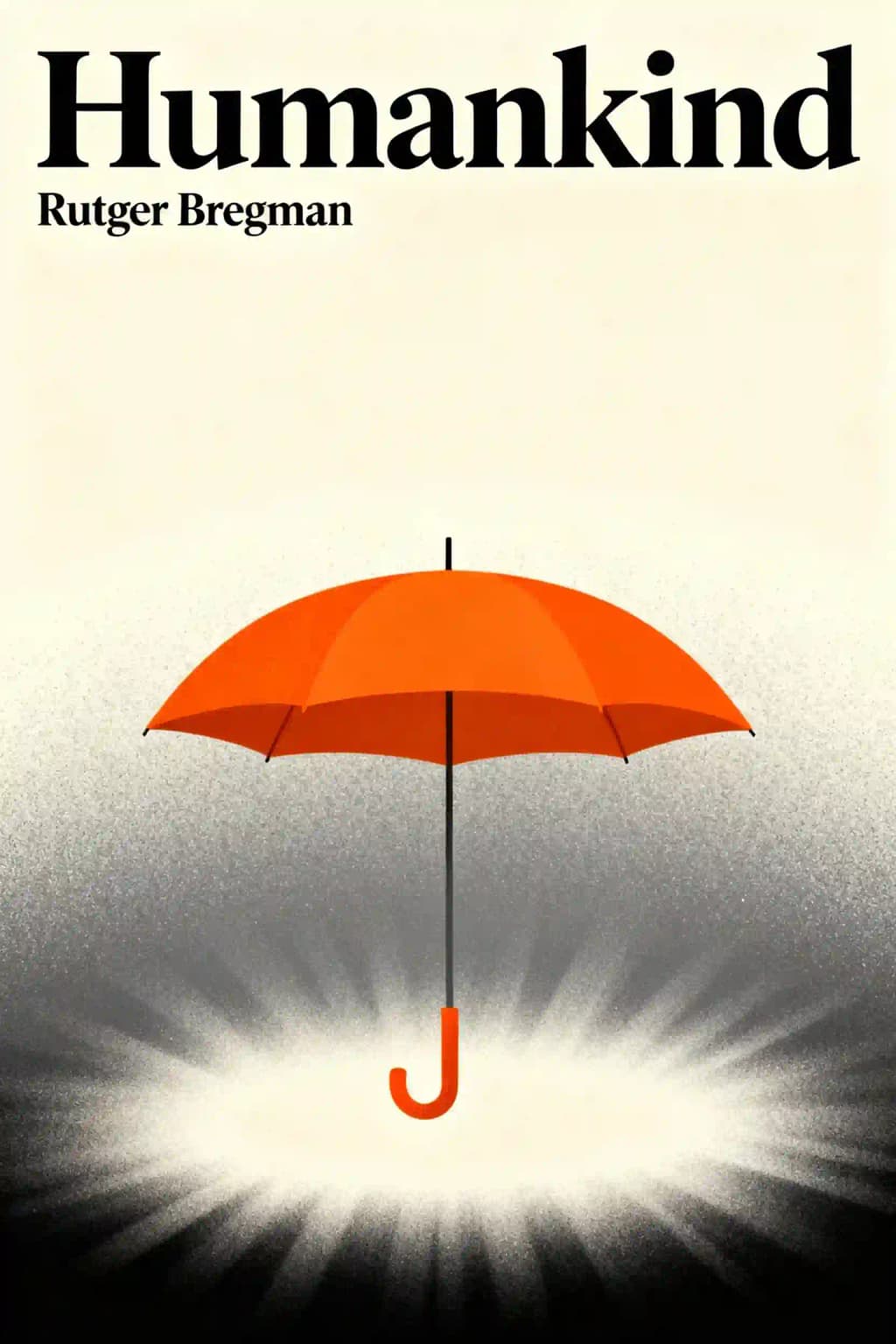
Bregman boldly challenges our darkest assumptions: humans aren't selfish monsters but fundamentally kind. What if Lord of the Flies got it wrong? Endorsed by Harari, this international bestseller reveals how believing in human goodness could revolutionize schools, prisons, and society itself.
Rutger Bregman is the bestselling author of Humankind: A Hopeful History and a Dutch historian renowned for his provocative ideas on human nature and societal progress.
His work, blending history, philosophy, and anthropology, challenges conventional wisdom by arguing that humans are fundamentally good—a theme rooted in his academic training at Utrecht University and UCLA.
Bregman gained global recognition with Utopia for Realists (2017), which advocates for universal basic income and shorter workweeks, and co-founded The School for Moral Ambition to inspire impactful careers. His TED Talk on poverty, named among the top talks of 2017, and features in The Guardian and The New York Times underscore his influence as a leading thinker.
Humankind, a New York Times bestseller, has been translated into 46 languages and sold over two million copies worldwide.
Humankind: A Hopeful History by Rutger Bregman challenges the long-held belief that humans are inherently selfish or violent. Drawing on historical events, psychological studies, and anthropological research, Bregman argues that kindness and cooperation are fundamental to human nature. The book critiques "veneer theory" (the idea that civilization masks innate brutality) and highlights examples like peaceful prehistoric societies and camaraderie during crises.
This book is ideal for readers interested in psychology, sociology, or history, particularly those seeking an optimistic perspective on human nature. Fans of Yuval Noah Harari’s Sapiens or Steven Pinker’s work will appreciate Bregman’s blend of storytelling and research. It’s also relevant for policymakers and educators exploring trust-based systems.
Yes, it’s a thought-provoking, well-researched critique of pessimistic views of humanity. Bregman’s accessible style and use of vivid anecdotes—like the real Lord of the Flies survival story—make complex ideas engaging. While some critics note oversimplification, the book’s hopeful message resonates in times of social division.
Bregman combines evolutionary biology (e.g., Homo puppy’s friendliness correlating with intelligence), historical re-examinations (e.g., Easter Island’s collapse myths), and psychological studies like the Stanford prison experiment’s debunking. He also rebuts Lord of the Flies with the real-life Tongan castaways who cooperated.
Veneer theory posits that morality is a thin layer over humanity’s selfish core. Bregman dismantles this by showing how altruism predates modern society, with evidence from prehistoric burial sites and child-development studies.
Yes. Bregman acknowledges humanity’s capacity for violence but argues systemic factors (e.g., inequality, distrust) drive harm, not inherent evil. He cites post-disaster solidarity and the success of cooperative communities like the Scottish Isle of Eigg.
Both explore human history, but Humankind focuses on debunking pessimism, while Sapiens covers broader cultural evolution. Bregman’s work is more prescriptive, advocating for institutions that leverage innate kindness.
Coined in Chapter 3, Homo puppy refers to humans’ evolved friendliness and social learning. Bregman links our survival to traits like playfulness and empathy, contrasting us with more aggressive hominids.
Bregman advocates for policies rooted in trust, such as universal basic income and restorative justice. He argues that systems assuming human goodness—like prison reforms in Norway—yield better outcomes than punitive models.
Some scholars argue Bregman oversimplifies human complexity, ignoring nuances in Rousseau vs. Hobbes debates. Critics also note cherry-picked examples and downplaying of historical atrocities, though many praise his hopeful vision.
저자의 목소리로 책을 느껴보세요
지식을 흥미롭고 예시가 풍부한 인사이트로 전환
핵심 아이디어를 빠르게 캡처하여 신속하게 학습
재미있고 매력적인 방식으로 책을 즐기세요
Humans are fundamentally decent rather than naturally selfish.
Optimism about human nature is actually the most realistic position?
The crisis brought out people's best qualities.
Our cynical view of humanity functions like a nocebo effect on society.
Humans themselves are domesticated apes.
HUMANKIND의 핵심 아이디어를 이해하기 쉬운 포인트로 분해하여 혁신적인 팀이 어떻게 창조하고, 협력하고, 성장하는지 이해합니다.
HUMANKIND을 빠른 기억 단서로 압축하여 솔직함, 팀워크, 창의적 회복력의 핵심 원칙을 강조합니다.

생생한 스토리텔링을 통해 HUMANKIND을 경험하고, 혁신 교훈을 기억에 남고 적용할 수 있는 순간으로 바꿉니다.
무엇이든 물어보고, 목소리를 선택하고, 진정으로 공감되는 인사이트를 함께 만들어보세요.

샌프란시스코에서 컬럼비아 대학교 동문들이 만들었습니다
"Instead of endless scrolling, I just hit play on BeFreed. It saves me so much time."
"I never knew where to start with nonfiction—BeFreed’s book lists turned into podcasts gave me a clear path."
"Perfect balance between learning and entertainment. Finished ‘Thinking, Fast and Slow’ on my commute this week."
"Crazy how much I learned while walking the dog. BeFreed = small habits → big gains."
"Reading used to feel like a chore. Now it’s just part of my lifestyle."
"Feels effortless compared to reading. I’ve finished 6 books this month already."
"BeFreed turned my guilty doomscrolling into something that feels productive and inspiring."
"BeFreed turned my commute into learning time. 20-min podcasts are perfect for finishing books I never had time for."
"BeFreed replaced my podcast queue. Imagine Spotify for books — that’s it. 🙌"
"It is great for me to learn something from the book without reading it."
"The themed book list podcasts help me connect ideas across authors—like a guided audio journey."
"Makes me feel smarter every time before going to work"
샌프란시스코에서 컬럼비아 대학교 동문들이 만들었습니다

HUMANKIND 요약을 무료 PDF 또는 EPUB으로 받으세요. 인쇄하거나 오프라인에서 언제든 읽을 수 있습니다.
Stop for a moment and think about how you'd react if disaster struck your city tomorrow. Would your neighbors turn on each other? Would chaos reign? Most of us would answer yes-and we'd be completely wrong. This isn't just optimistic thinking. It's what actually happens, again and again, backed by decades of research. Rutger Bregman's revolutionary book challenges the cynical view of humanity that shapes our schools, prisons, workplaces, and governments. What if the real story of who we are-the one written in our evolutionary history and proven in countless crises-is that humans are fundamentally decent? This isn't naive hope. It's a perspective so well-documented that Barack Obama called it one of his favorite books and Bill Gates praised its hopeful realism. At a time when believing in human goodness feels almost reckless, Bregman shows us why cynicism might be the real delusion.