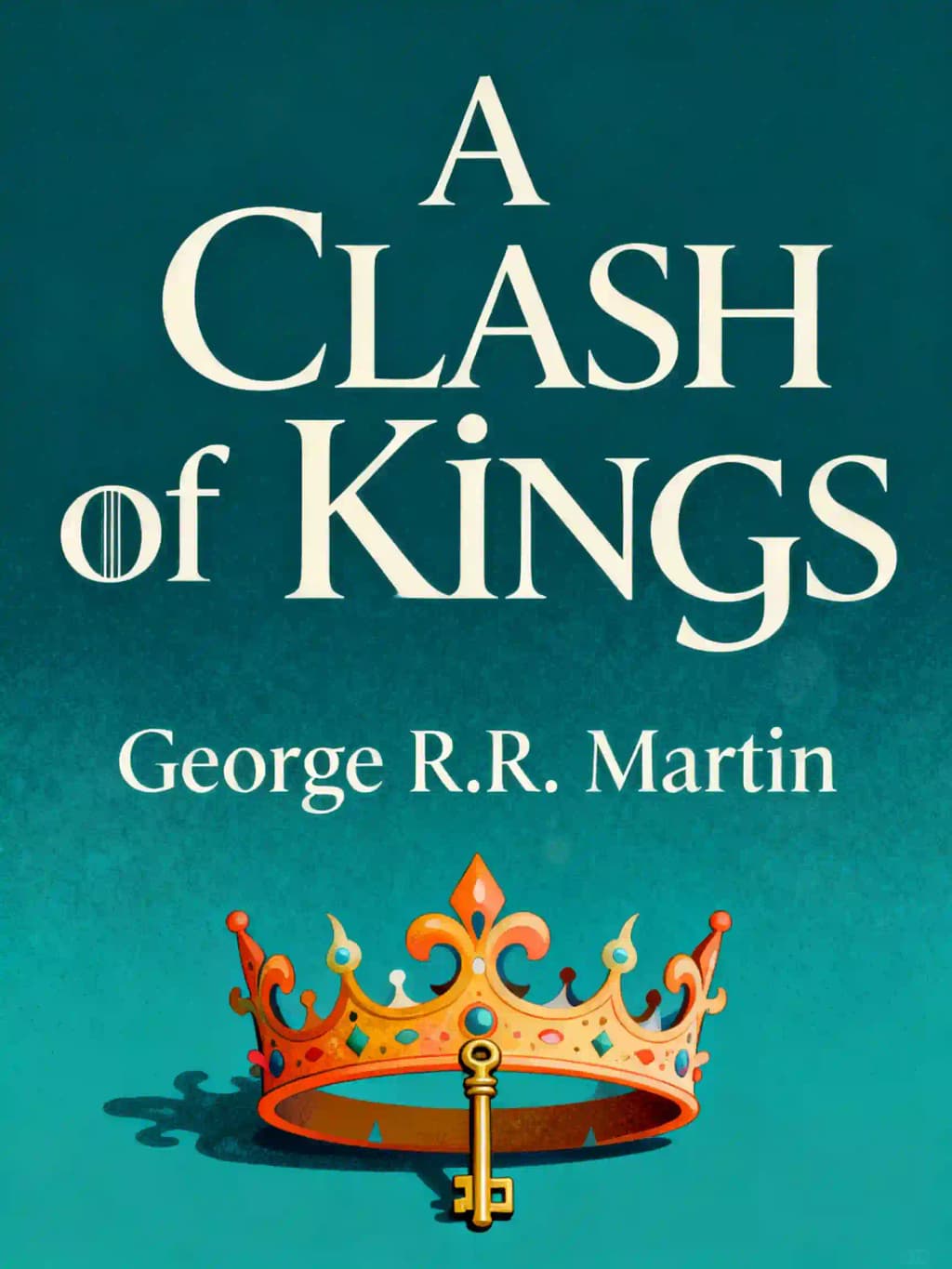
A Clash of Kings
A Song of Ice and Fire: Book Two
Overview of A Clash of Kings
In Martin's "A Clash of Kings," five kings battle for a bleeding realm. This 1,184-page masterpiece topped SF Site's Best of 1999 and made NYT's bestseller list. Even the LA Times praised its willingness to kill major characters - would you dare enter?

Key Themes in A Clash of Kings
- dynastic succession crisis
- medieval siege warfare
- political machination
- moral ambiguity
- supernatural resurgence
Quotes from A Clash of Kings
Power resides where men believe it resides. No more and no less.
The storms come and go, the waves crash overhead, the big fish eat the little fish, and I keep on paddling.
The night is dark and full of terrors.
Tears are not a woman’s only weapon.
When you play the game of thrones, you win or you die.
Characters in A Clash of Kings
- Tyrion LannisterThe clever and cynical Hand of the King
- Daenerys TargaryenThe Mother of Dragons seeking her lost dynasty
- Jon SnowA member of the Night's Watch beyond the Wall
- Stannis BaratheonA claimant to the throne aided by shadow magic
- Cersei LannisterThe ruthless Queen Regent protecting her power
About the Author
About the Author of A Clash of Kings
George Raymond Richard Martin, the bestselling author of A Clash of Kings and a visionary in epic fantasy, is celebrated for his intricately woven narratives of power, betrayal, and political intrigue. Born in Bayonne, New Jersey, in 1948, Martin honed his storytelling craft through a background in journalism and early ventures into chess tournament organizing before transitioning to full-time writing. His A Song of Ice and Fire series, which includes A Game of Thrones and A Storm of Swords, redefined modern fantasy with its morally complex characters and layered worldbuilding.
A Northwestern University graduate, Martin’s work draws from historical influences and psychological depth, earning him the moniker “the American Tolkien” from Time magazine. Beyond novels, he co-created the Wild Cards anthology and contributed to video games like Elden Ring.
The HBO adaptation of his series, Game of Thrones, became a global phenomenon, while its prequel, House of the Dragon, continues his legacy. Translated into over 47 languages, his books have sold tens of millions of copies worldwide, cementing his status as a cornerstone of contemporary fantasy.
Download Summary of A Clash of Kings
Get the A Clash of Kings summary as a free PDF or EPUB. Print it or read offline anytime.
FAQs About This Book
A Clash of Kings is the second novel in George R.R. Martin’s epic fantasy series A Song of Ice and Fire. It chronicles the brutal War of the Five Kings in Westeros, driven by rival factions vying for the Iron Throne. Key plotlines include Daenerys Targaryen’s quest to reclaim her birthright, Tyrion Lannister’s political maneuvering in King’s Landing, and the Stark family’s struggle for survival amid betrayal and supernatural threats beyond the Wall.
Fans of complex fantasy sagas with intricate political intrigue, morally gray characters, and richly detailed worldbuilding will appreciate this book. It suits readers who enjoy multi-perspective storytelling and morally ambiguous conflicts. Due to its mature themes of violence and power, it’s best for adults or older teens familiar with epic fantasy like The Lord of the Rings.
Yes—A Clash of Kings expands the stakes of Martin’s universe with deeper character development, shocking twists, and layered conflicts. Critics praise its realistic portrayal of medieval warfare and its critique of ambition. However, its dense plot and large cast may challenge casual readers.
Central themes include the corrupting influence of power, the futility of war, and the tension between duty and survival. Martin explores how loyalty and betrayal shape outcomes, particularly through characters like Theon Greyjoy’s tragic choices and Tyrion Lannister’s pragmatic leadership during the Battle of Blackwater.
Key characters include:
- Tyrion Lannister: The cunning Hand of the King, defending King’s Landing.
- Daenerys Targaryen: A exiled queen building her army in Essos.
- Arya Stark: A fugitive disguising herself to survive.
- Stannis Baratheon: A rigid claimant to the throne.
- Theon Greyjoy: A conflicted traitor to the Stark family.
While the Game of Thrones TV adaptation streamlines subplots and ages up characters, the novel delves deeper into internal monologues, secondary characters like Davos Seaworth, and magical elements (e.g., Bran Stark’s visions). The book also retains more graphic violence and nuanced political schemes omitted in the show.
Some readers find the sprawling cast and slow pacing overwhelming. Critics also note that its grim tone and lack of traditional heroes may alienate fans of optimistic fantasy. However, these elements are praised for subverting genre tropes and reflecting historical realism.
This climactic siege showcases Tyrion’s strategic genius and the Lannisters’ desperation to hold King’s Landing against Stannis Baratheon. The battle’s outcome reshapes alliances, solidifies Joffrey’s hold on power, and highlights the devastating human cost of war through wildfire’s destructive use.
The novel introduces rising threats like Daenerys’ dragons and the White Walkers, while fractures in Westeros’ nobility foreshadow civil unrest. Character arcs—such as Bran’s psychic abilities and Jon Snow’s mission beyond the Wall—lay groundwork for magical conflicts central to later plots.
- “A man who must say ‘I am the king’ is no true king.” (Tywin Lannister) — critiques legitimacy through assertion.
- “The night is dark and full of terrors.” (Melisandre) — underscores the novel’s ominous tone.
- “Chaos is a ladder.” (Petyr Baelish) — encapsulates the opportunism driving Westeros’ power struggles.
Each chapter focuses on one of nine characters, providing fragmented insights into the war’s scope. This structure reveals biases (e.g., Sansa’s naivety vs. Tyrion’s cynicism) and immerses readers in the chaos of conflicting agendas.
Its exploration of power dynamics, ethical ambiguity in leadership, and the consequences of ambition mirrors real-world political conflicts. The Stark family’s resilience and Daenerys’ fight against oppression also resonate with themes of justice and identity.