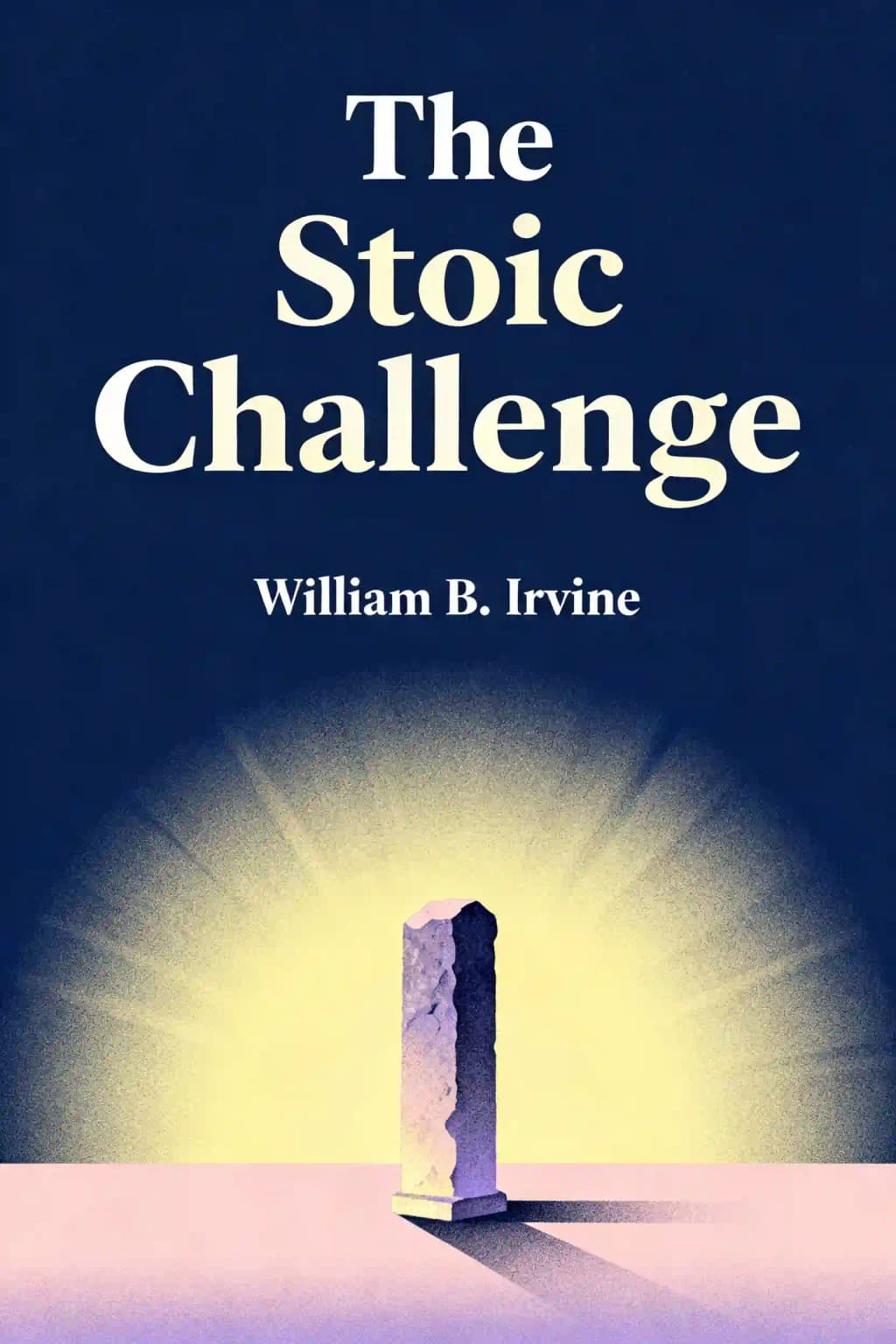
Stoic Challenge
A Philosopher's Guide to Becoming Tougher, Calmer, and More Resilient
Overview of Stoic Challenge
Transform life's setbacks into opportunities with "The Stoic Challenge" - your mental fitness program for resilience. Endorsed as "the ultimate mental fitness program" by Rework's co-author, this book blends ancient Stoic wisdom with modern psychology. What if your next crisis became your greatest teacher?

Key Themes in Stoic Challenge
- psychological reframing
- emotional resilience
- setback management
- anger prevention
- stoic equanimity
Quotes from Stoic Challenge
Anger is fundamentally incompatible with happiness.
No plague has cost the human race more than anger.
The difference lies not in what happens to us, but in how we choose to respond.
We're often responsible for many of our own setbacks through poor planning or bad choices.
Characters in Stoic Challenge
- William B. IrvineAuthor and philosopher who uses Stoic framing
- Neil ArmstrongAstronaut known for his extreme composure
- Bethany HamiltonProfessional surfer who overcame a shark attack
- Alison BothaSurvivor of a brutal attack and model of resilience
About the Author
About the Author of Stoic Challenge
William B. Irvine, author of The Stoic Challenge: A Philosopher’s Guide to Becoming Tougher, Calmer, and More Resilient, is a philosophy professor at Wright State University and a leading voice in modern Stoicism. Specializing in practical applications of ancient philosophy, Irvine’s work bridges academic rigor and accessible self-help, focusing on resilience, emotional mastery, and navigating life’s setbacks.
His bestselling A Guide to the Good Life: The Ancient Art of Stoic Joy helped catalyze the 21st-century Stoic revival, establishing him as a key interpreter of Stoic principles for contemporary audiences.
With a PhD from UCLA and eight books translated into over 20 languages, Irvine combines scholarly expertise with real-world relevance. His other works, including A Slap in the Face: Why Insults Hurt—And Why They Shouldn’t, explore human psychology through a Stoic lens. A frequent speaker on NPR and TEDx stages, Irvine also shares insights through his literary website and university lectures.
The Stoic Challenge continues his mission to equip readers with timeless strategies for mental toughness, drawing from both classical philosophy and modern behavioral science.
Download Summary of Stoic Challenge
Get the Stoic Challenge summary as a free PDF or EPUB. Print it or read offline anytime.
FAQs About This Book
The Stoic Challenge teaches readers to reframe adversity as opportunities for growth using Stoic philosophy. Irvine emphasizes techniques like the Stoic Test Strategy—viewing setbacks as intentional challenges to build resilience—and the framing effect to manage emotional responses. The book provides actionable steps to maintain inner tranquility through practices like negative visualization and toughness training, helping readers respond calmly to life’s obstacles.
This book is ideal for professionals, leaders, and anyone facing high-stress environments or personal setbacks. It’s particularly valuable for those interested in Stoicism, emotional control, or practical self-improvement strategies. Individuals dealing with chronic stress, career challenges, or health crises will find tools to transform adversity into resilience-building moments.
Yes, Irvine’s blend of ancient philosophy and modern psychology offers timeless strategies for mental resilience. Readers gain tools like reframing setbacks, anchoring techniques, and self-graded challenges to navigate stress. Its concise, actionable advice makes it a standout guide for anyone seeking to reduce frustration and cultivate calm in turbulent situations.
The strategy involves imagining setbacks as intentional tests from “Stoic gods” to strengthen resilience. By reframing obstacles this way, you bypass reactive emotions like anger, focus on solutions, and grade your response afterward. This mental shift helps maintain emotional stability and turns adversity into a game of resourcefulness.
Irvine uses the framing effect—a psychological phenomenon where perception shapes emotional response—to teach readers to reinterpret setbacks. For example, viewing a job loss as a chance to explore new paths (rather than a failure) reduces distress and fuels proactive problem-solving.
The book advises using the five-second rule: Pause immediately after a setback to invoke the Stoic Test reframe. This disrupts anger’s momentum, allowing time to choose a calm response. Irvine argues that avoiding anger preserves mental energy for constructive solutions.
Some may find the “Stoic gods” metaphor overly simplistic or dismissive of complex trauma. Others note that while reframing helps with minor setbacks, deeper psychological issues might require additional strategies beyond the book’s scope.
Unlike theoretical guides, Irvine focuses on practical daily applications, offering specific tools like toughness training and setback grading. It complements classics like Meditations by providing modern techniques for handling workplace stress, relationship conflicts, and personal crises.
Yes, Irvine’s strategies help professionals reframe deadlines, conflicts, or failures as tests of composure. For example, viewing a missed promotion as a chance to develop grit can reduce resentment and motivate skill-building. The book’s emphasis on solution-oriented thinking aligns with leadership and teamwork goals.
Toughness training involves voluntarily facing small adversities (e.g., cold showers or challenging tasks) to expand your comfort zone. By practicing resilience in controlled settings, you build confidence to handle unpredictable real-world setbacks with Stoic calm.
In an era of remote work, AI disruption, and global uncertainty, Irvine’s teachings on adaptability remain critical. The book’s focus on emotional agility and reframing unpredictability aligns with modern needs for mental health and career sustainability.
While not verbatim, central ideas include:
- “Setbacks are invitations to practice courage, not punishments.”
- “Your response to adversity defines its impact.”
- “Anchor your mind in gratitude to dissolve frustration.”
Parents can model reframing by treating challenges (e.g., a child’s tantrum) as tests of patience. Irvine’s self-grading technique encourages reflecting on reactions post-conflict, fostering emotional regulation that children emulate.