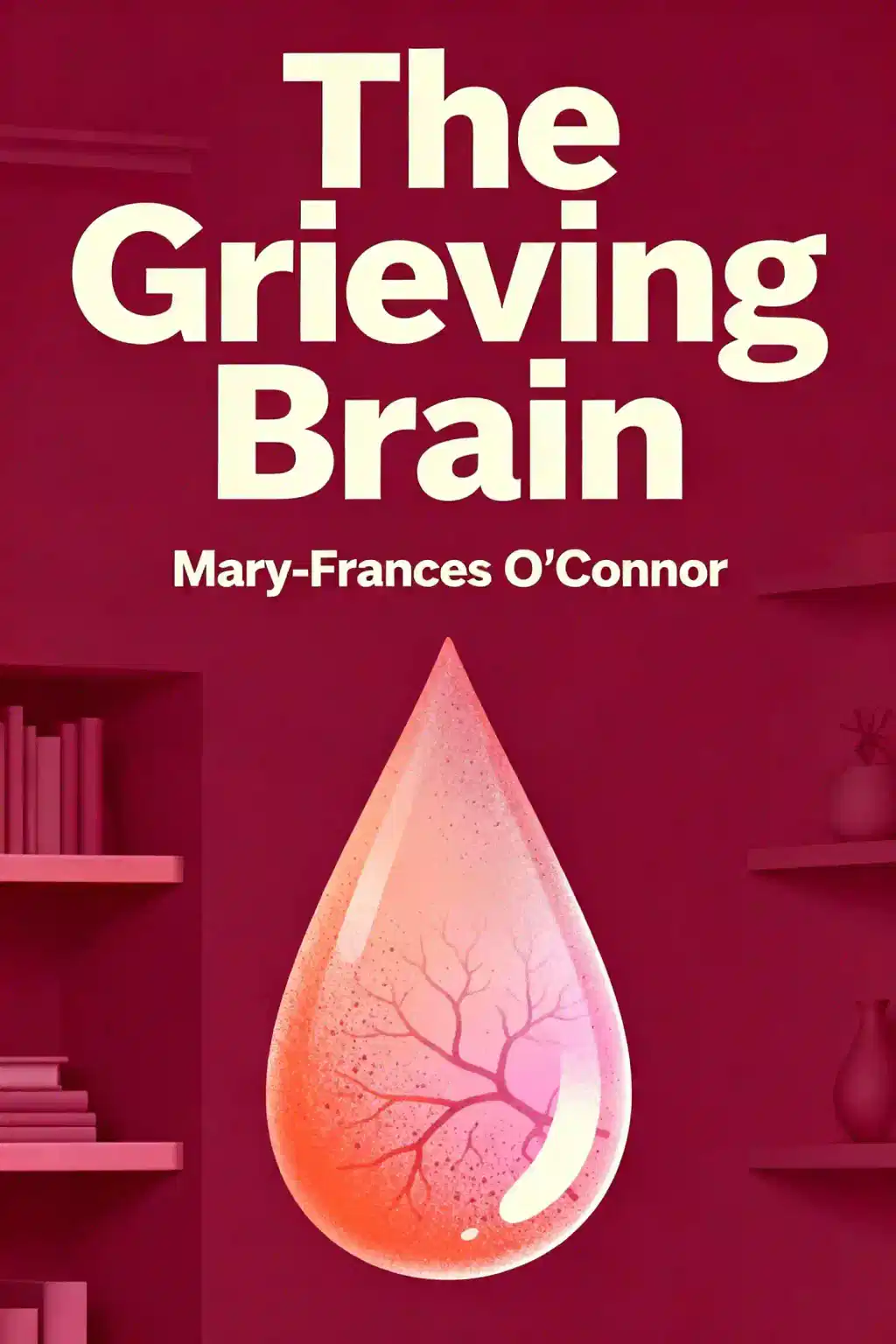
Grieving Brain
The Surprising Science of How We Learn from Love and Loss
Overview of Grieving Brain
Neuroscientist Mary-Frances O'Connor revolutionizes grief understanding by debunking the famous "Five Stages" model. Featured on Oprah's comfort book list, this NPR pick reveals why your brain struggles to process permanent loss - offering a scientific roadmap through our most universal human experience.

Key Themes in Grieving Brain
- neurobiology of loss
- attachment bond mapping
- spatial navigation of grief
- identity reconstruction after bereavement
- prediction error in mourning
Quotes from Grieving Brain
The brain cannot compute permanent absence.
Grieving isn't just psychological change-it requires neural rewiring.
Death resembles ghosting: our loved one has inexplicably stopped responding.
Our brains compute psychological closeness as overlap between self and other.
Why does permanent absence cause such devastation?
Characters in Grieving Brain
- Mary-Frances O'ConnorAuthor and neuroscientist studying grief
- Elisabeth Kubler-RossPsychiatrist known for her work on loss
About the Author
About the Author of Grieving Brain
Mary-Frances O'Connor, PhD, is the author of The Grieving Brain: The Surprising Science of How We Learn From Love and Loss and a leading psychologist specializing in the neuroscience of grief. Born in 1973 in Boulder, Colorado, she is a Professor of Clinical Psychology and Psychiatry at the University of Arizona, where she directs the Grief, Loss, and Social Stress (GLASS) Lab.
Her groundbreaking research includes conducting the first fMRI neuroimaging study of bereavement in 2003, revolutionizing our understanding of how the brain processes loss.
Dr. O'Connor's expertise is informed by both rigorous scientific training—including a postdoctoral fellowship at UCLA's Cousins Center for Psychoneuroimmunology—and personal experience with grief following her mother's death. She founded the Neurobiology of Grief International Network (NOGIN) in 2020 and has appeared on prominent platforms including the Huberman Lab podcast and TEDx.
Her follow-up book, The Grieving Body, explores how physical stress from loss can become an opportunity for healing. Dr. O'Connor's work bridges clinical psychology, neuroscience, and compassionate, research-backed guidance for those navigating loss.
Download Summary of Grieving Brain
Get the Grieving Brain summary as a free PDF or EPUB. Print it or read offline anytime.
FAQs About This Book
The Grieving Brain by Mary-Frances O'Connor explores the neuroscience behind grief and loss through groundbreaking research on how the brain processes bereavement. O'Connor explains how our brains become hardwired to expect loved ones' presence and why adapting to their absence is so challenging. The book reveals that grieving is a form of learning where the brain must update its mental map of the world to reflect the reality of loss.
Mary-Frances O'Connor is a Professor of Clinical Psychology and Psychiatry at the University of Arizona, where she directs the Grief, Loss and Social Stress (GLASS) Lab. She earned her PhD in clinical psychology from the University of Arizona and completed a postdoctoral fellowship in psychoneuroimmunology at UCLA. O'Connor conducted the first fMRI neuroimaging study of bereavement in 2003 and is a leading expert in complicated grief research.
The Grieving Brain is essential reading for anyone experiencing loss, grief counselors, mental health professionals, and individuals supporting grieving friends or family. The book is valuable for those seeking to understand why grief feels so overwhelming and takes so long. People dealing with complicated grief, unexpected loss, or struggling to accept a loved one's death will find O'Connor's neuroscience-based explanations reassuring and validating.
The Grieving Brain is worth reading for its unique scientific perspective that demystifies the grieving process through neuroscience research. The book was included on Oprah's list of Best Books to Comfort a Grieving Friend and offers evidence-based insights rather than platitudes. O'Connor's research helps mourners feel less lost by explaining that their experiences—like expecting the deceased to call or searching for their face—have neurological explanations and that healing is possible.
The virtual map concept in The Grieving Brain explains how our brains create mental representations of where our loved ones are located in space and time. Mary-Frances O'Connor describes how we live in two worlds simultaneously—the physical world and a virtual world in our minds. When someone dies, there's a painful mismatch between our brain's virtual map that expects to find them and the reality that they can no longer be found in physical dimensions.
Mary-Frances O'Connor distinguishes grief as the intense emotional response to loss—characterized by sadness, anger, yearning, and confusion—while grieving is the ongoing process of adaptation. Grief is the feeling; grieving is the learning process where the brain gradually rewires itself to accept the absence of a loved one. Understanding this distinction helps individuals recognize that while grief may never fully disappear, grieving evolves over time, allowing for healing and restoration of meaningful life.
The Grieving Brain explains that when we're constantly with loved ones, neurons fire and chemicals release in response to their presence, strengthening attachment bonds. After death, object-trace cells continue firing as the brain searches for the deceased, causing confusion and emotional pain. O'Connor reveals that grief activates brain regions associated with emotional pain similar to physical pain, and the adaptation process resembles withdrawal as the brain gradually stops producing certain chemicals and rewires neural pathways.
The continuing bonds theory in The Grieving Brain suggests that relationships with deceased loved ones don't end but evolve into new forms. Mary-Frances O'Connor explains that psychologists once believed maintaining connections with the deceased was unhealthy, but research now shows these bonds can be adaptive. The book addresses questions like "If my child has died, am I still a mother?" by affirming that the relationship changes but the bond remains, requiring a redefinition of self.
Grief takes so long because the brain must physically rewire itself to accept a loved one's permanent absence, according to Mary-Frances O'Connor. The neural pathways and chemical responses developed through constant presence don't disappear immediately. The brain slowly catches up with reality in a transition likened to withdrawal, where neurons must start firing in new ways. This neurological rewiring is emotionally draining and requires significant time to complete.
The Grieving Brain explains how mirror neurons contribute to our deep sense of empathy for others who are grieving. Mary-Frances O'Connor describes how these specialized brain cells help us understand and feel others' emotional pain. This neurological mechanism explains why witnessing someone else's grief can be so emotionally affecting and why communities often share in collective mourning, as our brains are wired to resonate with others' experiences of loss.
The Grieving Brain's key takeaways include understanding that grief is natural while grieving is adaptation, the brain uses virtual maps to navigate relationships, and resilience in grieving is possible. Mary-Frances O'Connor emphasizes that many people adapt well to loss and can restore meaningful lives. The book reveals that bewildering grief experiences—like expecting the deceased to return—have neurological explanations, which helps mourners feel validated rather than confused about their emotional responses.
The Grieving Brain helps with complicated grief by explaining the neurobiological mechanisms that make accepting loss difficult, providing validation for prolonged grief symptoms. Mary-Frances O'Connor's research on Prolonged Grief Disorder, newly included in DSM-5, offers frameworks for understanding when grief becomes clinically significant. The book guides readers toward creating a "new normal" by framing grieving as learning, helping individuals understand they have control over how their new chapter unfolds despite neurological challenges.