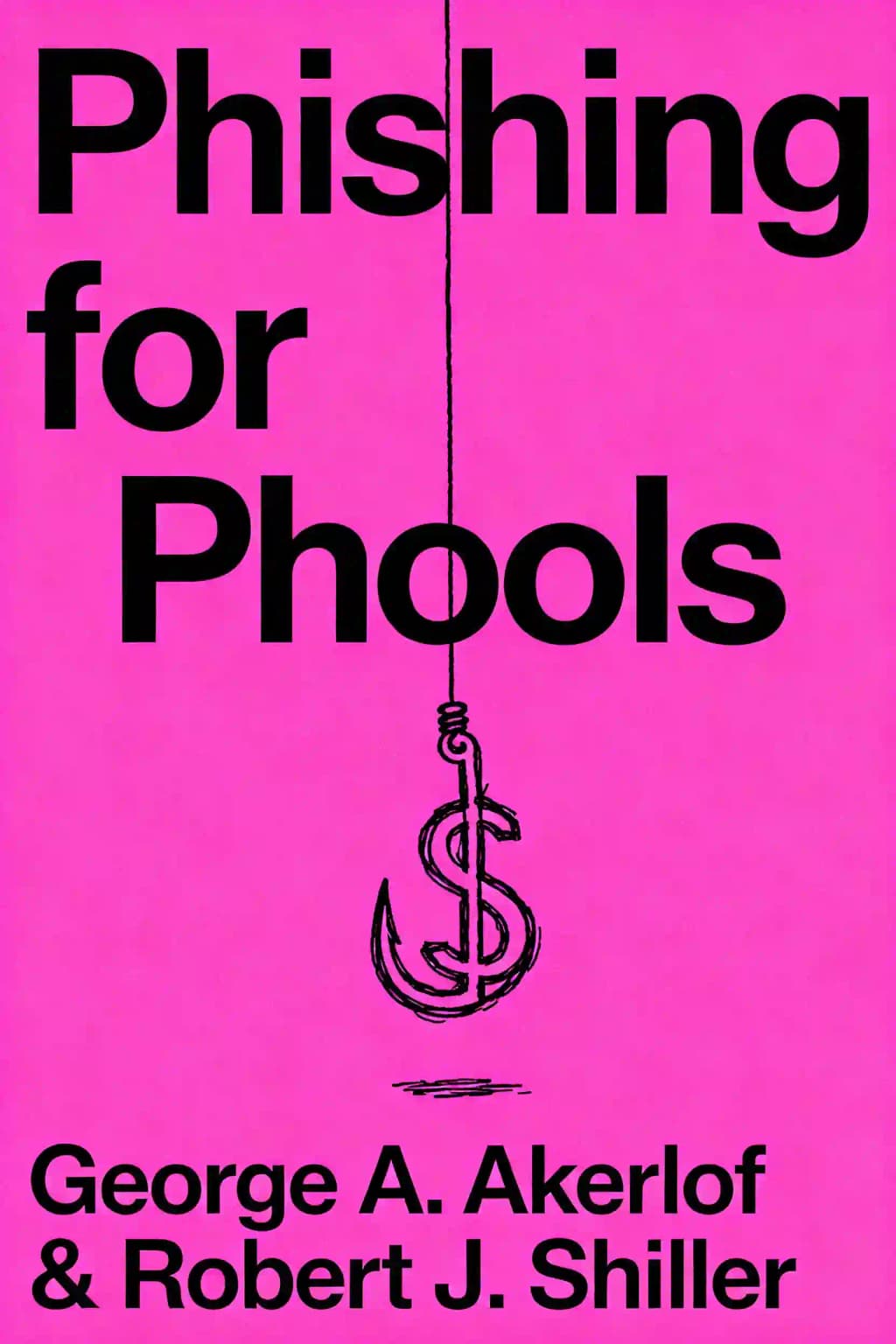
Phishing for Phools book cover

Phishing for Phools

George A. Akerlof & Robert J. Shiller
3.43 (2318 Reviews)

Overview of Phishing for Phools

Nobel Prize winners Akerlof and Shiller expose how free markets exploit our psychological weaknesses. Endorsed by economist Dani Rodrik as "fun but serious," this eye-opening work challenges Adam Smith's invisible hand theory. Discover why your rational choices might actually be carefully engineered traps.

Key Themes in Phishing for Phools

  • market manipulation
  • psychological vulnerability
  • consumer exploitation
  • behavioral economics
  • phishing equilibrium

Quotes from Phishing for Phools

  • Life Needs Frosting.

  • Free markets offer not just freedom to choose but freedom to phish.

Characters in Phishing for Phools

  • George A. AkerlofAuthor and Nobel Prize-winning economist
  • Robert J. ShillerAuthor and Nobel Prize-winning economist
  • Robert CialdiniSocial psychologist who identified vulnerabilities
  • Richard CialdiniCar salesman who used psychological scarcity
  • DellaVigna and MalmendierEconomists who studied health club contracts

About the Author

About the Author of Phishing for Phools

George A. Akerlof and Robert J. Shiller, Nobel Prize-winning economists and pioneers in behavioral economics, co-authored Phishing for Phools, a critical exploration of how psychological manipulation and asymmetric information distort modern markets.

Akerlof, a professor at Georgetown University and UC Berkeley, revolutionized economic theory with his seminal paper “The Market for ‘Lemons’” (2001 Nobel Prize), while Shiller, Sterling Professor of Economics at Yale University, is renowned for predicting the 2000 and 2008 financial crises and co-developing the Case-Shiller housing index. Their collaboration merges Akerlof’s work on information asymmetry with Shiller’s research on irrational market behavior, exposing systemic vulnerabilities to deceptive practices.

Akerlof’s earlier collaborations with Joseph Stiglitz and Shiller’s bestselling books like Irrational Exuberance and Narrative Economics further establish their authority in dissecting market psychology. Shiller’s New York Times “Economic View” column and Akerlof’s advisory roles in policymaking underscore their real-world impact.

Phishing for Phools builds on their shared legacy of challenging conventional economic models, offering a framework to understand manipulation in finance, politics, and advertising. The book has been widely cited in academic and policy circles, reflecting its relevance in an era of algorithmic targeting and misinformation.

Download Summary of Phishing for Phools

Get the Phishing for Phools summary as a free PDF or EPUB. Print it or read offline anytime.

FAQs About This Book

Phishing for Phools challenges the idea that free markets always benefit society, arguing they inherently enable manipulation through psychological tricks and deception. Nobel laureates George Akerlof and Robert Shiller use examples like predatory lending, misleading advertising, and harmful pharmaceuticals to show how businesses exploit cognitive biases, leading to financial crises and consumer harm.

This book suits economics students, policymakers, and general readers interested in market psychology. It’s valuable for those seeking to understand systemic risks in capitalism, ethical consumerism, or regulatory challenges. Critics of unchecked free markets will find its arguments particularly compelling.

Yes, for its accessible critique of market manipulation, though some ideas echo familiar economic critiques. The authors’ Nobel-winning credibility and real-world examples—like subprime mortgages and deceptive gym memberships—make it a thought-provoking read about modern consumer traps.

The term describes businesses exploiting emotional weaknesses or information gaps to sell harmful products. A “phool” is someone deceived by these tactics, such as buyers misled by hidden loan terms or patients prescribed unnecessary drugs.

They argue that profit-driven markets naturally incentivize firms to exploit cognitive biases, like overconfidence or addiction. Examples include car dealers emphasizing monthly payments over total cost and snack brands using addictive ingredients.

  • Cinnabon: Using scent marketing to lure impulse buyers.
  • Vioxx: Pharmaceutical companies downplaying drug risks.
  • Subprime mortgages: Banks hiding loan risks before the 2008 crash.

Critics argue it overlooks how technology (e.g., peer reviews, open data) reduces information asymmetry. The book also lacks concrete solutions beyond regulation, missing frameworks like Taleb’s Antifragility for resisting manipulation.

It frames the crisis as systemic phishing: banks exploited consumers’ trust and complexity bias to sell risky mortgages, leading to cascading defaults. This illustrates markets’ capacity for large-scale harm despite individual rationality.

  • “Markets harm as well as help us”: Highlights the duality of free markets.
  • “We are what we make of what people want to turn us into” (Sartre): Emphasizes how phishing shapes identities.

While Freakonomics explores hidden incentives, Phishing focuses on systemic deception. Akerlof and Shiller critique markets’ structural flaws, whereas Levitt and Dubner celebrate quirky decision-making.

The authors advocate skepticism toward “too good to be true” offers and support regulations limiting predatory practices. Peer-reviewed platforms (e.g., TripAdvisor) and transparency laws also mitigate phishing.

Its themes resonate in eras of algorithmic advertising, cryptocurrency scams, and AI-driven manipulation. The book warns that technological advances—like big data—intensify phishing risks unless balanced with consumer protections.

Explore Your Way of Learning

Phishing for Phools isn't just a book — it's a masterclass in Economics. To help you absorb its lessons in the way that works best for you, we offer five unique learning modes. Whether you're a deep thinker, a fast learner, or a story lover, there's a mode designed to fit your style.

Quick Summary Mode

Read or listen to Phishing for Phools Summary in 9 Minutes

Break down key ideas from Phishing for Phools into bite-sized takeaways to understand how innovative teams create, collaborate, and grow.

play
00:00
00:00

Fun Mode

Phishing for Phools Lessons Told Through 21-Min Stories

Experience Phishing for Phools through vivid storytelling that turns innovation lessons into moments you'll remember and apply.

play
00:00
00:00

Personalize Mode

Experience Phishing for Phools in your own learning style

Ask anything, choose your learning style, and co-create insights that truly resonate with you.

Personalize Mode

From Columbia University alumni built in San Francisco

BeFreed Brings Together A Global Community Of 1,000,000 Curious Minds

"Instead of endless scrolling, I just hit play on BeFreed. It saves me so much time."

@Moemenn
platform
star
star
star
star
star

"I never knew where to start with nonfiction—BeFreed’s book lists turned into podcasts gave me a clear path."

@Chloe, Solo founder, LA
platform
comments
12
likes
117

"Perfect balance between learning and entertainment. Finished ‘Thinking, Fast and Slow’ on my commute this week."

@Raaaaaachelw
platform
star
star
star
star
star

"Crazy how much I learned while walking the dog. BeFreed = small habits → big gains."

@Matt, YC alum
platform
comments
12
likes
108

"Reading used to feel like a chore. Now it’s just part of my lifestyle."

@Erin, Investment Banking Associate , NYC
platform
comments
254
likes
17

"Feels effortless compared to reading. I’ve finished 6 books this month already."

@djmikemoore
platform
star
star
star
star
star

"BeFreed turned my guilty doomscrolling into something that feels productive and inspiring."

@Pitiful
platform
comments
96
likes
4.5K

"BeFreed turned my commute into learning time. 20-min podcasts are perfect for finishing books I never had time for."

@SofiaP
platform
star
star
star
star
star

"BeFreed replaced my podcast queue. Imagine Spotify for books — that’s it. 🙌"

@Jaded_Falcon
platform
comments
201
thumbsUp
16

"It is great for me to learn something from the book without reading it."

@OojasSalunke
platform
star
star
star
star
star

"The themed book list podcasts help me connect ideas across authors—like a guided audio journey."

@Leo, Law Student, UPenn
platform
comments
37
likes
483

"Makes me feel smarter every time before going to work"

@Cashflowbubu
platform
star
star
star
star
star

"Instead of endless scrolling, I just hit play on BeFreed. It saves me so much time."

@Moemenn
platform
star
star
star
star
star

"I never knew where to start with nonfiction—BeFreed’s book lists turned into podcasts gave me a clear path."

@Chloe, Solo founder, LA
platform
comments
12
likes
117

"Perfect balance between learning and entertainment. Finished ‘Thinking, Fast and Slow’ on my commute this week."

@Raaaaaachelw
platform
star
star
star
star
star

"Crazy how much I learned while walking the dog. BeFreed = small habits → big gains."

@Matt, YC alum
platform
comments
12
likes
108

"Reading used to feel like a chore. Now it’s just part of my lifestyle."

@Erin, Investment Banking Associate , NYC
platform
comments
254
likes
17

"Feels effortless compared to reading. I’ve finished 6 books this month already."

@djmikemoore
platform
star
star
star
star
star

"BeFreed turned my guilty doomscrolling into something that feels productive and inspiring."

@Pitiful
platform
comments
96
likes
4.5K

"BeFreed turned my commute into learning time. 20-min podcasts are perfect for finishing books I never had time for."

@SofiaP
platform
star
star
star
star
star

"BeFreed replaced my podcast queue. Imagine Spotify for books — that’s it. 🙌"

@Jaded_Falcon
platform
comments
201
thumbsUp
16

"It is great for me to learn something from the book without reading it."

@OojasSalunke
platform
star
star
star
star
star

"The themed book list podcasts help me connect ideas across authors—like a guided audio journey."

@Leo, Law Student, UPenn
platform
comments
37
likes
483

"Makes me feel smarter every time before going to work"

@Cashflowbubu
platform
star
star
star
star
star

"Instead of endless scrolling, I just hit play on BeFreed. It saves me so much time."

@Moemenn
platform
star
star
star
star
star

"I never knew where to start with nonfiction—BeFreed’s book lists turned into podcasts gave me a clear path."

@Chloe, Solo founder, LA
platform
comments
12
likes
117

"Perfect balance between learning and entertainment. Finished ‘Thinking, Fast and Slow’ on my commute this week."

@Raaaaaachelw
platform
star
star
star
star
star

"Crazy how much I learned while walking the dog. BeFreed = small habits → big gains."

@Matt, YC alum
platform
comments
12
likes
108

"Reading used to feel like a chore. Now it’s just part of my lifestyle."

@Erin, Investment Banking Associate , NYC
platform
comments
254
likes
17

"Feels effortless compared to reading. I’ve finished 6 books this month already."

@djmikemoore
platform
star
star
star
star
star

"BeFreed turned my guilty doomscrolling into something that feels productive and inspiring."

@Pitiful
platform
comments
96
likes
4.5K

"BeFreed turned my commute into learning time. 20-min podcasts are perfect for finishing books I never had time for."

@SofiaP
platform
star
star
star
star
star

"BeFreed replaced my podcast queue. Imagine Spotify for books — that’s it. 🙌"

@Jaded_Falcon
platform
comments
201
thumbsUp
16

"It is great for me to learn something from the book without reading it."

@OojasSalunke
platform
star
star
star
star
star

"The themed book list podcasts help me connect ideas across authors—like a guided audio journey."

@Leo, Law Student, UPenn
platform
comments
37
likes
483

"Makes me feel smarter every time before going to work"

@Cashflowbubu
platform
star
star
star
star
star

See More Stories?

How people are talking about BeFreed across the web
1.5K Ratings4.7
Start your learning journey, now