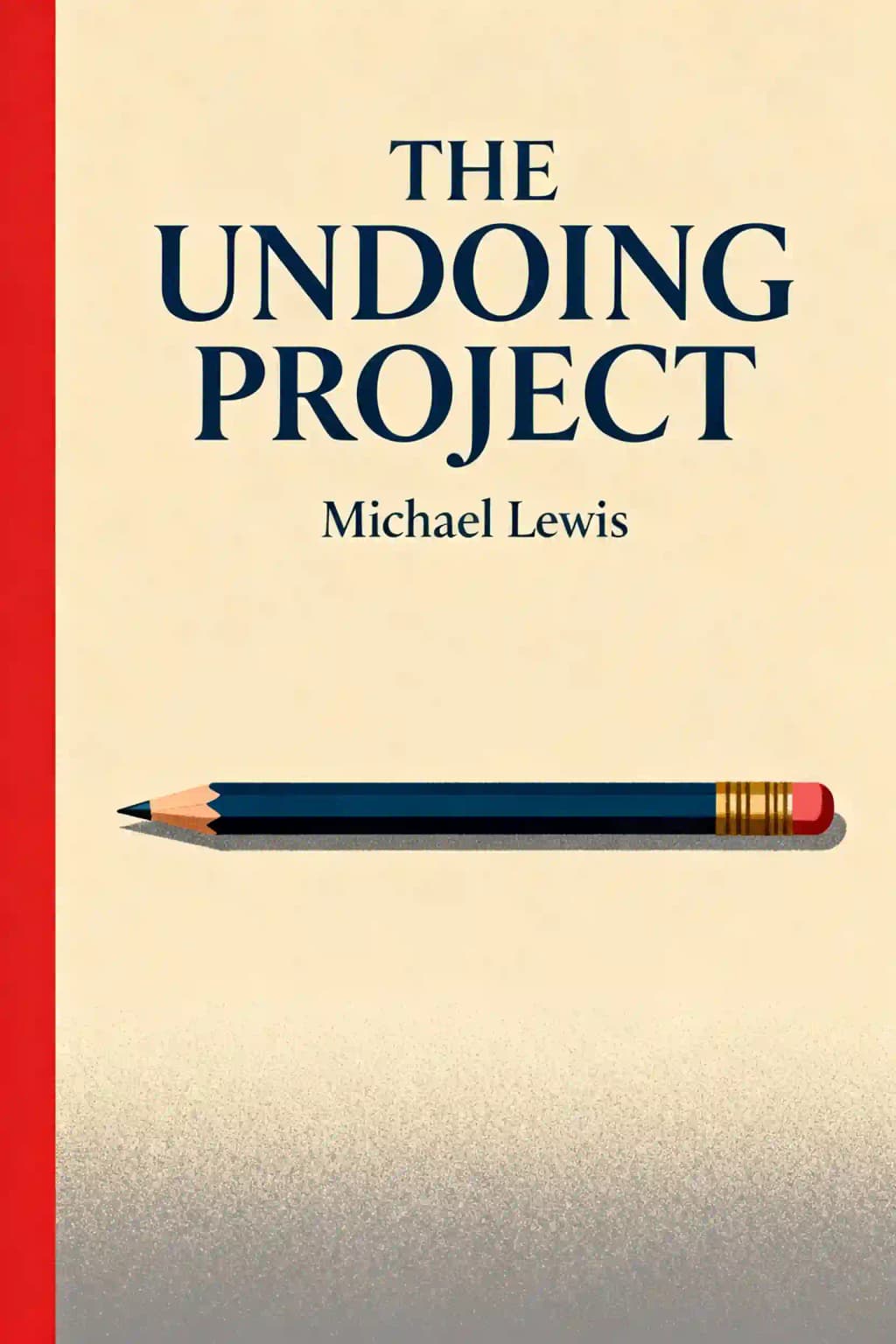
Undoing Project
A Friendship That Changed the World
『Undoing Project』の概要
Explore how two brilliant psychologists revolutionized our understanding of decision-making. Kahneman and Tversky's unlikely friendship changed economics, medicine, and data science forever. Even Houston Rockets GM Daryl Morey applies their insights - why do we trust algorithms over human intuition now?

『Undoing Project』の主要テーマ
- cognitive bias
- heuristic decision making
- intellectual collaboration
- behavioral economics
- human irrationality
『Undoing Project』の名言
Knowledge is literally prediction.
People were endlessly complicated and interesting.
I didn't want to be hunted.
Life as a series of coincidences.
His defining emotion is doubt.
『Undoing Project』の登場人物
- Amos TverskyIsraeli psychologist and Kahneman's collaborator
- Daryl MoreyGeneral manager of the Houston Rockets
- Michael LewisAuthor and narrator of the book
著者について
『Undoing Project』の著者について
Michael Monroe Lewis is the bestselling author of The Undoing Project and a renowned financial journalist celebrated for dissecting complex systems and human behavior.
Born in New Orleans in 1960, Lewis holds a Princeton art history degree and a London School of Economics master’s. He later worked as a Wall Street bond trader—an experience that fueled his debut exposé, Liar’s Poker.
The Undoing Project, a deep dive into the groundbreaking friendship between psychologists Daniel Kahneman and Amos Tversky, reflects Lewis’s signature blend of narrative-driven nonfiction and behavioral economics. His other works, including Moneyball (sports analytics), The Big Short (financial crisis), and The Blind Side (adapted into an Oscar-winning film), demonstrate his ability to transform niche subjects into cultural touchstones.
A longtime Vanity Fair contributor, Lewis’s books have collectively sold millions and inspired multiple award-winning adaptations, cementing his status as a master storyteller of modern finance and psychology.
Undoing Projectの要約をダウンロード
Undoing Projectの要約をPDFまたはEPUBで無料でダウンロード。印刷やオフラインでいつでもお読みいただけます。
この本に関するよくある質問
The Undoing Project explores the groundbreaking collaboration between psychologists Daniel Kahneman and Amos Tversky, whose research revolutionized our understanding of human decision-making. Their work uncovered systematic cognitive biases, such as the availability heuristic and prospect theory, challenging the assumption of human rationality in economics. The book intertwines their personal friendship with their scientific achievements, offering insights into how their partnership reshaped psychology, economics, and behavioral science.
This book is ideal for readers interested in psychology, behavioral economics, or the dynamics of intellectual partnerships. Fans of Michael Lewis’s narrative nonfiction (like Moneyball or The Big Short) will appreciate his engaging storytelling. Professionals in finance, policy, or any field requiring decision-making analysis will find actionable insights into cognitive biases.
Yes—it combines rigorous science with a compelling human story. Lewis vividly portrays Kahneman and Tversky’s friendship while explaining complex concepts like loss aversion and anchoring bias. The book’s exploration of irrational decision-making remains highly relevant to understanding modern behavioral economics and personal choice.
Prospect theory, developed by Kahneman and Tversky, explains how people evaluate risks and rewards asymmetrically. It shows that humans fear losses more than they value gains (loss aversion) and make decisions based on relative outcomes rather than absolute ones. This theory overturned traditional economic models that assumed rational decision-making, earning Kahneman a Nobel Prize.
Their partnership blended Kahneman’s introspective depth with Tversky’s bold creativity. Despite differing personalities, they challenged each other’s ideas through relentless debate, leading to breakthroughs like the “heuristics and biases” framework. Their collaboration demonstrates how intellectual synergy can drive innovation, though their eventual estrangement highlights the fragility of such partnerships.
- Cognitive biases: Humans rely on mental shortcuts (heuristics) prone to systematic errors.
- Loss aversion: Fear of losses outweighs potential gains, skewing decisions.
- Counterfactual thinking: People imagine alternative outcomes, fueling emotions like regret.
- Collaboration dynamics: Diverse perspectives can catalyze groundbreaking ideas.
The “undoing” refers to the mind’s tendency to imagine alternative realities to cope with regret or frustration. Kahneman found that people mentally “undo” traumatic events by envisioning how actions could have led to better outcomes. This concept explains why near-misses (e.g., almost winning a lottery) haunt us more than clear failures.
Kahneman and Tversky’s research laid the foundation for behavioral economics by proving that humans deviate predictably from rational decision-making. Their work influenced fields like finance and public policy, demonstrating that market inefficiencies stem from ingrained psychological biases rather than random errors.
Some critics argue the book prioritizes biographical drama over deep scientific analysis. A minor critique notes Lewis’s occasional focus on tangential figures (e.g., NBA analyst Daryl Morey) detracts from the central narrative. However, most praise its accessibility in explaining complex ideas.
- “Reality is a cloud of possibility, not a point”: Highlights how the mind constructs alternative scenarios.
- “Error wasn’t merely instructive; it was the key”: Emphasizes studying mistakes to understand cognition.
- “The quicker you let go…”: Underscores adapting to change, a theme in their bias research.
While Kahneman’s Thinking, Fast and Slow delves deeper into cognitive psychology, The Undoing Project focuses on the human story behind the science. Lewis’s book offers a narrative-driven complement to Kahneman’s academic work, making their theories accessible to a broader audience.
- Question biases: Recognize heuristics like anchoring or overconfidence.
- Embrace uncertainty: Accept that perfect rationality is unattainable.
- Reframe losses: Weigh risks by considering potential regrets.