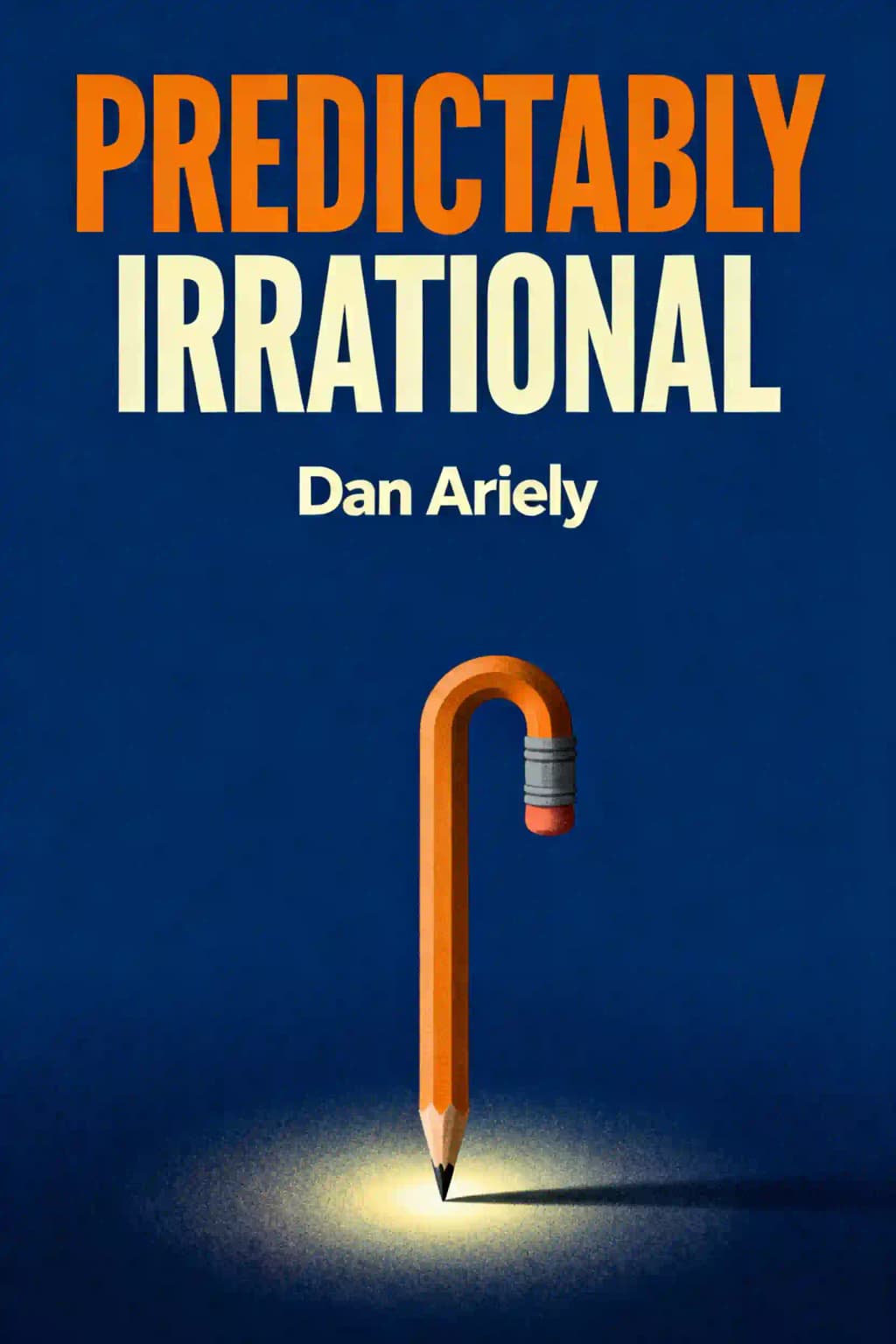
Why are we so predictably irrational? Dan Ariely's groundbreaking bestseller reveals how hidden psychological forces sabotage our decision-making. Endorsed by Charles Schwab, this mind-bending exploration has transformed business strategies worldwide. Discover why your brain's systematic biases might be costing you money every day.
著者の声を通じて本を感じる
知識を魅力的で例が豊富な洞察に変換
キーアイデアを瞬時にキャプチャして素早く学習
楽しく魅力的な方法で本を楽しむ
Have you ever driven across town to save $7 on a $25 pen, but wouldn't do the same to save $7 on a $455 suit? Or found yourself unable to resist a "Buy One Get One Free" offer even when you didn't need two items? These aren't random quirks - they're predictable patterns of irrationality that shape our decisions every day. Following a devastating accident where 70% of my body suffered third-degree burns, I gained an outsider perspective that made me question human behaviors I'd previously taken for granted. This tragedy sparked my journey into behavioral economics - the study of how we consistently make predictable errors in judgment that shape our decisions as consumers, businesspeople, and policymakers. What I discovered was both humbling and enlightening: our irrationality isn't random - it's systematic, repeatable, and most importantly, predictable. We rarely evaluate things in absolute terms. Instead, we judge options by comparing them to alternatives - a principle that marketers exploit brilliantly. Consider the Economist's peculiar subscription offer: an Internet-only subscription for $59, a print-only for $125, and a print-and-Internet combination also for $125. When I tested this on MIT students, 84% chose the combination package. But when I removed the useless print-only "decoy," only 32% chose the combination package. Nothing rational had changed, yet preferences dramatically shifted. This same principle appears everywhere in our lives. Williams-Sonoma boosted sales of their $275 bread maker by introducing a more expensive model that made the original seem like a bargain. The relativity trap extends beyond consumer choices to our very happiness. We constantly compare our salaries and achievements to others, which explains why publishing executive compensation led to skyrocketing CEO salaries - everyone suddenly felt underpaid compared to their peers. To fight this tendency, we must consciously choose smaller "circles" that boost our relative happiness rather than comparing ourselves to those who have more.
『Predictably Irrational』の核心的なアイデアを分かりやすいポイントに分解し、革新的なチームがどのように創造、協力、成長するかを理解します。
『Predictably Irrational』を素早い記憶のヒントに凝縮し、率直さ、チームワーク、創造的な回復力の主要原則を強調します。

鮮やかなストーリーテリングを通じて『Predictably Irrational』を体験し、イノベーションのレッスンを記憶に残り、応用できる瞬間に変えます。
何でも質問し、声を選び、本当にあなたに響く洞察を一緒に作り出しましょう。

"Instead of endless scrolling, I just hit play on BeFreed. It saves me so much time."
"I never knew where to start with nonfiction—BeFreed’s book lists turned into podcasts gave me a clear path."
"Perfect balance between learning and entertainment. Finished ‘Thinking, Fast and Slow’ on my commute this week."
"Crazy how much I learned while walking the dog. BeFreed = small habits → big gains."
"Reading used to feel like a chore. Now it’s just part of my lifestyle."
"Feels effortless compared to reading. I’ve finished 6 books this month already."
"BeFreed turned my guilty doomscrolling into something that feels productive and inspiring."
"BeFreed turned my commute into learning time. 20-min podcasts are perfect for finishing books I never had time for."
"BeFreed replaced my podcast queue. Imagine Spotify for books — that’s it. 🙌"
"It is great for me to learn something from the book without reading it."
"The themed book list podcasts help me connect ideas across authors—like a guided audio journey."
"Makes me feel smarter every time before going to work"

Predictably Irrationalの要約をPDFまたはEPUBで無料でダウンロード。印刷やオフラインでいつでもお読みいただけます。