第1章
The Attention Economy's Relentless Evolution
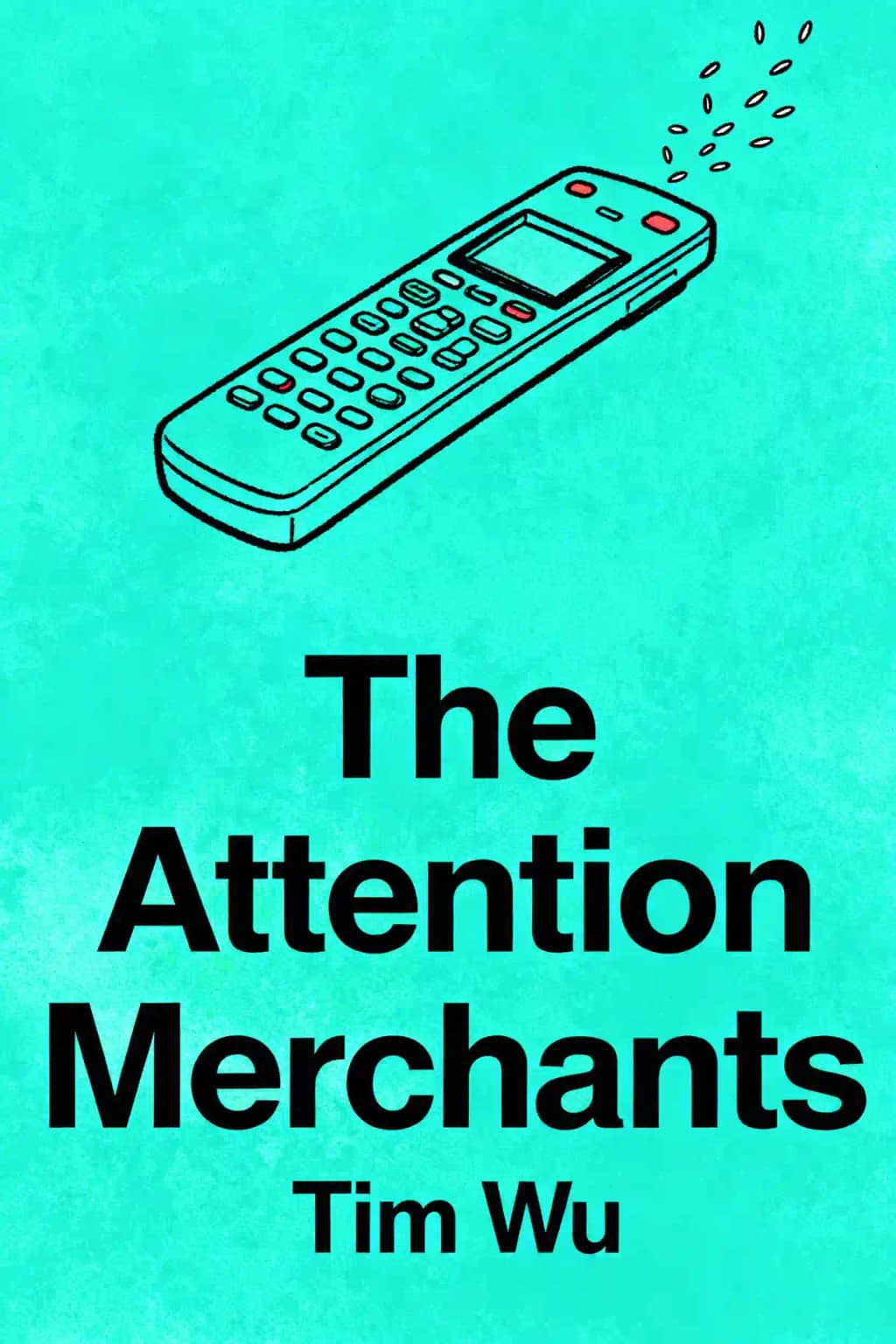
In a world where the average American now spends over 11 hours daily consuming media, Tim Wu's "The Attention Merchants" arrives as a crucial examination of how our most precious resource-our attention-became the primary commodity of the modern age. The book has earned praise from figures ranging from Arianna Huffington to Noam Chomsky, who called it "essential reading for anyone concerned about the operation of power and personal autonomy in the digital age." Since its 2016 publication, Wu's analysis has only grown more relevant, with tech executives like Tristan Harris citing the book as foundational to the "humane technology" movement. Wu, who coined the term "net neutrality" and served as special adviser to the New York State Attorney General, traces how industries evolved from simply selling products to harvesting and monetizing human attention itself-a transformation that has fundamentally altered our society, politics, and individual psychology.
第2章
The Birth of the Attention Economy
The attention economy began with a seemingly simple innovation in 1833. Benjamin Day, publisher of the New York Sun, introduced a revolutionary business model: sell newspapers below production cost to build massive readership, then sell access to those readers' attention to advertisers. This "penny press" strategy transformed newspapers from subscription-based publications into attention-harvesting machines.
Day's competitors quickly followed suit, leading to a fundamental dynamic that would define attention industries forever: under competitive pressure, content naturally gravitates toward the more sensational, lurid, and outrageous. The Sun abandoned journalistic ethics entirely, publishing fantastical stories about lunar discoveries of "man-bats" and unicorns on the moon. These fabrications worked spectacularly-the Sun's circulation reached 19,360, making it the world's most widely read newspaper.
This race to the bottom revealed how attention merchants naturally exploit our "automatic" rather than "controlled" attention. Our brains evolved to notice movement, bright colors, sexual imagery, and potential threats-precisely what advertisers learned to deploy. As attention industries matured, they became increasingly sophisticated at triggering these automatic responses.
By the late 1860s, Jules Cheret transformed advertising with his revolutionary Parisian posters-seven-foot-high, vibrant creations featuring beautiful, half-dressed women that were "luminous, brilliant, even blinding." These posters exploited fundamental aspects of human attention, catching viewers during "in-between" moments when attention wanders.
The poster craze soon overwhelmed Paris, prompting the Society for the Protection of the Landscape to condemn the "ugly poster" as destroying the city's beauty. Behind aesthetic objections lay deeper concerns about exploiting human attention without consent. Paris authorities eventually restricted poster placement-limits that still exist today, helping preserve the city's beauty while establishing one of the first examples of "attentional zoning."
What's striking about this early history is how quickly commercialization invaded previously sacred spaces. Before the nineteenth century, human attention remained largely untapped as a commercial resource. Religion stood as the primary claimant on human attention for centuries. Early Christians like Clement of Alexandria idealized "ceaseless prayer," while desert monastics maintained "a ceaseless vigil of prayer." Though organized religion weathered the Enlightenment, it would prove vulnerable to commercial rivals for human attention over the twentieth century, with faith declining most rapidly in the twenty-first century. Attention being ultimately zero-sum, these new commercial claimants offering "strange gods of their own" contributed significantly to religion's decline.
第3章
Propaganda and the Science of Persuasion
The techniques of mass attention capture reached new heights during World War I. In August 1914, Lord Herbert Kitchener faced the daunting task of raising a volunteer army for Britain as war with Germany loomed. He conceived an unprecedented direct appeal to the British public-launching what historians would later call "the first systematic propaganda campaign directed at the civilian population."
The concept of government advertising was revolutionary in 1914-an idea that would have seemed "repellent" to the general public before the war. Kitchener leveraged his celebrity status to launch recruitment drives through newspaper appeals and posters across the nation. His famous poster pointing directly at viewers with the caption "Your country needs YOU" proved nearly impossible to ignore.
When initial enthusiasm waned, Britain established a Parliamentary Recruiting Committee to run a permanent information campaign, blanketing the country with nearly 12.5 million posters by 1916. Though ultimately conscription would be needed, Kitchener's campaign was historically successful, persuading about half of Britain's military-aged men to voluntarily enlist by late 1915, despite the roughly 50% chance of death or injury.
When America entered the war in 1917, it borrowed British propaganda techniques but executed them on a vastly larger scale. The Committee on Public Information produced unprecedented volumes of propaganda through every medium-printing 75 million publications, organizing 75,000 "Four Minute Men" who delivered over 755,000 speeches reaching 134 million people, and producing propaganda films like "Pershing's Crusaders" and the wildly successful "The Kaiser, the Beast of Berlin."
The outlandish success of these propaganda campaigns set a new standard for public opinion manipulation, leaving a profound mark on the century to follow. Those who witnessed its power reacted in starkly different ways. Walter Lippmann, who had worked for the Creel Committee, became deeply cynical about democracy, arguing that public consent had been "manufactured" through simple stereotypes. Meanwhile, Sigmund Freud's nephew Edward Bernays saw propaganda's success as an opportunity, becoming the self-described "father of public relations" by applying wartime propaganda techniques to commercial interests.
Even the war's losers took note. Adolf Hitler, while imprisoned, praised British propaganda as "marvelous" for its simple presentation of "negative and positive notions of love and hatred," while criticizing German efforts as mere "pacifistic dishwater." The Nazis would later perfect these techniques, reaching unprecedented levels of influence over an entire population. On March 17, 1935, Hitler's voice reached an estimated 70% of German households-some 56 million people-as he announced military conscription. Joseph Goebbels declared German radio the "towering herald of National Socialism," capable of creating "one public opinion" and destroying "the spirit of rebellion."
第4章
The Golden Age of Advertising
The aftermath of World War I witnessed advertising's dramatic rehabilitation and explosive growth. Once derided as the domain of charlatans, advertising was now "the cornerstone of the most respectable American institutions." Between 1918 and 1920, industry revenue doubled; by 1930, it had increased tenfold as businesses recognized the profit potential in accessing the public mind.
Claude C. Hopkins, a former patent medicine pitchman now reinvented as an influential copywriter, captured this new confidence in his 1923 manifesto "Scientific Advertising," declaring that advertising had "reached the status of a science" where "every course is charted." Despite his unimpressive appearance-round spectacles, boutonniere, and slight lisp-Hopkins had become the creative wizard who could transform unknown products into bestsellers.
The 1920s saw the rise of large, big-city advertising agencies that functioned as private laboratories of attention capture. "Scientific advertising" consisted of three basic approaches: "demand engineering" (creating desire for previously unwanted products), "branding" (fostering loyalty by creating the impression that a product was unique), and targeted advertisements aimed at the increasingly important female consumer.
Demand engineering relied on creating awareness of problems people didn't know they had. Listerine transformed from a battlefield disinfectant and floor cleaner into a cure for "halitosis"-a clinical-sounding term for bad breath that played on social anxieties. Between 1922 and 1929, Listerine's annual earnings skyrocketed from $115,000 to over $8 million.
While Freudian influence is often cited in early advertising, leading firms actually embraced behavioral psychology. J. Walter Thompson's president Stanley Resor hired John B. Watson, author of the Behaviorist Manifesto, who believed humans could be conditioned like animals to respond predictably to stimuli. As Watson bluntly stated: "To make your consumer react, it is only necessary to confront him with either fundamental or conditioned emotional stimuli."
By 1928, Claude Hopkins declared advertising had reached its "end of history," with principles "as enduring as the Alps." American advertising spending skyrocketed from $700 million in 1914 to nearly $30 billion by 1929-about 3% of GDP. Advertising now saw itself as capitalism's priestly class, with President Coolidge declaring it "ministers to the spiritual side of trade." Many copywriters came from religious backgrounds, with Bruce Barton's 1925 bestseller even depicting Jesus as "an early advertising man."
第5章
Broadcasting and the Invasion of Private Space
In 1928, Walter Templin, Pepsodent's new general manager, desperately sought ideas to save the failing company. Despite once dominating the toothpaste market through Claude Hopkins's brilliant "film" campaign, Pepsodent was collapsing. Templin, a former radio set manufacturer, had a revolutionary idea after hearing "Amos 'n' Andy," a serial comedy featuring two white actors speaking in "Negro" voices. He noticed how the entire household stopped everything to listen attentively.
Despite industry resistance, Templin secured a million-dollar deal for NBC's first sponsored serial program. The show became radio's first bona fide hit, attracting an unprecedented 40 million nightly listeners. This success transformed broadcasting by merging entertainment with advertising, creating the model for selling "eyeballs" that would define commercial media. Pepsodent's sales doubled between 1929-1930.
Most momentously, "Amos 'n' Andy" demonstrated that an industry could "own" part of the day-7-8 p.m.-and breach the barrier between public and private space. Broadcasters soon colonized other time slots with daytime soap operas targeting women at home. These shows seamlessly integrated product promotion, with trusted characters testifying about products during episodes.
William S. Paley, CBS's president and chairman, transformed broadcasting with a revolutionary business model in 1928. He offered independent radio stations all of CBS's sustaining content for free-provided they carried sponsored content as well, for which they would be paid. Within three months, he shocked the industry by signing twenty-five new affiliates, making CBS larger than either of NBC's networks.
Paley grasped the attention merchant's business better than his chief rival, David Sarnoff of NBC and RCA. While Sarnoff viewed broadcasting as "pipes" and focused on technology, Paley understood that amassing audiences through compelling programming was the key to profitability. CBS aggressively marketed radio's persuasive power to advertisers, claiming it presented "the living voice of authority" with the "supple power to move people and mold them."
Television's adoption was remarkably swift-from 9% of homes in 1950 to 72% by 1956-with Americans soon watching nearly five hours daily. Early television viewing was an immersive, silent experience, with families sitting in darkened rooms, completely absorbed. This represented a new frontier in attention capture.
By the mid-1950s, television marked unprecedented attention capture through homogeneous programming consumed by most Americans simultaneously. Unlike state propaganda, television was voluntary and commercial, with shows like "I Love Lucy" serving as bait for the real persuasion vehicle: the television commercial.
American advertising experienced a golden age in the 1950s, with spending quadrupling from $1.3 billion to $6 billion. Rosser Reeves pioneered television advertising with his "unique selling proposition" approach, while Leo Burnett mastered brand mascots like the transformed Marlboro Man, whose campaign increased sales by 3,000 percent in just one year.
第6章
Resistance and Rebellion
The late 1950s saw the first significant resistance to television's dominance. Commander E. F. McDonald Jr., Zenith Radio Company's eccentric chief executive, detected growing consumer frustration with television commercials and tasked his engineers to create what would become the first remote control. The Flash-Matic, shaped like a snub-nosed revolver, allowed viewers to "shoot-out" ads by muting the volume. Though technologically primitive, this invention represented the first tool in a brewing resistance against the "industrialized harvest of attention."
Meanwhile, Vance Packard's bestseller "The Hidden Persuaders" exposed advertising's psychological manipulation techniques, particularly through figures like Ernest Dichter who conducted experiments on children to develop more effective commercials. The book awakened public consciousness to advertising's hidden influence.
The 1960s revolution promised a future where minds would attend to non-commercial realities-nature, spirituality, relationships-rather than manufactured desires. In spring 1966, Timothy Leary met Marshall McLuhan at New York's Plaza Hotel to discuss spreading his ideas about an attentional revolution. McLuhan gave Leary counterintuitive advice: "You call yourself a philosopher, a reformer. But the key to your work is advertising." This inspired Leary, who realized "successful philosophers were also advertisers who could sell their new models of the universe."
Shortly after, at the 1967 "Human Be-In" in Golden Gate Park, Leary unveiled his famous slogan: "Turn On, Tune In, Drop Out." The phrase became the counterculture's motto, essentially calling people to pay attention to where their attention was paid. While some misinterpreted it as simply "get stoned and abandon all constructive activity," many understood its deeper meaning aligned with philosopher Herbert Marcuse's concept of the "Great Refusal"-rejecting mass media manipulation and seeking liberation from all forms of repression.
While some followed Timothy Leary's advice to "drop out" entirely, and public broadcasting emerged as an alternative, the revolt ultimately failed because most people simply never stopped watching television. The attention merchants calibrated an effective response, recognizing that what people truly desired was individuality and self-expression-desires that could be channeled into consumption. As one executive noted in 1971, young people were "in the peak acquisitive years" with unprecedented spending power.
第7章
The Digital Revolution
By 1991, when 33-year-old Steve Case became CEO of AOL, four companies (CompuServe, Prodigy, AOL, and GEnie) were competing to get Americans to spend leisure time on "online computer networks"-no easy sell in an era when computers were unwieldy boxes with small screens displaying orange or green text.
Unable to match Prodigy's spending, Case's AOL bet on "electronic community"-letting users entertain themselves through communication tools. AOL's designers created a friendly, comforting environment where isolated individuals could connect. Their chat rooms, particularly the "private rooms" hosting up to 23 strangers, developed a reputation for excitement and transgression.
Email proved AOL's most important feature, with Case's team recognizing and encouraging its habit-forming properties. Unlike Prodigy, which charged users sending more than thirty emails monthly, AOL offered unlimited emails. Their interface centered on the application with the now-famous "You've got mail" greeting and whimsical mailbox image.
In 1993, AOL began mailing promotional floppy disks offering free trial memberships, achieving an extraordinary 10% response rate. The campaign expanded to CDs, with AOL's logo appearing on 50% of CDs produced worldwide by the mid-90s. According to marketing chief Jan Brandt, "We were logging in new subscribers at the rate of one every six seconds."
AOL had discovered something profound-that the greatest allure of computer networks was social interaction. This was revolutionary: while traditional content had always been the basis for capturing attention, AOL proved that representations of friends, acquaintances, and potential new connections could be equally compelling. This breakthrough revealed how incomplete the conquest of human attention had been from the 1910s through 1960s-the domain of interpersonal relationships had remained untouched by commercialization until now.
In 1996, Microsoft dominated the tech world as the most valuable company with billions in profits from Windows and Office software. CEO Bill Gates surprised many by publishing "Content Is King," prophesying that Internet content would be where "real money will be made," similar to broadcasting. Despite massive investments in content initiatives, most ventures failed spectacularly. Microsoft couldn't grasp that the Internet wasn't merely a new broadcast channel but something fundamentally different.
As Microsoft faltered, Google emerged with superior search capabilities but lacked a business model. Despite Larry Page's initial aversion to advertising-funded search engines, which he believed would be "inherently biased toward advertisers," financial reality pushed Google toward the advertising path.
Google's AdWords solution turned conventional attention merchant wisdom upside down. Instead of bombarding users with as many ads as possible, they showed relevant text-only advertisements exclusively when users expressed commercial intent through specific searches. Each ad received a "quality score" based on click rates, ensuring only relevant, popular ads appeared. This surgical approach meant many searches showed no ads at all.
The system proved wildly successful. Advertisers finally had metrics showing direct links between ads and purchases, with users being advertised to at moments close to purchase decisions. Money poured in by the billions, making Google the most profitable attention merchant in history.
第8章
The Social Media Revolution
In 2004, as Facebook launched at Harvard, it was merely the latest entrant in an already crowded "social networking" field dominated by platforms like Myspace and Friendster. What distinguished Facebook was its campus-based strategy-rather than forcing users to find their cohort among strangers, it recreated existing bounded social communities where connections already existed. The site immediately captivated students, who found validation in quantifying their friendships and social connections. As one Stanford newspaper noted: "Nothing validates your social existence like the knowledge that someone else has approved you." This insight into human psychology would prove crucial to Facebook's explosive growth.
While ostensibly about connection, Facebook's true allure was offering users an augmented representation of themselves-not as they were, but at their contrived best, with hundreds of friends, carefully curated photos, and selective life updates. This digital self-presentation became a form of personal brand management, with users crafting idealized versions of their lives. Zuckerberg demonstrated remarkable restraint in the early days, avoiding advertising that might degrade the experience. He famously rejected a $1 million offer from Sprite to turn the site green for a day, and turned down numerous other lucrative advertising proposals to maintain the platform's integrity.
By 2012, Facebook had accumulated 845 million monthly active users and announced its IPO, marking a watershed moment in digital history. Though it possessed unprecedented user data allowing advertisers to "nanotarget" specific demographics down to interests, behaviors, and social connections, Facebook faced significant challenges monetizing this attention compared to Google's search-based advertising model. Despite generating twice the pageviews, Facebook earned roughly one-tenth the revenue, highlighting the complexity of social media monetization.
Facebook had created a grand bargain with its users, offering access to "friends" in exchange for detailed demographic data and exposure to targeted advertising. Unlike traditional attention merchants who offered clear value (newspapers provided reporting, CBS offered shows like I Love Lucy), Facebook ingeniously turned users into "renters" improving their landlord's property by constantly updating profiles, sharing content, and expanding their networks. This user-generated content model created a self-sustaining ecosystem where users simultaneously consumed and produced content.
In the early 2000s, a curious new habit emerged on American streets-business professionals obsessively checking small devices, typing urgently with their thumbs. This behavior originated with Research in Motion's "BlackBerry," initially marketed to corporations as a mobile email device. The BlackBerry's success demonstrated an insatiable appetite for mobile connectivity, creating what would become known as "CrackBerry" addiction. While BlackBerry pioneered this frontier, Apple and Google would ultimately dominate it with iPhones and Androids, transforming what began as an elite corporate tool into a universal appendage. The introduction of app stores, mobile browsers, and constant connectivity revolutionized how people consumed digital content. By 2015, the fourth screen would command nearly three hours of the average American's day, becoming the attention merchants' manifest destiny-wherever you went, your smartphone (and its ads) went too, creating an unprecedented channel for continuous engagement and advertising exposure.
第9章
Reclaiming Our Attention
By the mid-2010s, online advertising had become epically invasive. News sites like boston.com subjected readers to extraordinary surveillance with barely any consent. Visiting sites like NYPost.com would trigger twenty or more tracking messages to ad networks, sharing not just what stories users read but any available intelligence about them. The attention merchants' hunger had expanded from attention to personal data, creating dossiers more detailed than any NSA collection.
The promise of customized advertising-presenting users with welcome, relevant content-fell dramatically short in execution. Instead of helpful valets, ads became stalkers. If you looked at shoes on Amazon, those same shoes would follow you across the web. Rather than being "relevant," ads exploited human frailties-diet aids for the overweight, gambling promotions for gamblers, even funeral services for cancer patients.
In 2011, Netflix made a bold move that would shake up both television and Internet content markets. When director David Fincher was shopping an American remake of the British political drama "House of Cards," Netflix executive Ted Sarandos made an unprecedented offer: $100 million for two thirteen-episode seasons upfront, with enormous creative control.
This decision represented Netflix's strategic decision to reject the attention merchant model dominating the Internet. While virtually all commercial Internet content in 2011 was advertising-driven, Netflix had taken the seemingly foolhardy decision to forgo advertising entirely. CEO Reed Hastings explained this as putting viewers "in control of the experience" without "cramming advertisements down people's throats."
This decision proved prescient. By zigging while others zagged, Netflix discovered a lost trove of human attention-not the splintered, fleeting kind being plundered by the web, but deeper, sustained attention hungry for engaging, immersive content. When "House of Cards" premiered in 2013, Netflix released all thirteen episodes at once, inadvertently sparking the "binging" phenomenon. Thousands of viewers consumed the entire thirteen-hour season in a single weekend.
By the late 2010s, wealthy and tech-savvy consumers could almost imagine the reign of attention merchants had been a temporary aberration. With commercial-free Netflix and Amazon, eBooks, and ad-blocked web browsing, advertising seemed increasingly avoidable-just another twentieth-century toxin like sugary drinks or processed foods.
Yet taking the historical view, such revolts against advertising are merely part of a larger dynamic. The attention merchant industry has been left for dead at least four separate times over the past century, only to resurge. The simple premise of capturing attention with entertainment and reselling it to advertisers has proven remarkably resilient.
What's needed is a human reclamation project-conservation of our mental space as a vital resource. This might begin with individuals setting aside blocks of time beyond the attention merchants' reach through "unplugging" or taking "digital Sabbaths," and reclaiming physical sanctuaries like classrooms, offices and homes for concentration and meaningful interaction.
The attention merchants have come to play a crucial role in setting the course of our lives and consequently humanity's future. As William James observed, our life experience ultimately amounts to whatever we've paid attention to. At stake in how we allocate attention is how our lives are lived. This should compel greater scrutiny of these bargains and sometimes refusing to deal at all. Reclaiming ownership of our attention means reclaiming ownership of our very experience of living.