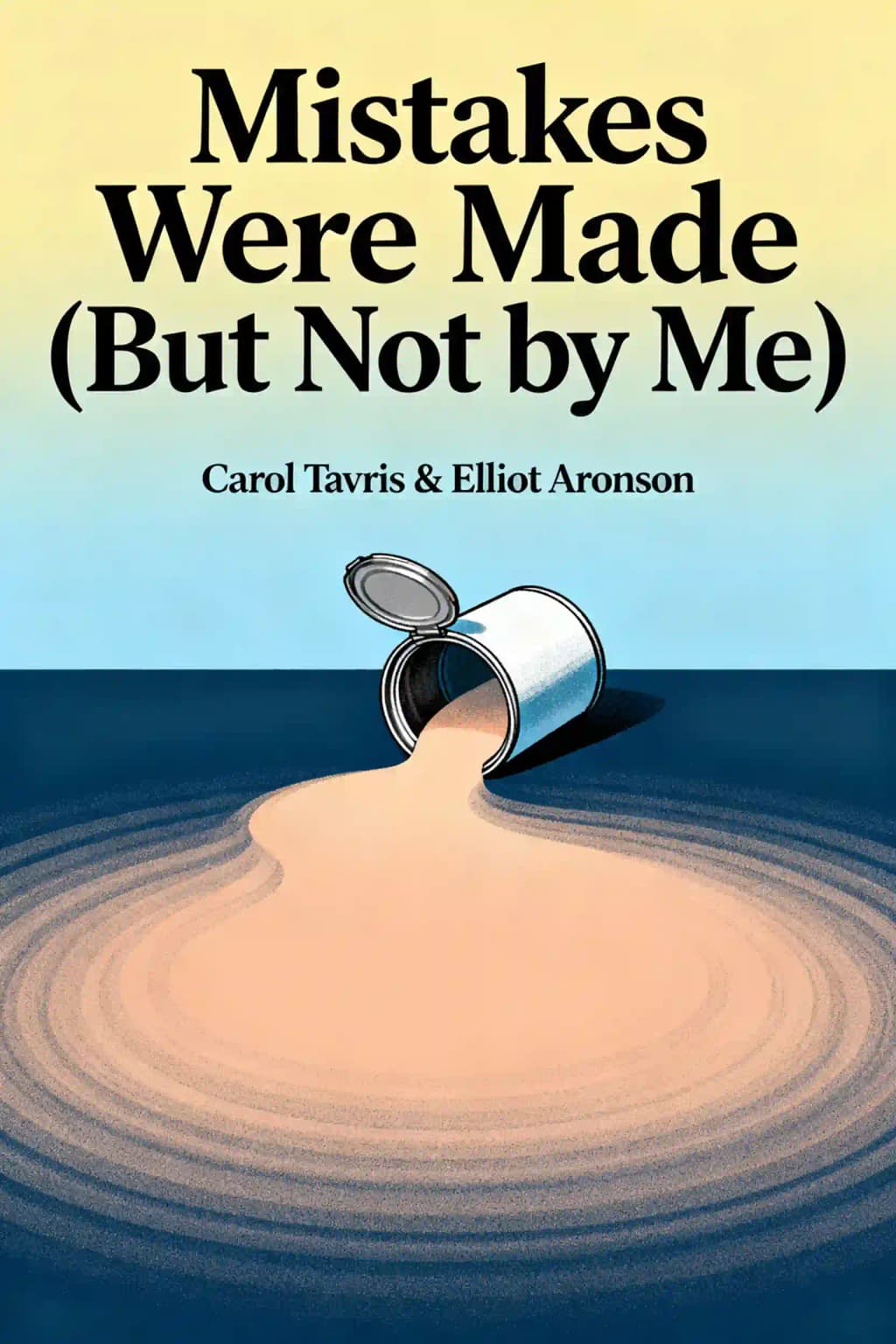
Why do we cling to being right even when we're wrong? "Mistakes Were Made" exposes our psychological blind spots with eye-opening clarity. Praised by biblical scholar Bart Ehrman, this mind-bending exploration of self-justification will forever change how you view your own decisions.
Carol Tavris and Elliot Aronson, renowned social psychologists and bestselling authors of Mistakes Were Made (But Not by Me), are leading experts in cognitive dissonance and self-justification.
Tavris, who holds a PhD from the University of Michigan, has authored influential works like Anger: The Misunderstood Emotion and The Mismeasure of Woman, blending rigorous research with accessible prose.
Aronson, a Stanford-trained psychologist and professor emeritus at UC Santa Cruz, pioneered advancements in social psychology, including the widely taught "jigsaw classroom" method. Aronson remains the only psychologist to win all three American Psychological Association awards for research, teaching, and writing.
Their collaboration on Mistakes Were Made synthesizes decades of research into how individuals rationalize poor decisions, a theme that has resonated across 11 translations and appearances in The New York Times, Scientific American, and top psychology podcasts. The book has become a staple in behavioral science curricula and organizational training programs worldwide.
Mistakes Were Made (but Not by Me) explores how cognitive dissonance and self-justification drive people to rationalize poor decisions, harmful actions, and false beliefs. Authors Carol Tavris and Elliot Aronson use psychological research to explain why individuals—from politicians to everyday people—double down on mistakes, escalate conflicts, and resist accountability, even in the face of contradictory evidence.
This book is ideal for psychology enthusiasts, professionals in law or leadership, and anyone seeking to understand biases in decision-making. It’s particularly relevant for those interested in social behavior, conflict resolution, or improving self-awareness about rationalization in personal and professional relationships.
Yes—it’s a research-backed, accessible guide to why people cling to flawed beliefs. The book offers timeless insights into political polarization, workplace disputes, and personal relationships, making it valuable for navigating conflicts or understanding societal issues like the Iraq War justification or false-memory scandals.
Key ideas include:
The authors describe cognitive dissonance as a mental conflict that arises when actions contradict beliefs. To reduce discomfort, people distort facts (e.g., smokers dismissing health risks) or blame others. This cycle reinforces poor decisions, as seen in cases like the MMR vaccine fraud or wrongful convictions.
Notable examples include:
The book details how small disagreements escalate as partners blame each other to avoid admitting fault. For example, one might justify infidelity by rewriting marital history, perpetuating resentment. Over time, this "conflict spiral" erodes trust and communication.
Some readers find the later chapters overly focused on societal failures (e.g., torture, wrongful convictions) without sufficient solutions. Others note that while the psychology is sound, the dense case studies may overwhelm casual readers.
The book argues that leaders often dismiss employee feedback to protect their ego, fueling resentment. For example, managers might blame team failures on “lazy staff” rather than flawed strategies. Recognizing this bias can improve accountability and collaboration.
Tavris and Aronson show how opposing groups vilify each other to resolve dissonance. For instance, supporters of conflicting policies (e.g., abortion rights vs. restrictions) often dehumanize opponents, deepening division.
Unlike Thinking, Fast and Slow (focused on decision-making heuristics), this book specifically examines how people defend poor choices. It pairs well with Predictably Irrational for a holistic view of human irrationality.
In an era of misinformation and polarized discourse, the book’s insights into confirmation bias and identity-driven justification remain critical. It helps readers navigate debates on AI ethics, climate change, and social justice with greater self-awareness.
著者の声を通じて本を感じる
知識を魅力的で例が豊富な洞察に変換
キーアイデアを瞬時にキャプチャして素早く学習
楽しく魅力的な方法で本を楽しむ
We all twist reality to protect our egos.
I played him a dirty trick, and ever since I have hated him.
Scientists are always changing their minds.
Everyone does it.
Mistakes Were Made (But Not By Me)
『Mistakes Were Made』の核心的なアイデアを分かりやすいポイントに分解し、革新的なチームがどのように創造、協力、成長するかを理解します。
『Mistakes Were Made』を素早い記憶のヒントに凝縮し、率直さ、チームワーク、創造的な回復力の主要原則を強調します。

鮮やかなストーリーテリングを通じて『Mistakes Were Made』を体験し、イノベーションのレッスンを記憶に残り、応用できる瞬間に変えます。
何でも質問し、声を選び、本当にあなたに響く洞察を一緒に作り出しましょう。

"Instead of endless scrolling, I just hit play on BeFreed. It saves me so much time."
"I never knew where to start with nonfiction—BeFreed’s book lists turned into podcasts gave me a clear path."
"Perfect balance between learning and entertainment. Finished ‘Thinking, Fast and Slow’ on my commute this week."
"Crazy how much I learned while walking the dog. BeFreed = small habits → big gains."
"Reading used to feel like a chore. Now it’s just part of my lifestyle."
"Feels effortless compared to reading. I’ve finished 6 books this month already."
"BeFreed turned my guilty doomscrolling into something that feels productive and inspiring."
"BeFreed turned my commute into learning time. 20-min podcasts are perfect for finishing books I never had time for."
"BeFreed replaced my podcast queue. Imagine Spotify for books — that’s it. 🙌"
"It is great for me to learn something from the book without reading it."
"The themed book list podcasts help me connect ideas across authors—like a guided audio journey."
"Makes me feel smarter every time before going to work"

Mistakes Were Madeの要約をPDFまたはEPUBで無料でダウンロード。印刷やオフラインでいつでもお読みいただけます。
Have you ever doubled down on a failing relationship because "we've invested so much time already," or kept pouring money into a money-pit car because "I've already spent thousands fixing it"? These seemingly innocent self-justifications reveal a powerful psychological mechanism affecting everyone from ordinary citizens to presidents. Since its 2007 publication, "Mistakes Were Made (But Not By Me)" has become a cultural touchstone, referenced everywhere from The New York Times to HBO's "Succession." Its enduring appeal lies in an uncomfortable truth: we all twist reality to protect our egos. Understanding this tendency is the first step toward making better decisions, improving relationships, and perhaps even healing societal divides.