Discover why your brain betrays you in crucial moments. Endorsed by Daniel Kahneman, this 4.7-rated guide reveals 40 methods to outsmart cognitive biases. "The best, funniest guide to cognitive bias in business" - Safi Bahcall. Warren Buffett's decision-making secrets inside.
Olivier Sibony, bestselling author of You’re About to Make a Terrible Mistake!, is a renowned behavioral strategy expert and professor at HEC Paris. He specializes in decision-making psychology, bridging business strategy and cognitive science. His work focuses on mitigating biases and organizational noise in high-stakes choices.
A former McKinsey & Company senior partner, Sibony brings 25 years of global corporate strategy experience to his work. He co-authored the New York Times bestseller Noise: A Flaw in Human Judgment with Nobel laureate Daniel Kahneman and Cass R. Sunstein, solidifying his status as a leading voice in behavioral economics.
Sibony’s insights are shaped by academic rigor, holding a PhD from Université Paris Dauphine, and practical board advisory roles across industries. His frameworks are taught at Oxford’s Saïd Business School and featured in Harvard Business Review. His Vernimmen Prize-winning teaching emphasizes real-world application.
You’re About to Make a Terrible Mistake!, awarded the 2019 Manpower Foundation Grand Prize, has been translated into 21 languages, reflecting its global resonance among executives and policymakers.
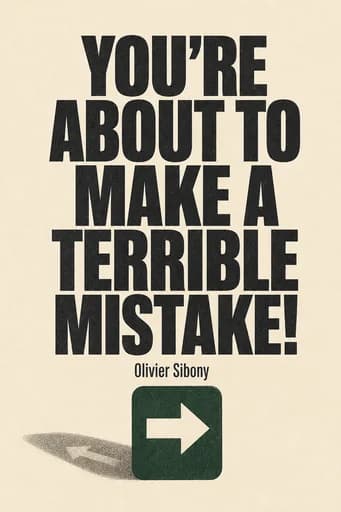
You're About to Make a Terrible Mistake! explores nine cognitive biases that distort strategic decision-making in business, offering 40 actionable methods to combat them. Drawing on behavioral economics and psychology, Olivier Sibony emphasizes designing organizational processes—not just individual awareness—to reduce errors. The book blends case studies, research, and practical frameworks like "decision hygiene" to help leaders improve choices.
Executives, managers, and decision-makers in business will benefit most, along with anyone interested in behavioral science. It’s ideal for leaders seeking systemic solutions to biases in teams or organizations. Sibony’s clear, research-backed approach also appeals to fans of Daniel Kahneman’s Thinking, Fast and Slow.
Yes—it’s praised for translating complex behavioral science into practical organizational strategies. Reviewers highlight its actionable advice on mitigating biases through structured processes rather than individual willpower. The book’s blend of academic rigor and real-world examples makes it a standout in decision-making literature.
Sibony outlines nine traps, including confirmation bias, overconfidence, and groupthink. He illustrates how these errors manifest in business contexts, such as mergers or investments, and provides tools like "pre-mortem analysis" to anticipate failures before decisions are finalized.
Unlike books focused on individual biases (e.g., Thinking, Fast and Slow), Sibony emphasizes institutional "decision hygiene"—systemic processes to reduce errors. He shifts the lens from personal improvement to organizational redesign, offering concrete methods for teams to leverage collective intelligence.
Decision hygiene refers to structured processes that minimize bias, such as devil’s advocacy, diverse input channels, and scenario planning. Sibony argues these systems are more reliable than training individuals to spot their own cognitive errors.
Examples span industries: failed mergers due to overoptimism, flawed investment decisions from anchoring bias, and product launches derailed by groupthink. These cases demonstrate how biases operate in high-stakes business environments and how to counteract them.
A former McKinsey strategist and HEC Paris professor, Sibony combines 25+ years of consulting experience with academic research. His expertise in behavioral strategy and collaboration with Daniel Kahneman (Noise) informs the book’s rigor and practicality.
Some note that Sibony’s solutions—while effective—require organizational buy-in, which can be challenging to implement. Critics also argue certain methods may slow decision-making, though proponents counter that accuracy justifies the pace.
Yes—principles like encouraging dissent and stress-testing assumptions scale well. Startups can adopt lightweight versions, such as rotating decision roles or using checklists to avoid overlooking risks.
With AI and rapid market shifts amplifying decision complexity, Sibony’s focus on bias-proof systems remains critical. The rise of remote teamwork also heightens the need for structured collaboration to counter fragmented communication.
Yes—Sibony collaborated with Kahneman on Noise and cites his research extensively. He builds on Kahneman’s dual-process theory, applying it to organizational strategy rather than individual cognition.
These emphasize systemic solutions over charismatic leadership.
It advocates for roles like “bias monitor,” anonymous idea submission, and separating brainstorming from evaluation stages. These methods reduce social pressures and surface diverse viewpoints.
Yes—the book provides templates for pre-mortems, scenario analysis, and red-teaming. Teams can use these to challenge assumptions and stress-test strategies before commitment.
著者の声を通じて本を感じる
知識を魅力的で例が豊富な洞察に変換
キーアイデアを瞬時にキャプチャして素早く学習
楽しく魅力的な方法で本を楽しむ
Individuals cannot overcome their own biases, but organizations can.
We trust the messenger more than we scrutinize the message.
Negativity takes the oxygen out of innovation.
Anything Ron Johnson touches just turns to gold.
Organizations don't naturally overcome biases-in fact, they often amplify them.
『You're About to Make a Terrible Mistake!』の核心的なアイデアを分かりやすいポイントに分解し、革新的なチームがどのように創造、協力、成長するかを理解します。
鮮やかなストーリーテリングを通じて『You're About to Make a Terrible Mistake!』を体験し、イノベーションのレッスンを記憶に残り、応用できる瞬間に変えます。
何でも質問し、学習スタイルを選び、自分に本当に響くインサイトを一緒に作れます。

"Instead of endless scrolling, I just hit play on BeFreed. It saves me so much time."
"I never knew where to start with nonfiction—BeFreed’s book lists turned into podcasts gave me a clear path."
"Perfect balance between learning and entertainment. Finished ‘Thinking, Fast and Slow’ on my commute this week."
"Crazy how much I learned while walking the dog. BeFreed = small habits → big gains."
"Reading used to feel like a chore. Now it’s just part of my lifestyle."
"Feels effortless compared to reading. I’ve finished 6 books this month already."
"BeFreed turned my guilty doomscrolling into something that feels productive and inspiring."
"BeFreed turned my commute into learning time. 20-min podcasts are perfect for finishing books I never had time for."
"BeFreed replaced my podcast queue. Imagine Spotify for books — that’s it. 🙌"
"It is great for me to learn something from the book without reading it."
"The themed book list podcasts help me connect ideas across authors—like a guided audio journey."
"Makes me feel smarter every time before going to work"

You're About to Make a Terrible Mistake!の要約をPDFまたはEPUBで無料でダウンロード。印刷やオフラインでいつでもお読みいただけます。
Ever watched a brilliant leader make an astonishingly bad decision and wondered how it happened? Even the smartest executives consistently fall into predictable decision traps. These aren't failures of intelligence or character-they're systematic cognitive biases that affect us all. Despite warnings, executives repeatedly make identical mistakes: overpaying for acquisitions, creating wildly optimistic budgets, ignoring disruption signals, and doubling down on failing ventures. The puzzle is that these bad decisions come from extremely successful individuals with good advice and proper incentives. The solution lies in behavioral science. We make systematic, predictable mistakes called cognitive biases. While unconscious-bias training has become popular for addressing discrimination, it rarely tackles how our own biases affect strategic decisions. Overcoming these biases requires three fundamental ideas: First, our biases create predictable patterns of strategic error. Second, individuals cannot overcome their own biases, but organizations can compensate through collaboration and process. Third, organizations don't naturally overcome biases-they often amplify them. Leaders must become "decision architects" who deliberately design processes to counteract these predictable errors.
We instinctively create coherent narratives from isolated facts rather than considering their insignificance. A sales executive might hear one mention of aggressive competitor pricing, notice a few salespeople leaving and client concerns, then rush to cut prices without examining broader market data or trends. This storytelling trap has snared even sophisticated players like Goldman Sachs with Terralliance and Elf Aquitaine with "oil-sniffing airplane" technology. Intelligence provides little immunity - studies show smart people routinely exhibit "myside bias" when interpreting facts. The "champion bias" makes us especially vulnerable when we trust messengers over messages, as when J.C. Penney hired Apple's Ron Johnson. His retail visionary reputation overshadowed critical analysis, leading to devastating results: 25% sales drop, $1 billion losses, and his departure after 17 months. While many executives claim to rely purely on data, we unconsciously create narratives to interpret information. Even scientists face this challenge, evidenced by the "replication crisis" where researchers' subtle choices unconsciously bias results toward desired outcomes.
Why do we attribute Apple's success solely to Steve Jobs? Our minds create heroic narratives that oversimplify complex realities - a fact proven by Apple's continued success after Jobs's death. When Ron Johnson was praised as the genius behind Apple Stores, this ignored crucial context: the stores' success aligned with three revolutionary product launches. Customers lined up for products, not store design. This attribution error - crediting individuals rather than circumstances - is pervasive. The halo effect leads us to let positive impressions color all judgments. We even evaluate leaders based on height and appearance. When trying to imitate business geniuses like Jobs, we assume we can replicate their exceptional qualities. Our drive to emulate geniuses stems from overconfidence and survivorship bias. By studying only successes while ignoring countless failures, we create a distorted view of success. Warren Buffett demonstrates this wisdom: despite thousands studying his methods, he advises average investors to simply buy index funds.
In 1994, Quaker Oats CEO William Smithburg made an intuitive decision to acquire Snapple for $1.7 billion. Despite his previous success with Gatorade, the deal became a disaster that led to his departure and Quaker's eventual acquisition by PepsiCo. Research shows two views on intuition: Gary Klein found professionals making effective snap decisions, while Kahneman and Tversky uncovered systematic biases. They agreed that intuition works only under specific conditions: environments with consistent patterns and opportunities for repeated practice with clear feedback. Intuition serves firefighters and emergency nurses well because their feedback is immediate. However, it fails psychiatrists, judges, and investors who work with delayed, ambiguous feedback. In political and economic forecasting, expert predictions often perform worse than random guesses. Strategic decisions particularly resist intuitive expertise - executives rarely face similar situations, and outcomes are hard to link to specific choices. Yet despite these being conditions where expert intuition cannot develop, many leaders still rely on gut feelings for strategic decisions.
When Netflix offered to sell 49% of their company to Blockbuster for $50 million in the early 2000s, Blockbuster dismissed them, believing they could easily replicate the model. By 2020, Netflix was worth $150 billion with 167 million subscribers, while Blockbuster had gone bankrupt in 2010. Our tendency to overestimate ourselves is pervasive - 88% of Americans believe they're above-average drivers. We're consistently overconfident about future outcomes, with economic forecasts skewing optimistic and the "planning fallacy" causing us to underestimate project needs. The Sydney Opera House is a prime example, costing 102 million Australian dollars and taking sixteen years versus the planned 7 million. We also suffer from "overprecision" - making predictions with excessive certainty. Most business plans ignore that competitors will actively defend their market share, treating competition as static rather than dynamic. Yet optimism serves a purpose. While excessive realism can paralyze, optimism drives action. The key is distinguishing between controllable factors - where optimism is productive - and uncontrollable ones, where it becomes self-deception. Organizations often balance ambition with realism to maintain momentum while managing risk.
A McKinsey study of 1,600 American corporations found a 92% correlation in business unit capital allocation between years, revealing a stark disconnect between strategic priorities and resource deployment. Despite championing agility, companies maintain static resource allocation. "High reallocators" outperformed conservative peers by 30% in shareholder returns over fifteen years, with lower bankruptcy rates. This inertia stems from anchoring bias - our tendency to insufficiently adjust from existing reference points. Budgets built on previous figures make breaking historical patterns difficult. Organizations often compound this by escalating commitment to failing initiatives, as seen in GM's Saturn division, which consumed $15 billion over twenty years before receiving another $3 billion prior to closure. In technological disruption, incumbents like Polaroid must choose between cannibalizing their profitable core business with new technology or risking obsolescence - a decision that seems clear in retrospect but challenges leaders with timing and profitability concerns.
Is a good decision maker simply one who makes good decisions? Examples like Paul the Psychic Octopus's World Cup predictions and Bill Miller's market-beating streak show how we wrongly focus on outcomes while ignoring luck, risk, and implementation quality. Statistical evidence, not isolated examples, reveals the true value of structured decision-making. A 2010 study of 1,048 investment decisions found that "how" factors-collaboration and process quality-explained 53% of returns variance, while analytical quality explained only 8%. For controllable factors, process is six times more important than analysis. Most organizations invest heavily in analytical work but spend little time on the decision-making process itself. Four key practices matter most: discussing risks and uncertainties, encouraging dissent from senior leaders, seeking contradictory information, and using predefined approval criteria. While some leaders resist "process" as bureaucratic, effective collaboration isn't about consensus-it's about ensuring diverse viewpoints are heard. Think of yourself as a decision architect, designing conditions for better judgment. By addressing cognitive biases through process design, we can significantly improve our most important decisions.