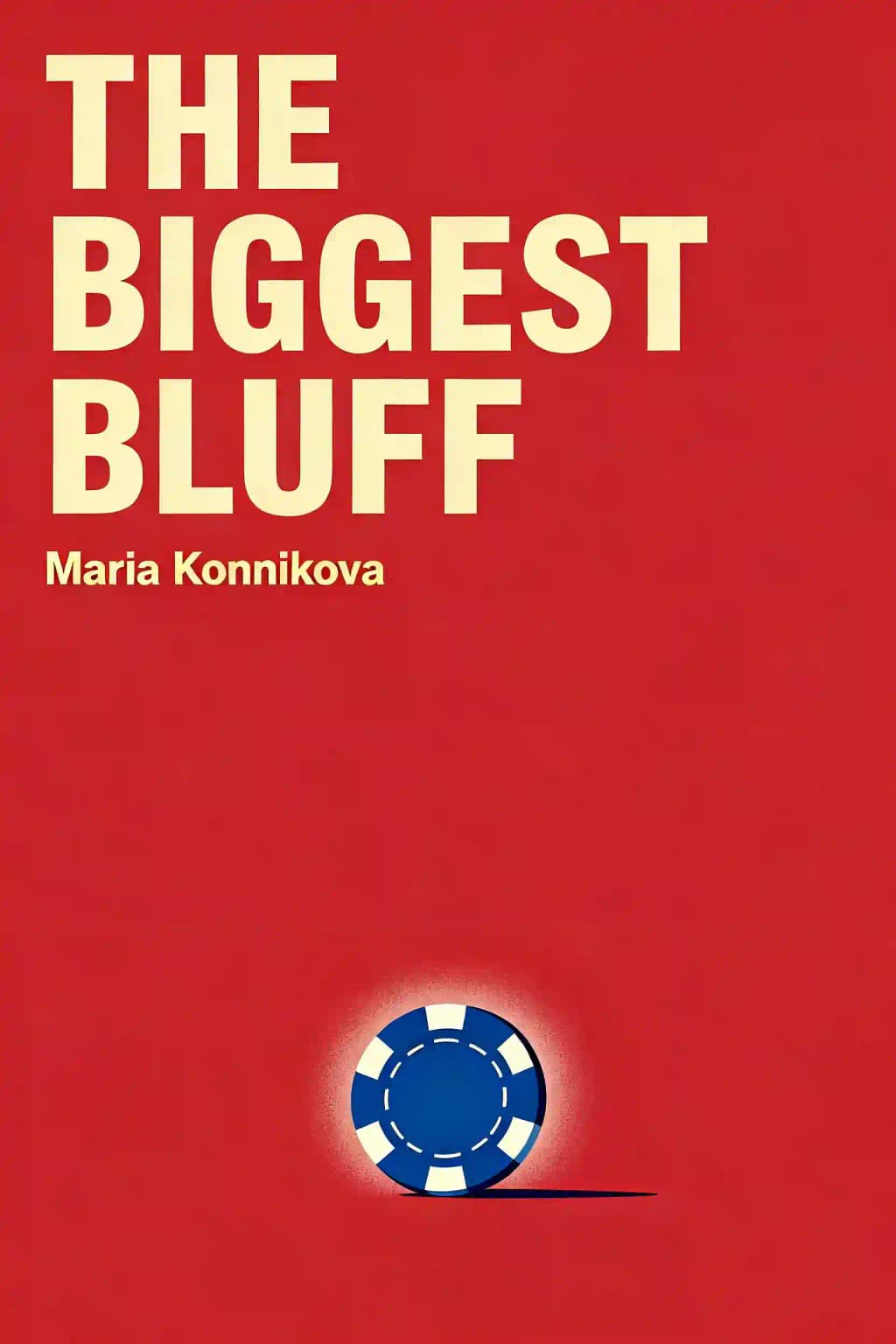
The Biggest Bluff
Overview of The Biggest Bluff
A psychologist's journey from novice to poker champion, earning $300,000 while learning life's biggest lessons about luck, skill, and decision-making. Recommended by Derek Sivers and honored with a Global Poker Award - can a card game really teach us to master uncertainty?

Key Themes in The Biggest Bluff
- decision making under uncertainty
- luck versus skill
- probabilistic thinking
- game theory application
- mastering emotional control
Quotes from The Biggest Bluff
Life is too short for complacency.
Pay attention.
Self-control is huge in the game.
You will never learn how to play good poker if you get lucky.
Characters in The Biggest Bluff
- Maria KonnikovaAuthor, psychologist, and poker novice turned pro
- Erik SeidelPoker legend and mentor to Maria Konnikova
- John von NeumannMathematician and creator of game theory
- Johnny ChanPoker professional who played Seidel in 1988
About the Author
About the Author of The Biggest Bluff
Maria Konnikova, a psychologist, New York Times bestselling author, and champion poker player, explores the interplay of skill and chance in The Biggest Bluff. Blending memoir, psychology, and narrative nonfiction, the book chronicles her year-long journey from novice to professional poker player under mentor Erik Seidel, dissecting decision-making, risk, and self-mastery.
A Harvard and Columbia PhD graduate, Konnikova leverages her expertise in human behavior—previously showcased in Mastermind: How to Think Like Sherlock Holmes (2013) and The Confidence Game (2016)—to unravel poker’s psychological complexities.
Her work as a New Yorker contributor and host of The Grift podcast reinforces her authority on deception and cognition. An ambassador for PokerStars, Konnikova won her first WSOP bracelet in 2024 and has earned nearly $1 million in tournament earnings. The Biggest Bluff was a 2020 New York Times Notable Book and a finalist for the Telegraph Sports Writing Award, translated into 15 languages.
Download Summary of The Biggest Bluff
Get the The Biggest Bluff summary as a free PDF or EPUB. Print it or read offline anytime.
FAQs About This Book
The Biggest Bluff chronicles psychologist Maria Konnikova’s journey from poker novice to professional champion under mentor Erik Seidel. Blending memoir, behavioral science, and game theory, it explores how skill and luck intersect in decision-making, offering insights into emotional control, risk assessment, and adapting to uncertainty. Konnikova earned over $300,000 in tournaments while studying poker’s psychological parallels to real-life challenges.
This book appeals to psychology enthusiasts, poker players, and anyone seeking to improve decision-making. It’s ideal for readers interested in behavioral science, resilience strategies, or narratives about mastering uncertainty. Professionals in high-stakes fields (finance, entrepreneurship) will find actionable frameworks for balancing skill and luck in volatile environments.
Yes—it’s a New York Times bestseller praised for merging storytelling with academic rigor. Konnikova’s transformation into a poker champion provides a unique lens to examine human behavior, making complex concepts like probabilistic thinking accessible. Critics highlight its relevance to personal growth and professional adaptability.
Key themes include:
- Skill vs. luck: How to distinguish controllable factors from chance.
- Emotional regulation: Managing “tilt” (emotional decisions) under pressure.
- Metacognition: Observing one’s own thought processes to avoid biases.
- Resilience: Adapting strategies when outcomes defy expectations.
Konnikova argues poker mirrors life’s unpredictability. For example, “bluffing” teaches strategic storytelling, while probabilistic calculations improve risk assessment. She demonstrates how acknowledging luck’s role reduces overconfidence and fosters adaptability—skills applicable to career changes, investments, and interpersonal relationships.
Poker legend Erik Seidel mentors Konnikova, emphasizing disciplined bankroll management, opponent psychology, and emotional detachment. His guidance helps her reframe losses as learning opportunities, a mindset applicable beyond poker. Their partnership underscores the value of expert mentorship in mastering complex skills.
The titular bluff symbolizes the illusion that skill alone guarantees success. Konnikova reveals how overestimating control leads to poor decisions. True mastery, she argues, lies in balancing effort with humility toward luck’s influence—a lesson she applies to poker and personal challenges.
Unlike theoretical texts, Konnikova uses her poker journey as a live case study, making abstract concepts like game theory tangible. The narrative blends raw memoir (e.g., sexism in poker) with actionable strategies, offering a relatable entry point into behavioral science.
Some reviewers note Konnikova’s privileged access to elite mentors like Seidel isn’t replicable for average readers. Others suggest the poker-heavy examples may alienate those unfamiliar with the game, though most praise her ability to extract universal lessons from niche experiences.
Absolutely. The book teaches risk-calibration techniques, such as separating outcomes from decision quality and avoiding “sunk cost fallacy.” Konnikova’s frameworks help professionals navigate layoffs, negotiate salaries, or invest wisely by embracing probabilistic thinking.
While both explore decision-making, Konnikova focuses on real-world application through poker, whereas Kahneman’s work is more theoretical. The Biggest Bluff supplements behavioral economics principles with tactical advice for high-pressure scenarios, making it a practical companion to Kahneman’s research.
- “The cards I get are destiny. How I play them is free will.”
- “Tilt is nothing but a failure to accept reality.”
These lines underscore the book’s core message: mastering reactions to uncertainty matters more than controlling external events.