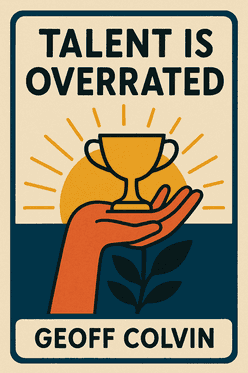
Talent Is Overrated: What Really Separates World-Class Performers from Everybody Else by Geoff Colvin Summary

Overview of Talent Is Overrated
Forget natural talent - Geoff Colvin's groundbreaking research reveals world-class performance comes from deliberate practice, not innate gifts. Endorsed by Donald Trump and compared to Gladwell's "Outliers," this book challenges everything you thought about success. What if Mozart wasn't born exceptional?
- Deliberate practice outperforms innate talent in mastering any skill.
- Natural ability accounts for less than 25% of high-level success.
- World-class performers invest 10+ years in focused skill-building.
- Coaching accelerates growth by targeting weaknesses invisible to practitioners.
- IQ scores show weak correlation with expert performance in specialized fields.
- Motivation evolves from external rewards to self-sustaining passion through practice.
- Growth mindset enables skill development where fixed talent beliefs limit progress.
- Experience without deliberate practice fails to improve performance quality.
- Resilience against setbacks proves more critical than early aptitude.
- Business excellence stems from practice systems, not born leadership traits.
- Creative breakthroughs emerge from accumulated practice, not spontaneous genius.
- Self-assessment and feedback loops drive continuous performance improvement.
About the Author of Talent Is Overrated
Geoffrey Colvin, senior editor-at-large for Fortune magazine and bestselling author of Talent Is Overrated: What Really Separates World-Class Performers from Everybody Else, is a leading voice on business leadership and human performance. A Harvard graduate with an MBA from NYU, Colvin draws on decades of reporting on global economic trends and interviews with top CEOs to challenge conventional wisdom about innate talent.
His work explores how deliberate practice, innovation, and adaptability drive excellence—themes echoed in his other books like Humans Are Underrated and The Upside of the Downturn, which was named Strategy + Business’s Best Management Book of the Year.
Colvin reinforces his insights through daily CBS Radio segments reaching seven million listeners and appearances on Today, Good Morning America, and CNN. A trusted moderator for leaders like Warren Buffett and Bill Gates, he translates boardroom strategies into actionable lessons. Talent Is Overrated has become a global staple, translated into 12 languages and cited in elite executive training programs.
FAQs About Talent Is Overrated
What is Talent Is Overrated by Geoff Colvin about?
Talent Is Overrated challenges the myth of innate talent, arguing that deliberate practice—targeted, feedback-driven skill development—is the true driver of exceptional performance. Geoff Colvin uses research and case studies to show how sustained effort, not genetic gifts, separates top performers in fields like music, sports, and business.
Who should read Talent Is Overrated?
This book is ideal for professionals, athletes, educators, and anyone seeking mastery in their field. It’s particularly valuable for those skeptical of "natural talent" myths and interested in evidence-based strategies for skill improvement.
Is Talent Is Overrated worth reading?
Yes, if you want actionable insights into achieving excellence. Colvin’s research-backed arguments and practical frameworks, like deliberate practice, provide a roadmap for surpassing perceived limitations.
What is deliberate practice in Talent Is Overrated?
Deliberate practice involves focused, structured repetition targeting specific weaknesses, coupled with continuous feedback. Unlike casual practice, it requires pushing beyond comfort zones and refining techniques systematically.
Does Talent Is Overrated believe in natural talent?
No. Colvin argues innate abilities are overstated, citing studies where "talented" individuals regressed without practice. He emphasizes that effort and strategy matter more than genetic advantages.
What are key quotes from Talent Is Overrated?
- “Great performance is more valuable than ever—but where does it really come from?”
- “We tend to think we’re barred from success by what we were born with. The range of cases where that’s true is far narrower than we think.”
These highlight Colvin’s focus on effort over inherent ability.
How does deliberate practice differ from hard work?
Deliberate practice is purposeful and analytical, focusing on specific gaps in skill. Hard work alone lacks the targeted feedback and iterative refinement needed for breakthrough performance.
Can Talent Is Overrated principles apply to career growth?
Yes. By adopting deliberate practice, professionals can systematically improve skills like leadership, negotiation, or technical expertise. Colvin’s framework helps individuals turn routine jobs into opportunities for mastery.
What criticisms exist about Talent Is Overrated?
Some argue Colvin overgeneralizes deliberate practice’s applicability, noting factors like opportunity and resources also influence success. Critics suggest his dismissal of innate traits may oversimplify complex performance dynamics.
How does Talent Is Overrated compare to Outliers by Malcolm Gladwell?
Both emphasize effort over talent, but Gladwell’s "10,000-hour rule" focuses on practice duration, while Colvin stresses quality of practice. Talent Is Overrated offers more tactical guidance for skill development.
What role do mentors play in deliberate practice?
Mentors provide critical feedback to identify weaknesses and adjust strategies. Colvin highlights coaching as essential for structuring effective practice and maintaining motivation.
Can you achieve excellence if you start late, per Talent Is Overrated?
Yes. While early starters gain an advantage, Colvin argues that deliberate practice’s principles—consistent effort, feedback, and adaptation—enable progress at any age.
Feel the book through the author's voice
Turn knowledge into engaging, example-rich insights
Capture key ideas in a flash for fast learning
Enjoy the book in a fun and engaging way
Key Themes in Talent Is Overrated
Quotes from Talent Is Overrated
Greatness isn't determined by genetics but by specific behaviors.
Deliberate practice is hard. It hurts. But it works.
The gifts possessed by top performers aren't what we think they are.
Mozart became Mozart by working furiously hard.
World class is no longer just a buzzword but a necessity for survival.
Characters in Talent Is Overrated
Quick Summary Mode - Read or listen to Talent Is Overrated Summary in 9 Minutes

Break down key ideas from Talent Is Overrated into bite-sized takeaways to understand how innovative teams create, collaborate, and grow.

Flash Card Mode - Top 10 Insights from Talent Is Overrated in a Nutshell

Distill Talent Is Overrated into rapid-fire memory cues that highlight key principles of candor, teamwork, and creative resilience.

Fun Mode - Talent Is Overrated Lessons Told Through 19-Min Stories

Experience Talent Is Overrated through vivid storytelling that turns innovation lessons into moments you'll remember and apply.
Personalize Mode - Read or listen to Talent Is Overrated Summary in 0 Minutes

Ask anything, pick the voice, and co-create insights that truly resonate with you.

From Columbia University alumni built in San Francisco
"Instead of endless scrolling, I just hit play on BeFreed. It saves me so much time."


"I never knew where to start with nonfiction—BeFreed’s book lists turned into podcasts gave me a clear path."


"Perfect balance between learning and entertainment. Finished ‘Thinking, Fast and Slow’ on my commute this week."
"Crazy how much I learned while walking the dog. BeFreed = small habits → big gains."
"Reading used to feel like a chore. Now it’s just part of my lifestyle."

"Feels effortless compared to reading. I’ve finished 6 books this month already."
"BeFreed turned my guilty doomscrolling into something that feels productive and inspiring."

"BeFreed turned my commute into learning time. 20-min podcasts are perfect for finishing books I never had time for."
"BeFreed replaced my podcast queue. Imagine Spotify for books — that’s it. 🙌"

"It is great for me to learn something from the book without reading it."
"The themed book list podcasts help me connect ideas across authors—like a guided audio journey."
"Makes me feel smarter every time before going to work"
From Columbia University alumni built in San Francisco
"Instead of endless scrolling, I just hit play on BeFreed. It saves me so much time."
"I never knew where to start with nonfiction—BeFreed’s book lists turned into podcasts gave me a clear path."
"Perfect balance between learning and entertainment. Finished ‘Thinking, Fast and Slow’ on my commute this week."
"Crazy how much I learned while walking the dog. BeFreed = small habits → big gains."
"Reading used to feel like a chore. Now it’s just part of my lifestyle."
"Feels effortless compared to reading. I’ve finished 6 books this month already."
"BeFreed turned my guilty doomscrolling into something that feels productive and inspiring."
"BeFreed turned my commute into learning time. 20-min podcasts are perfect for finishing books I never had time for."
"BeFreed replaced my podcast queue. Imagine Spotify for books — that’s it. 🙌"
"It is great for me to learn something from the book without reading it."
"The themed book list podcasts help me connect ideas across authors—like a guided audio journey."
"Makes me feel smarter every time before going to work"
"Instead of endless scrolling, I just hit play on BeFreed. It saves me so much time."
"I never knew where to start with nonfiction—BeFreed’s book lists turned into podcasts gave me a clear path."
"Perfect balance between learning and entertainment. Finished ‘Thinking, Fast and Slow’ on my commute this week."
"Crazy how much I learned while walking the dog. BeFreed = small habits → big gains."
"Reading used to feel like a chore. Now it’s just part of my lifestyle."
"Feels effortless compared to reading. I’ve finished 6 books this month already."
"BeFreed turned my guilty doomscrolling into something that feels productive and inspiring."
"BeFreed turned my commute into learning time. 20-min podcasts are perfect for finishing books I never had time for."
"BeFreed replaced my podcast queue. Imagine Spotify for books — that’s it. 🙌"
"It is great for me to learn something from the book without reading it."
"The themed book list podcasts help me connect ideas across authors—like a guided audio journey."
"Makes me feel smarter every time before going to work"
"Instead of endless scrolling, I just hit play on BeFreed. It saves me so much time."
"I never knew where to start with nonfiction—BeFreed’s book lists turned into podcasts gave me a clear path."
"Perfect balance between learning and entertainment. Finished ‘Thinking, Fast and Slow’ on my commute this week."
"Crazy how much I learned while walking the dog. BeFreed = small habits → big gains."
"Reading used to feel like a chore. Now it’s just part of my lifestyle."
"Feels effortless compared to reading. I’ve finished 6 books this month already."
"BeFreed turned my guilty doomscrolling into something that feels productive and inspiring."
"BeFreed turned my commute into learning time. 20-min podcasts are perfect for finishing books I never had time for."
"BeFreed replaced my podcast queue. Imagine Spotify for books — that’s it. 🙌"
"It is great for me to learn something from the book without reading it."
"The themed book list podcasts help me connect ideas across authors—like a guided audio journey."
"Makes me feel smarter every time before going to work"

Get the Talent Is Overrated summary as a free PDF or EPUB. Print it or read offline anytime.