Capitolo 1
The Art of Disagreement: When Conflict Becomes Conversation
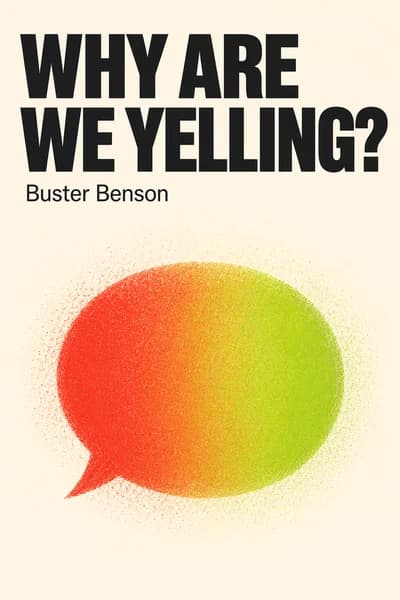
In a world increasingly divided, Buster Benson's "Why Are We Yelling?" arrives as a timely antidote to our cultural inability to disagree productively. This book has become required reading in conflict resolution courses at Harvard, Stanford, and Columbia Business School, with Brene Brown calling it "a guide to disagreeing without disconnecting." Benson, a former product leader at Twitter, Amazon, and Slack, draws from his experience managing teams through difficult conversations to present a radical idea: what if arguments aren't problems to eliminate but opportunities to embrace? Through personal stories, research, and practical frameworks, Benson transforms our understanding of disagreement from something to avoid into something to cultivate-like a gardener who discovers that some "weeds" actually strengthen the ecosystem. As anxiety disorders affect one in five American adults and "deaths of despair" continue rising, this book offers a path forward that treats disagreement not as a threat but as a skill that can be mastered.
Capitolo 2
Anxiety as Your Personal Map of What Matters
When reality doesn't match our expectations, anxiety sparks-signaling that something we value feels threatened. These sparks aren't random; they form a detailed map of our personal expectations, hopes, dreams, and disappointments. Left unexamined, they dictate our responses, often causing us to misread situations and try forcing the world to conform to our expectations rather than updating our beliefs to match reality.
Consider a seemingly trivial example: does water go bad if left sitting out for a few days? When the author posed this question, it sparked immediate, visceral reactions. The "absolutely not" camp feared bacteria and unknown contaminants, while others (particularly those from rural backgrounds or medical families) saw no issue. This seemingly simple question had triggered decade-long arguments between friends.
Our anxiety response operates on a scale from 1 (mild discomfort, like finding a tear in your favorite shirt) to 5 (life-altering emergencies like hospitalization). By noticing these sparks, we glimpse how we've been conditioned to react automatically to specific information. Even something as innocuous as a bagel sliced vertically can trigger surprising outrage, as demonstrated when a photo of bread-sliced bagels went viral on Twitter with comments like "Officer, I would like to report a crime."
This is cognitive dissonance in action-when something contradicts our expectations, we feel motivated to resolve that tension. Social media provides quick relief through qualifying perspectives ("That's a St. Louis thing") or rejecting them outright. But this makes us dependent on platforms for anxiety resolution rather than developing our own skills.
When anxiety arises in disagreement, first identify whether you're anxious about what is true, meaningful, or useful. For truth-based anxiety, seek mutually trusted information sources. For meaning-based anxiety, explore why the issue matters to each person. For utility-based anxiety, consider the consequences of inaction and confidence levels in proposed solutions.
The key insight: in disagreements, people who value rationality often make a critical mistake-focusing on simple truth-based arguments when conflicts are actually about meaning, values, or purpose. In the author's conflict with his wife about leaving their son home alone, he clung to an information-based argument rather than addressing the underlying concerns about family priorities. The path to better conversations starts with recognizing the anxiety spark that initiates the conflict.
Capitolo 3
The Four Voices That Drive Our Responses
Our internal voices represent our default reactions to anxiety-inherited from parents, culture, and experience. When facing opposing viewpoints, we experience cognitive dissonance proportional to how far the conflicting perspective is from our own. This often leads to demonizing those with opposing views.
These automatic reactions come from what psychologist Daniel Kahneman calls "System 1"-our fast, instinctive thinking that makes quick judgments to reduce anxiety. With practice, we can learn to treat these internal voices as suggestions rather than commands.
Our System 1 thinking manifests as four distinct internal voices that automatically respond to anxiety and cognitive dissonance:
The voice of power is our most primal, ancient internal voice that resolves disagreements by forcefully shutting them down. It's the voice that declares "Mine!" and uses force to end conflicts in our favor. We're born with this voice-as demonstrated by the author's two-year-old son screaming for his pink train. While the voice of power offers an evolutionary advantage by decisively ending conflicts, it's also the most expensive strategy, requiring constant battles to maintain dominance.
The voice of reason uses logic and appeals to higher authority rather than raw strength. It operates through institutions (religion, government, business, science) that establish internal systems of reason built on power foundations. The voice of reason works best within groups sharing the same cultural norms and authority structures-like using "sharing" and "taking turns" with children. Its effectiveness breaks down when addressing conflicts across different institutional boundaries or when cultural norms evolve.
The voice of avoidance addresses conflict by refusing to participate altogether. Unlike power and reason, avoidance operates covertly-there are no explicit rules or consequences around it, yet surveys show 85% of employees admit there are issues people are afraid to raise at work. This voice works best in low-stakes conflicts but doesn't actually solve problems-it merely postpones them.
The voice of possibility offers a fundamentally different approach. Unlike the first three voices that try to resolve conflict as a problem, this fourth voice seeks to make conflict productive. It's like seeing weeds not as pests to eradicate but as potential flowers that might produce sweet berries. This voice treats conflict like a blackberry bush that can be cultivated rather than yanked out-integrated into the garden, watered, and brought to health so it can play its part.
To identify how these voices manifest for you personally, try "talking" to them by asking questions: What's urgent right now? What's threatening? What could I be doing instead? How can I know if these answers serve my best interests? What would happen if I did nothing? This self-talk isn't a sign of mental health problems-it's normal and can generate real insight when you can distinguish between what's in your head versus what's in the world.
Capitolo 4
Understanding and Working With Our Biases
In an ideal world, we would observe reality, orient ourselves to what it means, and then take appropriate action. However, cognitive biases interfere at each step, causing us to see things that aren't there, misinterpret meanings, or take inappropriate actions.
Despite identifying over two hundred cognitive biases, we can't simply eliminate them-they're fundamental to how we think and necessary for functioning in an overwhelming world. Biases stem from three unsolvable conundrums: too much information, not enough meaning, and not enough time and resources. These aren't bugs but necessary shortcuts.
Three key biases affect our decision-making: The availability heuristic makes us consider only options that come easily to mind. In-group favoritism causes us to trust and favor people in our group over outsiders. Loss aversion makes us value things we already have more than things we don't yet possess.
Information overload influences the "head realm" and our looking process. When faced with too much information, we employ five strategies representing fifty biases: depending on context to determine what deserves attention, accepting what readily comes to mind, amplifying bizarre elements that might signal threats or opportunities, noticing new or different things, and seeking takeaways we'll need later. In hiring scenarios, hundreds of applications force us to use biased shortcuts.
Pattern matching influences the "heart realm" and how we orient ourselves. We transform scattered data points into meaningful stories, but this creates illusions as we fill gaps with assumptions and stereotypes. In hiring contexts with limited interview time, we unconsciously use stereotypes about protected characteristics to make judgments.
Constraints influence the "hands realm" and our leaping to action. With limited time and resources, we use biases to transform stories into quick decisions. Amazon's "bias for action" principle and Jeff Bezos's advice on "high-velocity decision making" suggest most decisions should be made with only 70% of desired information. Bezos advocates for "disagree and commit" to avoid decision paralysis.
Instead of trying to eliminate bias, we should embrace discomfort as essential for growth. Robin DiAngelo's work on white fragility illustrates how claiming to be "color-blind" actually reinforces bias. We can't escape bias-it's embedded in our institutions and environment. But we can learn to recognize and work with it by following four steps: opt in by acknowledging your blindness exists; observe your biases by noticing when defenses are triggered; repair damage caused by blind spots; and normalize challenging your own perspectives.
Capitolo 5
The Power of Speaking Only for Yourself
The author observes that disagreements quickly deteriorate when people stop speaking from their own perspective and start speculating about others' views. Our cognitive biases lead us to fill gaps with stereotypes and project our internal states onto others, then forget which parts came from reality versus our own fabrications.
When speaking from our own heart and perspective, we reveal truths that cannot be contested by others. We are the primary source of truth for our own hearts. Conversely, when we speak for others, we're merely speculating about things we have no claim on, which can be fully contested.
Speaking for yourself means avoiding two common bad habits: speaking for other people and speculating about groups. For example, saying "If you don't vaccinate your kids, it means you prioritize your children over mine" speculates about someone else's internal thoughts. Instead, speaking for yourself would involve sharing your own motivations and asking questions about theirs.
The author notes that opinion columns frequently engage in harmful speculation about groups, which relies on uncharitable generalizations. Speaking only for yourself invites people into conversations instead of talking about them, improves your mental model of others' positions, and helps others more accurately understand your position.
This approach also reduces reliance on group stereotypes and requires finding actual representatives of different perspectives, which grounds conversations in reality and opens up important new questions. By reframing discussions to invite personal perspectives rather than generalizations about what others should do, it becomes easier to see how each person arrived at their unique position.
Capitolo 6
Questions That Invite Surprising Answers
Surprising answers carry the most information. Our biases help us converge on stories and decisions without becoming paralyzed by too many options, but asking great questions balances our impatience for quick answers with finding the best possible answers.
To understand productive questions, the author compares two childhood games: Battleship and Twenty Questions. In Battleship, each question yields only one piece of information through trial and error. Twenty Questions requires more strategic questioning that "cleaves through the unknown" by dividing possibilities efficiently.
But real-life disagreements offer even more potential-we aren't confined to yes-or-no questions and can invite detailed stories and perspectives from others' minds. Open-ended questions like "What experiences led to your beliefs about ghosts?" create space for surprising answers and make people feel truly heard.
The author explores their nuanced perspective on ghosts as "unresolved open questions, living in limbo between reality and possibility." After surveying people about ghost beliefs, they found 52% believed in ghosts while 48% didn't, with ghost believers generally more open to considering conflicting information.
Rather than debating whether ghosts are "real," the author found more meaningful conversations by asking about people's relationship to mystery, sensitivity to nature, and experiences with the unexplainable. This approach revealed that "belief alignment" is just one reason to have conversations, and often not the most fulfilling one.
If disagreement is a tree nourished by anxiety and cognitive dissonance, it produces four distinct fruits: security, growth, connection, and enjoyment. When we fixate solely on security, we can't ask productive questions because information becomes weaponized. We must reorient conversations toward all four fruits together.
Security is our primary, instinctive fruit of disagreement-protecting possessions, self-worth, and group cohesion. Growth requires risk-taking at the frontier rather than staying safe at home. Connection often requires trusting others despite differences. Enjoyment binds the other fruits together, making disagreement sustainable and even relationship-strengthening.
When stuck in frustrating arguments, better questions can transform the conversation. Examples include "What formative events brought you to this belief?", "What's really at stake here?", "What's complicated about your position that people don't usually notice?", and "What would have to be true for you to change your mind?"
Capitolo 7
Building Arguments Together
Disagreements become productive when we stop "nutpicking"-selecting the weakest opponents to tear apart-and instead seek out the wisest representatives of opposing views. The author suggests we should actually help opponents build their strongest arguments while enlisting them to strengthen ours.
Due to our cognitive biases, we're better at finding flaws in others' arguments than our own, and vice versa-a quirk we can leverage for mutual benefit. The author references W.W. Jacobs' short story "The Monkey's Paw," where wishes are granted with terrible unintended consequences. This illustrates how we're often blind to the loopholes in our own desires and arguments.
The gun control debate exemplifies how difficult productive disagreement can be. When the author posed polarizing statements about guns, participants noticed which ones triggered anxiety and how intensely. These included claims about gun control reducing violence, the right to self-defense, the "guns don't kill people" argument, and Second Amendment interpretations.
The author illustrates the gun debate through a hypothetical brother and aunt arguing on Facebook. Both see the other as threatening their worldview-the brother fears public safety is compromised by easy gun access, while the aunt believes America's founding principles of self-reliance and freedom are under attack.
People are remarkably misinformed about those who disagree with them. A 2017 study showed that political partisans drastically overestimated certain demographic characteristics of the opposing party. Even on our own positions, we're often uninformed-the author discovered many Californians proposed gun laws already on the books.
When traditional debate formats failed to engage people in productive gun discussions, the author shifted to hosting a potluck dinner. Fifteen diverse guests gathered, bringing both food and their personal gun experiences. The shared meal created a tribal, inclusive atmosphere where different experiences could be exchanged naturally.
After sharing key statistics about guns in America, they tackled the question of what would constitute success in the gun debate. Various endgames were proposed, from eliminating semiautomatic weapons to reducing mass shootings. One participant suggested reframing the goal: "reduce the total number of homicides and suicides across the board as much as possible, regardless of how they happened." This shift allowed everyone to consider the problem differently.
The potluck format unlocked possibilities that typical debate formats couldn't. Sharing food created a primal sense of community and good faith that allowed the voices of reason and force to step back. Though they didn't solve gun violence, they gained wisdom by allowing their black-and-white positions to fade into a spectrum of gray possibilities.
Capitolo 8
Creating Neutral Spaces for Productive Conflict
Disagreements don't exist in a vacuum but are shaped by their environments. When reflecting on arguments, consider the power dynamics, expectations for outcomes, and hidden contextual influences like cultural norms or time constraints.
The author's online community, fruitful.zone, continued productive immigration conversations as participants used language of possibility rather than confrontation. They examined border safety data showing that exposure (heatstroke, dehydration) was the leading cause of death, with an estimated 10,000 people dying since 1994 according to Border Angels.
When discussing whether walls work, they approached it from multiple perspectives-the voice of power sees walls as effective barriers and symbols of strength, while the voice of reason examines data. They collaboratively researched immigration statistics, discovering that 85% of undocumented immigrants are visa overstays, most drugs enter through legal ports of entry, and immigration's impact on wages is minimal (0-0.3%).
Creating neutral spaces isn't without challenges. In the fruitful.zone community, they faced incidents like a misinterpreted comment about racism causing someone to leave (though they later returned) and instances of name-calling that tested their code of conduct.
While tech companies increasingly use "deplatforming" controversial figures, research shows this creates initial attention spikes followed by significant drop-offs in reach. However, censorship often backfires long-term-banned books like "Catcher in the Rye" and "To Kill a Mockingbird" gained popularity precisely because they were forbidden.
Each act of censorship creates martyrs whose ideas gain symbolic power, similar to how we remember Socrates, Jesus, and Giordano Bruno partly because they were martyred for their ideas. The alternative is creating communities that accept disagreement without resorting to censorship by treating participants as complex individuals rather than one-dimensional representatives of positions.
A truly neutral space for productive disagreement must operate on three levels: it must welcome different perspectives so new ideas can emerge, allow people to freely enter and exit conversations as ideas develop, and permit the space's own character to evolve based on the relationships and conversations it hosts.
The paradox of uncertainty reveals that while we're trained to seek certainty, there's wisdom in acknowledging what we don't know-what Socrates called "aporia." This realization that a path doesn't lead to truth can be frustrating initially but ultimately enjoyable because it frees us from maintaining false certainty.
Capitolo 9
Accepting Reality and Participating in It
Things can't be changed from the realm of wishful thinking and willful blindness. The Festival of Dangerous Ideas, cofounded by the Ethics Centre and Sydney Opera House in 2009, exemplifies both the power and challenges of creating neutral spaces for controversial topics.
It has featured opposing viewpoints like Christopher Hitchens' "Religion Poisons Everything" alongside Cardinal George Pell's "Without God We Are Nothing"-demonstrating how presenting contrasting perspectives creates healthier dialogue than either would in isolation.
However, the festival's 2014 controversy over a scheduled talk titled "Honour Killings Are Morally Justified" shows the limits of what even a space dedicated to dangerous ideas can tolerate. The talk was canceled after public outcry, with organizers explaining they intended to provoke thought, not simply provoke.
Accepting a dangerous idea without endorsing it means being willing to hear its specific version to confirm whether it matches your assumptions. When Uthman Badar's talk was canceled, the public condemned him for ideas he wasn't actually planning to present. The key is remaining open to the possibility that speakers don't think what we assume they think.
Whether to entertain dangerous ideas is a matter of personal preference, involving an internal assessment of risk tolerance and desire for adventure. When opinions differ on matters of heart, the best approach is asking questions that might spark surprising answers: What formative experiences have we had with dangerous ideas? Which ideas do we find most threatening? Could exploring them lead to growth, connection, and enjoyment?
Unproductive disagreement is perhaps our greatest existential threat-not because of some new disease, but our inability to properly face everyday problems. We must commit to having productive disagreements above fighting for any one thing, leading by example rather than passing blame.
This final step means stepping into the flow of what's happening and participating in an imperfect world as imperfect agents ourselves-yet with a desire to move the dance toward new possibilities. The goal isn't to emerge from disagreements unscathed, but to actually engage with them-to become scathed.
Capitolo 10
The Transformative Power of Productive Disagreement
Writing this book helped the author discover what productive disagreement meant personally. Once they stopped avoiding disagreements, their conversational world expanded dramatically, leading to significant life changes-quitting jobs, starting therapy, organizing disagreement potlucks, and experiencing both gains and losses in relationships.
When we learn to accept reality and participate in it, three superpowers emerge: disagreements transform from anxiety-inducing problems to opportunities; we recognize how few disagreements truly exist and can choose them proactively; and our world expands as we enter difficult conversations that once intimidated us, focusing on those where we can have direct impact.
If a disagreement is "an unacceptable difference between two perspectives," what happens when differences become acceptable or even exciting? The exchange transforms into something we barely have words for-dialogue, conversation, or an exchange resulting in improved perspectives.
When fear of disagreement dissolves, the world becomes a treasure trove of possibility. Disagreements become visible once you stop avoiding them. They become part of the environment, like blackberries on an overproducing bush-you don't need to eat them all, just enjoy the ripest ones ready for participation.
Political polarization isn't a disagreement itself but the cultural debt created by unproductive disagreements running on overdrive. Systemic problems like racism, sexism, the opioid epidemic, and climate change persist not because of specific disagreements but because those disagreements are stuck in unproductive states or exiled from discussion.
Imagine a world where we're no longer arguing whether climate change is real but building proposals for sustainability; where we're not debating if immigrants deserve entry but extending quality of life to everyone; where we're not fighting to appear worthy of basic human rights but contributing to society with our limited time.
The voice of possibility helps us see these obstacles as exactly what we need to address next-our call to adventure. We've grown to expect the obstacles between us and productive disagreement to never go away, and we use that expectation to justify not looking at them as they really are. Following these open possibilities to wherever they lead is our next call to adventure.