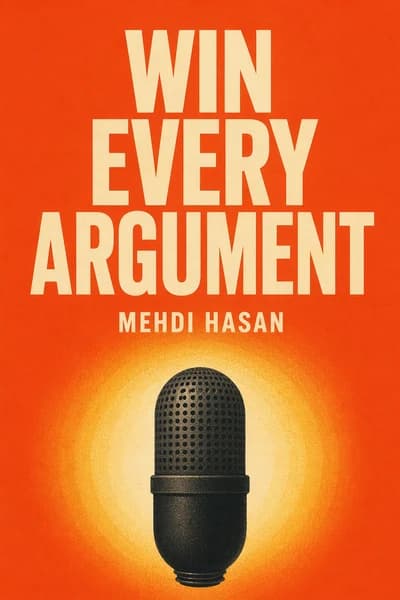
Master debater Mehdi Hasan reveals the ancient art of persuasion that made him MSNBC's most formidable voice. A New York Times bestseller that transforms Aristotle's rhetoric into modern weapons. Why do politicians fear facing him? These techniques work everywhere - from boardrooms to dinner tables.
Mehdi Raza Hasan, author of Win Every Argument: The Art of Debating, Persuading, and Public Speaking, is an award-winning British-American political journalist, broadcaster, and expert in rhetorical strategy.
Known for his incisive interview style and command of debate tactics, Hasan draws on decades of experience as a senior contributor to The Intercept, host of the Deconstructed podcast, and former presenter for Al Jazeera’s UpFront and Head to Head.
His career spans roles at MSNBC, The Guardian, and The New Statesman, where he honed his reputation for challenging power structures and dissecting political discourse. A co-author of Ed: The Milibands and the Making of a Labour Leader, Hasan merges academic rigor with real-world insights from interviewing global leaders and moderating high-stakes debates.
Recognized among the world’s "500 Most Influential Muslims" and a British Muslim Award winner, he founded the independent media platform Zeteo in 2024 to amplify underrepresented voices.
Win Every Argument distills his proven techniques into actionable advice, reflecting his mission to equip readers with tools for intellectual and civic engagement.
Win Every Argument by Mehdi Hasan is a guide to mastering persuasion, debating, and public speaking, blending classical rhetoric with modern tactics. It covers techniques like dismantling the "Gish gallop" (overwhelming opponents with false claims), leveraging the "rule of three" for structuring arguments, and balancing emotional appeals (pathos) with factual evidence (logos). The book draws from Aristotle’s principles, historical examples, and Hasan’s experience as a political debater.
This book is ideal for professionals, students, activists, and anyone seeking to improve their persuasive communication. It’s particularly useful for public speakers, debaters, or those navigating high-stakes discussions (e.g., workplace negotiations, social media debates). Critics note its political slant, so readers seeking bipartisan perspectives may need to supplement with other resources.
To counter the Gish gallop—a tactic flooding arguments with misinformation—Hasan advises:
The “rule of three” structures arguments into three main points (beginning, middle, end) for clarity and memorability. Examples include past/present/future or problem/solution/benefit. Hasan emphasizes this framework helps audiences absorb and retain complex ideas, citing its use by orators like Churchill.
Hasan argues confidence is critical—even surpassing pure competence—because it projects authority and engages listeners. Tips include practicing in low-risk settings (e.g., family debates), maintaining strong posture, and pacing speech. However, he stresses confidence must be paired with factual groundwork to avoid empty rhetoric.
“Receipts” are evidence (quotes, data) used to disprove opponents. Hasan advises:
Critics note Hasan’s occasional self-aggrandizement and politically one-sided examples, which may alienate non-progressive readers. Some argue the strategies assume good-faith opponents, limiting effectiveness in toxic debates (e.g., social media trolling).
Unlike academic texts, Hasan’s book modernizes Aristotle’s ethos, pathos, and logos with actionable steps for digital-era conflicts. It leans less on theory and more on real-world applications, such as rebutting viral misinformation or handling hostile interviewers.
Yes—its focus on critical thinking, evidence-based persuasion, and managing polarized debates remains vital amid AI-driven misinformation and social media fragmentation. However, readers may need to adapt tactics for emerging platforms.
While Hasan uses progressive examples (e.g., debating Trump supporters), he frames techniques as ideologically neutral. However, reviewers caution that his left-leaning lens may oversimplify counterarguments in bipartisan contexts.
Yes. The book advises gradual exposure (e.g., practicing at family gatherings), visualizing success, and refining body language (e.g., eye contact, pacing). It also stresses audience empathy: “Most people want you to succeed”.
Senti il libro attraverso la voce dell'autore
Trasforma la conoscenza in spunti coinvolgenti e ricchi di esempi
Cattura le idee chiave in un lampo per un apprendimento veloce
Goditi il libro in modo divertente e coinvolgente
Winning arguments isn't just an academic exercise-it's a superpower.
Emotions aren't 'intruders in the bastion of reason' but rather 'indispensable for rationality.'
Stories are '22 times more memorable than facts alone.'
Delayed gratification makes receipts more powerful.
Scomponi le idee chiave di Win Every Argument in punti facili da capire per comprendere come i team innovativi creano, collaborano e crescono.
Distilla Win Every Argument in rapidi promemoria che evidenziano i principi chiave di franchezza, lavoro di squadra e resilienza creativa.

Vivi Win Every Argument attraverso narrazioni vivide che trasformano le lezioni di innovazione in momenti che ricorderai e applicherai.
Chiedi qualsiasi cosa, scegli la voce e co-crea spunti che risuonino davvero con te.

Creato da alumni della Columbia University a San Francisco
"Instead of endless scrolling, I just hit play on BeFreed. It saves me so much time."
"I never knew where to start with nonfiction—BeFreed’s book lists turned into podcasts gave me a clear path."
"Perfect balance between learning and entertainment. Finished ‘Thinking, Fast and Slow’ on my commute this week."
"Crazy how much I learned while walking the dog. BeFreed = small habits → big gains."
"Reading used to feel like a chore. Now it’s just part of my lifestyle."
"Feels effortless compared to reading. I’ve finished 6 books this month already."
"BeFreed turned my guilty doomscrolling into something that feels productive and inspiring."
"BeFreed turned my commute into learning time. 20-min podcasts are perfect for finishing books I never had time for."
"BeFreed replaced my podcast queue. Imagine Spotify for books — that’s it. 🙌"
"It is great for me to learn something from the book without reading it."
"The themed book list podcasts help me connect ideas across authors—like a guided audio journey."
"Makes me feel smarter every time before going to work"
Creato da alumni della Columbia University a San Francisco

Ottieni il riassunto di Win Every Argument in formato PDF o EPUB gratuito. Stampalo o leggilo offline quando vuoi.
In today's polarized world, the ability to persuade isn't just useful - it's essential. Mehdi Hasan's "Win Every Argument" offers this superpower to anyone willing to learn. Drawing from his experiences debating figures from Boris Johnson to global leaders, Hasan has created what The Guardian calls "a masterclass in the art of persuasion." What makes this approach particularly valuable is that it doesn't just teach you to win - it teaches you to win with substance, integrity, and style. Whether in boardrooms, classrooms, or family dinners, these techniques transform ordinary conversations into opportunities for meaningful persuasion.