Capitolo 1
The Spectacle's Seductive Illusion
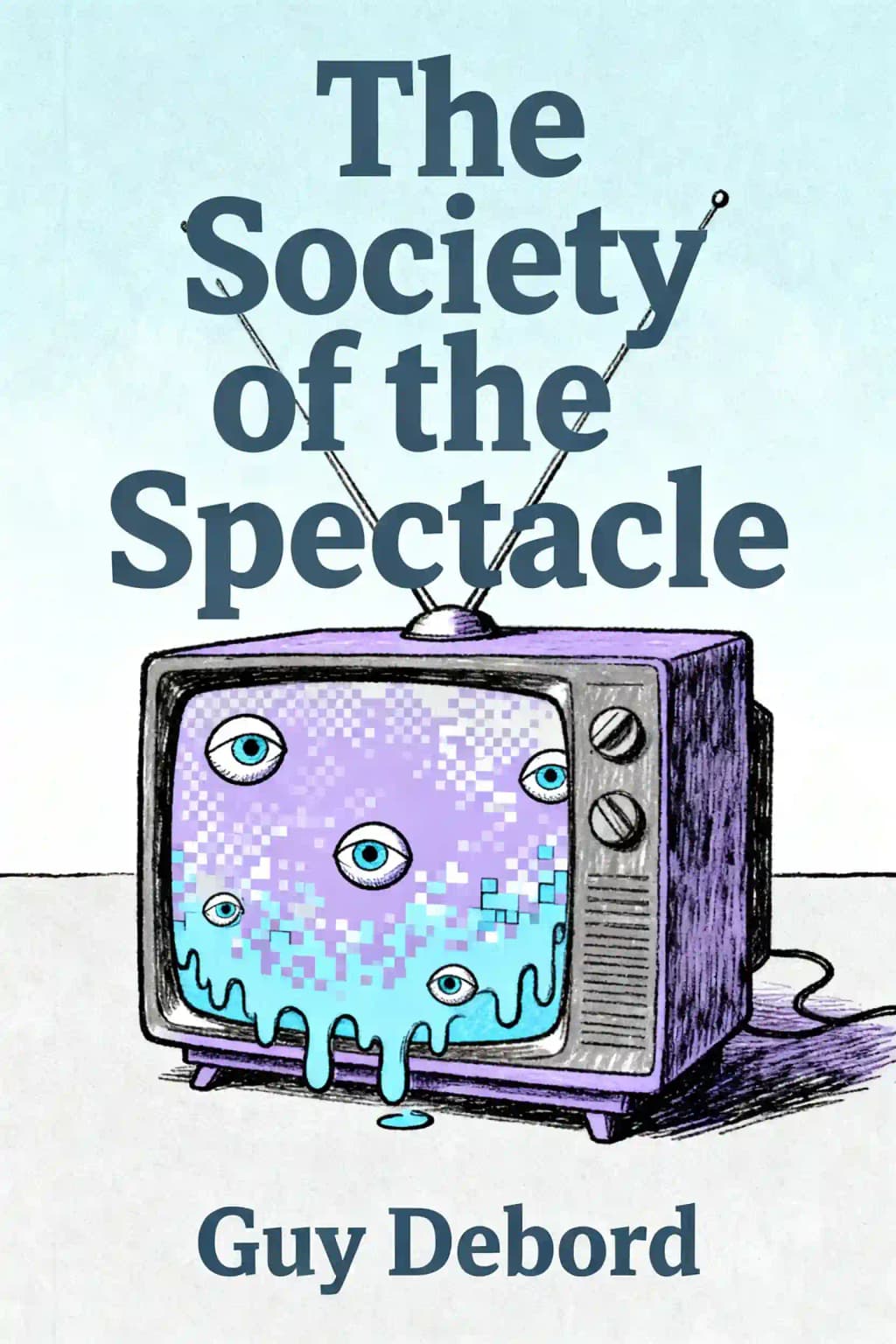
In 1967, a relatively unknown French Marxist philosopher named Guy Debord published a slim volume that would become one of the most prescient critiques of modern society ever written. "The Society of the Spectacle" arrived with little fanfare, yet its influence has steadily grown to become a cornerstone of media criticism and social theory. The book's enduring relevance is remarkable-its analysis of how images mediate our social relationships feels more accurate today than when it was written. Steve Jobs reportedly counted it among his favorite books, while cultural icons from David Bowie to Radiohead have referenced its ideas. During the Occupy Wall Street movement, protesters carried signs with Debord's aphorisms, and contemporary artists like Banksy and Barbara Kruger continue to visually reference his concepts of spectacle and commodification. What makes this dense theoretical text so compelling is its unflinching examination of how modern capitalism has transformed authentic social life into a parade of representations-a world where having has been replaced by merely appearing, and where our relationships with each other are increasingly mediated through images we passively consume rather than experiences we actively create.
Capitolo 2
The Separation of Reality and Representation
At the heart of Debord's analysis lies a fundamental inversion: in modern society, reality has been replaced by its representation. What was once directly lived experience has been relegated to a mere image-a shadow play of authentic life. This separation isn't simply a philosophical abstraction but the concrete foundation of our social organization.
The spectacle isn't merely a collection of images or media saturation, though these are its most visible manifestations. Rather, it represents a social relationship between people that is mediated by images. Think about how we increasingly experience life through screens-smartphones documenting experiences rather than living them, social media profiles carefully curated to project idealized versions of ourselves, news and entertainment that shape our understanding of the world. These aren't just technological developments but fundamental changes in how we relate to each other and to reality itself.
This mediation creates a profound separation. While direct experience forms a continuous flow of emotion and sensation, representational life consists of detached images stripped from their living context. Consider how we scroll through Instagram feeds showing exotic vacations, perfect meals, and curated lifestyles. These aren't just images but fragments of life removed from their context, presented as more real than reality itself. We begin to judge our own lives against these representations, creating a strange paradox where the image becomes more important than the experience it supposedly represents.
The spectacle simultaneously connects and separates us. We share common reference points through media and consumer culture, yet these same forces atomize us into isolated individuals. We might all watch the same television shows or follow the same celebrities, creating an illusion of community while actually preventing authentic connection. This pseudo-connection is particularly evident in social media, where we maintain hundreds of "friendships" while experiencing unprecedented levels of loneliness and isolation.
What makes the spectacle so insidious is how it presents itself as indisputable and inevitable. It says nothing more than "what appears is good, what is good appears." This tautological reasoning creates a closed system that seems impenetrable to criticism. The spectacle demands passive acceptance through its monopoly on appearances, presenting reality as it "must be" rather than as one possibility among many. When we try to imagine alternatives to consumer capitalism, we often find ourselves unable to think beyond its fundamental premises-evidence of how thoroughly the spectacle has colonized our imagination.
Capitolo 3
The Commodity as Life's Organizing Principle
The spectacle represents the moment when the commodity has achieved the "total occupation of social life." No longer merely objects we purchase, commodities have become the organizing principle of our entire existence. This transformation began with the industrial revolution but reached its apex in post-war consumer capitalism, where the economy shifted from addressing basic needs to manufacturing endless pseudo-needs.
In early capitalism, workers were valued only for their labor output and required minimal sustenance. But as commodity abundance became accessible to workers, the ruling class reconsidered this approach, treating workers as consumers whose leisure time became a new frontier for economic expansion. The commodity took on a seemingly humane approach, attending to workers' "leisure and humanity," while actually extending economic control from production to consumption. Our existence thus falls completely under what Debord calls "the total denial of man."
This transformation creates a strange paradox: economic growth liberates society from natural scarcity only to make it dependent on the economy's artificial scarcity. Consider how we've solved basic problems of survival yet find ourselves working longer hours to afford an ever-expanding array of products we're convinced we need. The latest smartphone, fashion trends, luxury vehicles-these aren't responses to genuine needs but manufactured desires that perpetuate economic growth for its own sake.
The spectacle leads individuals to identify personal satisfaction with survival itself, transforming both into commodities. Survival must always increase, creating a continuation of lack-there must never be enough satisfaction, as satisfaction begets additional lack. The accumulation of satisfaction becomes what Debord calls a "gilded poverty" that cannot transcend itself. Think about how acquiring the latest consumer goods provides only fleeting satisfaction before the next model is released, creating an endless cycle of desire and disappointment.
This system creates a profound shift in human values. Debord describes how society has moved from a state of being to having, and now from having to appearing. All actual "having" must draw prestige from appearances, and individual reality depends on social recognition. Your car, home, or clothing aren't valuable primarily for their utility but for what they communicate about your status. This creates a strange inversion where we no longer consume products for their use value but for their sign value-what they represent within the social hierarchy.
The commodity's triumph is complete when exchange value takes precedence over use value. Products are valued not for their utility but for their position within a system of signs. Consider how luxury brands command enormous premiums not because of superior functionality but because of what they signify. The process of exchange binds itself to every possible use, making use secondary to exchange. Exchange value becomes what Debord calls "the condottiere of use value," waging war for market ideological dominance.
Capitolo 4
Unity and Division Within the Spectacle
The spectacle presents itself as simultaneously united and divided, building unity upon disjunction. It appears as society itself, as a part of society, and as a means of unification. As a part of society, it is the sector that concentrates all gazing and all consciousness. Yet due to the very fact that this sector is separate, it is the common ground of the deceived gaze and false consciousness.
This contradiction manifests most clearly in politics, where power struggles between nations, political groups, and parties present themselves as legitimate opponents better equipped to manage society. Despite their apparent differences, they only offer continuation of the status quo. Think about how American political parties engage in fierce rhetoric while maintaining the fundamental structures of capitalism and corporate influence. Their theatrical conflicts mask their essential unity in preserving the spectacle.
The spectacle creates false dichotomies that generate fierce but trivial loyalties. These manufactured oppositions resurrect dormant racism and regionalism, staging pointless confrontations through sporting events and theatrical elections. The supposed conflict between youth and adult cultures merely reflects different modes of consuming the same spectacle. The real dynamic is not generational but the constant replacement of commodities by newer ones-it's the commodities themselves that confront and replace one another.
Within this system, the celebrity functions as the spectacle's living representative, offering individuals a model of an "actually lived life." People compensate for their narrow specialization at work by identifying with celebrities who appear to live complete lives with broad participation. These celebrities embody what specialists can never achieve: exercising power, enjoying leisure, and consuming diverse products. Yet these pseudo-lives offer no real choice, as the celebrity can seemingly participate in both the beginning and end of the production system, experiencing what ordinary individuals cannot.
Each celebrity exists as the opposite of individuality, surrendering their unique identity to become a public commodity. They represent consumable aspects of identity, demonstrating "happiness" across various lifestyles while their contradictory roles are neutralized by apparent excellence in each. The most admired celebrities are those known for their fakeness, famous precisely because they stoop below acceptable individual behavior-think of reality TV stars whose outrageous conduct becomes their primary commodity.
Beneath these false dichotomies lies a unity of poverty-trivial differences maintained within continued alienation. Individuals become united in opposition to each other while real contradictions remain repressed. The spectacle manifests in multiple forms: concentrated (associated with bureaucratic capitalism and dictatorial personalities), diffuse (promoting consumer choice among commodities), and integrated (combining elements of both while maintaining the spectacular society's fundamental misery).
Capitolo 5
Time Transformed: From Cyclical to Spectacular
The spectacle has fundamentally altered our relationship with time itself, transforming it from a dimension of human experience into a commodity to be consumed. This transformation represents one of the most profound ways the spectacle colonizes our lives.
In traditional agrarian societies, time was experienced as cyclical-following the rhythms of seasons, harvests, and natural cycles. This cyclical time allowed for authentic participation in communal events and celebrations that marked the passage of time. Though limited by natural constraints, this experience of time was directly connected to lived reality and shared social experience.
With the rise of capitalism and industrial production, time became irreversible and linear-measured not by natural rhythms but by the clock and the workday. This transformation created what Debord calls "the time of production"-time that has been commodified, segmented into equivalent units that can be bought and sold. Under this regime, "time is everything, man is nothing; at best he is the carcass of time"-a complete devaluation that inverts time's proper role as the space for human development.
Complementing production time is what Debord calls "pseudo-cyclical time"-the time allocated for consumption. Though appearing as free time for workers, it maintains the same characteristics: segmented, fungible units with qualitative dimensions suppressed in favor of quantitative equality. As workers earn more vacation time, it must be used to consume new entertainment products, making "free time" merely the raw material for generating new commodities.
This pseudo-cyclical time functions as a poor substitute for the authentic cyclical time of traditional societies. While no longer bound to natural order, individuals are instead bound to an economic "consumerist-nature" created by alienated labor. This time builds upon vestiges of ancient cyclical rhythms-day and night, work and weekend, holidays, vacations-generating new variations on these natural patterns that serve consumption rather than community.
Consider how contemporary society treats holidays and celebrations. What were once communal festivities marking significant seasonal transitions have become opportunities for increased consumption-Christmas as a shopping season rather than a spiritual celebration, Valentine's Day as an obligation to purchase flowers and chocolates, Halloween as an exercise in consumer spending. These pseudo-festivals poorly parody traditional gift exchange and communal celebration, resulting in expanding disappointment centered on promises of future equally disappointing pseudo-festivals.
The spectacle presents an image of unified blissful consumption while merely postponing awareness of contradictions until the next product disappoints. Each new release promises to resolve our unified pseudo-need-the desire to reconcile contradictory commodities. But like trendy baby names given to an entire generation, commodities promising uniqueness are mass-produced. Products briefly gain prestige at the center of social life before revealing their poor quality at home. Fortunately, another product will soon appear, demanding a new spectacle to tout its potential.
Capitolo 6
The Organization of Territory Under the Spectacle
The spectacle doesn't merely transform time-it fundamentally reorganizes physical space, eliminating geographic uniqueness while creating new forms of separation. This spatial transformation represents capitalism's direct method for appropriating natural and human environments.
Capitalist production has become ubiquitous, breaking down all barriers between societies. This process trivializes unique local customs, traditions, and cultures, commodifying them for global consumption. The global market creates a universal space where local goods and cultures become homogeneous and comparable, stripped of their unique character. Just as medieval craft guilds were destroyed to enable mass production, the autonomy and quality of places must be dissolved to create a standardized landscape suitable for commodity exchange.
As spectacular society eliminates geographic distance through transportation and communication technologies, it simultaneously creates new internal distances through spectacular separation-replacing direct experience with ephemeral recreations and cheap copies. Tourism exemplifies this contradiction, reducing travel to the leisure of seeing what has become banal. Business management techniques applied to travel ensure the equivalence of places, while the same modernization that removed time from travel has also removed the reality of place.
Urbanism serves as the modern method for preserving class power by maintaining atomization of workers even as urban conditions bring them physically together. After the street battles of the Paris Communards in 1871, power structures improved their methods of controlling streets, eventually eliminating them altogether in favor of highways and shopping malls. Lewis Mumford describes this as a "one-way system" where mass communication and sprawling isolation effectively control populations.
For the first time in history, architectural innovation targets the poor rather than the ruling class. Modern architecture no longer creates ornate, unique places but reproduces aesthetically bankrupt mass habitats dictated by production conditions. At their core lies an authoritarian decision-making process where profit-driven corporations work with municipalities to abstract local environments into interchangeable spaces. This architecture develops identically worldwide, with the same designs, materials, and international businesses appearing everywhere.
We now witness what Debord calls "the destruction of organic urban environments" by an urbanism that explodes cities and litters countryside with what Mumford calls "formless mass of thinly spread semi-urban tissue." This explosion manifests in strip malls, franchises, and landscapes designed for automobile-oriented consumption. The dictatorship of the automobile-the first product of commodity abundance-reconfigures human environments around speed and parking, creating centrifugal trends away from cities. Highways dislocate historical centers in favor of flat expanses, while the countryside develops around temporary "distribution factories"-poor urban center copies alienated from their surroundings by parking lots.
Unlike cities that mix people together, the countryside traditionally demonstrated isolation and separation. Modern urbanism replaces cities with pseudo-countryside devoid of connection to nature or traditional social structures. This creates what Debord calls a "new artificial peasantry," isolated not by physical distance but by architectural separation, blinded not by simple ignorance but by spectacular images that recreate simplemindedness. These "new cities" break completely from historical time, creating an unchanging present where "nothing will ever happen, and nothing ever has"-landscapes composed of historical absence.
Capitolo 7
Culture's Self-Negation in the Spectacle
Culture in a class-divided historical society is the sphere of shared ephemeral knowledge that exists independently as a division of intellectual labor. When culture detaches from history, it loses its unifying power and opposites become autonomous. Culture's drive for independence gradually undermines its historical basis, negating itself. The history that creates culture's relative autonomy is expressed as culture's history-a gradual march toward self-destruction.
The struggle between tradition and innovation driving historical societies' cultural development can only be sustained through innovation's permanent victory. Yet when history discovers its totalizing role in culture, it tends to suppress all alternatives, asserting itself as the dominant force. This freezes historical society into a specific ideological period, making the "time of production" an unchanging fact while allowing only superficial cultural changes.
The end of cultural history manifests in two opposing forms: culture as a specific domain attempting to transcend history, and the maintenance of ossified culture presented for spectacular contemplation. The first form links itself to social criticism, while the second defends ruling class power. Both exist under a unitary field within knowledge and sensory representation.
When art achieves independence, it represents reality with such flourish that reality itself seems dull by comparison. Reality can no longer be perceived in its full beauty, available only through memory or nostalgia. The greatness of art appears at the dusk of life, when lived experience has already faded. This creates a strange paradox where artistic representations of life seem more vibrant than life itself, encouraging passive contemplation rather than active participation.
The spectacular society consumes past art and culture, stripping it of original meaning and context while preserving only superficial forms devoid of communicative power. This consumption indiscriminately absorbs both positive and negative cultural elements, resulting in what Debord calls "the communication of the incommunicable." The spectacle's primary function is to bury historical memory beneath decontextualized artifacts, creating a parade of pseudo-novelty while maintaining modernist ideology at its core.
Once commodified, culture becomes the flagship product in spectacular society. Clark Kerr observed that knowledge production, distribution, and consumption already accounted for 29% of US gross domestic product in the 1960s, predicting the knowledge industry would drive the second half of the 20th century just as automotive drove its first half and railroads drove the latter 19th century. This prediction has proven remarkably accurate, as information and cultural products have become central to contemporary capitalism.
Capitolo 8
Ideology Materialized: The Spectacle as Concrete Reality
Ideology forms the intellectual foundation of class societies throughout history. Rather than pure fiction, ideological facts present distorted perspectives of reality that influence human actions, which in turn produce effects that materialize the very ideology underpinning them. Through autonomous economic production, ideology manifests concretely as the spectacle, creating a social reality built upon false beliefs that remodel reality in ideology's image.
The spectacle is ideology par excellence, exhibiting the essence of all ideological systems: oversimplification, impoverishment, and negation of real life. It isolates individuals on false islands of separate reality, establishing what Debord calls "the new power of deception" as the basis of spectacular power. Through the proliferation of images and personalized media, this alienated unreality has replaced lived experience with manufactured need-primarily the need for money. The spectacle transforms human decisions into considerations of economic value, privileging wealth over life itself.
When ideology becomes materialized through the spectacle, it no longer needs to prove its claims. What were once historical choices become accepted facts; ideological pretensions become reality itself. Even the names of alternative ideologies vanish as irrelevant. Materialized ideology has no name or historical agenda; it pretends to be simply "the way it is" and "the way it will always be." The history of coexisting ideologies is over, replaced by a single totalizing worldview that presents itself as natural and inevitable.
The spectacle disintegrates lived reality, replacing it with a flattened image-world that separates individuals from authentic experience. Like schizophrenics, we become mere spectators unable to participate meaningfully in our own lives, alienated from genuine events and relationships. We no longer recognize friends, family, or ourselves-only celebrities, those fictitious interlocutors who subject us to one-way dialog promoting consumption. The spectacle becomes our "mirror sign," a false reflection mistaken for reality itself, trapping us in a socialized form of autism.
The spectacle obliterates boundaries between self and world through constant sensory siege, erasing distinctions between true and false by burying authentic experiences beneath mediated falsehoods. Individuals are condemned to passive resignation, experiencing life primarily through proxies. This creates an infantile dependency on conspicuous consumption as the only pseudo-response to one-way communication. We desperately seek representation in the spectacle to alleviate what Debord calls "the torturing feeling of being on the edge of existence," exhibiting schizophrenic behaviors as we search for reality through consumption.
Capitolo 9
Reclaiming Authentic Life Beyond the Spectacle
Despite the spectacle's seemingly total domination, Debord's analysis isn't merely descriptive but prescriptive. He outlines possibilities for resistance and transformation, pointing toward ways we might reclaim authentic life from the grip of the spectacle.
Self-emancipation today requires liberation from our material basis in falsified reality. The "historic mission of establishing truth in the world" cannot be accomplished by isolated individuals or manipulated masses, but only by what Debord calls "the class that is able to dissolve all classes"-the working class-through participatory democracy in workers' councils. Here, practical theory validates itself through action when individuals become "directly linked to world history" and dialog within the council confronts and defeats its own conditions.
The revolutionary project of a classless society requires an inclusive historical life where all can participate in their own time. This means replacing singular historical time with a federated multiplicity of independent, playful times that can unite voluntarily-a communism suppressing spectacular media-driven histories and "abolishing everything that exists independently of individuals." The world has already dreamt of such a time-it has only to wake and remember to really live it.
A consciousness of history that threatens the spectacle can reappropriate space for lived time. The proletarian revolution is the critique of human geography, environments, and social relationships. Through revolutionary acts, individuals must construct environments that provide autonomous control of their labor and history. Revolution opens space to a dynamic play with informal, freely chosen rules. These open societies liberate authoritarian spaces while rediscovering the unique character of places without exclusivity.
The most revolutionary idea about urban development isn't from urbanism, technology, or aesthetics, but the decision to reconstruct the environment according to the needs of workers councils. The environment will be configured by the anti-state dictatorship of the proletariat-a collective form of self-management creating public good. The workers councils' power can only be effective if it transforms the totality of existing conditions, not settling for trivial reformist policies but demanding total transformation to recognize itself in a world of its own making.
The real negation of culture is the only way to preserve its value. This negation cannot be merely cultural-opposing dominant culture with "counterculture" is insufficient. What remains after negating culture's cultural aspects must exist at the level of everyday life-universally accessible, meaningful, and pointing beyond itself. The language of contradiction offers a unified critique of culture that dominates the whole cultural sphere, manifesting as knowledge integrated with poetry. This theoretical critique of society cannot be separated from its manifestation as unified social practice.
Debord's vision ultimately calls for a society where individuals directly participate in creating their own history rather than passively consuming representations of life. This requires not just political revolution but a complete transformation of everyday life-reclaiming time, space, and culture from the grip of the spectacle. Only through this total transformation can we move from the society of the spectacle to a society of lived experience, from alienation to authentic connection, from passive consumption to active creation.