Capitolo 1
Cake, Chaos, and the Guillotine's Shadow
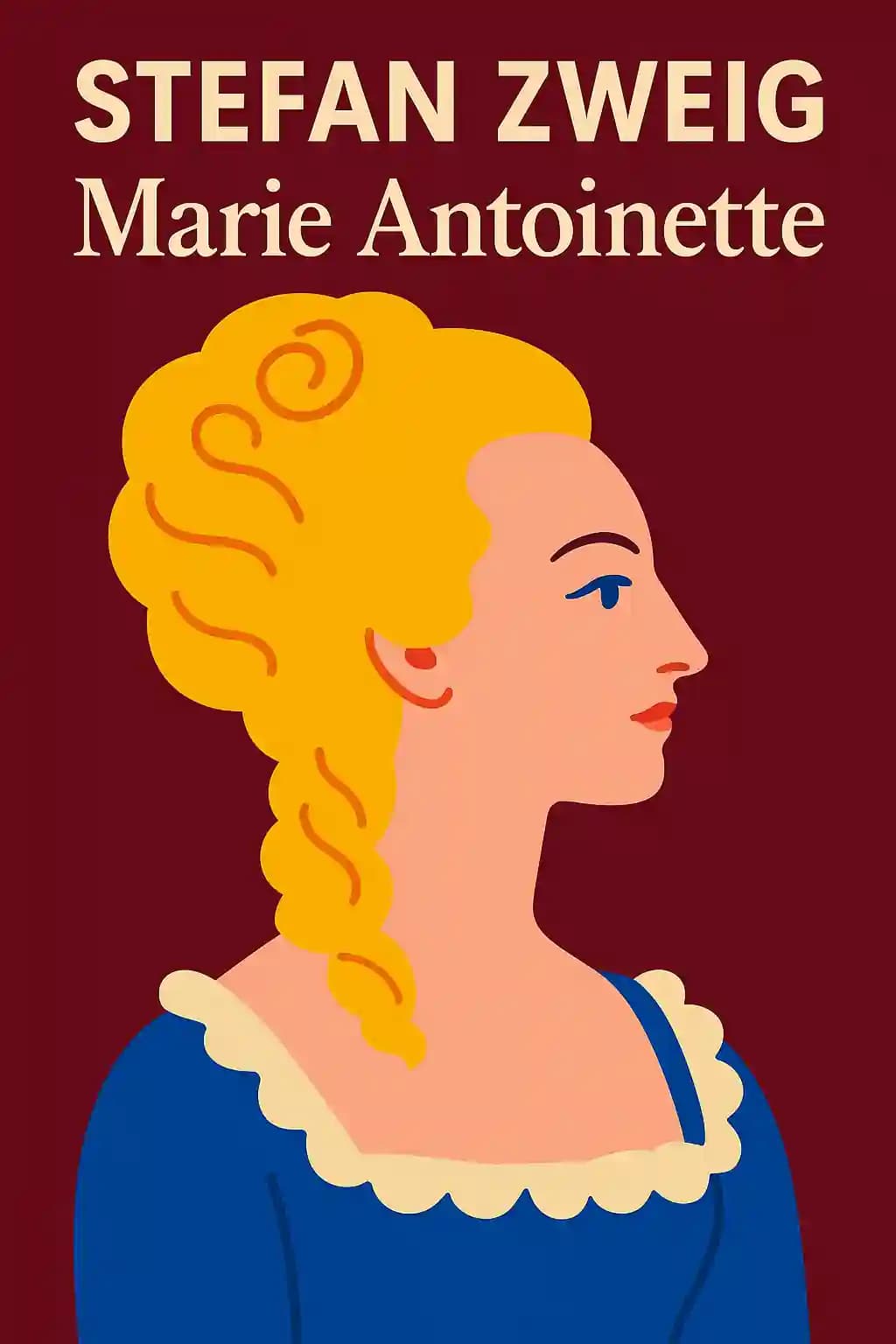
History remembers her for "Let them eat cake," but Stefan Zweig's masterful biography reveals Marie Antoinette as something far more fascinating: a woman who grew into her power too late. Written while Zweig fled Nazi persecution, this portrait of France's most misunderstood queen has been hailed as one of the greatest biographical works of the 20th century - even Freud himself praised Zweig's psychological insights.
From frivolous teenage bride to dignified prisoner awaiting the blade, Zweig traces how an unprepared Austrian archduchess became the lightning rod for a revolution. The narrative pulls you into the perfumed corridors of Versailles, where Marie Antoinette's extravagance masked her desperate loneliness in a loveless political marriage.
What makes this biography extraordinary is Zweig's compassionate yet unflinching examination of transformation under pressure. As the guillotine approaches, we witness not just the fall of monarchy but the emergence of human courage. This isn't merely history - it's a psychological thriller about a woman discovering her strength precisely when it's too late to save her.
Capitolo 2
A Child Bride in the Game of Empires
Marie Antoinette's destiny was sealed before she could comprehend it. Born an Archduchess of Austria, she became a pawn in the grand diplomatic chess match between the Habsburgs and the Bourbons. Her mother, the formidable Empress Maria Theresa, orchestrated her daughter's marriage to the future Louis XVI of France with cold political calculation, viewing the union as a means to secure the fragile alliance between historical rivals.
The young Marie Antoinette grew up in the opulent surroundings of Schonbrunn Palace, where her education proved woefully inadequate for her future role. Under the tutelage of Abbe Vermond, she displayed a natural vivacity and charm but little inclination toward serious study. Her mother lamented this intellectual indifference but recognized her daughter's social graces would serve her well at the French court.
At fourteen, Marie Antoinette faced the terrifying prospect of leaving everything familiar behind. The ceremonial handover at the Rhine border embodied the brutal symbolism of her transition-stripped of her Austrian clothes and possessions, even her little dog, she was dressed entirely in French garments, symbolically reborn as a daughter of France. Standing naked between two worlds, the young girl wept as strangers dressed her in foreign clothes, a moment that captured the essential loneliness of her position.
The journey to Versailles unfolded like an elaborate theatrical production. Towns and villages erupted in celebration as she passed, the people of France initially enchanted by this young, beautiful princess. Yet even amid the festivities, omens of future trouble appeared-in Strasbourg, she received a blessing from Cardinal de Rohan, the very man who would later become entangled in the scandal that would help destroy her reputation.
Capitolo 3
Versailles: A Gilded Cage
Life at Versailles immediately presented Marie Antoinette with a paradox-surrounded by luxury and hundreds of attendants, she found herself profoundly alone. The rigid etiquette that governed every moment of her day suffocated her natural spontaneity. Even the most intimate activities, from dressing to eating, were performed as public ceremonies with dozens of observers.
The marriage itself began disastrously. Louis, awkward and shy, proved unable to consummate the union-a problem that would persist for seven long years. This intimate failure quickly became a matter of international diplomacy, with Marie Antoinette's mother demanding regular reports on the royal bedchamber. The young dauphine found herself in the humiliating position of having her most private struggles dissected by diplomats and courtiers.
"What can I do?" she wrote to her mother. "I cannot force him."
The unconsummated marriage had profound political implications. The king's brothers, particularly the Count of Provence, began to position themselves as potential heirs, creating factions that would later turn against Marie Antoinette. When Louis finally overcame his physical issues through a minor surgical procedure, the resulting pregnancy neutralized these ambitions-and transformed former allies into bitter enemies.
Frustrated by her husband's emotional and physical distance, Marie Antoinette sought refuge in a small circle of friends and a whirlwind of amusements-gambling, theater, masked balls, and increasingly extravagant fashions. Her friendship with the glamorous Princesse de Lamballe and later the Comtesse de Polignac provided emotional sustenance but created jealousy among the excluded nobility.
Capitolo 4
Queen of the Rococo
When Louis XV died of smallpox in 1774, Marie Antoinette became Queen of France at just eighteen. The contrast between the new royal couple could not have been more stark. Louis XVI was fundamentally decent but chronically indecisive, more interested in his locksmithing hobby and hunting than in governing. Marie Antoinette, vibrant and impulsive, found herself married to a man who seemed the embodiment of inertia.
"There are times," she confided to a friend, "when I feel I am speaking to a wall."
The young queen embraced her position as arbiter of taste and fashion. Under her influence, Versailles became the epicenter of the Rococo style-ornate, playful, and exquisitely frivolous. Her dressmaker, Rose Bertin, achieved unprecedented influence, and the queen's elaborate hairstyles (sometimes reaching three feet in height) became the talk of Europe.
Marie Antoinette's extravagance wasn't exceptional for her position, but her timing was catastrophic. As France's financial situation deteriorated, her spending became a visible symbol of aristocratic excess. The nickname "Madame Deficit" began to circulate, unfairly blaming her for financial problems that had begun long before her arrival in France.
Her retreat to the Petit Trianon, a small chateau on the grounds of Versailles that Louis XVI gave her as a gift, further isolated her from court life. There, she created an intimate world where strict etiquette was relaxed, and she could enjoy the company of her favorites without the suffocating formality of Versailles. She built a rustic hamlet where she could play at being a shepherdess-a fantasy of simplicity that would later be used against her when revolutionaries portrayed her as mocking peasant life.
Capitolo 5
The Awakening of Conscience
In 1777, Marie Antoinette's brother, Emperor Joseph II of Austria, made a pivotal diplomatic visit to France that would profoundly impact his sister's life. As a ruler known for his reformist policies and austere lifestyle, Joseph was deeply disturbed by what he witnessed at Versailles. Appalled by his sister's frivolity, her excessive gambling habits, and the visible dysfunction of her marriage to Louis XVI, he delivered a blistering assessment of her conduct that would echo through history.
In a remarkable letter that spanned several pages, he outlined her failings with brutal clarity. "Your days begin late, are consumed by empty amusements, and end in frivolous company," he wrote. He questioned not only her daily routines but also her choice of intimate friends, particularly her close relationship with the Princesse de Lamballe and Duchesse de Polignac, whom he viewed as self-serving courtiers. Most damning was his criticism of her neglect of serious matters of state and her role as France's queen.
"What have you accomplished in the position God has placed you?" he demanded, adding with particular sharpness, "You read little, and reflect less." He warned her that such behavior was not merely a personal failing but a threat to the very institution she represented. The emperor reminded her that queens were not merely ornamental figures but vital participants in the machinery of state.
This fraternal intervention marked a decisive turning point in Marie Antoinette's life. Though she initially bristled at her brother's harsh words, describing them in letters to her mother as "unnecessarily cruel," the criticism gradually penetrated her conscience. The timing proved fortuitous, as significant personal changes soon followed. When she finally gave birth to a daughter, Marie Therese, in 1778, and then to Louis-Joseph, the long-awaited Dauphin, in 1781, motherhood began to transform her priorities and behavior.
The queen notably withdrew from the social whirl that had defined her early years at Versailles. She spent increasing amounts of time at the more intimate Petit Trianon and focused on raising her children, taking an unprecedented personal interest in their education and daily care. She also began showing more attention to matters of state, attending council meetings and engaging in political discussions with ministers.
Yet this transformation, however genuine, came too late to repair her severely damaged public image. Years of gossip, scandal, and strategic character assassination had already cemented her reputation as frivolous and morally corrupt in the public mind. The circulation of pornographic pamphlets, known as libelles, reached unprecedented levels, depicting the queen in increasingly outrageous sexual scenarios. These scandalous publications portrayed her in fictional liaisons with everyone from her female friends to members of the royal guard, and even foreign diplomats.
These libelles, often professionally printed and widely distributed, were not merely the product of popular discontent. Historical evidence reveals they were frequently funded and orchestrated by her political enemies, particularly the Duke of Orleans, who harbored ambitions to undermine the monarchy. This coordinated campaign of character assassination proved remarkably effective, creating a toxic narrative about the queen that would persist until the Revolution and beyond, despite her genuine attempts at personal reform.
Capitolo 6
The Diamond Necklace Affair: A Fatal Blow to Reputation
In 1785, Marie Antoinette became unwittingly entangled in a scandal that would irreparably damage her reputation. The "Diamond Necklace Affair" was a byzantine scheme orchestrated by Jeanne de la Motte, a con artist with noble pretensions. De la Motte convinced Cardinal de Rohan-who desperately wanted to regain favor with the queen-that Marie Antoinette secretly desired an enormously expensive diamond necklace but couldn't purchase it publicly.
The cardinal agreed to act as intermediary, securing the necklace from jewelers Boehmer and Bassenge. De la Motte arranged a nighttime meeting in the gardens of Versailles where an actress impersonated the queen, thanking Rohan for his assistance. Once the cardinal obtained the necklace, de la Motte and her husband promptly broke it up and sold the diamonds.
When the jewelers demanded payment from the queen, the scheme unraveled. Marie Antoinette, outraged at the use of her name, demanded a public trial. Louis XVI agreed, and Cardinal Rohan was arrested dramatically during a palace ceremony.
The trial became a sensation, with the public following every detail. Though the evidence clearly showed Marie Antoinette had no involvement, the verdict delivered a devastating blow. The cardinal was acquitted, implicitly suggesting the queen might have been involved after all. De la Motte was branded and imprisoned but later escaped to London, where she published scandalous "memoirs" further implicating the queen.
The affair confirmed what many already believed-that the court was corrupt, the queen untrustworthy, and the monarchy itself a decadent institution. As Zweig notes, "The diamond necklace was never worn by Marie Antoinette, but it strangled the monarchy."
Capitolo 7
Revolution Dawns
By 1788, France teetered on the brink of financial collapse. Decades of costly wars, including the Seven Years' War and the American Revolution (which France had supported to spite Britain), had drained the treasury. The situation was exacerbated by an archaic and inefficient tax system where the wealthy nobility and clergy were largely exempt, placing the burden on the already struggling common people. The royal court's lavish spending, though only a fraction of the deficit, became a lightning rod for public criticism. Louis XVI, after exhausting all other options and facing a deficit of over 140 million livres, reluctantly called the Estates-General, a representative assembly that hadn't met since 1614.
As political tensions mounted, Marie Antoinette found herself increasingly isolated at Versailles. Her inner circle began to crumble as close friends like the Duchesse de Polignac and the Comte d'Artois fled France, sensing the gathering storm. The Princesse de Lamballe remained steadfastly loyal, providing emotional support during these troubled times. The Swedish Count Axel von Fersen also stood by the queen, and their relationship has intrigued historians for centuries. Their surviving correspondence reveals an intimate emotional connection, with coded messages and passionate declarations of loyalty. While some historians argue for a physical affair, others see a deep platonic bond between two lonely souls caught in the machinery of statecraft.
When the Estates-General convened in May 1789, the proceedings quickly revealed deep structural problems in French society. The Third Estate, representing 98% of the population but allocated only one vote (equal to that of the clergy or nobility), demanded proportional representation and constitutional reforms. The deadlock over voting procedures - by order or by head - became a crucial turning point. The Third Estate's bold declaration of itself as the National Assembly on June 17, followed by the Tennis Court Oath three days later, marked a decisive break with traditional authority. Louis XVI's characteristic indecision proved disastrous - he wavered between conciliation and repression, ultimately satisfying neither reformers nor conservatives.
On July 14, 1789, the simmering tensions exploded when Parisians stormed the Bastille, a royal prison that had come to symbolize arbitrary monarchical power. Though the fortress held only seven prisoners at the time, its fall became an iconic moment that marked the revolution's beginning. The event demonstrated the power of collective action and the weakness of royal authority. In its aftermath, a wave of peasant uprisings known as the "Great Fear" spread across France, and municipal governments fell into the hands of revolutionaries. While few at this stage advocated for the abolition of monarchy itself, the traditional foundations of royal power had been irreparably shaken. Marie Antoinette, perhaps more politically astute than her husband, reportedly remarked, "This is no longer a revolt, it is a revolution."
Capitolo 8
From Palace to Prison
In October 1789, a mob marched from Paris to Versailles, demanding that the royal family return to the capital. After a night of violence in which several of the queen's guards were killed, Louis XVI agreed. The royal family was escorted to Paris, taking up residence in the Tuileries Palace under what amounted to house arrest.
Marie Antoinette, now thirty-four, underwent a remarkable transformation. The frivolous queen disappeared, replaced by a woman of dignity and courage. She took charge of negotiations with various political factions, showing more resolve than her vacillating husband. She corresponded secretly with foreign powers, seeking intervention to restore royal authority, while outwardly appearing to accept constitutional limits on the monarchy.
In June 1791, the royal family attempted to flee Paris in disguise, hoping to reach royalist strongholds in eastern France. The escape was meticulously planned by Count von Fersen but failed due to a series of delays and the king's recognizable face on French currency. They were stopped at Varennes, just short of their destination, and returned to Paris under guard.
This flight shattered any remaining trust between the people and their king. Though the revolutionary leadership initially maintained the fiction that the king had been "kidnapped," the constitutional monarchy was effectively dead. In September 1792, the monarchy was formally abolished, and the royal family was imprisoned in the Temple, a medieval fortress.
Capitolo 9
The Final Descent
The months that followed brought escalating horrors. Louis XVI was tried for treason, condemned to death, and guillotined on January 21, 1793. Marie Antoinette, now known simply as "the Widow Capet," remained in prison with her two children and her sister-in-law, Madame Elisabeth.
In July, revolutionary authorities separated the queen from her eight-year-old son, Louis-Charles. The boy was placed under the guardianship of a cobbler named Simon, who was instructed to raise him as a "son of the revolution." This separation broke Marie Antoinette's spirit more than any other cruelty she endured.
In August, she was transferred to the Conciergerie, a prison known as "the antechamber to death." There, in a damp cell with only the most basic furnishings, she awaited her inevitable trial. Her health deteriorated rapidly-her hair turned white, she suffered from hemorrhages, and her once-elegant appearance became haggard.
On October 14, 1793, Marie Antoinette faced the Revolutionary Tribunal. The charges against her were a mixture of political accusations and obscene fabrications, including the monstrous claim that she had sexually abused her own son. Despite exhaustion and illness, she defended herself with remarkable dignity, answering each charge clearly and calmly.
When asked to respond to the accusation involving her son, she rose to her full height and addressed the mothers in the audience: "If I have not answered, it is because Nature itself refuses to respond to such a charge against a mother. I appeal to all mothers here present."
The verdict was never in doubt. After a two-day trial, Marie Antoinette was found guilty and sentenced to death. She spent her final night writing a moving letter to her sister-in-law, entrusting her with the care of her surviving children. The letter was never delivered.
Capitolo 10
The Final Journey
On the morning of October 16, 1793, Marie Antoinette was taken to the guillotine in an open cart, her hands bound tightly behind her back. Her once-magnificent hair, which had been a symbol of her royal status and feminine beauty, was roughly cut short to accommodate the blade. Despite the humiliation of being displayed before the masses, witnesses, including several foreign diplomats and even her critics, recorded their astonishment at her extraordinary composure during the two-hour journey through Paris streets filled with jeering crowds.
The revolutionary artist Jacques-Louis David, who had previously dedicated his talent to celebrating the revolution's triumphs, was moved to sketch her final journey. His hastily drawn but powerful sketch captured an unexpected dignity - the former queen sat straight-backed in the crude cart, her face showing neither fear nor defiance, but rather a profound calm that seemed to transcend her circumstances. This sketch would later become one of the most poignant documents of the Revolution's human cost.
Historical accounts note that she remained stoic throughout the procession, even as crowds hurled insults and revolutionary songs filled the air. When she finally reached the Place de la Revolution (today's Place de la Concorde), she mounted the scaffold with remarkable poise. In what would become one of history's most memorable displays of aristocratic composure, she accidentally stepped on the executioner's foot and immediately apologized, saying, "Pardon me, sir. I did not mean to do it." This final act of courtesy, minutes before her death, spoke volumes about her character.
At precisely 12:15 PM, the blade fell, ending the life of a woman whose journey had been extraordinary - from the pampered archduchess of Austria to the Queen of France, and finally to prisoner number 280 of the Revolution. She was thirty-seven years old, her hair had turned completely white during her imprisonment, and she had aged well beyond her years due to the hardships she had endured.
The treatment of her remains reflected the revolution's attempt to erase all traces of royalty. Her body was unceremoniously thrown into an unmarked grave in the Madeleine cemetery and covered with quicklime to hasten decomposition - a final indignity for a woman who had once been the most glamorous figure in Europe. Twenty-two years later, during the Bourbon Restoration of 1815, King Louis XVIII ordered her remains to be exhumed. In a solemn ceremony that sought to restore dignity to the monarchy, her remains, along with those of Louis XVI, were reinterred in the royal crypt at the Basilica of Saint-Denis, joining centuries of French royalty in their final resting place.
The site of her original burial at the Madeleine would later become the location of a chapel of expiation, built to commemorate both Louis XVI and Marie Antoinette, standing today as a reminder of this dramatic chapter in French history.
Capitolo 11
The Verdict of History
Zweig's biography presents Marie Antoinette not as the frivolous villain of revolutionary propaganda nor as the saintly martyr of royalist hagiography, but as a woman of ordinary talents thrust into extraordinary circumstances. Her tragedy lies not in her death but in her late awakening to the seriousness of her position-an awakening that came too late to save her or the monarchy.
"Only when history's hammer struck her anvil-hard did her character emit a pure, noble sound," Zweig writes. "Suffering made her great."
The historical Marie Antoinette never said "Let them eat cake" when told the people had no bread-this quote was attributed to an unnamed princess in Jean-Jacques Rousseau's Confessions, written when Marie Antoinette was still a child in Austria. Yet the quote persists because it captures something essential about the disconnect between Versailles and the reality of French life.
What emerges most powerfully from Zweig's account is the transformation of Marie Antoinette under pressure. The queen who faced the revolutionary tribunal with dignity bore little resemblance to the thoughtless young woman who had played at being a shepherdess while France starved. Adversity revealed qualities that prosperity had concealed.
In the end, Marie Antoinette's story resonates not because she was exceptional, but because she was human-flawed, complex, capable of both frivolity and courage. Her journey from privileged obliviousness to tragic awareness mirrors the journey many of us make through life, though few with such dramatic consequences. In her, we see the human capacity for growth even in the face of catastrophe-a reminder that character is revealed not in times of ease but in moments of greatest trial.