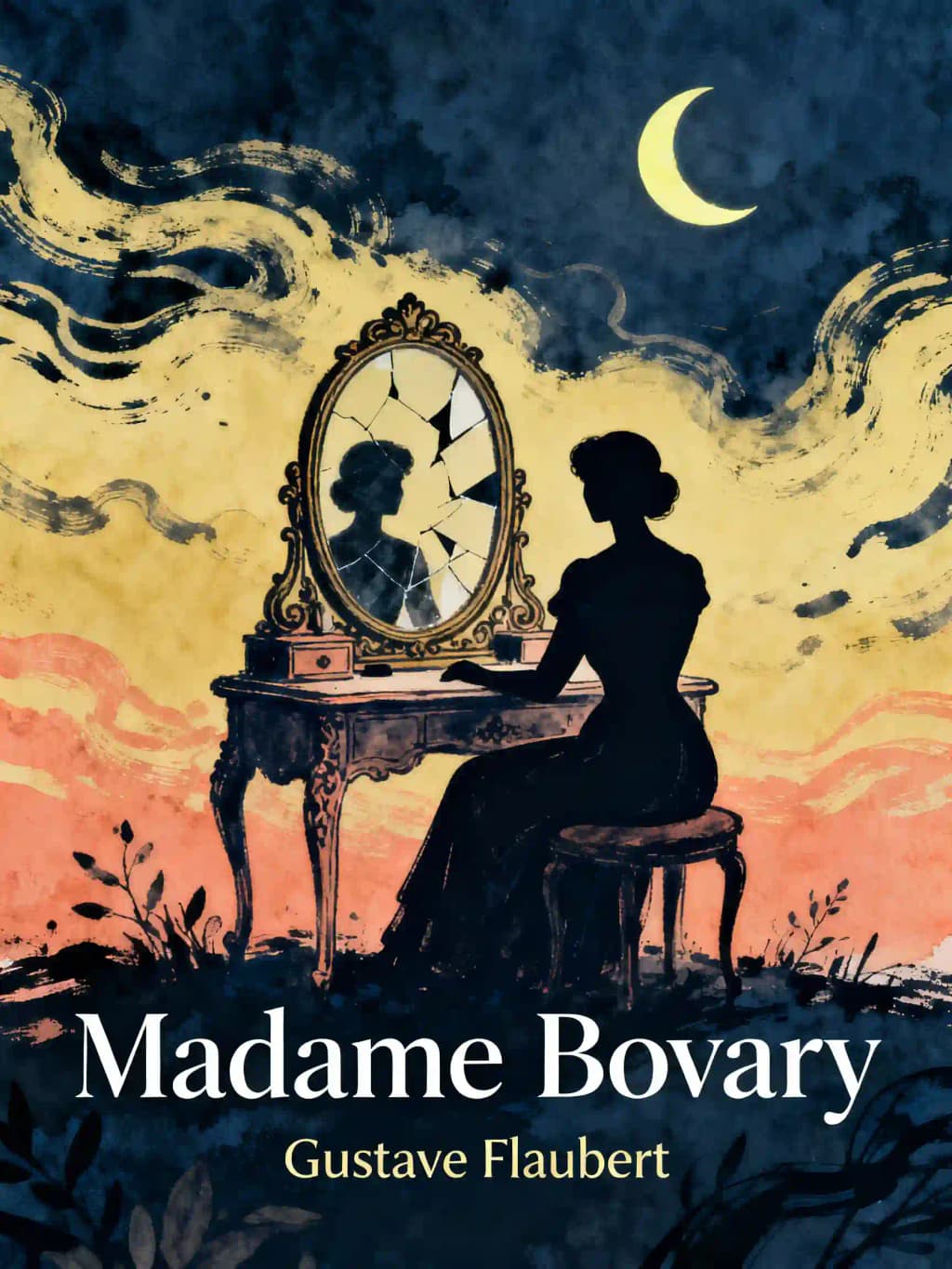
Madame Bovary
Panoramica di Madame Bovary
Flaubert's scandalous masterpiece - once prosecuted for indecency - revolutionized literature by rejecting romanticism for brutal realism. Emma Bovary's passionate downfall inspired Mario Vargas Llosa and sparked film adaptations, proving that society's most dangerous threat might be a bored provincial wife.

Temi chiave in Madame Bovary
- provincial boredom
- romantic disillusionment
- bourgeois mediocrity
- financial ruin
- escapist fantasy
Citazioni da Madame Bovary
Human speech is like a cracked kettle on which we tap crude rhythms for bears to dance to, while we long to make music that will melt the stars.
She wanted to die, but she also wanted to live in Paris.
Madame Bovary, c'est moi!
prose doing what poetry is supposed to do
supreme unapproachable assurance.
Personaggi di Madame Bovary
- Emma BovaryA provincial wife with tragic romantic illusions
- Charles BovaryA good-hearted but mediocre country doctor
- HomaisA self-serving provincial pharmacist
- RodolpheA callous and wealthy seducer
- Gustave FlaubertThe author who pioneered psychological realism
Sull'autore
Sull'autore di Madame Bovary
Gustave Flaubert (1821–1880) was a French novelist and leading exponent of literary realism, cementing his legacy with the 1857 masterpiece Madame Bovary. A scathing exploration of bourgeois morality and romantic disillusionment, the novel exemplifies Flaubert’s obsession with stylistic precision and psychological authenticity, developed through his habit of declaiming drafts aloud to refine their rhythm. Born in Rouen and educated as a reluctant law student, Flaubert drew inspiration from his travels across North Africa and observations of French society under the July Monarchy. His other major works include Sentimental Education, a panoramic portrait of 19th-century France, and Salammbô, a meticulously researched historical novel set in ancient Carthage.
Flaubert’s correspondence with contemporaries like George Sand and protégé Guy de Maupassant remains essential reading for insights into his creative process. Known for declaring "Madame Bovary, c’est moi," he transformed personal struggles with societal constraints into universal critiques. The novel’s controversial trial for obscenity in 1857 only heightened its fame, securing its status as a cornerstone of modern fiction. Translated into over 50 languages and adapted into numerous films and operas, Madame Bovary continues to be required reading in literature courses worldwide.
Scarica il riassunto di Madame Bovary
Ottieni il riassunto di Madame Bovary in formato PDF o EPUB gratuito. Stampalo o leggilo offline quando vuoi.
FAQ su questo libro
Madame Bovary follows Emma Bovary, a doctor’s wife in rural 19th-century France, whose obsession with romantic ideals leads her to pursue extramarital affairs and reckless spending. The novel explores themes of dissatisfaction, societal constraints on women, and the clash between romantic fantasy and mundane reality. Flaubert’s realist style critiques bourgeois life and the dangers of escapism.
This classic appeals to literature students, fans of psychological realism, and readers interested in feminist critiques of 19th-century society. Its layered themes on desire, morality, and gender roles make it valuable for those analyzing historical social dynamics or Flaubert’s influence on modern fiction.
Yes. Hailed as a masterpiece of realism, the novel offers sharp social commentary, rich symbolism, and a timeless exploration of human longing. Despite its 1857 obscenity trial, Flaubert’s precise prose and unflinching portrayal of Emma’s downfall ensure its relevance in literary canon.
Key themes include:
- Dissatisfaction: Emma’s relentless yearning for excitement beyond her provincial life.
- Freedom vs. confinement: Her entrapment in gender roles and financial dependency.
- Illusion vs. reality: Romantic fantasies clashing with societal norms.
- Wealth and materialism: Money as both a corrupting force and false salvation.
By contrasting Emma’s melodramatic ideals (shaped by romance novels) with the banality of her affairs and debts, Flaubert exposes romanticism’s destructive delusions. The novel’s irony lies in using lush prose to depict mediocrity, warning against mistaking art for life.
Emma seeks to escape boredom and societal repression through affairs, luxury, and self-mythologizing. Her education in romantic novels fuels a belief in transcendent love, blinding her to the consequences of her choices.
- The blind beggar: Represents moral decay and Emma’s spiritual blindness.
- Windows: Symbolize Emma’s longing for escape.
- Money: Embodies false promises of happiness and control.
Emma’s lack of agency—constrained by marriage laws and financial dependence—highlights 19th-century gender inequality. Her affairs and spending become futile attempts to claim autonomy in a male-dominated world.
Flaubert faced obscenity charges for depicting adultery and Emma’s sexual agency. Critics accused it of undermining morality, though Flaubert argued it showed the consequences of immorality. The trial solidified its status as a literary landmark.
Unlike Dickens’ social panoramas or Balzac’s detailed societies, Flaubert focuses on psychological depth and irony. His critique of romanticism contrasts with Eliot’s moral earnestness, offering a darker view of human ambition.
Some argue Emma is unsympathetic or that the pacing drags. Others find Flaubert’s detached tone cold, though it reinforces the novel’s realist ethos. Modern readers may critique its fatalism but acknowledge its thematic complexity.
Its exploration of materialism, existential dissatisfaction, and the search for identity resonates in an age of social media and consumer culture. Emma’s struggles mirror modern tensions between aspiration and reality.
- “Human speech is like a cracked kettle on which we tap crude rhythms… while we long to make music that will melt the stars.”
- “She wanted to die, but she also wanted to live in Paris.”