Capitolo 1
The Education Revolution: When School Gets in the Way of Learning
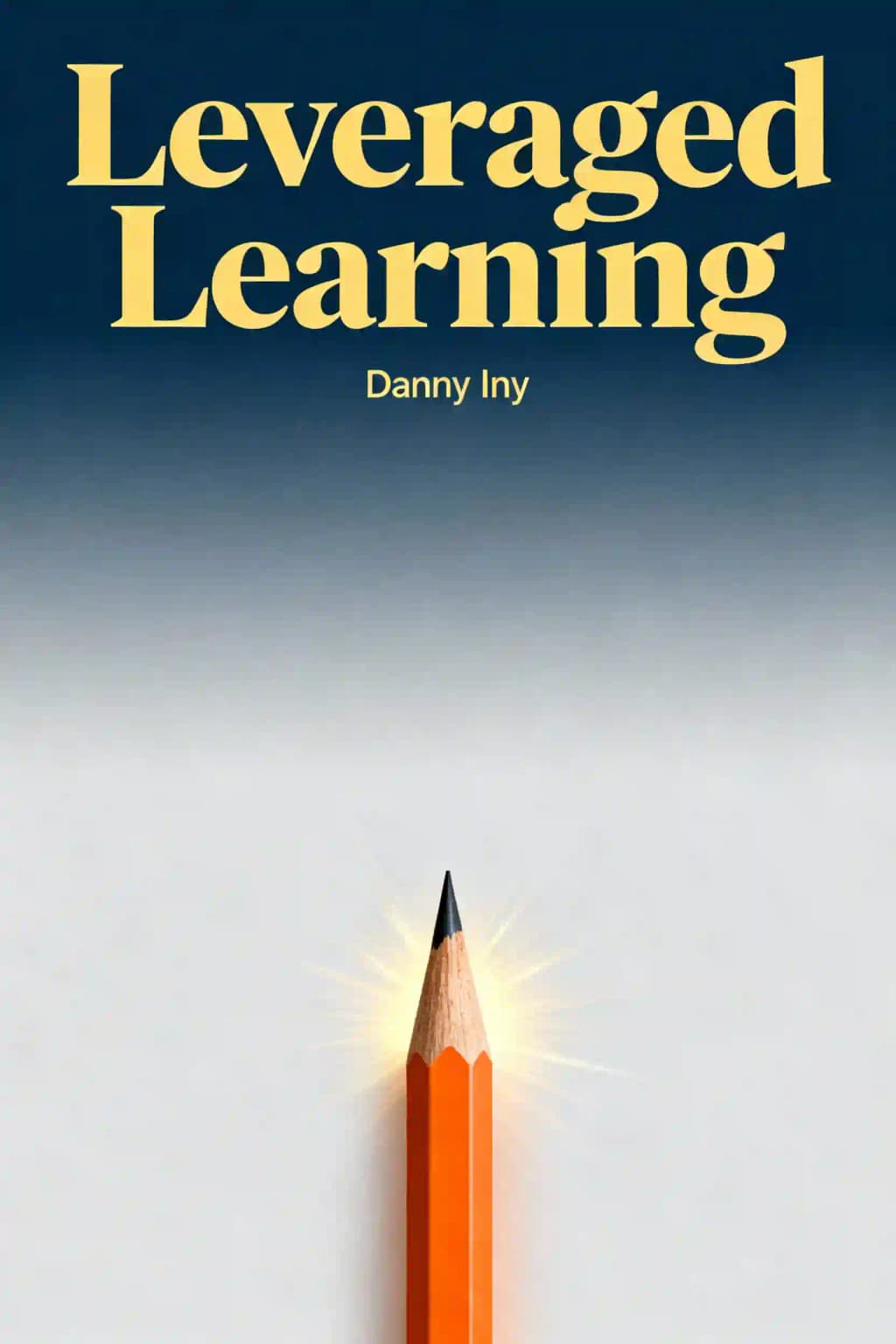
Did you know that Mark Twain once quipped, "I never let school get in the way of my education"? This sentiment has never been more relevant than today. Danny Iny's "Leveraged Learning" arrives at a critical moment when the $4.4 trillion global education industry faces an existential crisis. The book has become required reading for forward-thinking educators and business leaders, with luminaries like Seth Godin and Dorie Clark praising its revolutionary approach. While traditional institutions struggle with declining enrollment (down 6.5% in five years), innovative alternatives are emerging to address what the World Economic Forum calls education "priced as a luxury." As student debt surpasses $1.4 trillion and employers rank formal education dead last among twenty hiring factors, Iny offers a compelling roadmap for an education system that actually works.
Capitolo 2
The Broken Promise of Modern Education
Remember encyclopedias? As a child in the 80s and 90s, Danny Iny consulted the World Book Encyclopedia for answers to questions like "What is an aardvark?" Today, we'd simply ask Google or Siri. This transformation exemplifies the pattern of progress: what begins as revolutionary (flight, moon landings, genome sequencing) quickly becomes expected, then baseline, and finally outdated and frustrating when better alternatives emerge.
Education has followed this exact pattern. For centuries, formal education delivered on its core promise: a better life upon graduation. A university degree was genuinely a golden ticket to success, with lifetime benefits far outweighing costs. But entering the twenty-first century, this equation changed dramatically. Today's education system can't keep pace with rapidly evolving job markets, while degree ubiquity has undermined differentiation. The majority of recent graduates find themselves unemployed or underemployed, with only 27% working in their field of study. Meanwhile, costs have skyrocketed to unsustainable levels.
This crisis extends beyond college to the fundamental promise of upward mobility. The reliable formula of "work hard and get educated" no longer guarantees prosperity. While degree holders still earn more on average, removing elite schools and specific vocational programs significantly reduces this advantage. Geographic concentration of graduates in high-cost areas and pressure to pursue lucrative but potentially unsatisfying careers to manage debt further skew the data.
For education to truly "work," it must deliver outcomes reliably for most students, not just exceptional ones. It must impart knowledge and skills while developing meaningful insight and supporting emotional fortitude needed for lifelong success. And critically, it must do this cost-effectively, without crushing debt or requiring investments unjustified by outcomes.
Capitolo 3
Why Signals Turn to Smoke
When visiting a new city, we rely on signals like restaurant reviews rather than sampling every establishment. Similarly, we trust uniforms and credentials as shortcuts for making decisions across life. These signals generally serve us well because they emerge from substance - police uniforms represent training and responsibility, medical coats indicate education and ethical commitment.
Education followed this pattern: first came the need for knowledge and skill, then institutions to provide it, and finally credentials to certify graduates' abilities. Harvard existed for 177 years before issuing its first diploma - after all, a credential only matters once the institution's name carries weight.
But signals lose meaning when manipulated or overused. When only 5% of males born in 1900 held college degrees, those credentials powerfully differentiated candidates. Today, with nearly 40% of working-age Americans holding degrees, their impact has diminished, creating "academic inflation" where degrees become prerequisites for more jobs while simultaneously proving insufficient for success.
Even worse than ubiquity is education's growing disconnection from workplace needs. Traditional lecture formats prove ineffective for most students. Accreditation creates curriculum inertia. Instructors lack practitioner experience. Tenure allows academics to focus on personal interests rather than market demands. Most university programs were designed either by academics or large corporations, misaligned with the small and mid-market businesses that dominate our economies.
This explains why in Express Employment's 2017 survey, employers ranked education dead last among twenty hiring factors, and why a 2005 Department of Education study found the majority of college graduates couldn't compare viewpoints in newspaper editorials, with 14% demonstrating only elementary-school reading levels.
Capitolo 4
Education in the Age of Acceleration
Rather than imagining distant futures, it's more useful to extrapolate from current trends. The technologies enabling driverless vehicles signal what Thomas Friedman calls the "Age of Acceleration." These technologies aren't science fiction-they exist today and are proliferating into every area of life, with profound implications for our economies and job markets.
The preventative capabilities of new technologies-like sensors detecting pipe leaks before they become costly problems-create efficiency but also disrupt jobs. Friedman describes four directions jobs are being pulled: Up (requiring more knowledge for the same job), Apart (skilled parts requiring more skill while unskilled parts require less), Out (lost to outsourcing and automation), and Down (skills becoming obsolete faster). Reports from Oxford University and McKinsey suggest 47-49% of jobs could be eliminated by smart technology in coming decades.
Our intuition misleads us about what's easy versus difficult for computers. Tasks humans find challenging (like calculating to a million decimal places) are trivial for computers, while tasks we find simple (like identifying animals in photos) are traditionally harder for machines. Dave Snowden's Cynefin framework divides tasks into four domains: Obvious (clear cause-effect), Complicated (requiring expertise), Complex (cause-effect clear only in retrospect), and Chaotic (no clear relationship). Historically, technology first replaced Obvious tasks, then credentialism rose to train people for Complicated work. Now, intelligent machines are tackling Complicated and even Complex domains, threatening massive job displacement.
What should we teach in this environment? Imagine selecting team members for an important project with unknown requirements. Without knowing specific skills needed, you'd select for creativity, resourcefulness, work ethic, adaptability, and interpersonal abilities. Research confirms these soft skills drive career success-Harvard studies show 85% of job success comes from well-developed soft and people skills. The challenge for educators is teaching what robots can't replicate: intuition, ambiguity, self-awareness, and the humanist ideals of independent thinking and good citizenship.
Capitolo 5
The Four Major Transitions Reshaping Education
Like text messaging would change classic stories (imagine Romeo texting Juliet before her suicide), four major transitions are currently transforming education with seismic implications.
From Real-Time to Semi-Synchronous: Like restaurants using mise en place to deliver meals quickly, education is shifting from purely real-time to semi-synchronous delivery. This approach separates what must happen in real-time from what can be done within wider time windows. Online education offers pedagogical advantages including "flipped classrooms" where students consume content on their own schedule, with the ability to pause, rewind and re-watch until mastery. The ideal approach blends semi-synchronous convenience with selective real-time, face-to-face interaction.
From Just-in-Case to Just-in-Time: Traditional education loads students with information "just-in-case" they might need it someday, but this approach is becoming obsolete. In today's rapidly changing world, knowledge becomes outdated within a decade. The transition to "just-in-time" learning is already underway, with older students becoming the fastest-growing segment in education. The result is a movement toward lifelong learning spread across our lives rather than concentrated at the beginning of careers.
Education is evolving from concentrated study during youth to learning spread across our entire lives-what Jeff Cobb calls the "other 50 years." Stanford's 2025 project predicts the current four-year model will transform into six years distributed throughout a lifetime. This transition is already visible in demographics: 17% of student loan debt belongs to people over 50, and students 25 or older represent 40% of college enrollment.
From Information to Transformation: In today's world where information is readily available through Google and Wikipedia, the value of pure knowledge has plummeted. What matters now is the ability to apply knowledge and develop skills. While education does a decent job of imparting information, it fails at developing competence, which requires real-world application and feedback loops. For education to be truly transformative, it must be customized to each learner's unique strengths and weaknesses.
From Mandatory to Volitional: When education shifts from mandatory to volitional, students need compelling reasons to choose learning over competing entertainment options. Sebastian Thrun's experience with Udacity illustrates this challenge-despite 1.6 million student sign-ups, completion rates hovered around 7%. Course creators can address this by either reintroducing structure (deadlines, synchronous elements) like Seth Godin's altMBA with its 96% completion rate, or by developing truly engaging content through excellent instruction, careful planning, and community building.
Capitolo 6
The Economics of Educational Innovation
Despite incumbents having significant advantages in resources and reach, history repeatedly shows outsiders disrupting established industries. Amazon revolutionized retail without owning traditional stores, iTunes transformed music distribution without a record label background, Uber reinvented transportation without owning vehicles, Airbnb disrupted hospitality without owning hotels, TurboTax simplified tax filing without accounting firm roots, and Tesla reimagined automobiles without traditional manufacturing experience. These outsiders succeeded by identifying fundamental inefficiencies and leveraging technology to create superior customer experiences.
Higher education faces multiple barriers to innovation despite controlling 40% of the $4.4 trillion education market. Cognitive inertia among administrators leads to resistance to change and protection of traditional models. The incentive structure actively works against teaching excellence - tenure and advancement typically depend on research output and publication, while teaching undergraduates is often viewed as a burden rather than a core mission. This creates what one critic calls "the great divorce between teaching and prestige." The disconnect between academia and industry results in curricula that often lag years behind current workplace needs. Rigid accreditation processes, designed to ensure quality, inadvertently stifle experimentation and new approaches. Perhaps most troublingly, only 21 cents of every tuition dollar goes to actual instruction, with the rest consumed by administrative overhead, facilities, and non-academic services.
The future education ecosystem will likely divide into three distinct but interconnected categories: foundational education providing essential knowledge and critical thinking skills through traditional degree programs; "last mile" education bridging the gap between general education and specific career skills through specialized certificates and boot camps; and continuing education delivered through microlearning and just-in-time training to help professionals stay current. While foundational education will likely consolidate among a few prestigious providers leveraging digital delivery at scale, the "long tail" of education - highly specialized, niche-focused courses delivering specific information when needed - cannot effectively come from traditional universities due to their structural limitations and slow adaptation cycles.
Instead, lifelong learning will increasingly come from practitioners and subject matter experts working at the cutting edge of their fields. Their deep, current expertise and real-world experience justify premium pricing compared to traditional academic instruction. With technological change accelerating, most professional knowledge becomes outdated within 5-10 years, making continuous learning essential. The ideal educators in this new landscape are hybrid professionals who combine deep domain expertise with strong teaching abilities - practitioners who remain current through frontline work while developing the communication and pedagogical skills to effectively transfer their knowledge. This represents a fundamental shift from the traditional model of career academics teaching theory to one where working experts teach practical applications.
Capitolo 7
The Science of Effective Learning
How quickly can we acquire skills like surfing, poker, or foreign languages? Connor Grooms demonstrates rapid skill acquisition by learning Spanish in just 30 days through data-driven learning methods. Yet fluency alone doesn't qualify you to do much-the real value lies in applying knowledge effectively.
Our brains aren't designed to remember everything-they're actually designed to forget what isn't regularly used. This selective forgetting isn't a bug but a feature of our cognitive system, helping us retain only what's truly needed. Unlike computers that can process information without context, humans must connect new knowledge to existing understanding through "scaffolding"-building one idea upon another.
Edgar Dale's Cone of Experience suggests that we remember information better when we're actively involved with it rather than passively consuming it. We better remember things we do rather than things we merely read about because learning is associative (memories link to the environment and state in which they formed), and our brains prioritize information deemed relevant to us.
The iconic "wax on, wax off" scene from Karate Kid portrays a fantasy version of learning that wouldn't work in real life. The film depicts "far transfer"-applying learning from one context (waxing cars) to another completely different situation (blocking punches). Far transfer, while the holy grail of education, doesn't happen automatically. To achieve true transfer, we must teach not just the underlying principles but also help students understand how they apply across various circumstances.
Effective encoding begins with proper timing-spaced repetition over time works far better than cramming, like watering a lawn briefly but regularly rather than flooding it once. The best approach is "deliberate practice"-working systematically on challenging aspects rather than mindlessly reviewing notes or practicing only comfortable skills.
Capitolo 8
Beyond Knowledge: Insight and Fortitude
While early automation targeted menial, repetitive jobs, today's technology increasingly threatens knowledge-based professions. Physical jobs requiring sophisticated robotics remain costly to automate, but jobs centered on knowing and rudimentary thinking are vulnerable. This creates a "hollowing out" effect where both high and low-wage jobs grow while middle-wage positions stagnate.
In our rapidly changing world, where knowledge quickly becomes obsolete, the ability to generate novelty becomes essential. Insight isn't just accumulated knowledge but the capacity to see connections others miss, residing at the intersection of critical thinking and creativity-abilities that conventional education often fails to develop.
Critical thinking isn't just a cliche-it's a powerful, nuanced concept involving skillful analysis, assessment, and reconstruction of thought. Traditional methods like liberal arts education or case studies often fail to develop these skills effectively, with studies showing 36% of college students show no improvement after four years. Instead, we need specific techniques like evaluating claims, analyzing inferences, weighing decisions, analyzing problems, facilitating discovery, solving problems, and creating products/processes/services.
Creativity isn't just for artists or geniuses-it's for everyone, applicable to making things, finding unique solutions, hacking systems, and creating change. Creativity isn't mysterious or rare-it's a process and way of life involving small ideas that accumulate over time. Research shows creativity can be understood and taught through Sawyer's eight-stage framework: ask the right question, prepare your mind, spot answers around you, imagine possible worlds, generate great ideas, combine ideas, refine good ideas, and make ideas visible.
The creative process requires time to work, following four crucial mental steps: Preparation (wrestling with a problem until obvious ideas are exhausted), Incubation (setting aside the problem, allowing the mind to work "offline"), Illumination (the "aha!" moment when solutions appear), and Verification (checking if the insight actually works).
Capitolo 9
Building Educational Fortitude
Like an internal combustion engine - powerful yet surprisingly fragile - our learning capacity can be easily disrupted by stress, distraction, and self-doubt. This vulnerability explains why so many students quit: 28% of college students drop out in their first year, and online courses see dropout rates as high as 87%. These statistics reveal a critical gap between academic potential and completion that extends across educational contexts, from traditional universities to professional training programs.
Martin Seligman identified three patterns of pessimistic inference that lead to quitting: Personalization (believing failures are due to personal flaws rather than circumstances), Pervasiveness (believing setbacks affect all areas of life instead of specific situations), and Permanence (believing challenges will last forever rather than being temporary). These inferences become self-fulfilling prophecies that make quitting seem logical. For example, a student struggling with calculus might conclude "I'm bad at math" (Personalization), "I'm not cut out for college" (Pervasiveness), and "I'll never understand this" (Permanence).
Intelligence alone doesn't determine perseverance - gifted students are actually overrepresented in dropout statistics, with some studies showing that up to 20% of gifted students fail to complete their degrees. What distinguishes successful learners are non-cognitive capacities: intrinsic and extrinsic motivation, sustained perseverance through challenges, effective time management, structured work habits, and willingness to seek help when needed. College GPA correlates more strongly with these qualities than with raw intelligence, suggesting that how students approach learning matters more than natural ability.
Unlike height in basketball ("you can't coach height"), fortitude isn't an immutable trait but a teachable skill that can be developed through deliberate practice and support. Research demonstrates that motivation can be enhanced through goal-setting techniques, perseverance strengthened through progressive challenge, time management improved through structured planning systems, and work habits refined through accountability partnerships. Modern educators must explicitly teach these critical success skills, as without them, many students can't complete their training or achieve promised results.
Research identifies five key noncognitive factors linked to learning success: academic behaviors (attendance, homework completion), academic perseverance (grit, self-discipline), social skills (cooperation, assertion), learning strategies (study skills, metacognition), and academic mindsets. These mindsets include four crucial beliefs: sense of belonging ("I belong in this academic community"), growth mindset ("My abilities can develop through effort"), self-efficacy ("I can succeed at this"), and expectancy-value theory ("This is important and worth my effort"). Educators must support students in developing fortitude through four integrated approaches: modeling and reinforcing successful behaviors, providing graduated scaffolding for perseverance, creating structured opportunities for peer cooperation and support, and helping learners develop and refine effective learning strategies through guided practice and reflection.
Capitolo 10
The Six Layers of Leveraged Learning
Just as great chefs create dishes using five basic tastes, every learning experience consists of six essential components layered together:
Content: Using Michael Palmer's "backward-integrated design" approach, we must begin with the end in mind by asking what students should know and be able to do years after completing the course. This requires working backward through five steps: defining clear learning outcomes, planning assessments to measure achievement, determining necessary content, creating scaffolding for understanding, and ruthlessly pruning anything that doesn't directly serve student goals.
Success Behaviors: Success behaviors must be deliberately designed into learning experiences to ensure students actually apply what they learn. Research-backed strategies include teaching students to reflect on their learning, understand effective study techniques like self-testing, recognize the importance of sleep for memory, value effort over innate ability, and understand how stress affects thinking.
Delivery: Effective learning delivery isn't about lengthy courses but carefully designed experiences that match learning objectives. Students progress through seven stages of knowledge integration: from passive consumption to active consumption, critical evaluation, curation, modification, creating mash-ups, and finally creating from scratch. Deep learning requires active student participation deliberately designed into the curriculum.
User Experience: The educational experience has transformed dramatically from traditional classroom lectures to diverse digital formats. Online learning enables adaptive learning paths, flexible lesson lengths and pacing, and multiple content formats (video, audio, text). Learning must be designed for both "intentional" consumption (focused, dedicated time) and "interstitial" consumption (brief engagements during downtime).
Accountability: Without proper accountability structures, self-paced learning dramatically increases the likelihood students won't complete their work. Two effective accountability methods are: 1) Forced minimum progression-implementing structure with specific start dates and deadlines significantly improves completion rates; and 2) Raising the stakes-from commitment contracts where students donate to "anti-charities" if they fail to meet commitments, to simple visual cues like adding a frowning face icon to a student's portal for missed deadlines.
Support: Educational psychologist Benjamin Bloom's research revealed the staggering impact of one-on-one tutoring: students receiving mastery-based learning with tutoring performed two standard deviations above the control group, outperforming 98% of students in traditional classrooms. Today, technology and ingenuity are converging to solve this "2 Sigma Problem" through adaptive learning combined with competency-based approaches. The solution isn't purely technological but requires intelligent integration between technology and human support.
Capitolo 11
The Bridge to a Better Future
Danny contrasts the optimistic world of TED talks with our challenging reality, arguing that education is the bridge between the world we have and the world we want. Not through empty credentials, but through real education that builds knowledge, insight, and fortitude. This transformative education develops both technical competencies and essential human capabilities - creativity, critical thinking, collaboration, and communication. The gap between aspiration and reality requires not just incremental improvements but fundamental reimagining of how we learn and teach.
For teachers and experts, he emphasizes several critical priorities: staying at the cutting edge of their field through continuous professional development, designing innovative curriculum that reflects real-world challenges, teaching beyond mere knowledge transfer to include higher-order thinking skills, and cultivating environments that encourage experimentation and risk-taking. Success stories from graduates and strong industry partnerships help establish program legitimacy. Teachers must also embrace technology not as a replacement but as an amplifier of human connection and learning - using tools like adaptive learning platforms, collaborative workspaces, and immersive experiences to deepen student engagement.
Business leaders face equally important responsibilities in bridging this gap. Progressive companies like Ernst & Young, Google, Apple, and IBM have already dropped degree requirements for many positions, focusing instead on demonstrated skills and capabilities. Organizations need to develop more sophisticated assessment methods that evaluate both technical and human skills - from project portfolios to behavioral interviews. Creating robust learning cultures means providing time and resources for continuous development, recognizing and rewarding growth mindsets, and building clear pathways for skill advancement.
Though these changes may feel uncomfortable - like trapeze artists letting go of one bar to reach the next - they represent our best path to individual success and collective progress. The future of education isn't confined to degrees or traditional classrooms but embraces diverse learning pathways: online courses, mentorship programs, apprenticeships, project-based learning, and self-directed exploration. The world's knowledge is more accessible than ever through digital platforms, open educational resources, and global learning communities.
As Mark Twain might say today, don't let school get in the way of your education. True education is a lifelong journey of curiosity and growth, powered by intrinsic motivation rather than external credentials. The bridge to a better future requires all stakeholders - educators, business leaders, and learners themselves - to embrace this broader vision of learning and development. Success in the rapidly evolving global economy depends not on what degree you hold, but on your ability to learn, adapt, and create value in novel ways.