Capitolo 1
The Race to Learn: How Speed Becomes Your Ultimate Advantage
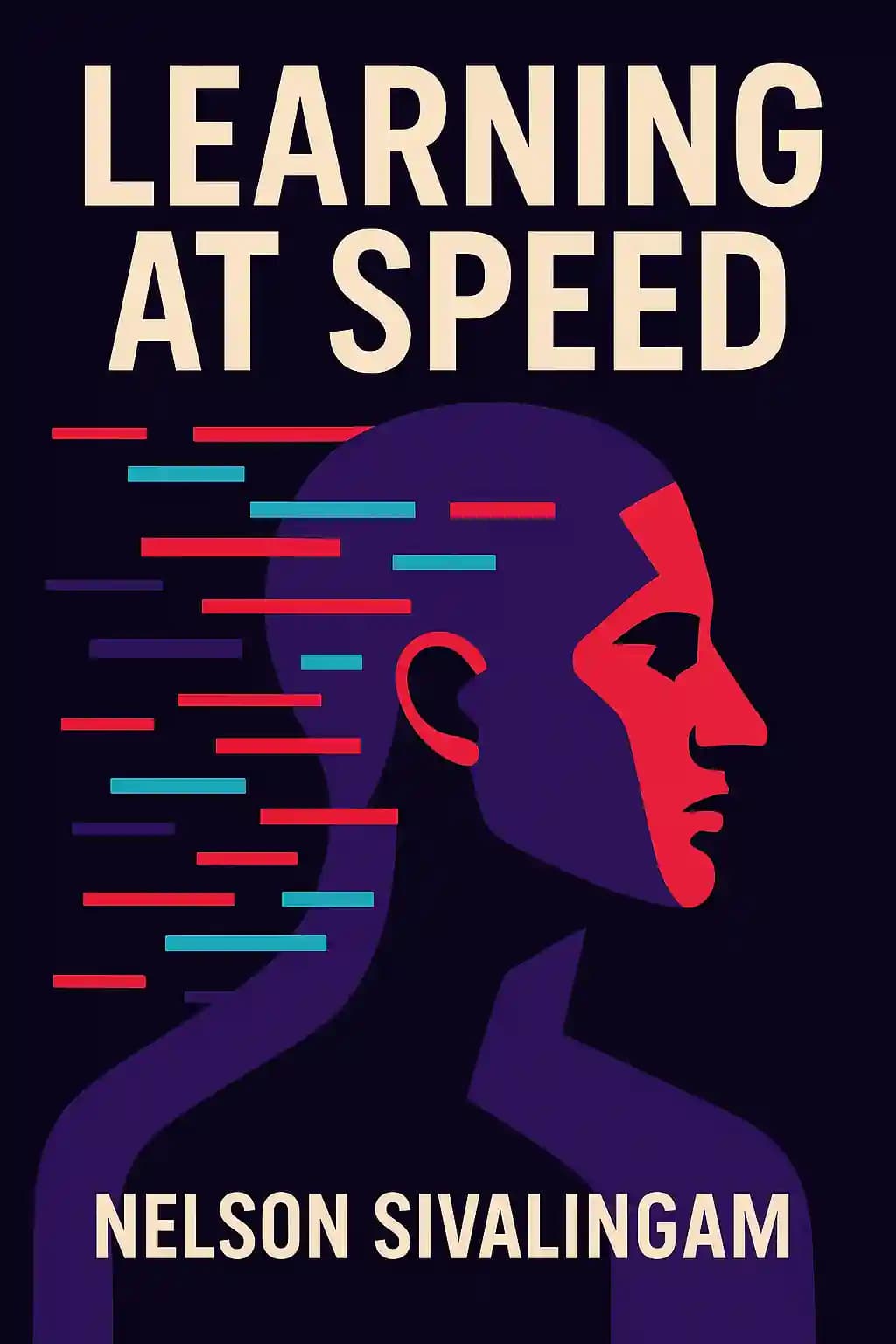
In a world where change is accelerating exponentially, a surprising competitive advantage has emerged-not capital, not technology, but the speed at which organizations learn. When Arcadia Group collapsed in 2020, ASOS quadrupled profits and acquired Topshop brands. The difference? Learning velocity. This revelation forms the foundation of Nelson Sivalingam's "Learning at Speed," a practical framework for organizations seeking to thrive amid disruption. As the founder of learning technology company HowNow, Sivalingam brings a unique entrepreneurial lens to L&D, applying startup methodologies to workplace learning. The book has garnered praise from learning leaders at companies like Bumble, with Lauren Cunningham emphasizing that "a company's speed of learning creates competitive advantage." In an era where 54% of employees need reskilling and 40% of core skills change within five years, Sivalingam's Lean Learning methodology couldn't be more timely.
Capitolo 2
The Learning Crisis: Why Traditional Approaches Are Failing
Most L&D functions are operating like failing startups-building solutions nobody wants. Despite organizations spending over $350 billion annually on training, 75% of managers remain dissatisfied with L&D, and only 12% of employees apply newly learned skills to their jobs. The fundamental problem? L&D often creates content without understanding the context in which learning occurs-the goals, roles, feedback systems, and social norms that shape how knowledge is applied.
Every organization has one of three learning cultures, each with distinct limitations. Compliance-driven cultures focus solely on meeting regulatory requirements, measuring success by completion rates rather than behavior change. Process-driven cultures extend beyond compliance to support business processes like onboarding, but still emphasize training delivery over actual learning, responding to every challenge with a course. Skills-driven cultures focus on building capabilities for career progression, but learning remains prescribed by the business through event-based programs that take employees away from their jobs.
None of these approaches can keep pace with today's rate of change. Organizations struggle to rapidly acquire knowledge for new products with short market timelines, adopt technologies, and mobilize talent for emerging roles. When the world changes faster outside than inside an organization, its end is likely near.
The solution isn't shorter courses or faster content production-it's a fundamental shift to what Sivalingam calls "Lean Learning." This approach helps teams learn what matters in the shortest time, apply it in moments that shape performance, and iterate based on feedback until solving business problems. It combines initial learning with ongoing support, practice opportunities, and knowledge sharing, cutting waste by delivering just enough learning at the point of need. Most importantly, it rebuilds organizational learning with performance at its heart.
Capitolo 3
The Lean Learning Mindset: Nine Essential Shifts
Before implementing Lean Learning practices, organizations must adopt the mindset that makes them possible. Like Microsoft's transformation under Satya Nadella, who cultivated a growth mindset that turned a stagnating business into an economic powerhouse, the right mindset influences behavior, behavior drives results, and results reaffirm mindset.
The Lean Learning mindset consists of nine essential shifts. First, love the problem rather than the solution. When we jump to solutions without understanding problems deeply, we risk addressing symptoms rather than root causes. Blockbuster failed because they were too attached to their revenue model to pivot toward streaming, while Netflix evolved by focusing on the problem rather than their DVD-mailing solution.
Second, develop a bias toward action. Taking too long risks the situation changing before implementation, making solutions irrelevant. Action accelerates learning-each attempt uncovers problem parameters and resource limitations, generating knowledge that informs the next iteration. Buffer demonstrated this by creating a landing page in hours to test demand before building their product.
Third, embrace fast failure. Organizations that aren't prepared to fail aren't prepared to learn. Amazon exemplifies this approach; despite shutting down countless failed projects, they've created massive successes like AWS and Prime. As Bezos says, "If you decide that you're going to do only the things you know are going to work, you're going to leave a lot of opportunity on the table."
Fourth, commit to continuous improvement. When everyone in the organization is in a permanent state of "work in progress," they remain open to learning from mistakes, each other, and experiences. Gmail launched in 2004 but only left beta in 2009 despite millions of users, demonstrating the value of ongoing refinement.
Fifth, tackle your riskiest assumptions first. Where would you start if you had to teach a monkey to recite Shakespeare on a pedestal? Many would rush to build the pedestal, but the right approach is tackling the infinitely harder task of training the monkey first.
Sixth, measure what matters. What we measure affects what we do. Organizations that measure time spent learning rather than performance improvement will optimize for learning hours, even if that doesn't improve business results.
Seventh, prioritize outcomes over outputs. Outputs are what we build-courses, workshops, technology purchases. Outcomes are the impact we make-business challenges solved and behaviors changed. The goal isn't to produce outputs but to reach specific outcomes, maximizing results with minimal output.
Eighth, eliminate waste. Traditional approaches often create training that tries to solve many problems for many people but ends up being either too much or too little. Lean Learning focuses on removing anything that doesn't add value.
Finally, empower the team. True empowerment requires active coaching, providing resources, and changing how work happens. Leaders should guide teams to define problems rather than prescribing solutions, allowing teams to iterate until successful.
Capitolo 4
Finding the Right Business Problem to Solve
Like Dollar Shave Club's billion-dollar success by addressing actual customer pain points in shaving subscription services, L&D must identify real business problems rather than simply fulfilling training requests. Many L&D teams rush toward solutions before validating problems, similar to how Kodak focused on improving film quality when digital photography was the real future. Taking time to understand issues deeply increases success probability, just as Amazon spent years studying customer shopping patterns before launching their successful Prime service.
Clayton Christensen's Jobs-To-Be-Done framework provides a powerful lens for identifying the right problems. When we buy products or services, we "hire" them to accomplish goals or solve problems. If they perform well, we rehire them; if not, we "fire" them. For example, Netflix was hired to deliver convenient entertainment, effectively firing traditional video rental stores. As Harvard professor Theodore Levitt famously noted, "People don't want to buy a quarter-inch drill. They want a quarter-inch hole!" Similarly, employees don't want training programs; they want to solve workplace challenges or advance their careers.
This framework can be powerfully applied to workplace learning by focusing on the job to be done rather than the learner. The job to be done represents progress you want to make in a particular circumstance, not the learning experience itself. For instance, a sales team might "hire" a negotiation workshop not for the workshop itself, but to win more deals and increase revenue. Learning experiences are products hired to accomplish goals or solve problems, like how professionals "hire" MBA programs not for the degree itself but for career advancement and network building.
Customer discovery interviews help validate assumptions and identify real problems through structured conversations with potential users. Most L&D teams only gather feedback after investing resources in a solution, potentially wasting effort solving the wrong problem - like developing lengthy e-learning courses when quick reference guides would suffice. These interviews should uncover four forces influencing behavior change:
• Push factors: What makes people unhappy with their current situation (e.g., missing deadlines due to poor time management)
• Pull factors: The attraction toward the desired outcome (e.g., getting promoted by improving leadership skills)
• Anxiety: Concerns about potential outcomes (e.g., fear of looking incompetent during training)
• Habits: Unwillingness to change existing behaviors (e.g., resistance to adopting new software tools)
By understanding these forces, L&D can design learning experiences that address both the functional and emotional aspects of the job to be done. For example, a leadership development program might combine practical management tools (functional) with confidence-building exercises (emotional). This comprehensive approach creates solutions that employees will actually "hire" to solve their problems, much like how successful products like Apple's iPhone address both practical needs and emotional desires.
Capitolo 5
The Learning Canvas: Your Strategy on a Page
First principles thinking-breaking complex problems into basic building blocks and reassembling them from the ground up-has driven many breakthrough innovations, from Gutenberg's printing press to Ford's assembly line. This approach is central to startup frameworks, helping entrepreneurs navigate decisions with limited resources. By questioning assumptions and focusing on fundamental truths, organizations can discover novel solutions that might otherwise be overlooked in traditional planning approaches.
The Learning Canvas applies this thinking to L&D, capturing the building blocks of a learning strategy on a single page. Adapted from the Business Model Canvas and Lean Canvas, it condenses what would have been a 50-page business plan taking months to create into a single page that takes hours to complete. This visual tool enables teams to quickly iterate on ideas, identify gaps in thinking, and align stakeholders around a common understanding of the learning initiative.
The canvas is divided into three sections: The WHY, HOW, and WHAT. The WHY represents the motivation that aligns and drives the organization, individual, and L&D team to invest time and resources. It consists of the problem you're trying to solve (defined as a "job story" following the format "When _____, I want to _____, so I can _____"), who it affects (customer segments), and the value they'll get from solving it (value proposition). For example, a job story might be "When onboarding new sales representatives, I want to quickly build their product knowledge, so I can reduce time-to-first-sale."
The HOW covers the actions needed to solve the problem and deliver value, including required knowledge and skills (solution), partners and stakeholders to involve, and key resources to deliver value. This section forces teams to think practically about implementation, considering elements like subject matter experts, technology platforms, content development resources, and delivery mechanisms. Each component must align with organizational constraints while maximizing impact.
The WHAT represents the results that indicate success, including measurements of the benefits (outcome), key progress metrics, and costs/ROI of solving the problem. This section ensures accountability by establishing clear success criteria upfront. Metrics might include completion rates, knowledge retention scores, behavior change indicators, and business impact measures like increased sales or reduced errors.
Using the Learning Canvas creates a plan to solve business challenges, though each block represents a hypothesis that needs testing. The canvas provides a framework for turning this plan into something tangible that can be tested through the Lean Learning process. Teams can use it to rapidly prototype solutions, gather feedback, and iterate based on real-world results. Regular reviews of the canvas help teams stay focused on delivering value while remaining flexible enough to adapt as new information emerges.
Capitolo 6
Building a Dynamic Learning Ecosystem
Modern workplace learning has evolved beyond traditional libraries and courses. Today's organizational knowledge no longer resides in a single content library-employees pull learning from diverse sources while companies continue pushing training programs. The L&D function must evolve from content creator to ecosystem conductor, orchestrating a diverse network of knowledge, skills, experts, and tools both inside and outside the organization.
A dynamic learning ecosystem includes four key components. First, open learning resources from outside the organization-industry insights from leading companies, how-to resources for common tools, thought leadership from domain experts, and learning media from reputable providers. With knowledge being created faster than L&D can develop content, incorporating these external resources helps employees find relevant information at their moment of need.
Second, collaborative learning and knowledge sharing within the organization. Companies like Google use peer-to-peer networks where employees volunteer to teach colleagues, while organizations like GymShark and Depop use tools to capture tacit knowledge and make it available on demand. Cohort-based courses offer bi-directional interaction between instructors and learners, creating accountability and belonging with completion rates around 85% compared to MOOCs' dismal 3-6%.
Third, job aids and performance support that provide just-in-time knowledge to help perform tasks without extensive training. These include checklists for consistency, templates for frequently asked questions or common processes, digital performance support within applications, flowcharts that distill complex processes into neat yes/no decisions, and QR codes that provide access to time-critical knowledge in physical environments.
Finally, coaching and mentoring to support performance improvement through one-to-one interactions. At Allen & Overy, they replaced performance reviews with year-round coaching conversations, creating more meaningful dialogue about career development. Meanwhile, 71% of Fortune 500 companies have mentoring programs, with workers reporting higher job satisfaction.
By orchestrating these diverse components, L&D can create a learning ecosystem that provides the right resources at the right time, enabling employees to learn and perform at the speed business requires.
Capitolo 7
Connecting Resources to People: The Personalization Challenge
Most L&D teams fail because employees don't find value in offered learning resources and don't invest their attention. Finding the right audience for learning resources is as critical as startups finding customers who value their product. L&D must choose between "push" and "pull" approaches to connect resources with learners.
Traditional "push" learning assigns training based on simple criteria like join date, department, and job role, often resulting in generic experiences with limited value. However, L&D can learn from marketing by using richer data to target learning more precisely. This includes skills data from light-touch assessments, performance data that identifies specific needs, career data revealing what employees have done and want to do, behavioral data from email patterns and meeting schedules, and external benchmark data about growing skill demands.
Self-driven "pull" learning, underpinned by need and personal interest, results in better knowledge retention and application. McKinsey found knowledge workers spend 20% of their time-one day per week-looking for knowledge needed to do their jobs. L&D can solve this by guiding employees to better control their learning through curation and on-demand access.
In today's content-rich world, curation is Queen. Developing one hour of eLearning takes 197 hours and costs $30,000, while curation takes minutes and costs nothing. The curation process follows three key steps: aggregate (bring learning resources together in one searchable place), filter (separate critical from unnecessary content based on relevance), and enrich (add context and organize content with annotations, playlists, and skills tags).
Effective learning combines both push and pull approaches. Push learning helps prepare employees for challenges they might not yet recognize, while pull learning data informs what organization-driven learning to push. When we connect the right resource with the right person at the right moment, we can shape performance for the better.
Capitolo 8
Shaping Performance in the Moments That Matter
In today's on-demand economy, we expect instant results. This immediacy is transforming learning. When learning experiences are designed for the moments that matter-intent-driven moments where an employee needs specific knowledge to execute a task well-learning connects to performance faster.
At these moments, employees are most motivated to learn and likely to engage with learning resources as they're in the context of applying what they learn. It's like someone trying to put out a house fire-they need a fire extinguisher, not an expensive watch. When you connect the right person with the right learning resource at the right moment, you maximize engagement.
Moments that matter fall into two categories: micro-moments that happen during workflow tasks like completing work on a new tool or resolving client queries, and macro-moments that occur throughout work life like onboarding or leadership development.
Understanding what shapes these moments helps design learning experiences that influence an employee's ability to pay attention, retain, and apply what they learn. Six contextual factors determine how effectively learning connects to performance:
1. Environment: Physical settings create unique learning challenges, with different optimal conditions for different tasks.
2. Technology: Access to technology determines where, when, and how people learn, with digital adoption platforms providing just-enough knowledge at the point of need.
3. Time: Understanding time context helps employees fit learning into their moments of need, with format determined by availability.
4. Activity: The task itself serves as both learning in motion and a trigger for further learning, with cognitive intensity determining how knowledge should be communicated.
5. Organization: Culture determines whether employees can learn at all, with psychological safety essential for trying new things and learning from failure.
6. External: Market forces and trends influence what and when you learn, with timely delivery of relevant learning saving organizations from legal action and financial losses.
By designing learning experiences that account for these contextual factors, L&D can ensure that knowledge is delivered in a way that maximizes its impact on performance.
Capitolo 9
Measuring What Matters: The Proof of Impact
Learning experiences should be designed to continuously collect and analyze data demonstrating impact, not just track learning activity. If it has measurable impact, scale it. If not, scrap it. While 36% of L&D teams evaluate based on participant satisfaction and 18% on knowledge change, only 8% assess wider organizational impact.
There are three levels of proof to consider. Proof of knowledge demonstrates what learners know after a learning experience, commonly measured through tests, discussions, Q&A sessions, and knowledge sharing activities. However, understanding what to do doesn't mean someone can actually do it.
Proof of skill demonstrates what employees can actually do as a result of learning, connecting learning to doing. This can be generated through simulations, stretch assignments, projects, observations, 360-degree feedback, and portfolios of work. Assessment quality depends on qualified assessors who are domain experts.
Most importantly, proof of performance captures measurable business improvement when skills are applied to solve organizational challenges. This requires both quantitative measurement (comparing metrics before and after learning) and qualitative measurement (building narratives connecting learning to performance through interviews, surveys, and workshops).
Both quantitative and qualitative methods have limitations, but combining them through triangulation helps mitigate these weaknesses. For example, correlating learning platform data with CRM sales data, interviewing reps and managers about the learning's contribution, and surveying customers about their experience provides comprehensive evidence of impact.
Measuring impact isn't a one-time event at a program's end-impactful learning requires evidence from start to finish. While business performance matters, waiting for those indicators can be too late-generating proof of knowledge and skills allows course correction before wasting resources.
Capitolo 10
From Theory to Practice: The Lean Learning Implementation
Just as Airbnb began with a simple website renting airbeds in a San Francisco apartment, successful learning experiences can start small too. Rather than spending months developing expensive training only to find it doesn't solve the business challenge, you can build something that quickly demonstrates results or signals the need to pivot.
The Minimum Valuable Learning (MVL) is the smallest learning experience that can quickly make a significant impact. It's not just a minimal viable course but the minimum version of all four parts of a winning learning experience: right resource, right person, right time, and right impact. This approach provides immediate value while minimizing development costs and gathering feedback for future iterations.
The Learning Experience Bullseye Framework helps convert your learning strategy into concrete experiences through three steps: Map (plotting potential learning experiences from impact measurement to specific resources), Score (using the ICE framework-Impact x Confidence x Ease-to evaluate options), and Prioritize (selecting the highest-scoring experience as your MVL).
Once you've built your MVL, the Learning Flywheel represents how learning experiences improve through iteration. The process includes several interconnected steps: Build (creating the smallest valuable learning experience), Test (making it available to users), Learn (where employees engage with resources), Practice (applying knowledge), Feedback (on both learner performance and the learning experience itself), Share (disseminating knowledge while reinforcing learning), and Ideate (deciding whether to pivot or persevere based on feedback).
This iterative process continues until you achieve Learning-Challenge Fit-the point at which your learning experience demonstrably improves performance and helps solve your specific business challenge. Only then are you ready to scale.
To accelerate implementation, Lean Learning sprints provide time-boxed increments (typically 2-4 weeks) that enable cross-functional teams to tackle business problems through learning strategies. These sprints break work into manageable chunks to accommodate changing demands, allowing for quicker release of learning experiences with early feedback loops.
Capitolo 11
Scaling Impact Through Strategic Marketing
In today's competitive attention economy, even the most carefully designed learning experiences fail without effective marketing. Organizations often fail not because their learning content is poor, but because internal customers don't "buy" what L&D is selling.
The A2R2 marketing funnel captures an employee's relationship with L&D through four critical stages: Awareness (recognizing both a problem and potential solutions), Activation (committing to a learning experience), Retention (staying engaged until achieving measurable improvement), and Referral (becoming advocates for your learning brand).
Building a strong learning brand is essential for generating demand and engagement. This includes defining who it's for (understanding employee motivations and needs), why it exists (communicating purpose through mission, values, and story), what it's called (a memorable name and catchy slogan), its visual identity (logo, colors, fonts), and its tone of voice (expressing personality and building emotional connection).
Social media offers powerful ways to share insights and build relationships with your audience. By going where employees already spend time, using tagging strategically, sharing valuable "nano-learning" content, engaging in conversations, and maintaining consistency, L&D can create awareness and drive engagement.
Influencer marketing-partnering with people of influence within the organization-can be incredibly powerful. Every organization has influencers who aren't necessarily those in positions of power. Research shows the five most influential people in a workforce can reach more than double the number a five-person leadership team can.
Other effective marketing tactics include search engine optimization (ensuring resources appear when employees search for answers), product positioning (communicating why your resources matter), compelling calls to action (transforming attention into action), and nudge marketing (using subtle cues like social proof, notifications, default options, and content verification to encourage desired behaviors).
By applying these marketing techniques, L&D can transform how learning is promoted within organizations, creating the same engagement that successful consumer brands achieve and establishing a culture of continuous learning that drives business impact.