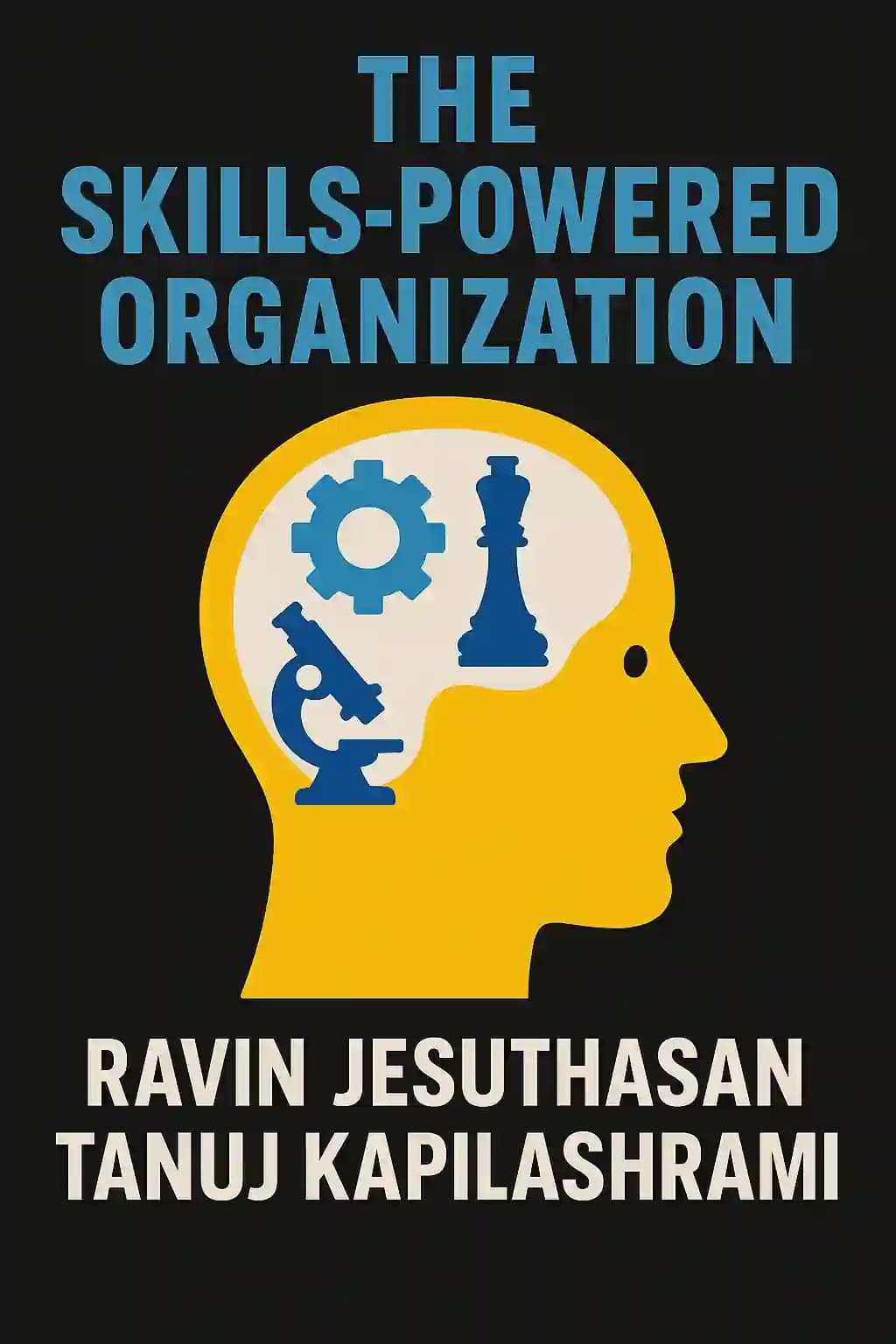
Revolutionize your workforce with "The Skills-Powered Organization," the 2024 Goody Award finalist that's reshaping 140-year-old job models. What if skills - not titles - were your company's currency? Discover how AI-powered skill matching has slashed attrition while boosting inclusion and productivity.
Ravin Jesuthasan and Tanuj Kapilashrami, authors of The Skillpowered Organization, are globally recognized authorities on workforce transformation and future-of-work strategies.
Jesuthasan, a Wall Street Journal bestselling author and Mercer’s Global Leader of Transformation Services, brings decades of research on AI-driven work redesign, shaped by his ground-breaking studies for the World Economic Forum and advisory role in PBS’s Future of Work documentary.
Kapilashrami, Standard Chartered’s Chief Human Resources Officer and Sainsbury’s PLC board member, combines 25+ years of HR leadership at global financial institutions with advocacy for inclusive, skills-based organizational cultures.
Their collaboration merges Jesuthasan’s data-backed frameworks for human-machine collaboration with Kapilashrami’s expertise in scaling agile talent strategies across 60+ markets. Jesuthasan’s prior works, including Reinventing Jobs, established his reputation for actionable automation frameworks, while Kapilashrami’s thought leadership on psychological safety and purpose-driven workplaces has been featured in the Economic Times and HR tech conferences worldwide.
Together, their insights have guided Fortune 500 companies and policymakers, with Jesuthasan named to the Thinkers 50 Radar list and Kapilashrami honored among Asia’s most influential HR innovators.
The Skills-Powered Organization provides a roadmap for businesses to replace outdated job-centric models with skills-based frameworks, enabling agility in an era of AI, climate change, and geopolitical shifts. Authors Ravin Jesuthasan and Tanuj Kapilashrami explain how to redesign work systems, deploy AI-driven talent marketplaces, and build organizational resilience by treating skills—not jobs—as the core currency of work.
HR leaders, C-suite executives, and managers seeking to future-proof their organizations will benefit most. It’s also valuable for workforce strategists interested in AI integration, talent mobility, and reinventing legacy systems like job hierarchies. Case studies from companies like Standard Chartered offer actionable insights for large-scale transformation.
Yes—the book combines rigorous research with practical examples, such as designing dynamic talent marketplaces and metrics for skill-based productivity. Its step-by-step guide to dismantling 140-year-old job structures makes it essential for leaders navigating AI-driven disruption.
The book argues AI accelerates the shift to skills-based models by automating routine tasks and democratizing access to complex work. For example, generative AI can elevate lower-skilled workers’ productivity, similar to industrial automation’s historical impact.
Unlike books focusing solely on gig economies or individual upskilling, this title offers a systemic approach to organizational change. It blends academic theory (e.g., skills taxonomy design) with real-world examples like Standard Chartered’s internal talent platform.
Some may find its reliance on corporate case studies less applicable to small businesses. Additionally, the rapid pace of AI advancement could outdate specific technical recommendations, though core principles remain relevant.
Yes—its emphasis on skill visibility helps individuals identify transferable competencies. The authors also discuss how talent marketplaces enable employees to pursue internal “gigs” aligned with emerging skills.
With AI reshaping industries like finance and tech, the book’s strategies for combining human skills with automation are critical. Its focus on geopolitical and climate-related disruptions also aligns with current enterprise risk priorities.
Key metrics include reduced time-to-fill skill gaps, increased internal talent mobility rates, and higher ROI from AI-augmented workflows. Standard Chartered reported productivity gains by tracking skill deployment efficiency.
Senti il libro attraverso la voce dell'autore
Trasforma la conoscenza in spunti coinvolgenti e ricchi di esempi
Cattura le idee chiave in un lampo per un apprendimento veloce
Goditi il libro in modo divertente e coinvolgente
Jobs, rather than skills, should be the primary currency of work.
Traditional boxes are disintegrating under multiple pressures.
Skills, not jobs, serve as the fundamental currency of work.
Each team formation becomes an opportunity to enhance DEI.
Organization-level leaders set strategic missions and standards.
Scomponi le idee chiave di The Skills-Powered Organization in punti facili da capire per comprendere come i team innovativi creano, collaborano e crescono.
Vivi The Skills-Powered Organization attraverso narrazioni vivide che trasformano le lezioni di innovazione in momenti che ricorderai e applicherai.
Chiedi qualsiasi cosa, scegli il tuo stile di apprendimento e co-crea intuizioni che risuonano davvero con te.

Creato da alumni della Columbia University a San Francisco
"Instead of endless scrolling, I just hit play on BeFreed. It saves me so much time."
"I never knew where to start with nonfiction—BeFreed’s book lists turned into podcasts gave me a clear path."
"Perfect balance between learning and entertainment. Finished ‘Thinking, Fast and Slow’ on my commute this week."
"Crazy how much I learned while walking the dog. BeFreed = small habits → big gains."
"Reading used to feel like a chore. Now it’s just part of my lifestyle."
"Feels effortless compared to reading. I’ve finished 6 books this month already."
"BeFreed turned my guilty doomscrolling into something that feels productive and inspiring."
"BeFreed turned my commute into learning time. 20-min podcasts are perfect for finishing books I never had time for."
"BeFreed replaced my podcast queue. Imagine Spotify for books — that’s it. 🙌"
"It is great for me to learn something from the book without reading it."
"The themed book list podcasts help me connect ideas across authors—like a guided audio journey."
"Makes me feel smarter every time before going to work"
Creato da alumni della Columbia University a San Francisco

Ottieni il riassunto di The Skills-Powered Organization in formato PDF o EPUB gratuito. Stampalo o leggilo offline quando vuoi.
The modern workplace is experiencing a seismic shift. For 140 years, we've organized work around rigid job descriptions within functional hierarchies. This industrial-age model is now crumbling under the weight of technological acceleration and changing workforce expectations. What's emerging instead? A revolutionary approach where skills - not jobs - serve as the fundamental currency of work. This transformation couldn't be more timely, arriving as organizations desperately seek new talent management models amid unprecedented disruption. Consider how quickly skills are becoming obsolete: 37% of the average job's skills have been replaced in just five years. When the pandemic hit, organizations with rigid job structures struggled while those with skills-based architectures pivoted rapidly. Verizon redeployed thousands of retail employees to virtual customer service within days. Bank of America shifted 30,000 employees to new functions based on their underlying skills. The evidence is overwhelming - traditional boxes are disintegrating under multiple pressures. This shift is gaining momentum across industries. IBM removed degree requirements from over 50% of their positions, championing "new collar jobs" that prioritize relevant skills over formal education. A Deloitte study shows 90% of executives are experimenting with skills-based approaches, with such organizations 63% more likely to achieve results across key metrics. The World Economic Forum estimates a "skills-first" approach could add over one hundred million people to the global talent pool by removing arbitrary barriers like degree requirements.
Skills-powered organizations view employees as collections of capabilities that can be deployed flexibly across work needs, creating a many-to-many relationship between talent and work instead of the traditional one-to-one job-person match. These organizations have five key characteristics: flatter structures with cross-functional teams, talent acquisition prioritizing skills over credentials, robust skill development programs, strong diversity focus, and exceptional agility. Companies like Google and Spotify exemplify this model, organizing around project-based teams rather than rigid departments. This transition requires reimagining HR processes. Performance reviews focus on skill development rather than just job responsibilities, while career paths become more fluid, allowing lateral moves and cross-functional experiences. IBM and AT&T have implemented skill-based career frameworks enabling employees to plot multiple trajectories based on evolving skill sets. Different skill categories help organizations make strategic decisions: "solid investments" like risk management retain value for 5-7 years; "quick dividends" like project management deliver value within months; "enduring" skills like teamwork remain valuable across technological changes; "adaptive" skills like cybersecurity require constant updating; and "commodity" skills are widely available but don't provide competitive differentiation.
Leading a skills-powered organization requires fundamentally different capabilities than traditional management. Leaders must shift from hierarchical authority to empowerment with accountability, from technical to humanistic automation, and from process execution to project guidance that sources talent broadly. Organizations typically evolve through three models. The "fixed" model features stable jobs and clear reporting relationships - providing clarity but struggling with rapid change. The "flex" model introduces greater adaptability through matrix structures and project-based work while maintaining some traditional elements. Novartis exemplifies this by keeping stable research divisions while creating flexible teams for drug development. The "flow" model represents the fully realized skills-powered organization where talent moves seamlessly based on skills and work requirements. Spotify's "squad" approach enables rapid team formation based on business needs. Standard Chartered built senior sponsorship to shift from talent-hoarding to talent-sharing. Their AI-driven internal talent marketplace now unlocks underutilized skills beyond rigid job structures, with employees viewing work as tasks rather than positions, effectively "crowdsourcing" skills across the organization.
Skills-powered organizations shape themselves around talent capabilities rather than forcing talent into predefined roles. This human-centered approach integrates learning directly into workflow. One airline redefined its offering from stability and benefits to development and growth, promising to "develop you for opportunity, either within or without." An oil and gas company transformed from analog gauges to digital interactive systems augmented by automation. This resulted in 45% improved profitability while increasing wages 7-13% due to higher skill requirements - suggesting continuous upskilling is an investment in perpetual reinvention rather than a cost. Standard Chartered centered employees in their transformation by eliminating manager approval for talent marketplace gigs and involving more leaders in curating learning experiences. They fostered social learning through global team competitions using online simulations. By democratizing access, these platforms challenge traditional hierarchies and create an employee-led movement toward becoming skills-powered.
AI provides the computational capability to manage complex relationships between skills and work at scale-essential for understanding demand, assessing supply, matching skills to work, and developing capabilities to close gaps. Platforms like TechWolf infer skills from project management tools, while Eightfold identifies skills within job descriptions, finds candidates, and tracks trending skills. These platforms can infer people's skills from current and previous roles, creating comprehensive skill profiles. Studies show we typically underestimate our capabilities-SkyHive found people self-report an average of 11 skills for their role, while AI inference identifies 34, revealing significant untapped potential when people's full capabilities become visible. Talent marketplaces use these algorithms to match work demands with available talent, while generative AI creates personalized development plans and customized content at scale. Standard Chartered's internal talent marketplace demonstrates AI-powered skills deployment across 85,000 employees in over 50 markets. Since its 2020 pilot in India that unlocked 14,000 hours of productivity ($584,000), it has scaled to deliver $6 million in productivity across 1,700+ gigs.
The skills revolution extends beyond individual organizations to entire ecosystems. By focusing on skills rather than jobs, companies reduce friction when engaging external talent, transforming B2B relationships into more efficient B2C connections with gig workers through talent marketplaces. As work evolves, talent increasingly operates outside traditional boundaries. Leena Nair, former Unilever CHRO and current Chanel CEO, declared that "culture is the new structure"-binding disparate interests to common purpose where hierarchies cannot. Companies like GitLab and Automattic demonstrate how strong cultural alignment maintains cohesion across entirely remote, global teams. Governments are also embracing skills-powered approaches. Singapore's SkillsFuture initiative provides citizens with financial support for training, jobs-skills insights, and advisory services. Since 2015, participation has increased from 35% to 50%, with over 600,000 Singaporeans benefiting. Similarly, Standard Chartered's Futuremakers program demonstrates ecosystem-wide skill development, reaching over one million young people across 43 markets.
The skills revolution is already here. Organizations embracing this transformation gain unprecedented agility, resilience, inclusivity, and productivity, while those clinging to industrial-age models of fixed jobs and rigid hierarchies will struggle. For individuals, this shift requires understanding your unique skill portfolio, continuously developing new capabilities, and navigating fluid career paths beyond traditional linear progressions. Organizations must establish clear vision, embrace experimentation, and develop key enablers like leadership support, governance structures, and technology platforms. Though the transition takes time, each step toward becoming skills-powered creates immediate value while building long-term capability. In a world of constant change, making skills - not jobs - the currency of work is essential for thriving. The question isn't whether to become skills-powered, but how quickly you can begin the journey.