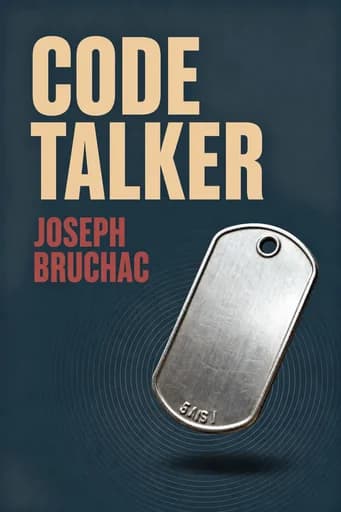
Discover the untold heroism of Navajo Marines whose secret language became America's unbreakable WWII code. Meticulously researched and endorsed by Navajo linguists, this classroom staple reveals how indigenous wisdom outsmarted enemy intelligence when traditional military codes failed.
Joseph Bruchac is the acclaimed author of Code Talker and a leading authority on Native American literature and storytelling. Born in 1942 and a citizen of the Nulhegan Abenaki Nation, Bruchac draws on his Indigenous heritage to craft powerful historical fiction illuminating Native American experiences, particularly untold stories from U.S. history.
With a PhD in comparative literature and over 120 published books spanning poetry, novels, and children's literature, Bruchac serves on the Elders Council of the Nulhegan Abenaki Nation and founded Greenfield Review Press, which pioneered publishing Native American writers. His other notable works include Dawn Land, Skeleton Man, and Thirteen Moons on Turtle's Back.
Bruchac has received numerous honors including the American Book Award, American Indian Youth Literature Award, and a Lifetime Achievement Award from the Native Writers' Circle of the Americas. His books are widely used in schools nationwide as essential resources for understanding Indigenous history and culture.
Code Talker by Joseph Bruchac follows Ned Begay, a Navajo man who recounts his journey from childhood to serving as a Marine code talker during World War II. The novel begins when six-year-old Kii Yazhi is sent to a boarding school where his native language is forbidden, then chronicles how he later uses that same Navajo language to transmit classified military messages in the Pacific theater. The story is framed as a grandfather sharing his war experiences with his grandchildren.
Joseph Bruchac is an award-winning American writer, storyteller, and educator born in 1942 in Greenfield Center, New York. A citizen and elder of the Nulhegan Abenaki Nation, Bruchac has authored over 120 books focusing on Indigenous peoples and Native American culture. He holds degrees from Cornell University, Syracuse University, and a PhD in comparative literature from the Union Institute of Ohio. His work has earned numerous honors including the American Book Award and Lifetime Achievement Award from the Native Writers Circle of the Americas.
Code Talker is ideal for middle-grade and young adult readers interested in World War II history, Native American experiences, and stories of cultural resilience. With a Lexile level of 910L and AR Level 6.4, it suits students in grades 6-8 and beyond. History enthusiasts, educators teaching about WWII or Indigenous history, and anyone seeking to understand the code talkers' contributions will find this novel compelling. The book also appeals to readers interested in stories about overcoming cultural oppression.
Code Talker is widely regarded as a powerful and well-researched historical fiction that honors the Navajo code talkers' crucial yet long-classified contributions to World War II. Joseph Bruchac's extensive research brings authenticity to Ned Begay's fictional narrative, incorporating real code talkers and actual battle sequences. The novel effectively balances educational content about Native American boarding schools and WWII history with an emotionally engaging personal story. It has received critical acclaim and numerous awards, making it a valuable read for understanding this important chapter of American history.
The central message of Code Talker is the powerful irony that the Navajo language—forcibly suppressed in boarding schools—became the very tool that saved countless American lives during World War II. Joseph Bruchac emphasizes cultural resilience, showing how Indigenous identity and language retain value despite systematic attempts at erasure. The novel also highlights themes of patriotism, sacrifice, and the importance of honoring contributions from marginalized communities. It demonstrates that cultural diversity is a strength, not a weakness, in American society.
Code Talker is historical fiction featuring a fictional narrator named Ned Begay, but it is grounded in extensive historical research and real events. While Ned's personal story is invented, the other code talkers mentioned in the book are actual historical figures, and all battles and troop movements reflect true WWII history. Joseph Bruchac conducted thorough research to accurately portray the Navajo code talkers' classified work and experiences. The boarding school experiences and cultural suppression depicted also reflect documented historical realities faced by Native American children.
In Code Talker, the Navajo code talkers were specially recruited Marines who used their native language to create an unbreakable military code during World War II. Ned Begay and other Navajo recruits were trained to transmit classified messages in Navajo, which Japanese forces could never decipher. This top-secret mission remained classified for decades after the war, preventing code talkers from discussing their contributions. Their work proved invaluable across Pacific theater battles, helping coordinate military operations and save thousands of American lives.
Six-year-old Ned Begay is sent to a mission school in Gallup, New Mexico, because his family believes Navajo people need leaders who can communicate in English to navigate the American legal system. His uncle explains that understanding "the white man's" language and ways will help protect their people from government oppression. At the boarding school, Ned and other Native children are forced to abandon their language, have their hair cut, and surrender traditional clothing. Speaking Navajo results in severe punishment, including having mouths washed with soap.
Throughout Code Talker, Ned Begay serves as a code talker in multiple major Pacific theater campaigns during World War II. He participates in the Battle of Bougainville, followed by critical operations in the Marianas Islands and Guam. Joseph Bruchac includes detailed, historically accurate descriptions of these battles and troop movements throughout the novel. While some readers find the military details extensive, these authentic battle sequences demonstrate the dangerous conditions under which code talkers performed their crucial communication work.
The profound irony at the heart of Code Talker is that the Navajo language—systematically forbidden and punished in boarding schools—became the secret weapon that helped win World War II. Ned Begay is severely disciplined for speaking Navajo as a child, yet as a Marine, his fluency in that same language makes him invaluable to the war effort. This reversal highlights how cultural suppression policies were not only cruel but shortsighted, as Indigenous languages possessed unique strategic value. The story powerfully illustrates how what was once considered "worthless" became priceless.
Code Talker provides a detailed portrayal of the traumatic Native American boarding school system that attempted to erase Indigenous culture. Joseph Bruchac depicts how children like Ned Begay were forcibly separated from families, stripped of traditional clothing and jewelry, given English names, and had their hair cut. Speaking native languages resulted in harsh punishments including mouth-washing with soap. The novel shows how these schools aimed to assimilate Native children into white American culture while destroying their Indigenous identity. This historical context is essential for understanding the code talkers' later significance.
Code Talker has a Lexile measure of 910L and an Accelerated Reader level of 6.4, making it appropriate for middle-grade readers in grades 6-8 and above. The 231-page novel combines accessible storytelling with substantive historical content about World War II and Native American experiences. While younger readers can comprehend the narrative, the book addresses mature themes including cultural oppression, warfare, and identity struggles. Joseph Bruchac's engaging grandfather-to-grandchildren narrative framework makes complex historical topics more approachable for young readers.
Senti il libro attraverso la voce dell'autore
Trasforma la conoscenza in spunti coinvolgenti e ricchi di esempi
Cattura le idee chiave in un lampo per un apprendimento veloce
Goditi il libro in modo divertente e coinvolgente
"You are not going just for yourself," his uncle said. "You are going for all of us."
"Navajo is no good, of no use at all!"
"TRADITION IS THE ENEMY OF PROGRESS."
Ned dreamed of becoming a teacher who would respect Indian students and expect excellence from them.
People began joking that perhaps the white men had eaten them.
Scomponi le idee chiave di Code Talker in punti facili da capire per comprendere come i team innovativi creano, collaborano e crescono.
Vivi Code Talker attraverso narrazioni vivide che trasformano le lezioni di innovazione in momenti che ricorderai e applicherai.
Chiedi qualsiasi cosa, scegli il tuo stile di apprendimento e co-crea intuizioni che risuonano davvero con te.

Creato da alumni della Columbia University a San Francisco
"Instead of endless scrolling, I just hit play on BeFreed. It saves me so much time."
"I never knew where to start with nonfiction—BeFreed’s book lists turned into podcasts gave me a clear path."
"Perfect balance between learning and entertainment. Finished ‘Thinking, Fast and Slow’ on my commute this week."
"Crazy how much I learned while walking the dog. BeFreed = small habits → big gains."
"Reading used to feel like a chore. Now it’s just part of my lifestyle."
"Feels effortless compared to reading. I’ve finished 6 books this month already."
"BeFreed turned my guilty doomscrolling into something that feels productive and inspiring."
"BeFreed turned my commute into learning time. 20-min podcasts are perfect for finishing books I never had time for."
"BeFreed replaced my podcast queue. Imagine Spotify for books — that’s it. 🙌"
"It is great for me to learn something from the book without reading it."
"The themed book list podcasts help me connect ideas across authors—like a guided audio journey."
"Makes me feel smarter every time before going to work"
Creato da alumni della Columbia University a San Francisco

Ottieni il riassunto di Code Talker in formato PDF o EPUB gratuito. Stampalo o leggilo offline quando vuoi.
Imagine being punished for speaking your native language, only to later use that same forbidden tongue to help win a world war. This was the reality for nearly 400 young Navajo men who served as code talkers during World War II. When the United States military discovered they couldn't create codes the Japanese couldn't break, they turned to something unexpected - the complex, unwritten Navajo language that became America's most impenetrable military secret. Through the eyes of Ned Begay, we witness a remarkable journey from cultural suppression to national salvation. As a child, Ned was forbidden to speak Navajo at boarding school, where teachers washed his mouth with soap for uttering even a word in his native tongue. Years later, those same sounds flowing from his lips would save countless American lives on blood-soaked Pacific islands. What makes this story so powerful isn't just the military achievement, but how these men maintained their cultural identity despite decades of attempted erasure - and ultimately used that identity to protect a nation that had tried to destroy it.
"You must not speak Navajo. You must speak only English." These crushing words greeted young Kii Yazhi (later renamed Ned Begay) at Rehoboth Mission School. The cultural assault was immediate - his sacred long hair cut off, traditional clothing replaced with uniforms, and his name changed after administrators misunderstood his Navajo introduction. The school's philosophy: "TRADITION IS THE ENEMY OF PROGRESS." Speaking Navajo brought harsh punishment - soap forced into mouths until foam spilled from nose and lips, while defiant students faced beatings or confinement in dark basements. Ned chose subtle resistance. Outwardly compliant and academically excellent, he secretly maintained his cultural identity. Behind woodsheds or in basement corners, he and others spoke Navajo, sharing songs and stories. Rather than destroying his connection to his language, the school strengthened his determination to preserve it. "I had no idea," Ned reflects, "that someday the very language they were trying to beat out of me would be needed by important white men." When Pearl Harbor thrust America into war, Navajos responded enthusiastically despite centuries of mistreatment. In April 1942, Marine recruiters sought bilingual Navajos for "special work" - their introduction to becoming "code talkers."
The Navajo code balanced simplicity and complexity. Words represented English letters-"wolachii" (ant) for A and "beesh doott'izh" (zinc) for Z-with seventeen additional words for common letters to prevent frequency analysis. Military terms received specific code words: "too'tsoh" (whale) for battleship, "gini" (chicken hawk) for dive bomber. For Ned, the irony was profound. After years of punishment for speaking Navajo, his native language had become his greatest asset. Speaking freely with fellow code talkers brought unexpected joy-their language finally valued. Ned's combat baptism came during Operation Cartwheel on Bougainville in November 1943. Despite 35,000 Japanese occupying the island, Marines landed at Empress Augusta Bay, away from enemy concentrations. The pre-dawn bombardment illuminated the darkness "like exotic blossoms," though many Japanese survived in reinforced bunkers. Landing proved harrowing as Japanese pillboxes remained hidden and intact. By nightfall, nearly 14,000 Marines and 6,000 tons of equipment were ashore, with seventy Marines killed or missing and 124 wounded. Bougainville's swampy jungle meant waterlogged foxholes amid relentless insects and steamy climate. Tragedy struck when Harry Tsosie died from friendly fire after leaving his foxhole at night. The code proved invaluable when conventional communications failed. During one incident, Marines couldn't stop friendly fire until Ned transmitted in code. Marine generals subsequently requested more code talkers, praising them in official reports.
February 1945 brought the largest Marine force ever to assault Iwo Jima, a small volcanic island 600 miles south of Tokyo. Despite months of bombing, Japanese defenses had strengthened under General Kuribayashi - sixteen miles of tunnels, hidden artillery, and dummy targets. Before boarding, Ned placed corn pollen on his tongue and head, praying to the Holy People. For thirty minutes, 9,000 Marines landed unopposed. Then the Japanese sprung their trap. A hurricane of fire erupted from hidden positions. Ned and Smitty clawed up loose sand terraces "like swimming up a waterfall," becoming perfect targets on the plateau. From foxholes, Ned transmitted desperate messages - ammunition requests, strike coordinates, casualty reports. Navajo voices remained calm despite Japanese jamming attempts. Their language held firm amid chaos. After four days of advancing inch by bloody inch, Company E captured Mount Suribachi. At 1015, they raised a small American flag. Six men, including Louis Charlo, a Crow Indian Marine, participated in this first flag-raising. Teddy Draper, the code talker highest on Suribachi, sent the historic message in Navajo code. Marines celebrated with cheers across the beachhead. During this battle, they lost three more code talkers. Ned understood the spiritual cost of war - his ancestors knew killing others injures part of oneself, requiring ceremony to restore balance.
Despite their crucial role, code talkers couldn't reveal their work after the war. Sworn to secrecy, they returned to reservation life facing continued discrimination-unlike white veterans, they couldn't use the G.I. Bill on reservation lands. Ned suffered terrible nightmares until his family arranged an Enemyway ceremony that restored his balance. During it, he had a vision returning to Bougainville at night. Everything once threatening now appeared beautiful-every leaf, flower, and creature in perfect harmony. When he opened his eyes, he was truly home, at peace. The code talkers' story remained classified until 1969 when computers made their code obsolete. They formed a Code Talkers Association and finally received recognition, including Congressional Gold Medals in 2001. The deeper irony: many had grandparents who survived the U.S. Army's campaign against the Navajos in the 1860s. The very language government boarding schools tried to eradicate became America's secret weapon. These men who served with distinction despite centuries of mistreatment became teachers, businesspeople, artists, and tribal leaders.
What does it mean to hold onto your identity when the world tries to strip it away? The code talkers answered this question with service, fighting for a country that had tried to erase their culture, and in doing so, preserved both. Their legacy shows that true strength often comes from what others try to take from us. The boarding schools couldn't erase the Navajo language - they only drove it deeper into the hearts of those who spoke it. What was meant to be destroyed became indispensable. When we face pressures to abandon our authentic selves, the code talkers offer a powerful lesson: our greatest contributions often come from the very things others tell us to discard. Their story challenges us to preserve what makes us unique and to recognize that our differences aren't weaknesses - they're potential strengths waiting for the right moment. As Ned tells his grandchildren, "I pray you'll never face battle as I did, but that you'll fight to preserve our language with the same warrior spirit. Let our language keep you strong, and you will never forget what it means to be Navajo, to walk in beauty."