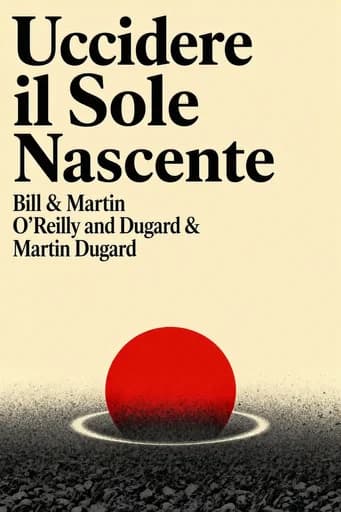
Unraveling WWII's Pacific endgame, this multi-million seller explores the controversial atomic bombings and MacArthur-Truman tensions. How did America's most devastating military decision shape our world? O'Reilly's Goodreads-nominated masterpiece reveals the human cost behind history's deadliest conflict.
Bill O’Reilly, co-author of Killing the Rising Sun, is a bestselling author, veteran journalist, and conservative commentator renowned for his gripping historical narratives. A former host of Fox News’ top-rated The O’Reilly Factor, he has written over 25 books, including the acclaimed “Killing” series (Killing Lincoln, Killing Kennedy) with historian Martin Dugard.
O’Reilly’s expertise in blending rigorous research with accessible storytelling stems from his journalism career, which earned multiple Emmy Awards. His digital platform No Spin News reaches millions monthly, and his works have sold tens of millions of copies worldwide.
Martin Dugard, O’Reilly’s longtime collaborator, is a historian and New York Times bestselling author known for immersive historical accounts. His partnership with O’Reilly has produced definitive works on pivotal moments in history, including Killing Jesus and Killing Patton.
Dugard’s background in exploration journalism and narrative nonfiction informs the duo’s meticulous approach to unpacking complex events like the Pacific Theater in World War II, the focus of Killing the Rising Sun. The “Killing” series has been adapted into National Geographic documentaries and translated into dozens of languages, cementing its status as a cornerstone of popular history.
Killing the Rising Sun examines the final stages of World War II in the Pacific, detailing pivotal events like the battles of Peleliu and Iwo Jima, the Manhattan Project’s development of atomic weapons, and President Truman’s decision to bomb Hiroshima and Nagasaki. The book argues these actions prevented a catastrophic Allied invasion of Japan, saving millions of lives.
History enthusiasts, military strategy scholars, and readers interested in World War II’s Pacific Theater will find this book compelling. Its narrative-driven style also appeals to fans of O’Reilly’s Killing series seeking accessible historical accounts.
The authors assert that Japan’s adherence to the Bushido code and refusal to surrender necessitated the atomic bombings. They emphasize the projected million-plus Allied casualties from a ground invasion and highlight how the bombs accelerated Japan’s surrender, preventing Soviet involvement in post-war Japan.
The book details Japan’s imperial expansion under Emperor Hirohito, including atrocities like the Rape of Nanking and forced labor camps. It explains the doctrine of hakkō ichiu (“eight crown cords under one roof”), which justified territorial conquests to unify Asia under Japanese rule.
The narrative traces J. Robert Oppenheimer’s leadership in developing the atomic bomb, the Trinity test’s success, and Truman’s ethical dilemma over deploying it. The authors frame the bomb as a tragic but inevitable tool to end the war swiftly.
While acknowledging the bombs’ horrific human toll, the book defends their use as the “least terrible option” compared to a prolonged invasion. Critics argue this perspective oversimplifies historical context and downplays alternatives like negotiated surrender.
Hirohito is depicted as a divine figurehead whose refusal to surrender extended the war. The authors contrast his secluded life with the suffering of Japanese civilians, arguing his delayed capitulation caused unnecessary destruction.
The Battle of Peleliu and Iwo Jima are analyzed for their brutality and strategic significance. These campaigns demonstrated Japan’s willingness to fight to the death, influencing Allied decisions to avoid a mainland invasion.
Like earlier titles, it uses a fast-paced, character-driven narrative but focuses more on geopolitical analysis than individual biographies. The book’s controversial stance on the atomic bomb distinguishes it within the series.
The authors cite military records, survivor testimonies, and historical biographies. However, some historians critique the lack of Japanese primary sources and reliance on Western perspectives.
Critics argue it oversimplifies complex moral decisions and perpetuates a one-sided view of the war. Descriptions of atomic bomb victims have also been criticized as insensitive.
The book concludes with Japan’s formal surrender aboard the USS Missouri, MacArthur’s post-war governance, and the beginning of Japan’s transformation into a democratic ally. It frames the outcome as a necessary step toward global stability.
Senti il libro attraverso la voce dell'autore
Trasforma la conoscenza in spunti coinvolgenti e ricchi di esempi
Cattura le idee chiave in un lampo per un apprendimento veloce
Goditi il libro in modo divertente e coinvolgente
This requires action.
I shall return.
Alex, what you are after is to see that the Nazis don't blow us up.
People of the Philippines, I have returned!
Die, to ensure that you do not leave ignominy behind you.
Scomponi le idee chiave di Killing the Rising Sun in punti facili da capire per comprendere come i team innovativi creano, collaborano e crescono.
Vivi Killing the Rising Sun attraverso narrazioni vivide che trasformano le lezioni di innovazione in momenti che ricorderai e applicherai.
Chiedi qualsiasi cosa, scegli il tuo stile di apprendimento e co-crea intuizioni che risuonano davvero con te.

Creato da alumni della Columbia University a San Francisco
"Instead of endless scrolling, I just hit play on BeFreed. It saves me so much time."
"I never knew where to start with nonfiction—BeFreed’s book lists turned into podcasts gave me a clear path."
"Perfect balance between learning and entertainment. Finished ‘Thinking, Fast and Slow’ on my commute this week."
"Crazy how much I learned while walking the dog. BeFreed = small habits → big gains."
"Reading used to feel like a chore. Now it’s just part of my lifestyle."
"Feels effortless compared to reading. I’ve finished 6 books this month already."
"BeFreed turned my guilty doomscrolling into something that feels productive and inspiring."
"BeFreed turned my commute into learning time. 20-min podcasts are perfect for finishing books I never had time for."
"BeFreed replaced my podcast queue. Imagine Spotify for books — that’s it. 🙌"
"It is great for me to learn something from the book without reading it."
"The themed book list podcasts help me connect ideas across authors—like a guided audio journey."
"Makes me feel smarter every time before going to work"
Creato da alumni della Columbia University a San Francisco

Ottieni il riassunto di Killing the Rising Sun in formato PDF o EPUB gratuito. Stampalo o leggilo offline quando vuoi.
Picture a nervous scientist clutching a letter in the Oval Office. It's October 1939, and Alexander Sachs has come to deliver Albert Einstein's warning: Nazi Germany might build "extremely powerful bombs of a new type." President Roosevelt's response was immediate: "Alex, what you are after is to see that the Nazis don't blow us up." With a simple command-"This requires action"-the atomic age began. But the weapon developed to stop Hitler would instead end a different war, one fought with a ferocity that made Europe's battlefields look civilized. This is the story of how America faced an enemy that preferred death to surrender, and the impossible choice that followed.
The Pacific War shattered American assumptions about combat. On Peleliu in September 1944, Colonel Kunio Nakagawa transformed the island into an elaborate death trap - hidden mortars, camouflaged spider traps, and 500 caves filled with soldiers who would never surrender. The samurai code of Bushido forbade it: "Do not survive in shame as a prisoner. Die, to ensure that you do not leave ignominy behind you." After two months of fighting, it took 13 million bullets and 150,000 mortar rounds - roughly 1,500 rounds per enemy soldier killed. Nakagawa committed ritual suicide rather than face capture. As American forces pushed closer to Japan's home islands, a terrifying question emerged: If Japan fought this desperately for a small island, how many Americans would die invading the homeland? Military planners estimated casualties could reach half a million.
While his soldiers died by the thousands, Emperor Hirohito lived a surprisingly mundane existence. Standing just five feet five inches, the nearsighted, absentminded emperor rose at seven each morning for oatmeal and black bread. Yet behind this ordinary facade lived a man deeply complicit in extraordinary atrocities. When Japanese forces captured Nanking in December 1937, Hirohito pronounced himself "deeply satisfied" as soldiers executed 90,000 Chinese troops and raped 80,000 women. Half of Nanking's 600,000 citizens were murdered or violated-while the Japanese public celebrated. Japan's expansion was driven by necessity. Lacking natural resources, it invaded Manchuria in 1937, fighting under hakko ichiu-the belief that all Asia must unite under one emperor. When Roosevelt embargoed oil sales in 1940, Japan had only six months of fuel reserves. The embargo accelerated war rather than preventing it. On November 8, 1941, Hirohito approved detailed plans for a surprise attack on Pearl Harbor. By 1944, as American forces closed in, the emperor publicly appeared as a man of peace while privately declaring his intention to "remain in this divine land and fight to the death." His divine status made surrender unthinkable, even as his nation starved.
Harry Truman was at Speaker Sam Rayburn's happy hour on April 12, 1945, when an urgent call interrupted. He left so hastily he forgot his hat-a telling detail in an era when no gentleman went outdoors bareheaded. At the White House, Eleanor Roosevelt delivered the news: "Harry, the president is dead." Her response to his offer of help proved prescient: "Is there anything we can do for you? For you are the one in trouble now." Truman inherited not just the presidency but the burden of ending the war. By April 24, Secretary of War Henry Stimson briefed him on the Manhattan Project-a weapon capable of obliterating an entire city. At Los Alamos, Robert Oppenheimer consumed five packs of cigarettes daily, his weight dropping to 115 pounds as he drove toward the Trinity test in New Mexico's Jornada del Muerto desert-"Journey of Death." As the test approached, Oppenheimer quoted the Bhagavad Gita: "Now I am become death, the shatterer of worlds." This terrible power would soon rest in Truman's hands alone.
Five thousand miles from Los Alamos, Marines battled through monsoon-soaked Okinawa, just 400 miles from Tokyo. The battlefield was a hellscape of constant shelling and rotting corpses. Private First Class Desmond Doss, a conscientious objector who refused to carry weapons, rescued 75 wounded men during a retreat, lowering them down a cliff one by one under Japanese fire. After 82 days, Okinawa fell on June 23, 1945-over 20,000 Americans dead. As battle raged, former Japanese prime minister Koki Hirota met Soviet ambassador Yakov Malik on June 24, desperately seeking Russian help negotiating peace. After midnight, Hirota finally admitted Japan "seeks an early peace." But Malik remained impassive: "Peace does not depend upon Russia." Unknown to Hirota, Stalin had already promised to attack Japan within three months. Meanwhile, on July 16, the Trinity test detonated with brightness so intense it penetrated closed eyelids, creating a 40,000-foot fireball and turning desert sand to green glass. The weapon was ready.
The USS Indianapolis departed San Francisco carrying a mysterious fifteen-foot crate and small cylinder - the atomic bomb components. After delivering its cargo to Tinian Island on July 27, the cruiser steamed toward the Philippines unescorted. Captain Charles McVay had ceased defensive zigzagging, and hatches remained open against the stifling heat. At 12:02 a.m. on July 30, Japanese submarine I-58 fired six torpedoes. Indianapolis sank in twelve minutes. Over 800 men entered oil-covered water with only a dozen life rafts. Their SOS was never received. Then the sharks appeared. For four days, survivors endured blinding sun, desperate thirst, hallucinations, and relentless shark attacks. Lieutenant Wilbur Gwinn accidentally spotted them during routine patrol. Lieutenant Adrian Marks defied regulations and landed in rough seas, rescuing fifty-six men before his plane was damaged beyond repair. Of over 800 men in the water, only 317 survived. Twenty-three years later, haunted by guilt, Captain McVay ended his life with his service revolver.
At Potsdam in July 1945, Truman faced "the most terrible formula in the history of the world." Believing invasion could cost half a million American casualties, he authorized the bomb-yet rather than issuing a direct order, he let military plans proceed, attempting to distance himself from the moral weight. On August 6, 1945, the Enola Gay dropped Little Boy on Hiroshima. At 8:15:17 a.m., it detonated with the force of 20,000 tons of TNT, creating a fireball over a million degrees. Within seconds, 70,000 people were dead. Everyone within a mile radius simply vanished. Survivors suffered horrific burns, their skin hanging "like rugs." Sixteen-year-old Akira Onogi abandoned a trapped mother as fires approached, her daughter crying for help-an image that would haunt him forever. Emperor Hirohito maintained silence. Three days later, Fat Man killed 45,000 in Nagasaki. Finally, Hirohito declared it was time to "bear the unbearable." On August 15, the Japanese people heard their emperor's voice for the first time. Nearly three years later, Truman summoned pilot Paul Tibbets to the Oval Office. After a long silence, he asked, "What do you think?" Tibbets replied, "Mr. President, I think I did what I was told." Truman slapped his desk: "You're damn right you did. And I'm the guy who sent you." The atomic bombs ended the war but opened a Pandora's box that can never be closed.