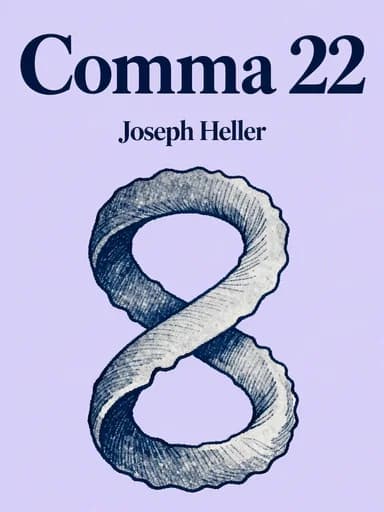
Trapped in war's bureaucratic madness, "Catch-22" coined a term now embedded in our language. Translated into 30+ languages with millions sold, Heller's WWII satire influenced everything from "M*A*S*H" to corporate culture. What paradoxical prison are you caught in today?
Joseph Heller (1923–1999), the acclaimed author of Catch-22, was a renowned American novelist and master of satirical fiction whose works critique the absurdities of war and bureaucracy.
Born in New York City, Heller drew heavily from his experiences as a B-25 bombardier in World War II, flying 60 combat missions over Italy, to craft the novel’s darkly humorous critique of military logic. A Distinguished Professor of Creative Writing at CUNY, Heller’s sharp wit and unflinching examination of societal structures cemented his legacy in 20th-century literature.
His other notable works include the introspective Something Happened and Closing Time, the sequel to Catch-22, both exploring themes of existential angst and institutional dysfunction. Translated into over a dozen languages and selling more than 10 million copies, Catch-22 remains a cornerstone of modern American literature, with its title entering the lexicon as a symbol of paradoxical dilemmas.
Catch-22 is a satirical World War II novel following Captain John Yossarian, a bombardier trapped in a paradoxical military rule: pilots can avoid dangerous missions if declared insane, but requesting exemption proves sanity. The story critiques war bureaucracy and explores themes of absurdity, survival, and the futility of institutional logic.
This novel suits readers of dark comedy, anti-war literature, and existential philosophy. Fans of satire like Slaughterhouse-Five or 1984 will appreciate its critique of bureaucracy and human irrationality. It’s also ideal for those interested in iconic literary phrases, as “Catch-22” entered vernacular usage.
Yes—it’s a landmark 20th-century novel celebrated for its inventive structure, dark humor, and enduring critique of institutional absurdity. Its exploration of paradoxical logic remains relevant to modern discussions of bureaucracy and mental health.
The term refers to a self-contradictory military rule: pilots can avoid combat if mentally unfit, but fearing death proves rationality, forcing them to fly. This paradox symbolizes the absurdity of bureaucratic systems and no-win scenarios.
Yossarian is the protagonist, a B-25 bombardier desperate to survive WWII. His escalating paranoia and refusal to accept senseless missions highlight the novel’s themes of individual vs. institutional insanity.
Heller flew 60 missions as a bombardier, mirroring Yossarian’s role. His exposure to military inefficiency and existential dread shaped the novel’s critique of war’s futility.
The fragmented timeline reflects the chaos and irrationality of war, forcing readers to piece together events and confront the disjointed reality experienced by soldiers.
Unlike linear war narratives, Catch-22 uses satire and circular logic to highlight systemic absurdity rather than battlefield horror. It contrasts with gritty works like All Quiet on the Western Front by focusing on psychological survival.
Some critique its repetitive structure and lack of emotional depth in side characters. Others argue its satire oversimplifies war’s complexities, though this exaggeration serves its thematic goals.
Its exploration of bureaucratic paradoxes resonates in modern contexts like corporate policies, government red tape, and mental health stigma. The term “Catch-22” remains shorthand for unwinnable dilemmas.
Senti il libro attraverso la voce dell'autore
Trasforma la conoscenza in spunti coinvolgenti e ricchi di esempi
Cattura le idee chiave in un lampo per un apprendimento veloce
Goditi il libro in modo divertente e coinvolgente
There was only one catch and that was Catch-22, which specified that a concern for one's own safety in the face of dangers that were real and immediate was the process of a rational mind.
That's some catch, that Catch-22.
Everyone is trying to kill me.
Man was matter... The spirit gone, man is garbage.
What difference does that make?
Scomponi le idee chiave di Catch-22 in punti facili da capire per comprendere come i team innovativi creano, collaborano e crescono.
Vivi Catch-22 attraverso narrazioni vivide che trasformano le lezioni di innovazione in momenti che ricorderai e applicherai.
Chiedi qualsiasi cosa, scegli il tuo stile di apprendimento e co-crea intuizioni che risuonano davvero con te.

Creato da alumni della Columbia University a San Francisco
"Instead of endless scrolling, I just hit play on BeFreed. It saves me so much time."
"I never knew where to start with nonfiction—BeFreed’s book lists turned into podcasts gave me a clear path."
"Perfect balance between learning and entertainment. Finished ‘Thinking, Fast and Slow’ on my commute this week."
"Crazy how much I learned while walking the dog. BeFreed = small habits → big gains."
"Reading used to feel like a chore. Now it’s just part of my lifestyle."
"Feels effortless compared to reading. I’ve finished 6 books this month already."
"BeFreed turned my guilty doomscrolling into something that feels productive and inspiring."
"BeFreed turned my commute into learning time. 20-min podcasts are perfect for finishing books I never had time for."
"BeFreed replaced my podcast queue. Imagine Spotify for books — that’s it. 🙌"
"It is great for me to learn something from the book without reading it."
"The themed book list podcasts help me connect ideas across authors—like a guided audio journey."
"Makes me feel smarter every time before going to work"
Creato da alumni della Columbia University a San Francisco

Ottieni il riassunto di Catch-22 in formato PDF o EPUB gratuito. Stampalo o leggilo offline quando vuoi.
A bombardier sits naked in a tree during a funeral. A dead man's belongings haunt a tent, impossible to remove because he never officially existed. A soldier wrapped entirely in bandages may or may not be hollow inside. Welcome to the world of "Catch-22," where the only way to prove you're crazy enough to stop flying combat missions is to demonstrate you're sane enough to keep flying them. Joseph Heller's masterpiece doesn't just tell a war story-it exposes the machinery of madness that grinds up human beings while calling itself rational. The novel gave us a term now woven into everyday language, describing those impossible situations where the rules themselves trap you: needing experience to get a job that would give you experience, requiring insurance to afford treatment that would qualify you for insurance. But beneath its dark comedy lies a devastating question: What happens when the system designed to protect you becomes the thing you need protection from?
The rule is elegantly simple: any pilot requesting grounding for insanity must be sane, because only a sane person fears deadly missions. Anyone truly insane would happily keep flying. There's no escape because the escape route itself is the trap. What makes this paradox brilliantly terrifying is that Catch-22 doesn't exist as written regulation. Characters cite it with absolute authority, but nobody can produce the document. It's a phantom rule with real power, enforced through collective belief rather than legal text. This fictional regulation expands to justify every absurdity: Why can't you see the commander? Catch-22. Why must you keep flying? Catch-22. Heller's genius lies in showing how arbitrary rules, once accepted, become unquestionable. Colonel Cathcart keeps raising required missions-from twenty-five to thirty, forty, fifty, eventually eighty-always just beyond Yossarian's reach. This moving target creates psychological torture more effective than physical threat. The novel populates itself with characters embodying different responses to systemic madness. Cathcart volunteers his men for extra missions to impress superiors, treating human lives as ledger entries. Major Major Major Major, cursed with a name that became his rank through IBM error, adopts a policy of never being available when people want to see him.
Yossarian isn't brave or cowardly-he's rational in an irrational world. When Clevinger argues the enemy shoots at everyone, Yossarian cuts through the absurdity: "What difference does that make?" His survival strategies-faking liver conditions, moving bomb lines on maps, appearing naked at ceremonies-aren't madness but recognition that the emperor has no clothes and will kill you for noticing. What separates Yossarian from selfishness is genuine compassion. Near the novel's end, the Snowden incident is fully revealed. After flak hits their plane, Yossarian treats Snowden's visible thigh wound, believing he's saved him. But when Snowden whispers "I'm cold," Yossarian discovers flak has torn through his side, spilling organs into the plane. This reveals "Snowden's secret": beneath all stories about meaning, we're fragile biology that stops working. Confronted with Snowden's literal insides, Yossarian sees past patriotic abstractions to mortality's brutal physics-not cynicism but terrible clarity.
In Yossarian's tent lives the ghost of Mudd-a soldier who died before completing his paperwork, so officially he never existed. His belongings remain because you can't remove possessions of someone who was never there. When new roommates finally dispose of Mudd's things as unwanted clutter, the casual erasure terrifies Yossarian more than the original death. The system's ultimate power isn't just killing you-it's erasing you so completely that your death doesn't even count. The soldier in white appears completely wrapped in bandages with tubes recycling fluids in a closed loop. Dunbar suggests he might be "hollow inside, like a chocolate soldier," triggering ward-wide panic. The patient has no voice, no face, no identity beyond medical processing. Doc Daneeka gets declared officially dead despite walking around alive because paperwork says he was aboard a crashed plane. The military won't correct the error because admitting mistakes proves more impossible than accepting a living dead man. Each character represents the tyranny of paperwork over reality-the system's refusal to acknowledge its own errors.
Milo Minderbinder transforms from mess officer to international syndicate operator whose M&M Enterprises-where "everybody has a share"-trades across the Mediterranean with anyone, regardless of allegiance. His business logic divorces completely from morality or patriotism. When he contracts with Germans to bomb his own squadron, he justifies it as good business: the Germans are syndicate members too, and profit benefits everyone. Heller satirizes capitalism within warfare-Milo buys eggs for seven cents, sells for five, yet profits through elaborate shell companies. After cornering the Egyptian cotton market, he approaches Yossarian during Snowden's funeral to taste chocolate-covered cotton. Milo's effectiveness stems from complete sincerity-he genuinely believes profit equals patriotism, seeing no contradiction between serving his country and doing business with its enemies. His declaration that "what's good for M&M Enterprises is good for the country" parodies corporate logic equating private profit with public good. Together with Colonel Cathcart's careerism, these characters create a gallery of madness that feels less like exaggeration than documentary, revealing how unchecked capitalism and institutional self-interest devour human welfare.
The novel's darkest chapter sends Yossarian through nightmare Rome, searching for Nately's prostitute and her kid sister. He encounters brutal scenes: a convulsing soldier mocked by onlookers, men beating dogs and children, teeth scattered on pavement, police violently seizing civilians. This hellish journey culminates when Yossarian discovers that Aarfy-the affable navigator-has raped and murdered the maid Michaela, throwing her body from a window. Aarfy remains smugly confident: "They can't arrest me for that." When police arrive, they arrest Yossarian for being in Rome without a pass, completely ignoring the murder. This selective enforcement exemplifies bureaucratic absurdity elevated above human life. Institutions meant to protect citizens instead become arbitrary enforcers of meaningless regulations while actual crimes go unpunished. This isn't incompetence-it's the system working exactly as designed, prioritizing its own rules over human lives.
Yossarian faces three choices: accept Cathcart and Korn's corrupt deal, continue flying deadly missions, or desert. His decision crystallizes when he learns Orr-his tentmate thought dead-had been planning escape to Sweden all along, deliberately practicing crash landings. This revelation transforms despair into hope. Yossarian's desertion becomes moral choice, not mere self-preservation. His declaration of "responsibilities"-to reach Sweden and save Nately's whore's kid sister-shows maintained humanity. Even the chaplain and Major Danby find courage to resist from within, suggesting multiple valid paths of resistance. Yossarian's final leap-narrowly missing Nately's whore's knife-represents commitment to life despite its dangers. When Danby warns his conscience will never rest, Yossarian responds: "God bless it. I wouldn't want to live without strong misgivings." Moral discomfort beats comfortable complicity. In embracing uncertainty, Yossarian paradoxically finds the freedom military certainty denied him. His escape isn't victory but refusal-refusal to let the system define his worth or claim his life. In a world of bureaucratic absurdity, the question isn't whether systems will trap us-they will-but whether we'll maintain our capacity to see the madness and choose to jump anyway, strong misgivings and all, toward whatever uncertain freedom waits.