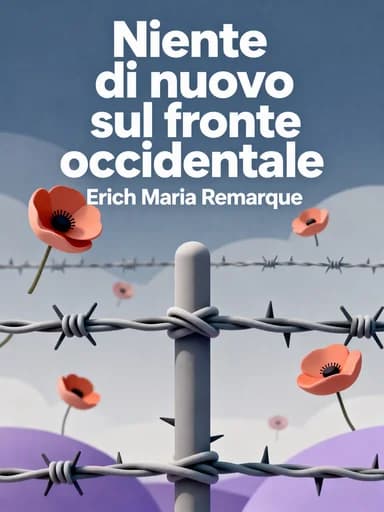
All Quiet on the Western Front
Panoramica di All Quiet on the Western Front
Banned by Nazis, this searing 1929 WWI novel follows German soldiers' psychological devastation in combat. Translated into 45+ languages, its raw anti-war message inspired Oscar-winning films and remains hauntingly relevant amid modern conflicts like Ukraine.
Temi chiave in All Quiet on the Western Front
- trench warfare reality
- lost generation disillusionment
- dehumanization of soldiers
- psychological trauma of combat
- futility of nationalism
Citazioni da All Quiet on the Western Front
Our knowledge of life is limited to death. What else remains?
The first bombardment showed us our mistake, and under it the world as they had taught it to us broke in pieces.
But now, for the first time, I see you are a man like me. I thought of your hand-grenades, of your bayonet, of your rifle; now I see your wife and your face and our common need. Forgive me, comrade; how could you be my enemy?
"Iron Youth," he called them with pompous certainty.
Personaggi di All Quiet on the Western Front
- Paul BaumerThe protagonist and narrator, a young soldier
- KantorekThe schoolmaster who encouraged enlistment
- Corporal HimmelstossA sadistic training officer and former postman
- KemmerichA fellow soldier who suffers a fatal leg injury
- Gerard DuvalA French printer killed by Paul in a shell hole
Sull'autore
Sull'autore di All Quiet on the Western Front
Erich Maria Remarque (1898–1970) was a renowned German novelist and author of the landmark anti-war novel All Quiet on the Western Front. He drew from his traumatic World War I experiences as a soldier in the Imperial German Army to craft this harrowing portrayal of battlefield disillusionment.
Wounded multiple times during the war, Remarque channeled his firsthand understanding of combat’s psychological toll into the novel’s raw depiction of soldier life, establishing it as a defining work of 20th-century war literature. Beyond this seminal work, Remarque explored similar themes of resilience and human suffering in The Road Back, Three Comrades, and Arch of Triumph—the latter adapted into a 1948 film starring Ingrid Bergman.
Known for his stark prose and unflinching examination of conflict’s aftermath, Remarque became a global literary voice. His debut novel was translated into over 50 languages and adapted into the 1930 Academy Award-winning film. Banned and burned by the Nazis for its pacifist stance, All Quiet on the Western Front remains a cornerstone of anti-war discourse, with recent editions and adaptations reaffirming its enduring relevance.
Scarica il riassunto di All Quiet on the Western Front
Ottieni il riassunto di All Quiet on the Western Front in formato PDF o EPUB gratuito. Stampalo o leggilo offline quando vuoi.
FAQ su questo libro
All Quiet on the Western Front by Erich Maria Remarque follows German soldier Paul Bäumer during World War I, exposing the physical and psychological trauma of trench warfare. It critiques nationalist propaganda by contrasting youthful idealism with the dehumanizing reality of survival, camaraderie loss, and existential despair. The novel’s iconic ending underscores war’s futility with Paul’s anonymous death amid an official report declaring “all quiet”.
This book is essential for readers interested in anti-war literature, historical fiction, or psychological studies of combat. Its raw depiction of soldier alienation resonates with those exploring themes like nationalism’s dangers, generational trauma, or the human cost of conflict. Critics and educators often recommend it for its unflinching critique of militarism.
Key themes include:
- Survival vs. Humanity: Soldiers suppress emotion to endure chaos, losing their pre-war identities.
- Disillusionment: Patriotic myths collapse as recruits face starvation, injury, and bureaucratic indifference.
- Comradeship: Bonds between soldiers contrast with their isolation from civilians.
- Existential Despair: Paul’s loss of purpose mirrors a generation “destroyed by war” even if they survive.
The novel rejects battlefield heroism, instead detailing rats, gas attacks, and amputations. A haunting scene shows Paul trapped in a shell crater with a dying French soldier, humanizing the enemy while illustrating war’s intimate horrors. Remarque emphasizes visceral details like stolen boots or maggot-infested wounds to underscore degradation.
The title bitterly contrasts the military’s sterile reports with frontline suffering. Paul’s death on a “peaceful day” highlights how institutions erase individual tragedy, reducing soldiers to statistics. This irony amplifies the novel’s anti-war message, condemning the disconnect between command and combat.
Paul transforms from a patriotic student to a disillusioned survivor numb to loss. His empathy for enemies (e.g., the French soldier he kills) reveals war’s universal toll. By the end, he sees no future beyond the trenches, symbolizing a generation stripped of hope.
Remarque attacks nationalist rhetoric as manipulative propaganda. Teachers and leaders glorify war without understanding its reality, creating a “gulf” between decision-makers and soldiers. Paul realizes French troops are similarly exploited, rejecting divisive patriotism.
- Kemmerich’s Boots: Passed between soldiers, they represent survival’s grim pragmatism.
- Butterfly in the Trenches: A fleeting symbol of beauty juxtaposed with Paul’s fatalistic final moments.
- Corpse Horses: Their agonized screams mirror soldiers’ silent suffering.
The novel redefined war literature by prioritizing soldiers’ psychological wounds over battlefield drama. Its timeless critique of militarism and vivid first-person narration make it a staple in anti-war discourse. Banned by the Nazis, its historical impact further cements its legacy.
Veterans struggle to reconnect with families romanticizing war. A hospital scene shows civilians dismissing Paul’s trauma, deepening his alienation. This rift underscores war’s isolating aftermath and society’s failure to comprehend combat experiences.
- “We are not youth any longer.” – Paul’s loss of innocence.
- “A hospital alone shows what war is.” – Critique of sanitized war narratives.
- “I am young, I am twenty years old; yet I know nothing of life but despair.” – Existential hopelessness.
Paul’s unceremonious death under a “quiet” sky emphasizes war’s anonymity and systemic indifference. The official report erases his humanity, mirroring how institutions reduce soldiers to expendable tools. This conclusion cements the novel’s anti-war stance.