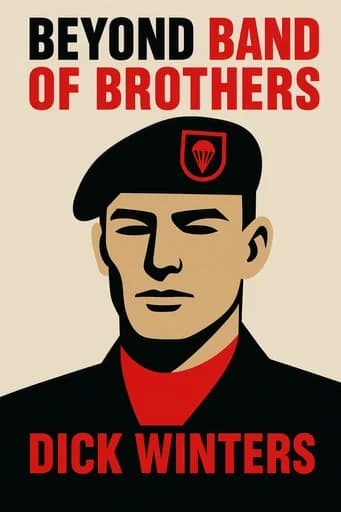
Step into Major Dick Winters' boots as he leads the legendary Easy Company through D-Day and beyond. This memoir, immortalized by HBO's "Band of Brothers," reveals untold war stories while teaching timeless leadership principles that military commanders and Fortune 500 executives still study today.
Dick Winters (1918–2011) was a decorated WWII commander and leadership expert whose memoir Beyond Band of Brothers (co-authored with military historian Cole C. Kingseed) chronicles his frontline experiences leading Easy Company’s 506th Parachute Infantry Regiment. A Lancaster, Pennsylvania native and Franklin & Marshall College graduate, Winters’ transformative leadership during pivotal WWII campaigns—from D-Day to Hitler’s Eagle’s Nest—forms the core of this military history classic.
His battlefield strategies and ethical command philosophy, detailed through wartime diaries and comrades’ accounts, remain studied in military academies and corporate leadership programs.
Cole C. Kingseed, a retired U.S. Army colonel and West Point military history professor, collaborated with Winters to distill decades of firsthand accounts into this definitive narrative. The book expands on Stephen Ambrose’s seminal Band of Brothers, which inspired HBO’s Emmy-winning miniseries produced by Tom Hanks and Steven Spielberg. Translated into 15 languages and adapted into global educational curricula, Beyond Band of Brothers has sold over 2 million copies, cementing Winters’ legacy as one of history’s most analyzed combat leaders.
Beyond Band of Brothers is Major Dick Winters' firsthand account of leading Easy Company, 506th Parachute Infantry Regiment, through pivotal WWII campaigns like D-Day and the Battle of the Bulge. The memoir blends tactical insights with personal reflections on leadership, camaraderie, and the psychological toll of war, offering an intimate perspective absent from broader historical narratives.
This book is ideal for military history enthusiasts, leadership scholars, and readers seeking visceral WWII accounts. It resonates with fans of Stephen Ambrose’s Band of Brothers and the HBO series, as Winters provides deeper context about decision-making under fire and the bonds forged in combat.
Yes—Winters’ unflinching honesty and humility elevate this memoir beyond typical war stories. Critics praise its focus on leadership principles and the untold sacrifices of Easy Company soldiers, making it essential for understanding WWII’s human dimension.
Winters stresses leading by example, meticulous preparation, and prioritizing troop welfare. His mantra—“Follow me”—captures his hands-on approach, while his decision-making during crises (e.g., the Brecourt Manor assault) remains a military leadership benchmark.
The narrative spans D-Day parachute drops, liberating Nazi death camps, the Battle of the Bulge’s frozen trenches, and capturing Hitler’s Berchtesgaden retreat. Winters’ strategic role in these events is detailed through maps, diary entries, and after-action reports.
While Ambrose chronicles Easy Company’s collective journey, Winters’ memoir adds personal introspection, postwar reflections, and previously unreleased anecdotes. It shifts focus to leadership challenges and the moral weight of command.
Winters highlights his soldiers’ resilience and sacrifices, deflecting praise onto their collective bravery. His writing avoids glorification, instead underscoring the brutal realities of combat and the psychological scars carried home.
Notable lines include:
These encapsulate Winters’ humility and the era’s fading legacy.
Raised in rural Pennsylvania and educated at Franklin & Marshall College, Winters’ disciplined, ethical approach stemmed from his upbringing. His emphasis on teamwork over individual glory reflected his belief in collective duty.
Some readers find Winters’ clinical tone overly restrained, lacking emotional depth. However, this aligns with his personality—analytical and reluctant to self-mythologize—which fans argue reinforces the memoir’s authenticity.
Unlike Patton’s or MacArthur’s top-down narratives, Winters centers frontline leadership’s chaos and moral complexity. His focus on small-unit tactics offers a granular contrast to grand-strategy memoirs.
Winters advised producers, ensuring historical accuracy, and his memoir provided untold stories adapted into the series. His leadership philosophy shaped protagonist portrayals, cementing his legacy in popular culture.
Recurring themes include:
Senti il libro attraverso la voce dell'autore
Trasforma la conoscenza in spunti coinvolgenti e ricchi di esempi
Cattura le idee chiave in un lampo per un apprendimento veloce
Goditi il libro in modo divertente e coinvolgente
Sobel "made" Easy Company into a combat-ready unit.
"Wild Bill" Guarnere fought "like a man possessed."
Winters wondered if he would ever return home.
Change the world or go home.
Scomponi le idee chiave di Beyond Band of Brothers in punti facili da capire per comprendere come i team innovativi creano, collaborano e crescono.
Vivi Beyond Band of Brothers attraverso narrazioni vivide che trasformano le lezioni di innovazione in momenti che ricorderai e applicherai.
Chiedi qualsiasi cosa, scegli il tuo stile di apprendimento e co-crea intuizioni che risuonano davvero con te.

Creato da alumni della Columbia University a San Francisco
"Instead of endless scrolling, I just hit play on BeFreed. It saves me so much time."
"I never knew where to start with nonfiction—BeFreed’s book lists turned into podcasts gave me a clear path."
"Perfect balance between learning and entertainment. Finished ‘Thinking, Fast and Slow’ on my commute this week."
"Crazy how much I learned while walking the dog. BeFreed = small habits → big gains."
"Reading used to feel like a chore. Now it’s just part of my lifestyle."
"Feels effortless compared to reading. I’ve finished 6 books this month already."
"BeFreed turned my guilty doomscrolling into something that feels productive and inspiring."
"BeFreed turned my commute into learning time. 20-min podcasts are perfect for finishing books I never had time for."
"BeFreed replaced my podcast queue. Imagine Spotify for books — that’s it. 🙌"
"It is great for me to learn something from the book without reading it."
"The themed book list podcasts help me connect ideas across authors—like a guided audio journey."
"Makes me feel smarter every time before going to work"
Creato da alumni della Columbia University a San Francisco

Ottieni il riassunto di Beyond Band of Brothers in formato PDF o EPUB gratuito. Stampalo o leggilo offline quando vuoi.
A group of volunteers gathered in tar-paper huts without doors, windows, or electricity, eaten alive by mosquitoes, preparing to become something they couldn't yet imagine. They didn't know that decades later, their story would captivate millions through an HBO series, or that historians would call them the finest rifle company in World War II. What transforms ordinary people into extraordinary leaders? The answer lies not in grand speeches or natural-born heroism, but in something far more accessible-the daily choice to serve others before yourself. Dick Winters never wanted fame. He wanted to bring his men home alive. That singular focus would forge a leadership legacy that continues to reshape how we think about command, courage, and character.
Camp Toccoa, Georgia, was designed to break men. Of 5,300 enlisted volunteers, only 1,800 survived to Fort Benning. For officers, the attrition was worse: 400 started, 148 finished. Captain Herbert Sobel ruled Easy Company with tyrannical precision, earning the nickname "Black Swan." He couldn't read maps, panicked under pressure, and conducted arbitrary inspections that humiliated his men. Yet his merciless standards created something extraordinary - the men didn't unite with Sobel, they united against him, forming bonds of protection and mutual survival that would prove unbreakable in combat. Daily runs up Currahee Mountain became their identity. When they earned their paratrooper wings at Fort Benning, Colonel Sink had his troopers shout "Currahee" instead of "Geronimo" when jumping. By Camp Sturgis, Easy Company had emerged as the regiment's strongest unit, bound by shared suffering into something resembling family. When they departed New York Harbor aboard the S.S. Samaria in September 1943, Winters wondered if he'd ever see home again.
Winters jumped into Normandy at 0110 hours on June 6, 1944, landing with only a trench knife after his leg bag tore away. Lieutenant Meehan's plane had crashed, killing all seventeen men aboard. By 0600 hours, only nine riflemen and two officers had assembled from Easy Company's full strength of 139 men. At Le Grand Chemin, Captain Hester assigned an urgent mission: neutralize a four-gun 105mm German battery hammering Utah Beach. Winters had eleven men against fifty Germans. He crawled through drainage ditches to observe enemy positions, then divided his force into three assault teams for a flanking maneuver. "Wild Bill" Guarnere, having just learned his brother died in Italy, fought with fierce determination. The three-hour engagement cost four American lives while inflicting fifteen enemy casualties and capturing twelve prisoners. The Brecourt Manor assault became a textbook example taught at West Point. Winters earned the Distinguished Service Cross-but what mattered more was bringing his men through alive.
After Normandy, Easy Company jumped into Holland for Market Garden on September 17, greeted by jubilant Dutch civilians freed from Nazi occupation. On October 5, defending "the Island" between two rivers, Winters led a rifle squad encountering seven Germans at a machine gun. On his command - "Ready, Aim, Fire!" - they eliminated all seven. But a larger German force appeared, killing beloved Corporal William "Duke" Dukeman. When reinforcements arrived, Winters ordered a bayonet attack. As the smoke signal dropped, he sprinted 175 yards across open field, tripping on hidden barbed wire yet somehow outpacing everyone. Reaching the road alone behind German infantry, he shot the sentry from the hip, then pivoted right, emptying two clips into the confused enemy. This action became Easy Company's finest engagement - demonstrating their tactical superiority. On October 9, Winters moved to battalion headquarters as executive officer. Leaving Easy Company was the hardest thing he'd done. The Battle of the Bulge proved their toughest campaign. Hitler's December 16 counteroffensive sent the 101st to Bastogne - critically under strength, inadequately clothed, short on ammunition. As they approached, retreating soldiers shouted "Run! They've got everything!" Easy Company kept walking silently toward the firefight. The winter of 1944-45 was brutal. Artillery rationed to three rounds. Trench foot and frostbite claimed a third of casualties. Despite being surrounded, outnumbered, and undersupplied, they held. General McAuliffe's famous "Nuts!" reply to German surrender demands gave them quiet pride. When you're freezing, hungry, and surrounded, leadership isn't about inspiration - it's about presence, sharing the same misery and refusing to quit.
On January 13, Winters selected Easy Company to lead the attack on Foy, briefing Lieutenant Dike despite doubts about his competence. The assault began well until Dike inexplicably halted 75 yards from the village, leaving his men exposed in the killing zone. When Colonel Sink demanded action, Winters ordered Lieutenant Ronald Speirs to take command. Speirs' actions became legendary-after leading the assault into Foy, he made an incredible run through enemy territory to coordinate with I Company, then returned through the same gauntlet of fire. Easy Company secured Foy by 1100 hours with few casualties. The next day, regiment ordered a daylight assault on Noville across open fields. Winters devised an alternative using natural terrain-his battalion reached position without loss while 1st Battalion suffered heavy casualties. In Haguenau, facing another tactically unsound order, Winters orchestrated a fake patrol using artillery fire while his exhausted men rested-a calculated disobedience that saved lives. Winters' promotion to major on March 8, 1945 marked an extraordinary progression from platoon leader to battalion commander in just two and a half years.
On May 5, 1945, Easy Company entered Berchtesgaden and discovered Hitler's Alpine retreat. Winters found Hermann Goering's compound filled with stolen art and a wine cellar containing nearly 10,000 bottles of the world's finest liquors. Victory brought not jubilation but exhausted relief-quiet gatherings sharing drinks from Goering's collection, the weight of losses hanging heavy. Winters felt like a retired fire horse, physically and emotionally drained, unsure of his place in a world without war. Easy Company's toll was staggering: 48 men killed, over 100 wounded-150% casualties. Yet at its peak during Holland and the Ardennes, it distinguished itself as one of history's finest rifle companies through exceptional training, shared combat experience, and uncommon brotherhood. Winters' service concluded November 29, 1945. His transition focused on straightforward goals: meaningful employment, finding a partner, starting a family, and discovering peace. After his January 22, 1946 discharge as Major, he chose to be known simply as Mr. R.D. Winters. Historian Stephen Ambrose later brought Easy Company's saga to international attention through "Band of Brothers." When asked where he would have served in WWII, Ambrose's immediate response-"With Easy Company"-reflected both the unit's combat record and Winters' exceptional leadership.
Easy Company's exceptional performance stemmed from bonds forged in Sobel's harsh Toccoa training and tempered through combat from Normandy to Germany's Eagle's Nest. Winters consistently chose them for the toughest missions, creating mutual trust and brotherhood that endured beyond the war. Winters' leadership philosophy was straightforward yet profoundly effective. Character begins with unwavering honesty, building the bedrock of trust. The Infantry School at Fort Benning distills leadership to two words: "Follow Me!" Leaders must lead from the front, never asking their team to face risks they wouldn't endure themselves. Physical fitness is non-negotiable-Winters ran nightly even during combat blackouts, ensuring exhaustion never compromised his decision-making. Develop teamwork by understanding individual strengths and matching men to missions. Meticulous preparation eliminates obstacles-his reconnaissance before Brecourt Manor and along the Nijmegen dike proved crucial. Share credit generously-when you stop worrying about recognition, you accomplish more. Lieutenant Burr Smith captured Winters' impact: "Dick, you were blessed with the uniform respect of 120 soldiers who would have followed you to certain death." War doesn't create great leaders-it reveals them. True leadership transcends time, remaining as relevant today as on Europe's battlefields. The question isn't whether you'll face your own Normandy-it's whether you'll have the character to lead from the front, the humility to share credit, and the courage to serve others first.