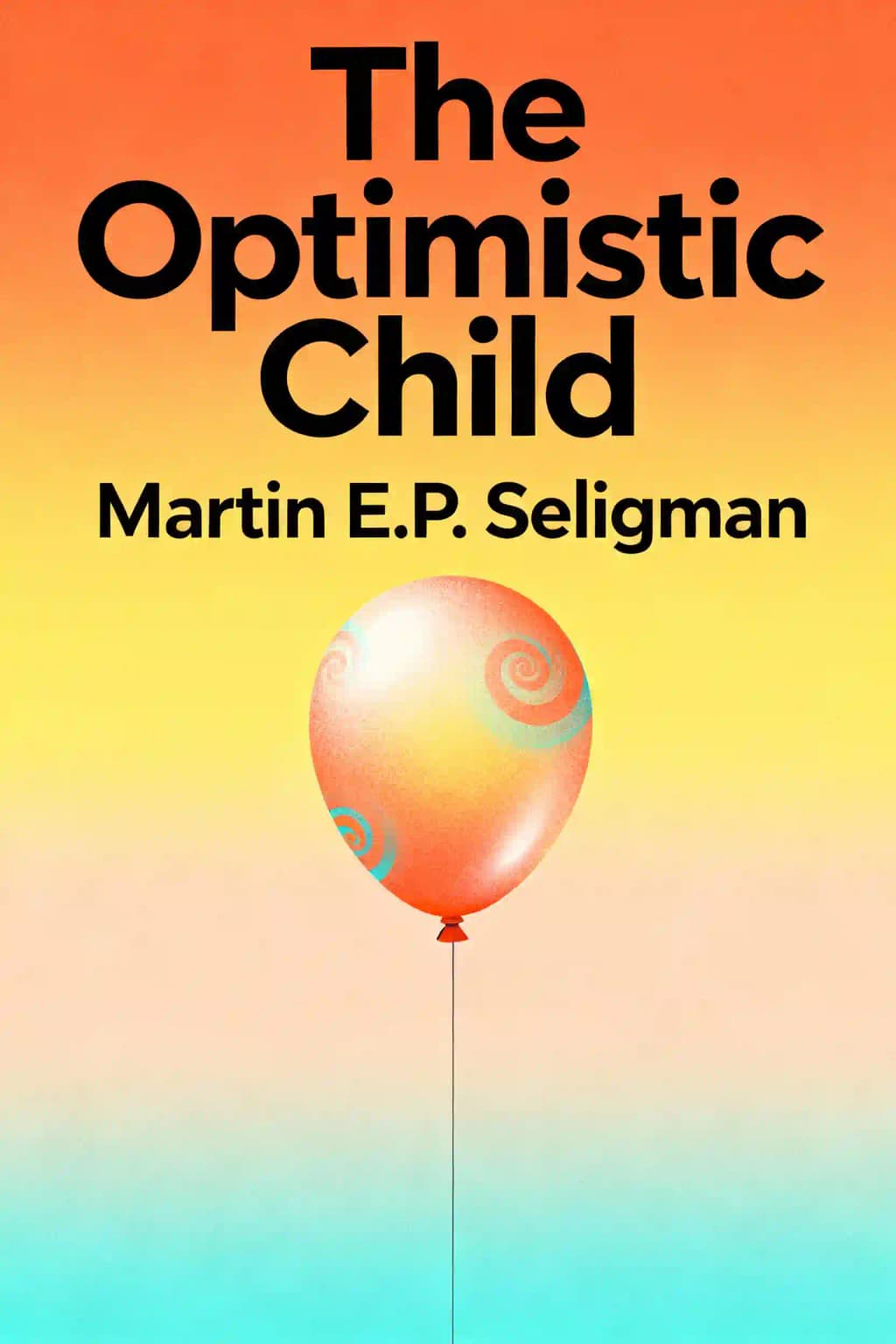
Optimistic Child: A Revolutionary Approach to Raising Resilient Children book cover

Optimistic Child

A Revolutionary Approach to Raising Resilient Children

Martin E.P. Seligman
4.04 (1402 Reviews)

Overview of Optimistic Child

Discover why the "father of positive psychology" Martin Seligman's groundbreaking approach shields children from depression while building lifelong resilience. What if preventing mental illness isn't about fixing problems, but teaching optimism? This revolutionary parenting guide transformed how we nurture emotional strength.

Key Themes in Optimistic Child

  • learned helplessness
  • explanatory style
  • psychological resilience
  • cognitive behavioral parenting
  • mastery based confidence

Quotes from Optimistic Child

  • Pessimism-not low self-esteem-was the true culprit behind the depression epidemic.

  • Feelings of self-esteem naturally develop as byproducts of mastering challenges-not as direct targets.

  • Low self-esteem is the consequence of failure, not its cause.

  • Optimism isn't about seeing the glass as half full or expecting Hollywood endings.

  • Classroom walls are plastered with generic affirmations.

Characters in Optimistic Child

  • Martin SeligmanAuthor and psychologist researching optimism
  • IanSix-year-old boy struggling with pessimistic talk
  • TamaraSeven-year-old girl developing resilience
  • MarlaPessimistic child prone to depressive episodes

About the Author

About the Author of Optimistic Child

Martin E.P. Seligman, author of The Optimistic Child, is a groundbreaking psychologist and the founder of positive psychology, a field dedicated to understanding human flourishing. A former president of the American Psychological Association and longtime professor at the University of Pennsylvania, Seligman’s work on learned helplessness and resilience revolutionized modern psychology. His expertise in child development and mental health underpins this parenting guide, which merges clinical research with actionable strategies to nurture optimism and emotional resilience in children.

Seligman’s influential works, including Learned Optimism and Authentic Happiness, have sold millions of copies worldwide and shaped education programs, corporate training, and therapeutic practices. His TED Talk on positive psychology has been viewed over 20 million times, amplifying his evidence-based approach to well-being.

Credited with developing the PERMA model of well-being (Positive Emotion, Engagement, Relationships, Meaning, Accomplishment), Seligman’s frameworks are taught in universities and applied by organizations like the U.S. Army to build mental toughness. The Optimistic Child remains a cornerstone of preventive mental health strategies, translated into over 20 languages and widely adopted in school curricula.

Download Summary of Optimistic Child

Get the Optimistic Child summary as a free PDF or EPUB. Print it or read offline anytime.

FAQs About This Book

The Optimistic Child presents a research-backed program to help children build resilience against depression by cultivating optimism. It teaches cognitive strategies to reframe setbacks using three dimensions: permanence (temporary vs. permanent causes), pervasiveness (specific vs. universal causes), and personalization (internal vs. external causes). The book emphasizes actionable skills over empty praise to foster lasting emotional health.

Parents, educators, and mental health professionals seeking evidence-based methods to nurture resilience in children. It’s especially relevant for those addressing anxiety, academic challenges, or low self-esteem. The techniques also benefit adults wanting to reframe their own pessimistic tendencies.

Yes, for its validated 30-year study showing a 50% reduction in depression rates among participants. It combines academic rigor (from Seligman, a pioneer in positive psychology) with practical exercises like “disputing negative thoughts”. Critics note its focus on Western individualism, but its core framework remains widely applied in therapy and education.

Explanatory style refers to how individuals interpret life events. Optimists view setbacks as temporary (permanence), limited in scope (pervasiveness), and caused by external factors (personalization). Seligman argues this mindset can be taught through guided reflection and real-world problem-solving.

Seligman links pessimism to learned helplessness—a belief that efforts won’t change outcomes, rooted in his 1967 dog experiments. The book counters this by teaching children to identify controllable factors in adversity. For example, a poor grade becomes a solvable problem (“I’ll study differently”) rather than a fixed trait (“I’m bad at math”).

  • Adversity: Identify the triggering event.
  • Belief: Note automatic pessimistic thoughts.
  • Consequences: Assess emotional/behavioral impacts.
  • Disputation: Challenge inaccuracies in beliefs.
  • Energization: Reinforce actionable solutions.

This framework helps children break cycles of negative thinking.

Seligman warns against empty affirmations (“You’re special!”) that ignore achievement. True self-esteem stems from mastering challenges, not passive praise. He cites studies showing excessive positivity increases depression risk when reality contradicts inflated self-views.

  • “Optimism is not about chanting positive slogans; it’s about how you explain setbacks.”
  • “Children need to fail, grieve, and persist to build mastery.”
  • “Pessimism is an acquired habit, not an inborn trait.”

It addresses “helicopter parenting” by advocating for guided autonomy. For instance, letting children navigate minor conflicts (e.g., playground disputes) builds problem-solving skills. The 2023 Yale Child Study Center cites Seligman’s work in combating pandemic-era anxiety spikes.

Some argue it oversimplifies depression as a thinking error, neglecting biological/structural factors. Seligman’s 1960s animal experiments also face ethical scrutiny. However, later editions integrate neuroplasticity research, strengthening its evidence base.

Both emphasize growth-oriented thinking, but Seligman focuses on depression prevention through cognitive restructuring, while Dweck targets academic/creative achievement. The Optimistic Child includes structured exercises; Mindset offers broader principles.

With 37% of U.S. teens now reporting depressive symptoms (CDC, 2024), Seligman’s prevention-first approach aligns with current mental health priorities. Schools like Singapore’s POSITIVE program use his methods to reduce academic stress.

Explore Your Way of Learning

Optimistic Child isn't just a book — it's a masterclass in Psychology. To help you absorb its lessons in the way that works best for you, we offer five unique learning modes. Whether you're a deep thinker, a fast learner, or a story lover, there's a mode designed to fit your style.

Quick Summary Mode

Read or listen to Optimistic Child Summary in 10 Minutes

Break down key ideas from Optimistic Child into bite-sized takeaways to understand how innovative teams create, collaborate, and grow.

play
00:00
00:00

Fun Mode

Optimistic Child Lessons Told Through 23-Min Stories

Experience Optimistic Child through vivid storytelling that turns innovation lessons into moments you'll remember and apply.

play
00:00
00:00

Personalize Mode

Experience Optimistic Child in your own learning style

Ask anything, choose your learning style, and co-create insights that truly resonate with you.

Personalize Mode

From Columbia University alumni built in San Francisco

BeFreed Brings Together A Global Community Of 1,000,000 Curious Minds

"Instead of endless scrolling, I just hit play on BeFreed. It saves me so much time."

@Moemenn
platform
star
star
star
star
star

"I never knew where to start with nonfiction—BeFreed’s book lists turned into podcasts gave me a clear path."

@Chloe, Solo founder, LA
platform
comments
12
likes
117

"Perfect balance between learning and entertainment. Finished ‘Thinking, Fast and Slow’ on my commute this week."

@Raaaaaachelw
platform
star
star
star
star
star

"Crazy how much I learned while walking the dog. BeFreed = small habits → big gains."

@Matt, YC alum
platform
comments
12
likes
108

"Reading used to feel like a chore. Now it’s just part of my lifestyle."

@Erin, Investment Banking Associate , NYC
platform
comments
254
likes
17

"Feels effortless compared to reading. I’ve finished 6 books this month already."

@djmikemoore
platform
star
star
star
star
star

"BeFreed turned my guilty doomscrolling into something that feels productive and inspiring."

@Pitiful
platform
comments
96
likes
4.5K

"BeFreed turned my commute into learning time. 20-min podcasts are perfect for finishing books I never had time for."

@SofiaP
platform
star
star
star
star
star

"BeFreed replaced my podcast queue. Imagine Spotify for books — that’s it. 🙌"

@Jaded_Falcon
platform
comments
201
thumbsUp
16

"It is great for me to learn something from the book without reading it."

@OojasSalunke
platform
star
star
star
star
star

"The themed book list podcasts help me connect ideas across authors—like a guided audio journey."

@Leo, Law Student, UPenn
platform
comments
37
likes
483

"Makes me feel smarter every time before going to work"

@Cashflowbubu
platform
star
star
star
star
star

"Instead of endless scrolling, I just hit play on BeFreed. It saves me so much time."

@Moemenn
platform
star
star
star
star
star

"I never knew where to start with nonfiction—BeFreed’s book lists turned into podcasts gave me a clear path."

@Chloe, Solo founder, LA
platform
comments
12
likes
117

"Perfect balance between learning and entertainment. Finished ‘Thinking, Fast and Slow’ on my commute this week."

@Raaaaaachelw
platform
star
star
star
star
star

"Crazy how much I learned while walking the dog. BeFreed = small habits → big gains."

@Matt, YC alum
platform
comments
12
likes
108

"Reading used to feel like a chore. Now it’s just part of my lifestyle."

@Erin, Investment Banking Associate , NYC
platform
comments
254
likes
17

"Feels effortless compared to reading. I’ve finished 6 books this month already."

@djmikemoore
platform
star
star
star
star
star

"BeFreed turned my guilty doomscrolling into something that feels productive and inspiring."

@Pitiful
platform
comments
96
likes
4.5K

"BeFreed turned my commute into learning time. 20-min podcasts are perfect for finishing books I never had time for."

@SofiaP
platform
star
star
star
star
star

"BeFreed replaced my podcast queue. Imagine Spotify for books — that’s it. 🙌"

@Jaded_Falcon
platform
comments
201
thumbsUp
16

"It is great for me to learn something from the book without reading it."

@OojasSalunke
platform
star
star
star
star
star

"The themed book list podcasts help me connect ideas across authors—like a guided audio journey."

@Leo, Law Student, UPenn
platform
comments
37
likes
483

"Makes me feel smarter every time before going to work"

@Cashflowbubu
platform
star
star
star
star
star

"Instead of endless scrolling, I just hit play on BeFreed. It saves me so much time."

@Moemenn
platform
star
star
star
star
star

"I never knew where to start with nonfiction—BeFreed’s book lists turned into podcasts gave me a clear path."

@Chloe, Solo founder, LA
platform
comments
12
likes
117

"Perfect balance between learning and entertainment. Finished ‘Thinking, Fast and Slow’ on my commute this week."

@Raaaaaachelw
platform
star
star
star
star
star

"Crazy how much I learned while walking the dog. BeFreed = small habits → big gains."

@Matt, YC alum
platform
comments
12
likes
108

"Reading used to feel like a chore. Now it’s just part of my lifestyle."

@Erin, Investment Banking Associate , NYC
platform
comments
254
likes
17

"Feels effortless compared to reading. I’ve finished 6 books this month already."

@djmikemoore
platform
star
star
star
star
star

"BeFreed turned my guilty doomscrolling into something that feels productive and inspiring."

@Pitiful
platform
comments
96
likes
4.5K

"BeFreed turned my commute into learning time. 20-min podcasts are perfect for finishing books I never had time for."

@SofiaP
platform
star
star
star
star
star

"BeFreed replaced my podcast queue. Imagine Spotify for books — that’s it. 🙌"

@Jaded_Falcon
platform
comments
201
thumbsUp
16

"It is great for me to learn something from the book without reading it."

@OojasSalunke
platform
star
star
star
star
star

"The themed book list podcasts help me connect ideas across authors—like a guided audio journey."

@Leo, Law Student, UPenn
platform
comments
37
likes
483

"Makes me feel smarter every time before going to work"

@Cashflowbubu
platform
star
star
star
star
star

See More Stories?

How people are talking about BeFreed across the web
1.5K Ratings4.7
Start your learning journey, now