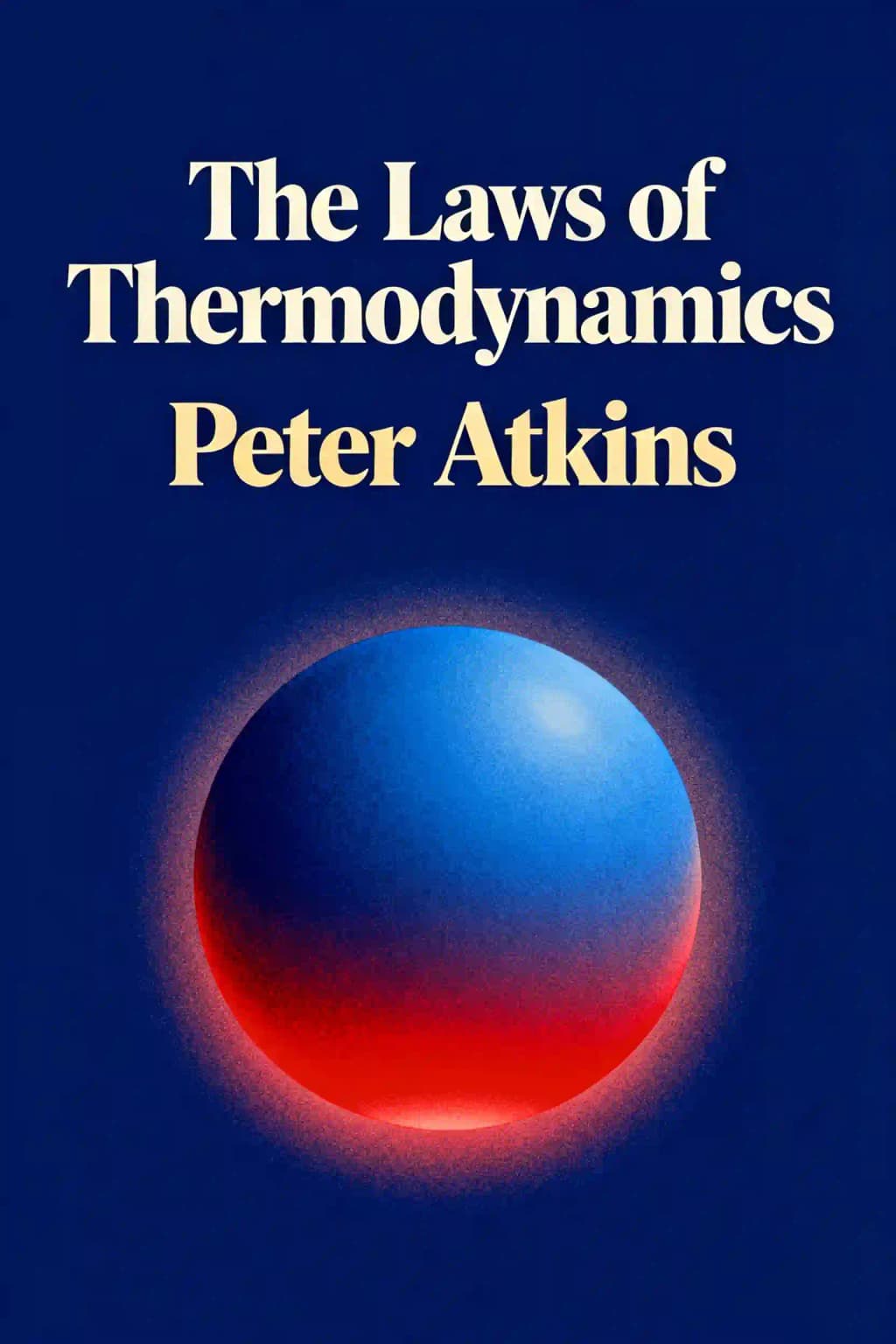
The Laws of Thermodynamics
A Very Short Introduction
Overview of The Laws of Thermodynamics
Demystifying nature's most fundamental rules, Atkins' guide transforms complex thermodynamics into everyday revelations. Beloved in academia for making entropy and energy conservation accessible to all, this slim volume explains why your coffee cools and why time only flows forward.

Key Themes in The Laws of Thermodynamics
- energy conservation
- entropy and disorder
- thermal equilibrium
- molecular motion
- laws of nature
Quotes from The Laws of Thermodynamics
Energy can neither be created nor destroyed, only transformed.
The second law tells us what's probable.
Every spontaneous process increases the total entropy of the universe.
Characters in The Laws of Thermodynamics
- Peter AtkinsAuthor and chemist who explains thermodynamic laws
- Tom StoppardPlaywright who used entropy as a central metaphor
- C.P. SnowPhysicist who noted the importance of the laws
About the Author
About the Author of The Laws of Thermodynamics
Peter William Atkins, author of The Laws of Thermodynamics, is a renowned British chemist and bestselling science communicator celebrated for distilling complex scientific concepts into accessible prose.
A former Professor of Chemistry at the University of Oxford and Fellow of Lincoln College, Atkins built his career on advancing physical chemistry education, evidenced by his seminal textbooks Physical Chemistry and Molecular Quantum Mechanics, which remain foundational in academic curricula worldwide.
His popular science works, including Galileo’s Finger: The Ten Great Ideas of Science and Conjuring the Universe: The Origins of the Laws of Nature, explore themes of cosmic order and scientific inquiry, reflecting his lifelong advocacy for rationalism and secularism.
Honored with the Royal Society of Chemistry’s Meldola Medal and honorary doctorates from institutions like the University of Utrecht, Atkins combines rigorous scholarship with a flair for narrative. His books have been translated into over 20 languages, solidifying his legacy as a bridge between academia and public understanding of science.
Download Summary of The Laws of Thermodynamics
Get the The Laws of Thermodynamics summary as a free PDF or EPUB. Print it or read offline anytime.
FAQs About This Book
The Laws of Thermodynamics by Peter Atkins provides a concise, non-mathematical introduction to the four fundamental laws governing energy, heat, and entropy. It covers concepts like energy conservation, entropy’s role in irreversibility, and the behavior of matter at absolute zero, with real-world examples from engines to biological systems.
This book is ideal for students, science enthusiasts, and professionals seeking a clear understanding of thermodynamics without heavy mathematics. Its accessible style suits readers with basic science knowledge, making it a primer for newcomers and a refresher for those revisiting the subject.
Yes. Critics praise Atkins’ ability to simplify complex ideas, calling it a “powerful and compact introduction” that balances depth with readability. It’s particularly recommended for those seeking foundational knowledge or a conceptual grasp of thermodynamics.
- Zeroth Law: Defines thermal equilibrium.
- First Law: Energy cannot be created or destroyed (conservation).
- Second Law: Entropy in closed systems always increases.
- Third Law: Entropy approaches zero as temperature nears absolute zero.
Entropy is framed as a measure of disorder or energy dispersal. The second law emphasizes its inevitable increase, illustrated through examples like heat transfer and engine efficiency. Atkins links entropy to everyday phenomena, such as why ice melts or why engines waste energy.
Yes. Applications include engines, refrigerators, chemical reactions, and biological processes. The final chapter explores thermodynamics’ role in fields like engineering and environmental science, showcasing its relevance to technology and natural systems.
Unlike his dense textbooks (e.g., Physical Chemistry), this book avoids advanced math, prioritizing conceptual clarity. It’s designed for broader audiences, whereas his textbooks cater to chemistry students needing technical rigor.
The zeroth law establishes that if two systems are in thermal equilibrium with a third, they are in equilibrium with each other. This foundational concept enables temperature measurement and underpins all thermodynamic analyses.
Atkins uses analogies, relatable examples (e.g., refrigerators), and plain language to explain abstract ideas. Key equations are introduced sparingly, with focus on their conceptual meaning rather than derivation.
Some readers may desire more mathematical rigor or deeper dives into topics like statistical mechanics. However, these omissions align with the book’s goal as a concise primer.
The third law states that entropy approaches zero as a system’s temperature nears absolute zero. This principle explains why achieving absolute zero is impossible and informs cryogenics research.
The second law dictates irreversible processes, such as heat flowing from hot to cold or fuel burning in an engine. It explains why systems degrade over time and underscores the inefficiencies inherent in energy conversions.