Chapter 1
The Engineering Ballet: Why Things Don't Fall Down
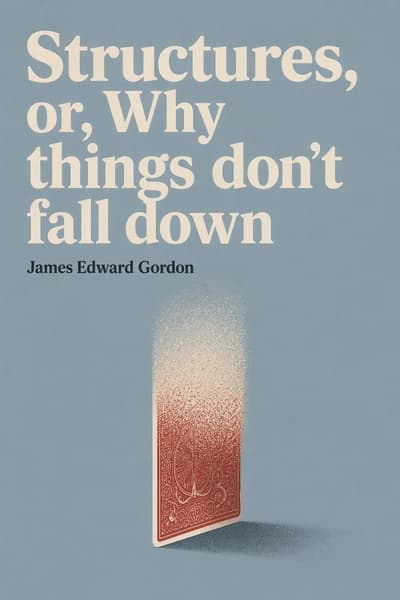
Structures: Or Why Things Don't Fall Down by James Edward Gordon has become a cornerstone text in engineering education since its publication in 1978. What makes this book particularly remarkable is how it transformed the typically dry subject of structural engineering into an accessible, even entertaining narrative. Gordon's work has influenced generations of engineers and architects, with figures like Norman Foster citing it as essential reading. The book's enduring popularity stems from its unique ability to explain complex engineering concepts without resorting to intimidating mathematics, making it accessible to both professionals and curious laypeople. Even Elon Musk reportedly keeps a copy in his personal library, appreciating its fundamental approach to understanding how our built world remains standing against the relentless pull of gravity.
Chapter 2
The Hidden Dance of Forces All Around Us
The world around us is a complex ballet of forces, tensions, and compressions that most of us never notice. From the majestic arch of a cathedral to the delicate structure of a bird's wing, from the humble garden fence to the towering skyscraper - all exist in a constant negotiation with the forces that would pull them down. This invisible dance is the subject of structural engineering, a field that touches everything in our physical environment.
Structures aren't merely the domain of engineers and architects. They're fundamental to understanding life itself. Every living organism, from the smallest bacterium to the tallest redwood, must develop strategies to maintain its physical integrity against gravity and other forces. The earliest life forms faced the challenge of creating a container - a membrane - to separate their internal chemistry from the external world. As life evolved and competition soared, organisms developed increasingly sophisticated structural solutions: skeletons, shells, and protective elements.
The human journey of structural understanding began with simple mimicry of nature - using sticks and stones as tools. Our ancestors intuitively grasped concepts of stress and strain long before they could be mathematically described. The leap from primitive tools to sophisticated Stone Age artifacts represents an instinctual comprehension of structural principles that modern engineering sometimes struggles to match.
This book explores the science of elasticity - why things bend rather than break, how materials respond to forces, and the fundamental principles that govern all structures. By stripping away complex mathematics, we can appreciate the elegant simplicity that underlies seemingly complex structures. Whether you're an engineer, a biologist, or simply curious about why things stand up, understanding these principles offers a new lens through which to view the world.
Chapter 3
The Birth of Structural Science: Hooke's Elegant Insight
The science of elasticity - understanding how structures carry loads without collapsing - began with a fundamental insight: structures resist mechanical stresses through a balanced interplay of internal forces. This wasn't always obvious. Galileo struggled with these concepts, but it was Robert Hooke who made the breakthrough in the 17th century with his famous law: the extension of a spring is proportional to the force applied.
What Hooke discovered was revolutionary - solids resist mechanical loads not by being rigidly unyielding, but through a clever interaction of internal forces that change the material's shape. This stretching or compression enables them to push back against the forces applied. When you pull on a string, it stretches slightly; when you push on a column, it compresses marginally. These tiny deformations are how structures "fight back" against the forces trying to deform them.
This insight transformed our understanding of structures. The deflection of structures, though often invisible to the naked eye, is perfectly natural and crucial to their function. Hooke demonstrated this with examples ranging from the stretching of strings to the bending of Salisbury Cathedral's columns. Even the most solid-looking structures bend and flex under load - they just do it in ways too subtle for us to perceive without instruments.
Despite the elegance and utility of Hooke's law, its initial application was hampered by personal rivalries, particularly with Isaac Newton, whose disdain for applied science sidelined Hooke's contributions. The philosophical climate of the 18th century further stagnated progress in elasticity studies, as theoretical considerations were prioritized over practical applications. Engineers were left to rely on intuitive methods rather than comprehensive theoretical frameworks, delaying the potential of elasticity theory to transform structural design.
This historical context helps us appreciate how revolutionary these concepts were - and how much we take them for granted today. Every time you see a bridge spanning a river or a skyscraper reaching for the clouds, you're witnessing Hooke's principles in action, allowing these structures to dance with the forces of nature rather than rigidly opposing them.
Chapter 4
The Language of Structures: Stress and Strain
To truly understand structures, we need a vocabulary that describes what happens when forces act upon materials. Two key concepts emerged that transformed structural analysis: stress and strain. These seemingly simple ideas provided engineers with the tools to predict how structures would behave under load.
Stress measures the internal forces within a material, expressed as force per unit area. It's analogous to pressure in fluids but applies to solids. When you pull on a rod, the stress is the force divided by the cross-sectional area. This concept took centuries to develop fully - Galileo noted that a rod's strength in tension scales with its cross-sectional area, but it was Cauchy who extended this into a comprehensive understanding of stress as a condition at a point within a material.
Strain, on the other hand, measures how much a material deforms under stress. It's the proportional extension of a material - how far apart the atoms are pulled relative to their original positions. Unlike stress, strain is dimensionless, often expressed as a percentage. In most engineering applications, strains are quite small - less than 1% - but they're crucial for understanding how materials respond to forces.
The relationship between stress and strain for a given material is characterized by Young's modulus, named after Thomas Young. This value tells us how stiff a material is - how much it resists deformation under load. Materials with high Young's moduli, like diamond (12,000,000 MN/m2), are very stiff, while materials with low values, like rubber (1 MN/m2), are easily deformed.
What's fascinating is the enormous range of stiffness in natural and manufactured materials. From the soft elasticity of biological tissues to the rigid structure of steel and diamond, materials span a spectrum of responses to force. This diversity allows engineers and nature alike to select materials with properties suited to specific structural challenges.
Strength is distinct from stiffness - it's the maximum stress a material can withstand before failing. Here again, we see remarkable diversity. Some materials, like concrete, are strong in compression but weak in tension, while others, like steel, excel in both. Biological materials often show impressive strength-to-weight ratios compared to denser metals, a reminder that nature's engineering solutions can still teach us valuable lessons.
These concepts - stress, strain, stiffness, and strength - form the fundamental language through which we understand and design structures, bridging the intuitive knowledge of ancient builders with the precision of modern engineering.
Chapter 5
When Structures Fail: Safety and Fracture Mechanics
Despite our best calculations, structures sometimes fail. Understanding why is crucial for designing safer buildings, bridges, and machines. The history of structural engineering is partly a history of failures and the lessons learned from them.
In the 19th century, a philosophical divide emerged between French theoretical and British practical approaches to structural engineering. French elasticians excelled in mathematical analysis, while British engineers like Telford favored practical experience, wary of elegant but potentially flawed theoretical models. This tension highlighted a crucial question: how reliable are our strength calculations?
Engineers began using "factors of safety" - designing structures to withstand stresses several times greater than expected - but accidents still occurred. These failures were often attributed not to defective materials but to unknowns in the calculation process, revealing gaps between theoretical and actual stress levels.
A breakthrough came in 1913 when Inglis unraveled the mystery of why structures failed at stresses well below their theoretical breaking points. He discovered that imperfections like cracks dramatically elevate stress around them, creating "stress concentrations" that can initiate failure. This insight revolutionized understanding of structural failures, particularly in brittle materials like glass and concrete.
Modern fracture mechanics emerged from this realization, focusing on energy rather than forces. When a structure is loaded, it stores strain energy - potential energy resulting from deformation. For a crack to propagate, this strain energy must be converted to fracture energy. Griffith's principle established that cracks remain stable below a critical length but propagate catastrophically once they exceed it.
This understanding has profound implications for material selection. Mild steel, though weaker than high-tensile steel, often proves safer in large structures because of its greater fracture toughness - the energy required to propagate cracks. The work of fracture can be significantly higher in tough materials, which absorb energy during fractures to a much greater depth than brittle ones.
Nature demonstrates similar principles. Children's bones, contrary to popular belief, aren't particularly brittle. Initially forming from collagen, bones mature with embedded osteones, achieving significant strength and stiffness by adulthood. While old age induces gradual embrittlement, the critical crack length for bones remains constant across different species, affecting the mechanical vulnerability of both large and small creatures.
These insights into failure mechanisms have transformed how we design structures, moving beyond simple strength calculations to consider how materials behave when they contain inevitable flaws and imperfections - a more realistic approach that has saved countless lives.
Chapter 6
Tension and Pressure: The Pull of Life
Some of the most elegant structures in both nature and engineering operate primarily under tension - the pulling force that stretches materials. Tension structures, characterized by unidirectional tensile forces, appear in simple forms like ropes or rods, but also in biological examples like tendons, muscles, and spiders' webs.
In animals, muscles efficiently convert chemical energy to mechanical work but rely on tendons for strength. Tendons, being stronger, require a smaller cross-section, acting both as ropes and springs to reduce bulk and weight, aiding movement efficiency. This elegant solution demonstrates how evolution has optimized structures for both strength and economy of materials.
Pressure vessels - containers designed to hold gases or liquids under pressure - represent another crucial application of tension principles. Historically, the lack of strong pressure vessels led the Romans to construct elaborate aqueducts for water transport. Advances in pressure technology allowed for more efficient boilers, a pivotal development in the Industrial Revolution that transformed transportation through steamships and railways.
The mathematics of pressure vessels reveals elegant principles. Spherical vessels distribute stress evenly, making them materials-efficient for containing high-pressure fluids. Any stress on their shell acts in multiple directions parallel to the surface. Cylindrical vessels, though requiring more material, are widely used for practical reasons. Their stress distribution is uneven - circumferential stress is double the longitudinal stress - explaining why sausage skins split lengthwise rather than around their circumference.
Chinese engineering approaches to sustaining pressure in open membranes, like sails and parachutes, reveal a unique adaptation of these principles. Unlike Western methods of securing ship masts with complex rigging, Eastern designs rely on simpler, more flexible systems that allow natural bulging to manage stress and maintain integrity.
Nature offers fascinating examples of tension structures in flight. Bats have membrane wings supported by elongated finger bones, while pterodactyls possessed a unique single-finger wing structure akin to a sail without battens. The enormous Pteranodon, with an 8-meter wingspan, exemplified lightweight flying efficiency. Birds, meanwhile, evolved feathers rather than membrane wings, gaining advantages in resilience and aerodynamic benefits while protecting against damage.
These examples from both human engineering and natural evolution demonstrate how tension can be harnessed to create structures that are both strong and lightweight - a principle that continues to inspire modern design.
Chapter 7
The Art of Connection: Joints and Fastenings
Structures are only as strong as their weakest links, which are often the joints where components connect. The common engineering fallacy of valuing material economy over structural efficiency often manifests in neglecting the crucial importance of joint design. Historical anecdotes, such as wartime shipbuilding practices, highlight the perils of this negligence.
Traditional craftsmen understood the need for flexibility in joints to accommodate natural material movement, which often prevented catastrophic failures. In contrast, modern mass production sometimes prioritizes rigid strength over flexibility, which can result in brittleness and joint failure. This was evident in structural failures in ships and aircraft during the World Wars, where the drive for rapid production sometimes compromised joint quality.
Joints must efficiently transfer load between structural components, but achieving uniform stress distribution is challenging. Ideal joints like glued scarf joints in timber or butt-welds in metal distribute stress evenly, but more common lapped joints often result in stress concentrations. The efficiency of a joint frequently depends on its width rather than the overlap length, a principle that guides the design of connections in everything from furniture to aircraft.
Different joining methods offer distinct advantages and challenges. Riveted joints, though fallen out of favor due to cost and weight considerations, offer reliability and crack resistance. They can slip slightly and redistribute stress, mitigating concentration effects. Welding has become prevalent for its cost-effectiveness and strength benefits, but weld quality depends heavily on the welder's skill, with defects potentially leading to catastrophic failures. Unlike riveted joints, welding lacks natural barriers to crack propagation, posing greater risks in large steel structures.
Creep - the slow deformation of materials under constant stress - further complicates joint behavior. Most materials extend over time when subjected to load, challenging the elementary assumption of Hookean elasticity. This phenomenon affects structures like old wooden buildings and ships, which often sag due to uneven load distribution over time. While creep can sometimes beneficially redistribute stress, it may weaken structures under reversed loads.
Understanding these principles of connection is crucial not just for engineers but for anyone who builds or creates - from carpenters crafting furniture to hobbyists assembling models. The art of joining materials effectively combines scientific principles with practical wisdom accumulated over centuries of trial and error.
Chapter 8
The Remarkable Properties of Soft Materials
Life required a container - a membrane to separate its internal chemistry from the external world. The materials needed to house early life forms were scarce, and the invention of soft materials or membranes became crucial. These membranes must maintain selective permeability while stretching and retracting without failure, working elastically at strains much higher than those of ordinary engineering materials.
Surface tension - the energy required to increase a liquid's surface area - plays a crucial role in both biology and technology. Unlike in solids where tension depends on strain, liquid surfaces can stretch infinitely without breaking. Surface tension aids emulsion stability, which is crucial for biological structures by preventing coalescence of droplets, stabilized by electrical charges.
Living tissues demonstrate elasticity far exceeding what we typically see in engineering materials. Biological tissues can exceed strains of 50% with ease, allowing for extensibility and recovery unseen in typical engineering materials. Such tissues are stable under pressure, which is essential for structures such as blood vessels, ideally designed to avoid the formation of aneurysms by having a non-linear stress-strain curve.
The heart functions as a powerful pump, sending blood through arteries whose elasticity eases cardiac workload. This elasticity acts similarly to an air-chamber in a mechanical pump, stabilizing blood pressure fluctuations. If arteries harden with age, increased blood pressure burdens the heart, highlighting the critical role of arterial elasticity. Arteries benefit from Poisson's ratio, which affects how materials deform in directions perpendicular to the applied force, ensuring stability and minimal length fluctuation under high pressure.
Animals rarely experience catastrophic tissue failure due to the remarkable properties of soft tissues, including their ability to deflect blows and avoid stress concentration. Unlike rubber, which is prone to rupturing due to stress concentrations, most animal tissues can absorb and dissipate energy, reducing fracture risks. Soft tissues possess complex molecular structures with elastin providing flexibility and collagen imparting strength and resilience, especially at high strains.
These properties of soft materials - their elasticity, resilience, and ability to withstand extreme deformation - have inspired numerous engineering innovations, from medical devices to flexible electronics. Understanding how nature has solved the challenges of creating durable yet flexible structures continues to inform cutting-edge material science.
Chapter 9
Masonry Magic: Walls, Arches, and Dams
For millennia, humanity has favored masonry construction, exploiting its prowess in compression while avoiding its weakness in tension. The immense success of masonry owes not just to circumventing tensile stresses but also to its alignment with pre-scientific design sensibilities. Unlike other structures, blind reliance on proportions in masonry does not lead to failure, historically fostering grand buildings that have stood for centuries.
Understanding masonry stability hinges on recognizing how weight positions influence joint pressure. Historical insights reveal that masonry structures, much like a child's toy tower, fall from instability, not from crushing. The elegant construct of walls relies on proper weight distribution, often elusive in skewed designs. This understanding is captured in the concept of "thrust lines" - the paths through which compressive forces travel within a structure.
Arches, dating back to 3,600 B.C., evolved from simple corbelling into durable structures with wedge-shaped 'voussoirs'. The keystone, often celebrated in symbolism, structurally mirrors other stones, while lateral thrust redirects vertical force, creating stability beyond what walls alone could achieve. Thrust lines in arches, while complex, permit flexibility with hinge points - modern bridges embrace this, resisting collapse with three hinges. They promise remarkable resilience, outlasting severe environmental shifts, from earthquakes to heavy traffic.
Masonry dams share a critical vulnerability with walls: stability. Weight must counteract the lateral water pressure thrust, strictly adhering to the 'middle third' principle to prevent cracking. Cracks are catastrophic in dams, allowing water to seep, causing damaging lift, and risking overturning - illustrated by wartime dam breaches. Reinforcement with tensioned steel rods, akin to cathedral pinnacles adding stability through weight, addresses such risks, balancing cost constraints.
Scale presents particular challenges in masonry structures. While faith or mere paint might whimsically sustain structures in stories, true stability demands scientific consistency. Scale models can mislead, as scaling alters stress exponentially faster than size, confounding simple intuition. Gravity plays a bigger hand in design than many realize, yet masonry's resilient nature allows towering architectures to stand for centuries.
Nature demonstrates similar principles in vertebrate skeletons. The backbone of animals, including humans, is an intricate structure composed of vertebrae and intervertebral discs. In youth, disc materials are flexible and can withstand tensile stress. As aging occurs, these discs become less resilient and more susceptible to pressure, much akin to a masonry column. The architecture of nature demonstrates adaptability; vertebrae scale proportionally with animal size, while limb bones become substantially thicker to support mass.
Chapter 10
Spanning the Void: The Art of Bridge Building
Bridges have long fascinated humanity through their practicality and symbolism, connecting physical spaces as well as cultural history. The nursery rhyme 'London Bridge' hints at the mystical roots of bridge making. Structurally, a bridge must support weight safely through chosen techniques influenced by available materials, engineering trends, and cultural attitudes.
Arch bridges, valued for their robustness and aesthetic elegance, have been utilized since Roman times. A key consideration is the rise of the arch relative to its span, especially for longer spans, which presents challenges when constructing on level ground without excessive earthworks for approaches. Brunei's Maidenhead Railway Bridge is a notable historical example, showcasing the resilience of flat arches despite criticism and concern about their stability.
The use of cast iron allowed for the creation of open, trellis-like frameworks, significantly reducing weight compared to masonry. This material, while brittle, resembles stone in its strength in compression but weakness in tension. Historically, implementing cast iron in bridge construction provided savings in labor and transport costs and allowed for flatter arches with cheaper foundations.
Modern arch bridges with suspended roadways involve splitting the arch into two parallel elements made of steel or reinforced concrete, allowing the roadway to be hung at any desired level. This innovation has been applied to significant structures like the Hell Gate and Sydney Harbour bridges, both supported by solid rock foundations to handle the considerable thrust on the abutments.
Suspension bridges have been favored for their capacity to span wide rivers more economically than masonry counterparts. Initially constructed with wrought iron chains, as seen in Telford's historic projects, these bridges are now built using high-tensile steel wires, allowing for incredibly long spans due to their lightness and strength. Though flexible, suspension bridges proved unsuitable for railways due to the heavy loads involved.
The cables in a suspension bridge effortlessly assume the optimal shape, guided by the loads they bear, which parallels the concept of thrust lines in arches. Turning an arch upside down illustrates this interchange, highlighting how compressive thrust lines in arches mimic the tensile paths in suspension bridges.
Bowstring girders, or tied arches, evolved as a solution for building light, cheap, and rigid railway bridges during the Victorian era. By tying the ends of an arch with a tension member, like a roadway, the design eliminates lateral thrusts on the abutments, allowing the entire structure to rest on narrow masonry columns or even on rollers for thermal expansion.
These diverse approaches to bridge building demonstrate how engineers have creatively solved the challenge of spanning voids, adapting their solutions to the specific demands of each situation and the materials available.
Chapter 11
The Philosophy of Design: Finding Optimal Forms
Structural design optimization shares similarities with biological evolution in striving for minimal resource use while meeting functional demands. Structures like airplanes and bridges must choose between continuous shells or lattice frameworks, weighing supporting and resisting forces against expenses and available materials. Each design represents a trade-off between shape, weight, and cost.
The relative weights of tension and compression structures reveal that, while short compression members could be lighter due to needing fewer end fittings, this advantage diminishes with increased length due to buckling risks. Tension members maintain their efficiency over longer spans, making them preferable for long-distance load carrying. This reasoning explains the construction advantages of tents and sailing rigs with minimal compression points balanced by extensive tension elements.
The square-cube law historically implied that increasing a structure's size disproportionately increased stress and limited size. Yet, considerations like the greater efficiency of larger structures in compression and economies of scale mitigate these penalties. Modern large ships and aircraft defy these rules, benefiting instead from scale economies.
Decisions between space-frames and monocoques depend on contextual needs; space-frames traditionally offer lighter, cheaper solutions for compressive loads, but monocoques excel under high torsional demands. This evolution in construction replaced early aircraft frameworks with monocoque designs as speed necessitated strength against torsion. Significantly, nature reflects this same principle: vertebrates embody sophisticated space-frames, whereas flying animals highlight reliance on simple tension-focused forms.
Blown-up structures cleverly manage load distribution by converting compression into tension, reducing both weight and cost. This has roots in ancient transportation methods like inflatable animal skin boats and continues to modern pneumatic innovations like air-supported roofs. Plants and animals naturally leverage this structural principle, highlighting its ecological significance.
In wheel design, Sir George Cayley's insight that weight could be minimized by utilizing tension rather than compressive forces within spokes revolutionized transportation. This innovation, alongside pneumatic tires, transformed bicycling, though it proves less suitable for smaller wheels with heavier loads.
The selection of materials historically swayed more by tradition and aesthetics than rational evaluation. Despite early fancies, contemporary choices remain constrained by similar biases. The 20th century's reliance on energy-intensive materials like steel and concrete draws heavily on finite resources, emphasizing a need for efficiency paradigms akin to natural processes. Timber's promising resurgence offers an alternative with a cleaner energy cycle.
These philosophical considerations of design remind us that engineering is not merely a technical discipline but an art that balances multiple competing factors to create structures that are efficient, durable, and sometimes beautiful.