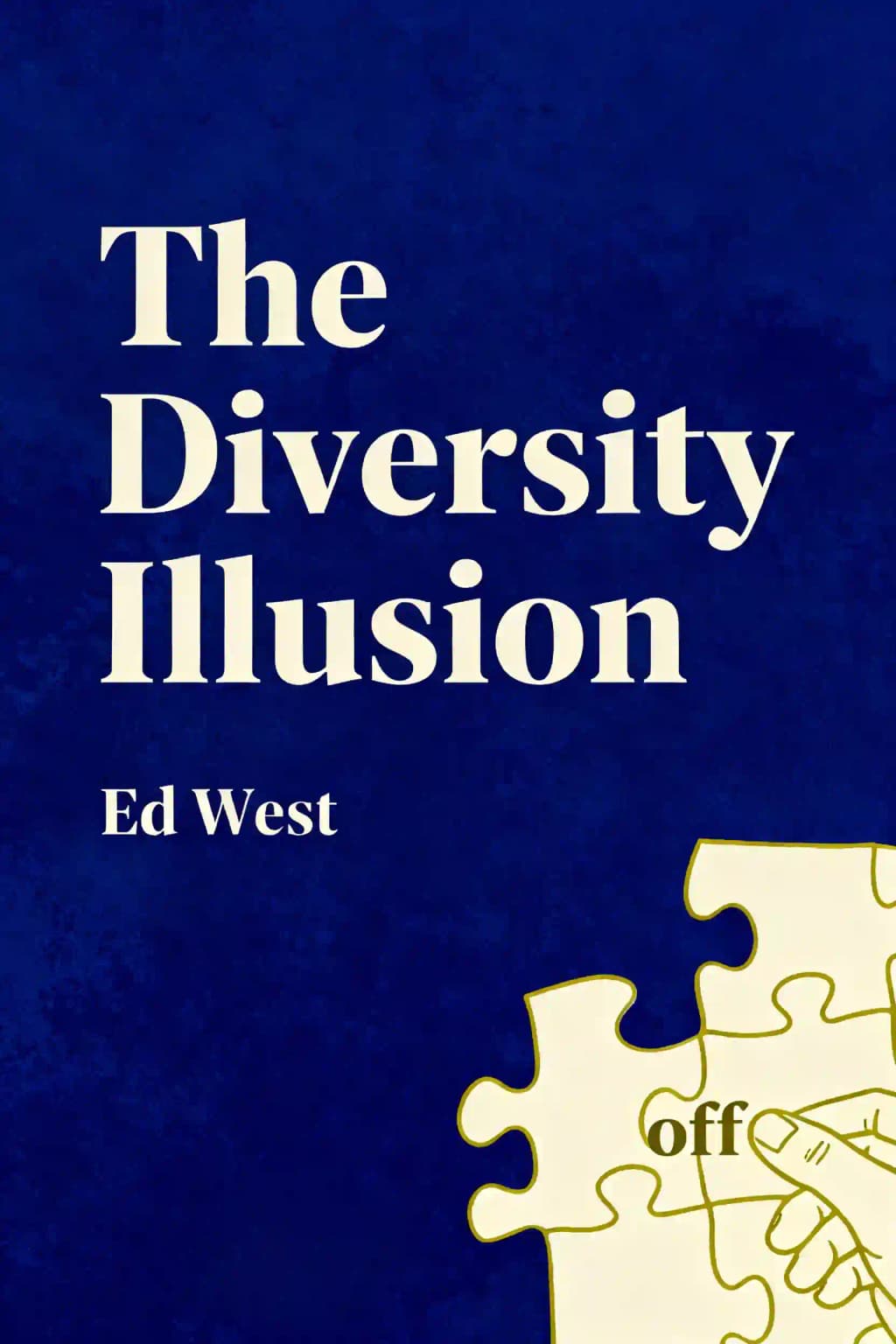
The Diversity Illusion
Overview of The Diversity Illusion
In "The Diversity Illusion," Ed West challenges mainstream immigration narratives with data-driven precision. Praised by Peter Hitchens as "powerful" and the Telegraph as "enticingly provocative," this controversial examination has sparked vital debates while earning 90%+ positive reviews for its refreshingly nuanced approach.

Key Themes in The Diversity Illusion
- social cohesion
- demographic transformation
- multiculturalism critique
- national identity
- immigration policy
Quotes from The Diversity Illusion
Diversity became not just a side effect but an official good.
Racism became our Victorian sexual impropriety.
The notion of 'collective identity' is an ideological fiction.
Labor shortages are typically temporary while immigration is permanent.
What society do we want?
Characters in The Diversity Illusion
- Ed WestAuthor and journalist exploring British identity
- Gillian DuffyRochdale grandmother involved in a 2010 incident
- Gordon BrownFormer British Prime Minister
- Stephen OppenheimerGeneticist researching British ancestry
- Christopher CaldwellAuthor and commentator on European immigration
About the Author
About the Author of The Diversity Illusion
Ed West, British author and social commentator, examines the complexities of multiculturalism in The Diversity Illusion, a provocative exploration of mass immigration’s societal impacts. A former columnist for The Daily Telegraph and deputy editor at UnHerd, West combines historical analysis with incisive cultural criticism, drawing from his decades of journalism focused on religion, politics, and identity.
His works, including the critically acclaimed Tory Boy and the Substack newsletter Wrong Side of History, frequently challenge progressive orthodoxies through a blend of wit and rigorous research.
West’s examination of Britain’s demographic shifts in The Diversity Illusion reflects his reputation as a contrarian thinker, informed by his tenure at The Spectator and The Catholic Herald. The book, named a Sunday Times Political Book of the Year, has sparked widespread debate for its unflinching critique of post-war immigration policies.
His insights continue to shape discussions through his digital platform, which reaches over 39,000 subscribers.
Download Summary of The Diversity Illusion
Get the The Diversity Illusion summary as a free PDF or EPUB. Print it or read offline anytime.
FAQs About This Book
The Diversity Illusion argues that mass immigration and enforced multiculturalism have eroded social cohesion in Britain, citing research on trust erosion and cultural conflict. Ed West blends data with historical analysis to claim diversity undermines shared identity, focusing on post-WWII immigration policies. Critics accuse him of selectively using studies to support his thesis, though he frames it as challenging politically correct narratives.
This book appeals to readers interested in conservative perspectives on immigration, sociology students analyzing multiculturalism debates, and policymakers seeking contrarian views on integration. West’s mix of statistics and accessible writing makes it suitable for those exploring critiques of progressive social engineering.
Yes, for understanding anti-multiculturalism arguments, though readers should cross-check sources. West’s provocative claims about diversity’s societal costs—like reduced community trust—spark debate, but critics note omissions of counterstudies on successful integration. Its value lies in confronting taboo topics rarely discussed in mainstream media.
- Social fragmentation: Diversity decreases communal trust and solidarity.
- Cultural displacement: Rapid demographic shifts marginalize native cultural norms.
- Policy failure: Postwar immigration policies prioritized economic needs over social harmony.
- Elite disconnect: Leaders promote multiculturalism while living in homogeneous enclaves.
West asserts multiculturalism fosters parallel societies rather than integration, using case studies of segregated neighborhoods and identity politics. He contrasts this with assimilationist models in nations like Japan, arguing shared cultural values prevent societal fractures.
The book references Robert Putnam’s studies on diversity reducing social capital, census data on ethnic concentration trends, and historical analyses of pre-1960s Britain. However, critics argue West ignores research showing economic benefits of immigration and long-term integration success.
West advocates for reduced immigration and assimilation-focused policies, criticizing Britain’s “open door” approach as destabilizing. He suggests prioritizing cultural compatibility and skill-based entry criteria, akin to pre-1970s systems.
- Cherry-picked data: Selective use of studies to support anti-diversity claims.
- Nostalgia bias: Idealizes homogeneous 1950s Britain without addressing its systemic inequalities.
- Overlooked benefits: Ignores immigration’s role in economic growth and innovation.
Unlike Tory Boy (a memoir) or Brahmins (critiquing elite progressives), this book focuses narrowly on diversity’s societal impacts. It shares West’s signature blend of polemics and dark humor but with heavier use of demographic data.
Its rejection of multiculturalism as a societal ideal clashes with mainstream academic and media narratives, with critics labeling it xenophobic. West counters that he highlights legitimate trade-offs between diversity and social stability.
The book remains cited in anti-immigration rhetoric amid Europe’s ongoing asylum crises and populist movements. Its warnings about rapid demographic change resonate with voters concerned about housing shortages and cultural preservation.
While direct quotes aren’t provided in sources, key ideas include:
- “Diversity, when unchecked, becomes division.”
- “Multiculturalism is a utopian experiment with unintended consequences.”
These encapsulate West’s argument that enforced diversity risks societal discord.