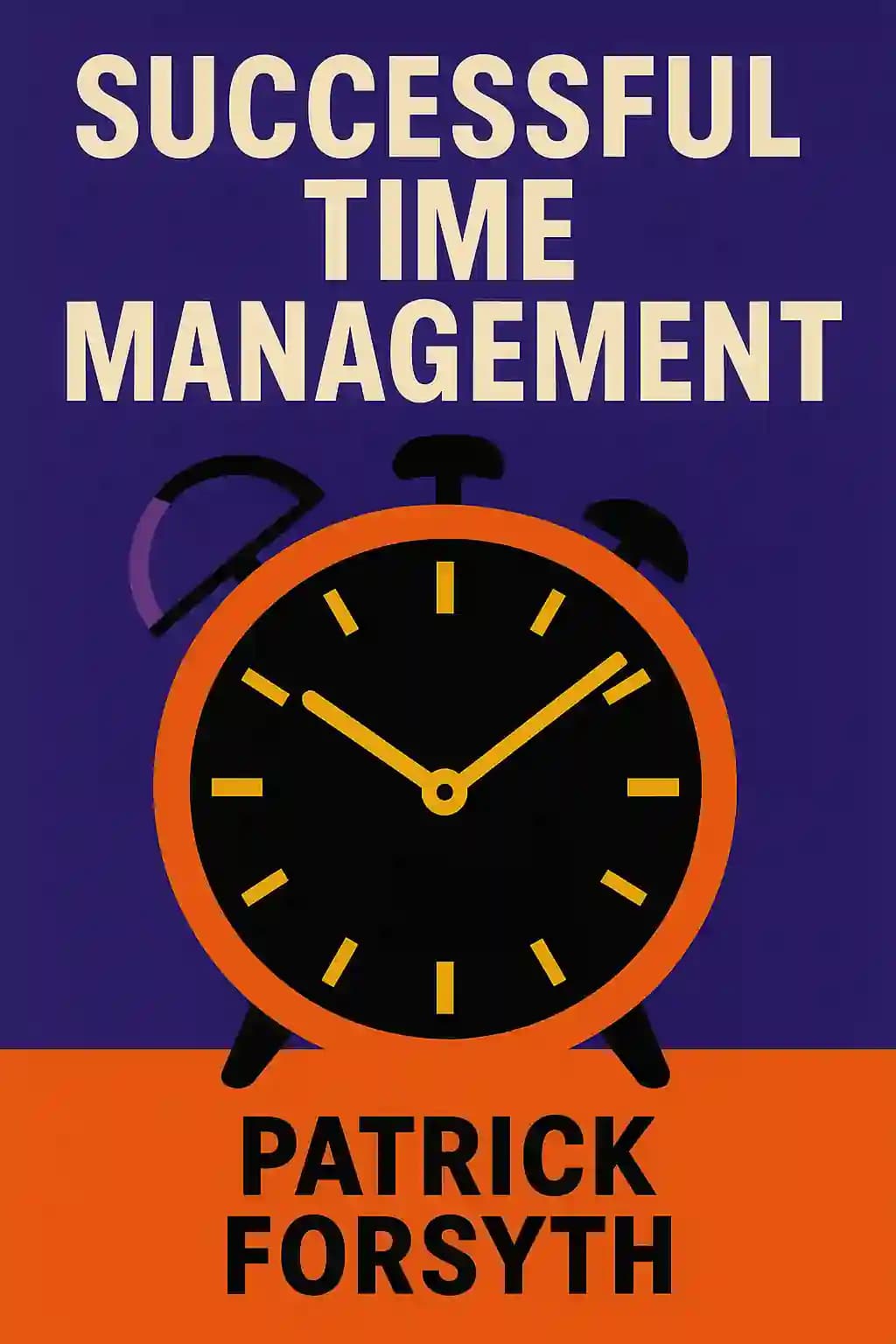
Successful Time Management ("Sunday Times" Creating Success)
Overview of Successful Time Management ("Sunday Times" Creating Success)
Translated into 17 languages, "Successful Time Management" delivers Patrick Forsyth's productivity secrets from his 50+ business books. Need to escape email overwhelm? This million-selling guide offers immediate solutions that transformed how professionals worldwide reclaim their most valuable resource - time itself.

Key Themes in Successful Time Management ("Sunday Times" Creating Success)
- priority setting
- delegation strategies
- workflow optimization
- distraction management
- workplace efficiency
Quotes from Successful Time Management ("Sunday Times" Creating Success)
Time is the great equalizer-we all have exactly the same amount each day.
Never let perfection be the enemy of the good.
Self-delusion is common in this area.
Organization and time management are inseparable partners.
Disorder rarely accompanies good time management.
Characters in Successful Time Management ("Sunday Times" Creating Success)
- Patrick ForsythAuthor and expert on time management strategies
About the Author
About the Author of Successful Time Management ("Sunday Times" Creating Success)
Patrick Forsyth, author of Successful Time Management, is a seasoned business consultant and prolific writer specializing in productivity, professional development, and workplace efficiency. With over 25 years of experience in management training and consultancy, Forsyth founded Touchstone Training & Consultancy, advising organizations globally on marketing, communication, and time optimization strategies.
His expertise stems from a career spanning publishing, corporate leadership, and international consulting across Europe and Southeast Asia.
Forsyth has authored 120+ nonfiction books, including Marketing: A Guide to the Fundamentals (part of The Economist series) and How to Write Reports and Proposals, which distill complex workplace challenges into actionable frameworks. His works, celebrated for their clarity and practicality, have been translated into 24 languages and are frequently cited in professional training programs.
Known for blending analytical rigor with accessible prose, Forsyth’s insights on productivity have solidified his reputation as a trusted voice in business literature. Successful Time Management remains a cornerstone resource, reflecting his decades of research and real-world application in organizational efficiency.
Download Summary of Successful Time Management ("Sunday Times" Creating Success)
Get the Successful Time Management ("Sunday Times" Creating Success) summary as a free PDF or EPUB. Print it or read offline anytime.
FAQs About This Book
Successful Time Management provides actionable strategies to optimize productivity through self-awareness, SMART goal-setting, and proactive planning. It teaches methods like time-tracking audits, task prioritization (80/20 rule), and the LEAD system to eliminate inefficiencies. The book emphasizes communication tactics and practical tools to reduce distractions, organize workflows, and achieve career-focused results.
This book targets professionals, managers, and executives seeking to overcome chaotic schedules. It’s ideal for those struggling with distractions, cluttered workflows, or reactive work habits. Patrick Forsyth’s advice also benefits remote workers, entrepreneurs, and teams aiming to streamline email management, delegation, and task prioritization.
Yes—it offers concrete frameworks like time logging and SMART objectives to reclaim 10–20% of wasted hours. Critics note its simplistic style but praise its actionable checklists for email organization, meeting efficiency, and document control. The 7th edition adds templates for immediate implementation.
Forsyth advises a 7-day audit, categorizing activities into:
- Plannable time (strategic tasks)
- Reactive time (emails/meetings)
- Wasted time (distractions like social media).
This reveals patterns, highlights peak productivity windows, and identifies areas for improvement.
The LEAD system (List, Evaluate, Act, Delegate) helps prioritize tasks by urgency and impact. It combines with the 80/20 rule to focus on the 20% of efforts yielding 80% of results. Forsyth includes templates to apply LEAD daily.
It recommends batching emails into designated slots, using templated responses, and implementing a “4D rule” (Delete, Delegate, Do, Defer). The book also advocates for inbox-zero techniques and folder organization to reduce search time.
Some reviewers find its tone overly basic for seasoned managers. The 80/20 rule and SMART goals are considered standard, but the book’s strength lies in synthesizing these concepts with modern challenges like digital distractions and remote work.
While both emphasize task breakdown, Forsyth focuses more on organizational workflows (meetings, emails) and self-auditing. David Allen’s GTD offers broader life management. Forsyth’s approach is particularly effective for corporate environments needing structured systems.
Yes—it teaches boundary-setting via time-blocking, delegation matrices, and “no” strategies for low-priority requests. Case studies show how minimizing reactive tasks creates space for personal goals.
“Time management is self-management: the battle isn’t against the clock, but against habits that sabotage focus.” Forsyth stresses that 70% of productivity gains come from eliminating inefficiencies, not working faster.
New content includes remote-work strategies, digital tool recommendations (e.g., Trello, Asana), and exercises for hybrid teams. Updated templates address modern challenges like virtual meeting fatigue and cross-timezone coordination.
Forsyth has 30+ years training executives at Touchstone Consultancy, specializing in productivity and communication. His methods are tested across industries, with clients reporting 15–30% efficiency gains.