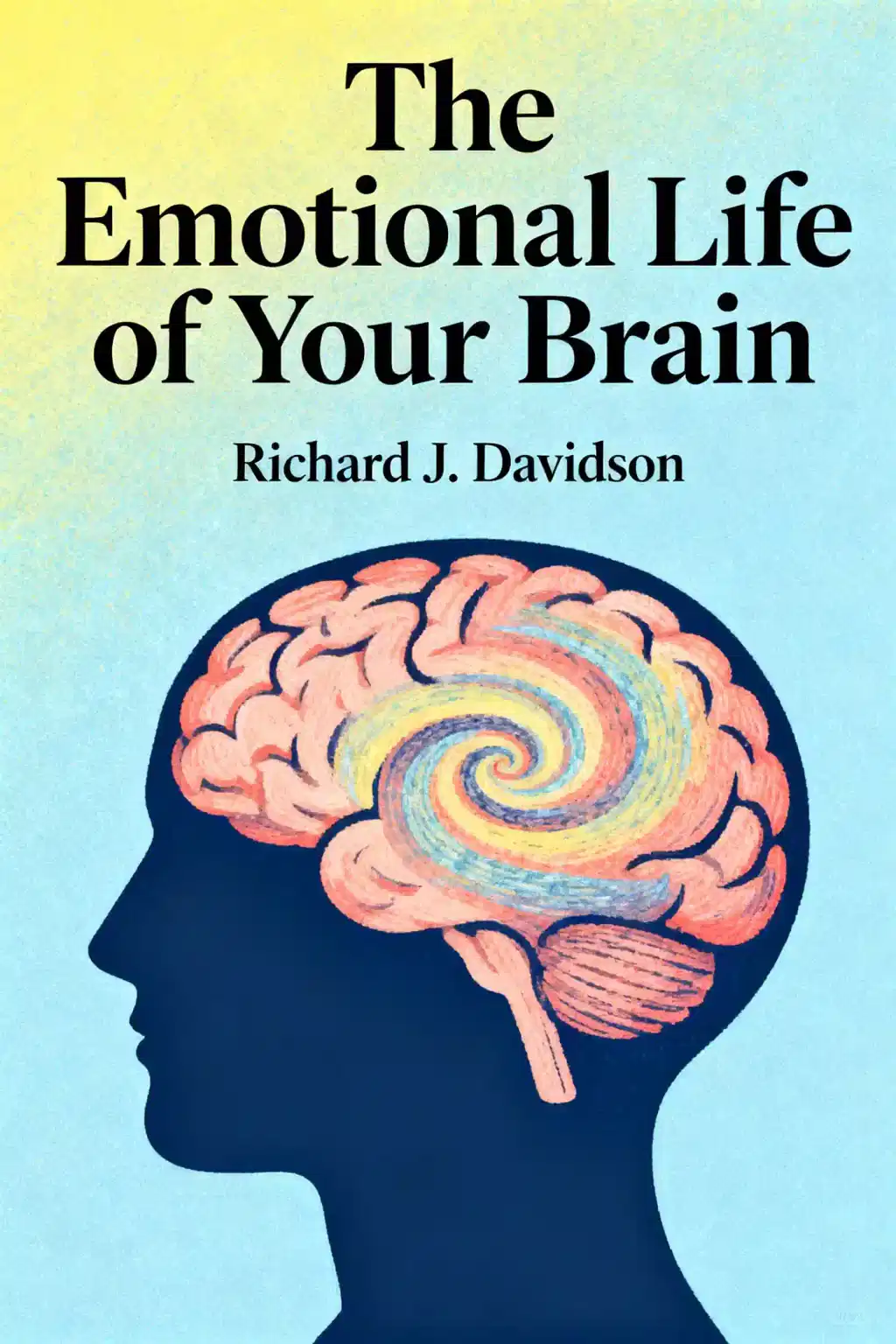
The Emotional Life of Your Brain: How Its Unique Patterns Affect the Way You Think, Feel, and Live--and How You Can Change Them by Richard J. Davidson Summary

Overview of The Emotional Life of Your Brain
Discover how your emotions are uniquely wired in this groundbreaking exploration of neuroplasticity by renowned neuroscientist Richard Davidson. What if you could rewire your emotional patterns? Learn the science-backed strategies that have revolutionized mental wellness and emotional intelligence training worldwide.
- Richard Davidson's six emotional styles define your brain's unique reactivity patterns
- Neuroplasticity lets you reshape emotional responses through mindfulness and targeted practice
- Resilience outlook and self-awareness form core dimensions of your emotional fingerprint
- Your emotional style isn't fixed—brain circuits adapt with conscious effort
- High social intuition correlates with stronger emotional cue recognition abilities
- Sensitivity to context determines how well you adjust emotional reactions
- Attention style impacts emotional regulation and focus durability during stress
- Childhood experiences shape but don't permanently lock emotional style trajectories
- Mind-body awareness training physically alters prefrontal cortex emotional control regions
- Depression treatment should address specific emotional style dimensions not just symptoms
- Emotional fingerprint analysis enables personalized mental health intervention strategies
- Richard Davidson's research proves emotional traits map to measurable brain activity patterns
About the Author of The Emotional Life of Your Brain
Richard J. Davidson, neuroscientist and New York Times bestselling author of The Emotional Life of Your Brain, is a world-renowned pioneer in affective neuroscience and wellbeing research. As founder of the University of Wisconsin–Madison’s Center for Healthy Minds and Healthy Minds Innovations, his work bridges cutting-edge brain science with practical strategies for emotional resilience.
The book synthesizes decades of research into six emotional styles shaped by brain activity patterns, reflecting Davidson’s groundbreaking studies on meditation’s neurological impacts and his collaboration with the Dalai Lama.
A Harvard-trained psychologist and Vilas Professor of Psychology, Davidson has been featured in Time Magazine’s “100 Most Influential People” list and major media including NPR, The Today Show, and TED Talks. His follow-up work Altered Traits (co-authored with Daniel Goleman) further explores meditation’s transformative potential.
Recognized for translating complex neuroscience into accessible insights, Davidson’s frameworks inform corporate wellness programs and academic curricula globally. The Emotional Life of Your Brain has been translated into 15 languages and endorsed as essential reading by mental health professionals and business leaders alike.
FAQs About The Emotional Life of Your Brain
What is The Emotional Life of Your Brain about?
The Emotional Life of Your Brain explores how brain patterns shape emotional responses through six dimensions of Emotional Style: resilience, outlook, social intuition, self-awareness, sensitivity to context, and attention. Co-authored by neuroscientist Richard J. Davidson and Sharon Begley, it blends neuroscience research with practical strategies to modify emotional habits, offering insights into treating conditions like anxiety and depression.
Who should read The Emotional Life of Your Brain?
This book is ideal for psychology enthusiasts, mental health professionals, and individuals seeking evidence-based methods to improve emotional resilience. It’s particularly relevant for those interested in neuroplasticity, mindfulness practices, or understanding how brain circuits influence personality and mood disorders.
What are Richard J. Davidson’s credentials?
Richard J. Davidson is a Harvard-trained psychologist, founder of UW–Madison’s Center for Healthy Minds, and a Time 100 honoree. A pioneer in affective neuroscience, he’s renowned for studying meditation’s neurological effects and collaborating with the Dalai Lama. His work integrates brain imaging, genetics, and clinical research.
What are the six dimensions of Emotional Style?
The six dimensions are:
- Resilience: Recovery speed from adversity.
- Outlook: Sustaining positive emotions.
- Social intuition: Reading emotional cues.
- Self-awareness: Recognizing bodily emotional signals.
- Sensitivity to context: Adapting behavior to situations.
- Attention: Focus and distraction filtering. These traits determine how individuals experience and regulate emotions.
How does The Emotional Life of Your Brain help with mental health?
Davidson links emotional disorders like depression to imbalances in brain circuits, offering exercises (e.g., mindfulness) to recalibrate them. The book provides tools to enhance resilience, reframe negative outlooks, and improve social interactions, supported by case studies on autism and mood disorders.
Is The Emotional Life of Your Brain scientifically validated?
Yes. Davidson’s research uses fMRI, EEG, and genetic analysis to map emotional traits to specific brain regions. Studies on meditation practitioners and clinical populations validate his frameworks, emphasizing measurable neural changes from intentional practice.
What practical advice does the book offer?
It suggests mindfulness meditation, cognitive reframing, and attention-training exercises to reshape Emotional Style. For example, focused breathing improves attention, while gratitude journaling strengthens positive outlooks. These methods are rooted in Davidson’s four-decade neuroscience career.
How does this book compare to Altered Traits?
While Altered Traits (co-authored with Daniel Goleman) focuses on meditation’s long-term effects, The Emotional Life of Your Brain emphasizes personalized emotional change through brain science. Both highlight neuroplasticity but differ in scope: one targets meditation research, the other emotional self-regulation.
What criticisms exist about the book?
Some reviewers note the dense neuroscience jargon may challenge casual readers. Critics also argue that self-assessment tools for Emotional Style lack rigorous validation, though Davidson clarifies they’re based on peer-reviewed studies.
Why is The Emotional Life of Your Brain relevant in 2025?
As mental health awareness grows, the book’s blend of neuroscience and self-help remains timely. Its strategies align with trends in personalized wellness, workplace mindfulness programs, and AI-driven mental health tools, offering a science-backed approach to emotional resilience.
What key quotes define the book’s message?
- “Emotional Style is not destiny”: Highlights neuroplasticity’s role in reshaping emotional responses.
- “The brain’s emotional circuits are as tangible as its visual ones”: Underscores measurable brain-behavior links. These quotes reinforce Davidson’s thesis that intentional practice can rewire emotional patterns.
Are there workshops or tools based on the book?
Davidson’s nonprofit, Healthy Minds Innovations, offers apps and courses inspired by the book’s frameworks, such as meditation guides and emotional resilience trainings. These resources translate research into accessible practices for stress reduction and focus.
Feel the book through the author's voice
Turn knowledge into engaging, example-rich insights
Capture key ideas in a flash for fast learning
Enjoy the book in a fun and engaging way
Key Themes in The Emotional Life of Your Brain
Quotes from The Emotional Life of Your Brain
Emotions [are not] mere distractions-neurological static interfering with rational thought.
There is no ideal Emotional Style-civilization needs different emotional types.
Emotions weren't controlled by the primitive limbic system...but by the prefrontal cortex.
The prevailing view cast emotions as primitive responses...unworthy of serious scientific attention.
Mainstream psychology viewed emotions as mere distractions.
Characters in The Emotional Life of Your Brain
Quick Summary Mode - Read or listen to The Emotional Life of Your Brain Summary in 8 Minutes

Break down key ideas from The Emotional Life of Your Brain into bite-sized takeaways to understand how innovative teams create, collaborate, and grow.

Flash Card Mode - Top 7 Insights from The Emotional Life of Your Brain in a Nutshell

Distill The Emotional Life of Your Brain into rapid-fire memory cues that highlight key principles of candor, teamwork, and creative resilience.

Fun Mode - The Emotional Life of Your Brain Lessons Told Through 21-Min Stories

Experience The Emotional Life of Your Brain through vivid storytelling that turns innovation lessons into moments you'll remember and apply.
Personalize Mode - Read or listen to The Emotional Life of Your Brain Summary in 0 Minutes

Ask anything, pick the voice, and co-create insights that truly resonate with you.

From Columbia University alumni built in San Francisco
"Instead of endless scrolling, I just hit play on BeFreed. It saves me so much time."


"I never knew where to start with nonfiction—BeFreed’s book lists turned into podcasts gave me a clear path."


"Perfect balance between learning and entertainment. Finished ‘Thinking, Fast and Slow’ on my commute this week."
"Crazy how much I learned while walking the dog. BeFreed = small habits → big gains."
"Reading used to feel like a chore. Now it’s just part of my lifestyle."

"Feels effortless compared to reading. I’ve finished 6 books this month already."
"BeFreed turned my guilty doomscrolling into something that feels productive and inspiring."

"BeFreed turned my commute into learning time. 20-min podcasts are perfect for finishing books I never had time for."
"BeFreed replaced my podcast queue. Imagine Spotify for books — that’s it. 🙌"

"It is great for me to learn something from the book without reading it."
"The themed book list podcasts help me connect ideas across authors—like a guided audio journey."
"Makes me feel smarter every time before going to work"
From Columbia University alumni built in San Francisco
"Instead of endless scrolling, I just hit play on BeFreed. It saves me so much time."
"I never knew where to start with nonfiction—BeFreed’s book lists turned into podcasts gave me a clear path."
"Perfect balance between learning and entertainment. Finished ‘Thinking, Fast and Slow’ on my commute this week."
"Crazy how much I learned while walking the dog. BeFreed = small habits → big gains."
"Reading used to feel like a chore. Now it’s just part of my lifestyle."
"Feels effortless compared to reading. I’ve finished 6 books this month already."
"BeFreed turned my guilty doomscrolling into something that feels productive and inspiring."
"BeFreed turned my commute into learning time. 20-min podcasts are perfect for finishing books I never had time for."
"BeFreed replaced my podcast queue. Imagine Spotify for books — that’s it. 🙌"
"It is great for me to learn something from the book without reading it."
"The themed book list podcasts help me connect ideas across authors—like a guided audio journey."
"Makes me feel smarter every time before going to work"
"Instead of endless scrolling, I just hit play on BeFreed. It saves me so much time."
"I never knew where to start with nonfiction—BeFreed’s book lists turned into podcasts gave me a clear path."
"Perfect balance between learning and entertainment. Finished ‘Thinking, Fast and Slow’ on my commute this week."
"Crazy how much I learned while walking the dog. BeFreed = small habits → big gains."
"Reading used to feel like a chore. Now it’s just part of my lifestyle."
"Feels effortless compared to reading. I’ve finished 6 books this month already."
"BeFreed turned my guilty doomscrolling into something that feels productive and inspiring."
"BeFreed turned my commute into learning time. 20-min podcasts are perfect for finishing books I never had time for."
"BeFreed replaced my podcast queue. Imagine Spotify for books — that’s it. 🙌"
"It is great for me to learn something from the book without reading it."
"The themed book list podcasts help me connect ideas across authors—like a guided audio journey."
"Makes me feel smarter every time before going to work"
"Instead of endless scrolling, I just hit play on BeFreed. It saves me so much time."
"I never knew where to start with nonfiction—BeFreed’s book lists turned into podcasts gave me a clear path."
"Perfect balance between learning and entertainment. Finished ‘Thinking, Fast and Slow’ on my commute this week."
"Crazy how much I learned while walking the dog. BeFreed = small habits → big gains."
"Reading used to feel like a chore. Now it’s just part of my lifestyle."
"Feels effortless compared to reading. I’ve finished 6 books this month already."
"BeFreed turned my guilty doomscrolling into something that feels productive and inspiring."
"BeFreed turned my commute into learning time. 20-min podcasts are perfect for finishing books I never had time for."
"BeFreed replaced my podcast queue. Imagine Spotify for books — that’s it. 🙌"
"It is great for me to learn something from the book without reading it."
"The themed book list podcasts help me connect ideas across authors—like a guided audio journey."
"Makes me feel smarter every time before going to work"

Get the The Emotional Life of Your Brain summary as a free PDF or EPUB. Print it or read offline anytime.