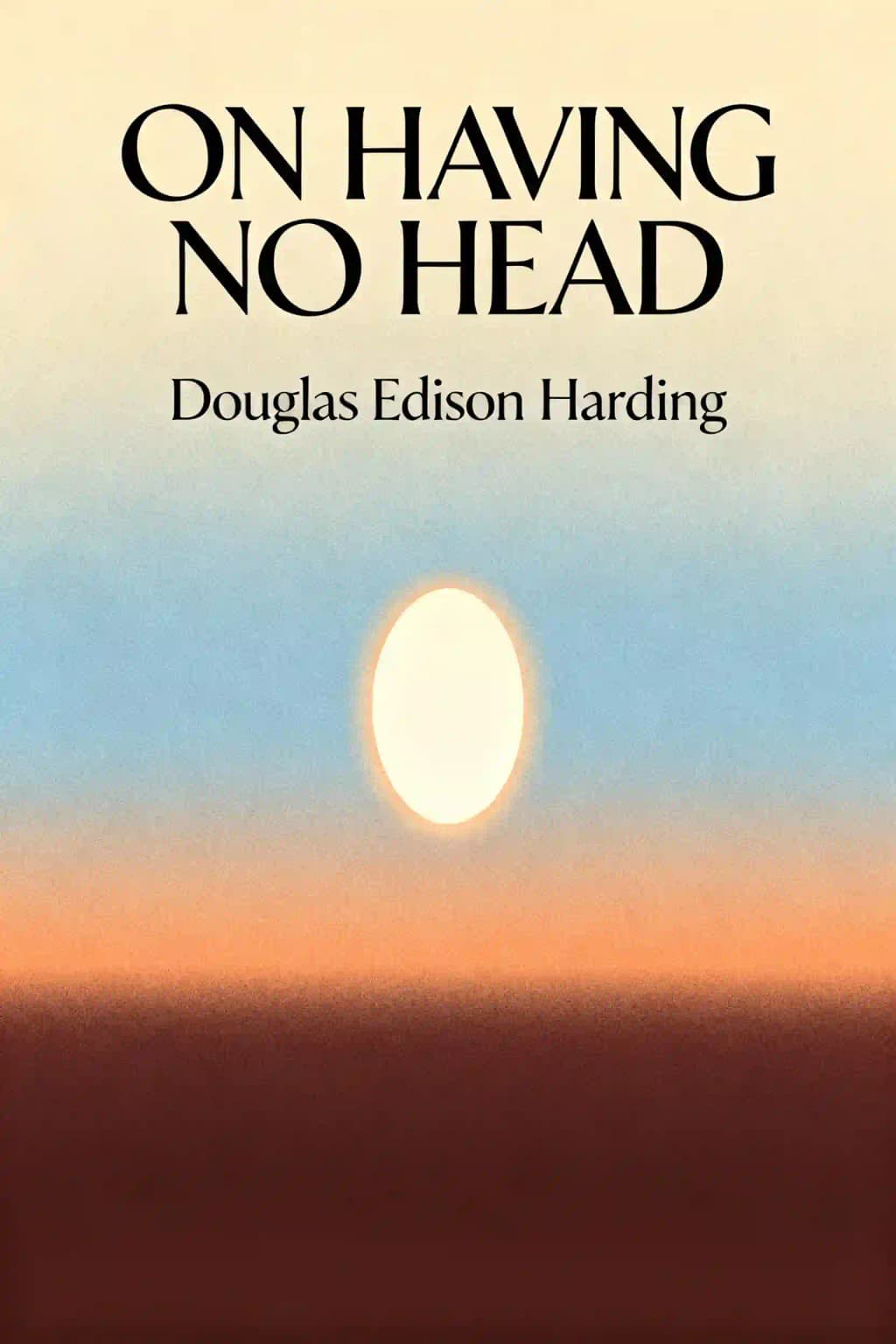
On Having No Head
Overview of On Having No Head
Discover a headless reality where your true self isn't what you think. Harding's 1961 philosophical classic blends Eastern spirituality with Western thought, creating a radical shift in perception. Experience the paradoxical joy of seeing everything except what you've always assumed was "you."

Key Themes in On Having No Head
- first-person perspective
- non-dual awareness
- subjective experience
- ego dissolution
- direct perception
Quotes from On Having No Head
Our true nature is not what we think, but what we are when we stop thinking.
I had lost a head and gained a world-a world utterly free of 'me.'
It abolishes confrontation-meeting someone, there is only one face (theirs).
The best day of my life-my rebirthday-was when I found I had no head.
Characters in On Having No Head
- Douglas Edison HardingAuthor and subject who discovered 'headlessness'
- Richard LangContemporary teacher spreading Harding's message
- Sam HarrisContemporary teacher of the headless perspective
About the Author
About the Author of On Having No Head
Douglas Edison Harding (1909–2007), author of On Having No Head, was an English philosopher and pioneer of experiential spirituality renowned for his "headlessness" philosophy.
A trained architect and Royal Engineers veteran, Harding's rejection of his fundamentalist Christian upbringing led to a lifelong exploration of consciousness, culminating in his 1961 breakthrough work that blends Western pragmatism with Eastern non-dual awareness.
His innovative "headless experiments"—simple perceptual exercises demonstrating the self as boundless awareness—established him as a unique voice in contemplative practices. Harding's influential The Hierarchy of Heaven and Earth (1952), foreworded by C.S. Lewis, remains a cult classic in philosophical spirituality.
His later works like The Face Game and Look For Yourself further refine his approach to identity beyond conventional boundaries.
Translated into over 15 languages, Harding's teachings continue inspiring spiritual seekers and consciousness researchers worldwide, with On Having No Head enduring as a minimalist masterpiece in mindfulness literature.
Download Summary of On Having No Head
Get the On Having No Head summary as a free PDF or EPUB. Print it or read offline anytime.
FAQs About This Book
On Having No Head explores Douglas Harding’s transformative realization of "headlessness" – the direct experience of consciousness as boundless awareness rather than a physical head. Through autobiographical reflection, Harding argues that our true identity is an "open capacity" for the world, blending Zen-inspired insights with practical exercises to help readers perceive this non-dual reality firsthand.
This book suits seekers of non-dual spirituality, Zen enthusiasts, and readers curious about consciousness beyond intellectual frameworks. Its concise, experiential approach appeals to those tired of abstract philosophy and craving direct self-inquiry. Harding’s clear prose makes it accessible to both beginners and advanced practitioners.
Yes – its 80-page brevity delivers profound insights through Harding’s vivid Himalayan awakening account and actionable "experiments". Critics praise its unique fusion of Western logic and Eastern mysticism, though some find its headlessness metaphor oversimplified. Over 60 years later, it remains a cult classic in non-dual literature.
The Headless Way refers to perceiving oneself as a "no-thing" – an empty yet aware space that contains reality. Harding developed practical exercises (like pointing to where your face appears) to help individuals shift from identifying as a head-bound self to recognizing their true nature as limitless consciousness.
- “I had lost a head and gained a world”: Encapsulates the freedom of realizing consciousness isn’t confined to the body.
- “This nothing…was vastly filled”: Describes awareness as an abundant void.
- “I forgot my name…only the Now existed”: Highlights the ego-dissolving immediacy of Harding’s awakening.
While sharing Zen’s emphasis on direct experience over doctrine, Harding’s approach uses Western-friendly visual experiments rather than koans. Both aim to reveal non-dual awareness, but Harding rejects meditation practices in favor of instantaneous "seeing". Critics argue this misses Zen’s gradual training.
- Mirror experiment: Observing your reflection to contrast others’ heads with your own headless awareness.
- Pointing method: Directing attention to where your face appears (empty space).
- Field-awareness: Noticing peripheral vision as evidence of boundless consciousness.
Some philosophers argue Harding overemphasizes visual perception while ignoring tactile/mental self-awareness. Others claim his "no head" metaphor risks literal misinterpretation. Despite this, even critics acknowledge its value for sparking non-dual inquiry.
Its timeless theme of transcending limited self-identity resonates in an era of digital narcissism and existential anxiety. Modern mindfulness movements increasingly adopt Harding’s experiments for rapid de-identification techniques.
Harding coined "rebirthday" to describe his Himalayan awakening at age 33 – the moment he realized his true nature as headless awareness. The term symbolizes spiritual rebirth through directly perceiving consciousness rather than conceptualizing it.
He contrasts first-person experience (boundless awareness) with third-person observation (headed humans). While others see our heads, we only perceive the world from awareness itself – a perspective shift he calls "the greatest discovery".
- The Power of Now (Tolle) – Non-conceptual presence
- Zen Mind, Beginner’s Mind (Suzuki) – Direct experience focus
- The Untethered Soul (Singer) – Consciousness beyond identity
Harding’s work bridges these themes with unique Western pragmatism.