Capítulo 1
The Future of Work: Unleashing Talent Through Skills-Based Organizations
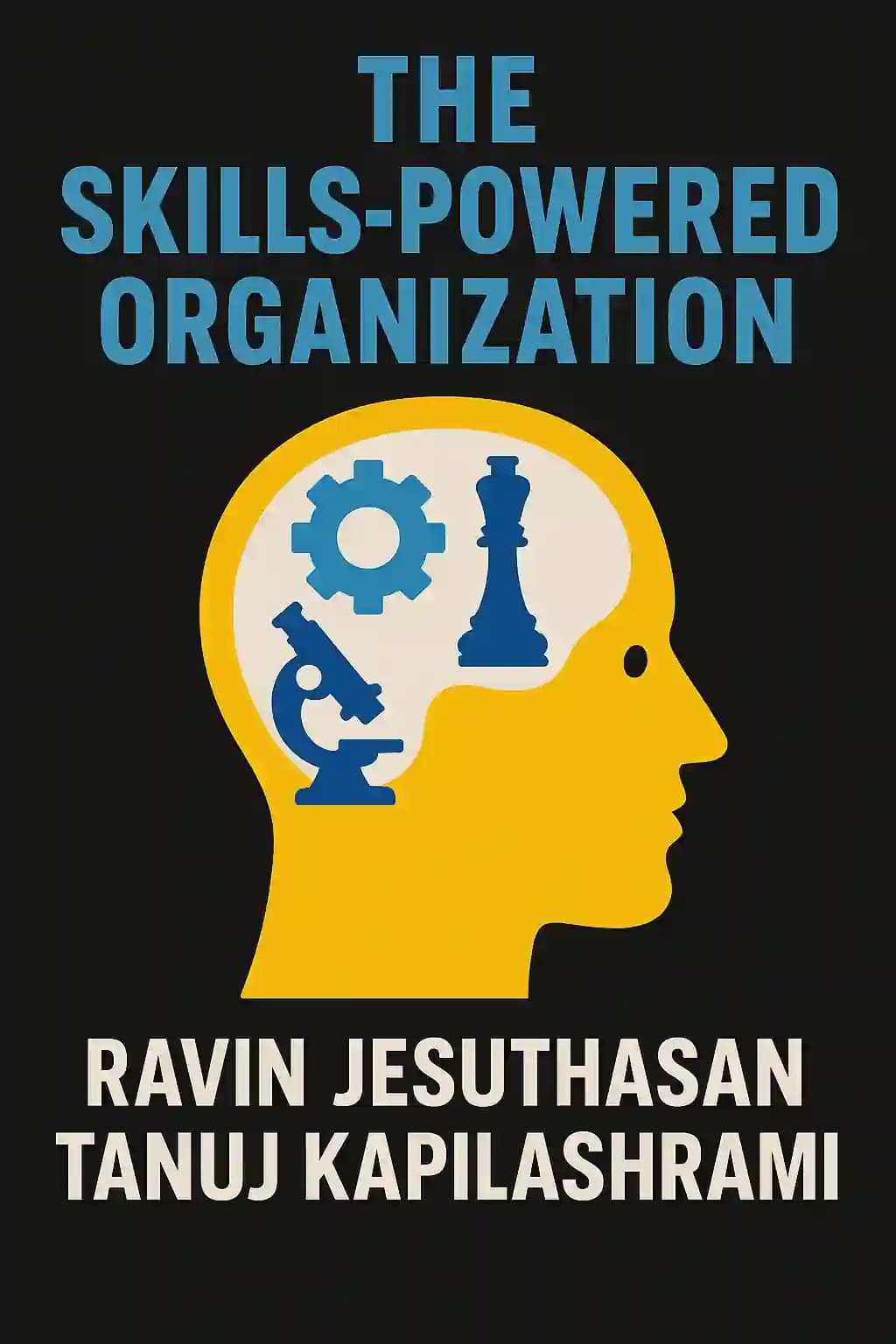
In a world where technological change is accelerating and traditional career paths are dissolving, Ravin Jesuthasan and Tanuj Kapilashrami offer a revolutionary framework that's reshaping how organizations operate. "The Skills-Powered Organization" has become a cornerstone text for forward-thinking executives, with industry titans like Microsoft's Satya Nadella and LinkedIn's Ryan Roslansky publicly endorsing its principles. What makes this book particularly timely is its arrival during the post-pandemic workplace transformation, where organizations are desperately seeking new models for talent management amid unprecedented disruption. The authors challenge a fundamental assumption that has governed work for 140 years: that jobs, rather than skills, should be the primary currency of work.
Capítulo 2
Breaking Down the Boxes: Why Traditional Job Structures Are Failing
For nearly a century and a half, we've organized work around rigid job descriptions housed within functional hierarchies. This approach served the industrial age well, creating clear reporting lines and predictable career paths. But today's environment demands something radically different. The evidence is overwhelming-these traditional boxes are disintegrating under multiple pressures.
Consider how quickly skills are becoming obsolete. According to the Burning Glass Institute, 37% of the average job's skills have been replaced in just five years. The pandemic dramatically illustrated this problem when companies with rigid job structures struggled to redeploy talent, while those with skills-based architectures pivoted rapidly. Verizon redeployed thousands of retail employees to virtual customer service roles within days, while Bank of America shifted 30,000 employees to new functions based on their underlying skills.
The shift to skills is gaining momentum across industries. IBM's former CEO Ginni Rometty championed "new collar jobs" that prioritize relevant skills over formal education, leading IBM to remove degree requirements from over 50% of their positions. A Deloitte study shows 90% of executives are experimenting with skills-based approaches, with such organizations 63% more likely to achieve results across key metrics.
This transition is further accelerated by changing workforce attitudes. Today's talent increasingly values flexibility and autonomy, with 28% of Gen Z workers choosing independent work for enjoyment and 24% for autonomy. The traditional promise of stable, lifelong employment has given way to a "learn, do, learn, do, rest, learn... repeat" career pattern that requires constant skill development and redeployment.
The implications are profound. The World Economic Forum estimates a "skills-first" approach could add over one hundred million people to the global talent pool across eighteen economies by removing arbitrary barriers like degree requirements and focusing on actual capabilities.
Capítulo 3
Defining the Skills-Powered Organization: A New Operating System
What exactly is a skills-powered organization? It's one where skills, not jobs, serve as the fundamental currency of work. These organizations exhibit five key characteristics: flatter structures with cross-functional teams, talent acquisition that prioritizes skills over credentials, robust skill development programs, strong diversity and inclusion focus, and exceptional agility to pivot quickly as market conditions change. For example, companies like Google and Spotify have embraced this model, organizing work around project-based teams rather than rigid departmental structures.
This approach requires a fundamental mindset shift. Rather than seeing employees as occupants of fixed positions, skills-powered organizations view them as collections of capabilities that can be deployed flexibly across various work needs. This creates a many-to-many relationship between talent and work, rather than the traditional one-to-one relationship between jobholder and job. Consider how companies like Microsoft maintain talent pools of employees with specific skill sets who can be rapidly deployed to different projects based on business needs.
The transition to a skills-powered organization often involves reimagining traditional HR processes. Performance reviews focus on skill development and application rather than just job responsibilities. Career paths become more fluid, allowing for lateral moves and cross-functional experiences. Companies like IBM and AT&T have successfully implemented skill-based career frameworks that enable employees to plot multiple potential career trajectories based on their evolving skill sets.
The Burning Glass Institute and Coursera's Skills Compass Report offers a useful framework for understanding skill investments, categorizing them into five types:
1. Solid investments: High acquisition cost but durable skills like risk management, advanced data analytics, and strategic planning. These skills typically retain their value for 5-7 years and form the backbone of organizational capability.
2. Quick dividends: Medium-to-high longevity skills that are less expensive to learn than hire, such as project management methodologies or specific software platforms. These can be developed through targeted training programs and start delivering value within months.
3. Enduring: High-longevity, low-cost skills like teamwork, communication, and problem-solving with excellent ROI. These foundational skills remain valuable across technological changes and market shifts.
4. Adaptive: Costly technical skills requiring constant updating, such as cybersecurity expertise or artificial intelligence capabilities. Organizations must budget for ongoing training and development to maintain these skills.
5. Commodity: Widely available, inexpensive skills like basic web development or standard office software proficiency. While necessary, these skills don't typically provide competitive differentiation.
Understanding these categories helps organizations make strategic decisions about which skills to build internally versus acquire externally, and which will provide the greatest competitive advantage over time. Leading organizations typically focus their internal development efforts on solid investments and enduring skills while using strategic hiring or partnerships to access adaptive skills. They also create detailed skill maps that identify critical capabilities for future success and potential skill gaps that need addressing.
Capítulo 4
Leadership in the Skills-Powered Era: Five Essential Shifts
Leading a skills-powered organization requires fundamentally different capabilities than traditional management. Jesuthasan and Kapilashrami identify five critical leadership shifts:
First, leaders must move from hierarchical authority to empowerment and alignment. Rather than controlling through position power, they must establish frameworks that balance autonomy with accountability as employees move fluidly between projects based on skills and preferences. Organization-level leaders set strategic missions and standards, while project leaders deconstruct work into tasks and assemble teams based on required skills.
Second, leaders need to shift from technical to humanistic work automation. As AI and machine learning transform work, skills-powered leaders must understand what humans uniquely contribute in creativity, cultural context, and innovation while eliminating biases that assume machines always produce greater efficiency.
Third, leaders must transition from episodic to continuous focus on diversity, equity, and inclusion. Each team formation and assignment becomes an opportunity to enhance DEI or perpetuate existing bias.
Fourth, leaders need to move beyond digital savvy to true tech fluency. In environments where teams constantly form and disband, algorithms become central to supervision and coordination, providing insights to determine where automation will replace, augment, or reinvent human work.
Finally, leaders must shift from process execution to project guidance, sourcing talent beyond traditional organizational boundaries and rapidly assembling teams based on skills using agile methodologies.
Standard Chartered Bank exemplifies this leadership transformation. They began by changing the narrative-renaming all middle managers as "people leaders" to shift mindsets from managing tasks to leading people. They created a leadership agreement defining fourteen practices that leaders must model as they "aspire," "inspire," and "execute," focusing on abilities critical for leading skills-powered agile teams rather than traditional hierarchical management.
Capítulo 5
Reinventing Organizational Structure: From Fixed to Flow
The transition to a skills-powered organization requires fundamentally reimagining how work is structured and talent is deployed. The authors identify three progressive models that organizations typically evolve through, each representing a distinct approach to organizing work and managing talent.
The fixed model represents traditional organizations with stable jobs, clear reporting relationships, and well-defined career paths. While providing clarity, accountability, and predictability, this model increasingly struggles with today's demands for rapid change and cross-functional collaboration. Organizations operating in this model often face challenges like siloed departments, slow decision-making, and difficulty redeploying talent quickly to address emerging needs. Companies like IBM and GE historically exemplified this approach, with their rigid hierarchies and standardized job classifications.
The flex model introduces greater adaptability through matrix structures, project-based work, and flexible team assignments while maintaining some traditional organizational elements. This hybrid approach allows organizations to respond more quickly to changing needs while preserving necessary stability. Companies operating in this model might maintain permanent functional departments but regularly form cross-functional project teams. Pharmaceutical companies like Novartis have adopted this approach, maintaining stable research divisions while creating flexible project teams for drug development.
The flow model represents the fully realized skills-powered organization where talent moves seamlessly to where it's needed based on skills and work requirements. This model maximizes agility and innovation but requires sophisticated systems and cultural changes to coordinate effectively. Organizations operating in this model treat roles as fluid, with work organized around projects and initiatives rather than fixed positions. Companies like Spotify with their "squad" model exemplify this approach, allowing rapid formation and dissolution of teams based on business needs.
Standard Chartered's journey illustrates this evolution in practice. They began by building strong senior sponsorship to encourage leaders to move from talent-hoarding to talent-sharing - a crucial cultural shift. Their AI-driven internal talent marketplace has become central to unleashing underutilized skills beyond rigid job structures. Employees now think about work in terms of tasks and activities, effectively "crowdsourcing" required skills from across the organization. This has led to increased employee engagement and faster project completion rates.
The bank is now exploring implementing the flow model in specific areas, particularly in its technology vertical. They're considering a pilot to transition engineering teams to a skills-powered flow model, focusing on rapidly identifying, assessing, developing, and deploying talent based on specialized engineering skills. This includes creating skill taxonomies, implementing real-time skills tracking, and developing new approaches to performance management and career development that align with a more fluid organizational structure.
This transformation requires significant changes in leadership mindset, technology infrastructure, and organizational processes. Success factors include robust skills assessment tools, clear governance frameworks, and strong change management to help employees and leaders adapt to new ways of working.
Capítulo 6
Transforming the Work Experience: Human-Centered Design
Skills-powered organizations fundamentally reshape how work feels for participants. Rather than forcing talent to fit predefined roles, these organizations shape themselves around talent capabilities, creating a more human-centered experience.
This approach requires intentionally designing learning into the flow of work, making development a core part of the value proposition. One airline exemplified this by redefining its proposition from stability and benefits to development and growth, promising to "develop you for opportunity, either within or without."
An oil and gas company demonstrated this principle by transforming its operations from analog gauges and physical work to digital interactive systems and mental work augmented with automation. This resulted in 45% improved profitability while increasing wages 7-13% due to higher skill requirements, setting the stage for perpetual reinvention by creating the mindset for continuous upskilling.
A global pharmaceutical company extended flexibility beyond traditional boundaries by implementing location-independent work, determining salaries based on skill market value with geographic differentials, extending flexibility to lab and manufacturing jobs through algorithmic task scheduling, offering diverse work arrangements, and creating a culture of inclusion that extends beyond organizational walls.
Standard Chartered placed employees at the center of their transformation by not requiring manager approval for employees to join gigs on the talent marketplace, involving more people leaders in curating learning experiences, and enabling social learning through competitions where global teams "play and learn" via online simulations. By democratizing access, these platforms challenge typical organizational hierarchies and create space for an employee-led movement toward becoming skills-powered.
Capítulo 7
Building Critical Organizational Capabilities: Work Design, Talent Development, and Deployment
Beyond having a skills taxonomy, three pivotal organizational capabilities deliver the workforce, cultural, and business outcomes of a skills-powered enterprise: work design to understand skill demand, talent development to ensure timely skill acquisition, and talent deployment to enable optimal expression of skills across various work engagements.
Work design has become critical as leaders face growing plurality in work accomplishment methods and increasing demands for agility. The effective process involves deconstructing jobs into elemental tasks, analyzing optimal human-automation combinations, determining the best talent engagement arrangements, and reconstructing work with a clear view of evolving skills profiles.
When analyzing how to combine humans and automation, leaders must consider each task's characteristics and objectives. A critical concept is Return on Improved Performance (ROIP), which takes four forms: eliminating mistakes, reducing variance, incrementally improving value, or exponentially improving value. With generative AI proliferating, understanding where to substitute, augment, or create new human work is becoming essential for all leaders.
After determining optimal human-automation combinations, organizations must consider three dimensions when connecting talent with work: the assignment (how small it can be deconstructed, how widely dispersed, how detached from employment), the organization (boundary permeability, strength of links with others, depth of collaboration), and rewards (time frame, individualization, creative options beyond traditional compensation).
Talent deployment in skills-powered organizations enables redeployment at unprecedented speed and scale. Unilever's "Flex" marketplace demonstrates success with 700+ projects resourced in 90 days, 60% cross-functional deployment, and 530,000 unlocked hours equivalent to 241 full-time employees.
Standard Chartered transformed its talent approach by focusing on skills and aspirations rather than past performance as predictors of success. Based on extensive research, they identified four key skills-the ability to grow, collaborate, execute, and lead-all underpinned by learning agility. These skills now drive hiring, promotion, and development decisions, enabling a talent strategy that provides targeted development for high-potential talent while ensuring growth opportunities for the entire workforce.
Capítulo 8
AI as the Engine of Skills-Powered Organizations
AI provides the computational capability to manage the complex relationships between skills and work at scale-essential rather than optional for understanding skill demand, assessing skill supply, matching skills to work, and developing capabilities to close skill gaps.
Deep learning algorithms help organizations identify skills required by various bodies of work. Platforms like TechWolf can infer skills from project management tools, while Eightfold can identify skills within job descriptions, find candidates, and track trending and adjacent skills through sophisticated models.
Platforms like SkyHive and Eightfold provide visibility into real-time labor market movements at a skill level by analyzing thousands of data sources. These platforms can infer people's skills from their current and previous roles, experiences, and education, creating comprehensive skill profiles. Studies show we typically underestimate our skills-SkyHive found people self-report an average of 11 skills for their role, while AI inference identifies 34.
Talent marketplaces use deep learning algorithms to match skills demanded by various types of work to the skills supplied by talent. Generative AI is transforming learning by creating personalized development plans, interactive learning activities, real-time feedback systems, and customized learning content at scale.
Standard Chartered's internal talent marketplace exemplifies AI-powered skills deployment. What began as a cultural initiative evolved into a commercial imperative, using AI to match skills supply and demand across 85,000 employees in over 50 markets. Since its 2020 pilot in India that unlocked 14,000 hours of productivity ($584,000), it has scaled to deliver $6 million in productivity across 1,700+ gigs.
Capítulo 9
HR's Transformation: From Employment Steward to Work Steward
As organizations transition toward making skills the currency of work, HR must fundamentally transform from being stewards of employment to becoming stewards of work itself. This evolution requires HR to pivot from service delivery to driving business outcomes through talent innovation and agility.
According to the World Economic Forum's "HR4.0" study, HR leaders need new capabilities in data analytics, technology understanding, systems thinking, and strategic workforce planning. Six key imperatives include developing new leadership capabilities, managing workplace technology integration, enhancing work experiences, building agile learning cultures, establishing human capital metrics, and embedding diversity and inclusion.
HR professionals must become product managers of the "work product," moving beyond one-size-fits-all approaches to personalized experiences. The pivot to skills requires wholesale changes to HR's product architecture across multiple domains: workforce planning must evolve from headcount to integrated capability planning; learning must shift from job-based to perpetual talent reinvention; skills supply chains need to integrate acquisition, development and deployment; talent mobility should progress from position-based movement to holistic marketplaces; careers must transform from vertical ladders to boundaryless experiences; organization design should evolve from static hierarchies to fluid networks; and rewards need to link directly to skill expression and impact.
Standard Chartered's HR transformation exemplifies building a data-driven function for greater business impact. They established a specialized People Insights and Analytics team to move beyond operational reporting toward strategic insights about people, performance, and future work. Simultaneously, they upskilled the entire HR function through a "Data Wizard" certification program covering fundamental data concepts, analytics products, and narrative development. They've streamlined reporting from 8,000 to 1,000 reports, focusing on commercial challenges while democratizing data access across the organization.
Capítulo 10
Beyond the Organization: Skills in the Broader Ecosystem
The skills-powered approach extends beyond individual organizations to entire ecosystems, fundamentally reshaping how work gets done. By focusing on skills rather than jobs, companies reduce the friction of engaging external talent, transforming traditional B2B relationships (outsourcing entire jobs) into more efficient B2C relationships with individual gig workers through sophisticated talent marketplaces. Platforms like Upwork, Toptal, and Fiverr exemplify this shift, enabling organizations to access specific skills on demand while allowing professionals to monetize their expertise independently.
As work evolves beyond the industrial model, talent increasingly operates outside traditional structural boundaries. This shift is evident in the rise of digital nomads, freelance collectives, and virtual talent networks. Leena Nair, former Unilever CHRO and current Chanel CEO, famously declared that "culture is the new structure"-binding disparate interests to common purpose in ways hierarchies never could. Companies like GitLab and Automattic demonstrate how strong cultural alignment can maintain cohesion across entirely remote, globally distributed teams.
Technology, particularly Web3, accelerates this transformation through DAOs (Decentralized Autonomous Organizations) which use smart contracts and digital tokens to enable direct member governance. DAOs feature collective decision-making, permissionless ownership, flat structures, transparent information flows, and open-sourced intellectual property-contrasting sharply with traditional organizations' centralized, hierarchical, and closed nature. Notable examples include MakerDAO in decentralized finance and Decentraland in virtual worlds, where token holders directly influence strategic decisions and resource allocation.
Governments worldwide are increasingly embracing skills-powered approaches to workforce development. Singapore's SkillsFuture initiative provides citizens with financial support for training, jobs-skills insights, advisory services, and a comprehensive portal to empower lifelong learning. The program offers up to S$1,000 in credit for each adult citizen and additional mid-career support. Since its 2015 launch, skill development participation has increased from 35% to 50% by 2022, with over 600,000 Singaporeans benefiting from the initiative. France's Skills Investment Plan targets training for low-skilled jobseekers and disadvantaged youth while addressing evolving skill demands through a 57 billion investment program, focusing particularly on digital skills and emerging industries.
Standard Chartered's Futuremakers program demonstrates how private sector organizations can contribute to ecosystem-wide skill development. The program leverages the bank's expertise to help disadvantaged young people learn new skills and improve employability through vocational training, mentoring, career planning, and upskilling. Between 2019-2022, it has reached over one million young people (74% women) across 43 markets, with particular success in regions like Asia and Africa. The program specifically targets entrepreneurship skills, employability, and digital literacy, creating pathways to economic independence for participants.
This ecosystem approach to skills development creates multiple pathways for talent development and deployment, enabling greater mobility and opportunity across traditional organizational boundaries. It represents a fundamental shift from rigid, organization-centric talent models to fluid, skills-based networks that better serve both individuals and organizations in the modern economy.
Capítulo 11
Becoming a Skills-Powered Organization: A Practical Roadmap
Organizations can successfully transition to becoming skills-powered by addressing three critical factors: establishing a North Star vision to anchor the journey, embracing continuous experimentation, and focusing on key enablers.
A North Star for becoming a skills-powered organization serves as a clear vision statement that guides direction, remains simple and enduring, focuses on one big idea aligned with business needs, and defines expected outcomes. Microsoft exemplifies this approach, with their North Star components providing context for experimentation while narrowing focus.
Experimentation is crucial for testing the design principles of a skills-powered organization before full deployment. Effective experiments should address specific objectives that ensure sustainability and long-term value creation, define stakeholder roles and responsibilities for proper governance, and establish clear success metrics.
Successful skills-powered organizations require eight key enablers: (1) Leaders who support cultural shifts and redesign work; (2) Governance structures for skills taxonomy management; (3) Employees who maintain skills profiles; (4) Culture and change management that engages stakeholders; (5) HR functions that support work redesign; (6) Functional processes across finance, IT, and legal to enable cross-boundary work; (7) Technology and AI platforms; and (8) Foundational enablers including skills taxonomy.
For individuals looking to thrive in a skills-powered world, Lewis Garrard offers six essential tips: understand your motivations and interests, conduct a personal skills audit, develop a strategy for uniqueness by combining different domains, invest in "skills to build skills" like influence and transdisciplinary thinking, develop side hustles that expose you to new ideas, and balance organization-specific skills with adaptability to new contexts.
The skills-powered organization might seem daunting, but it is here to stay. Many organizations have already begun realizing the promise of exponentially greater agility, resilience, inclusivity, and productivity that comes from embarking on this journey. Understanding and experimenting with being a skills-powered organization now will better prepare you to face the vital challenges of the future.