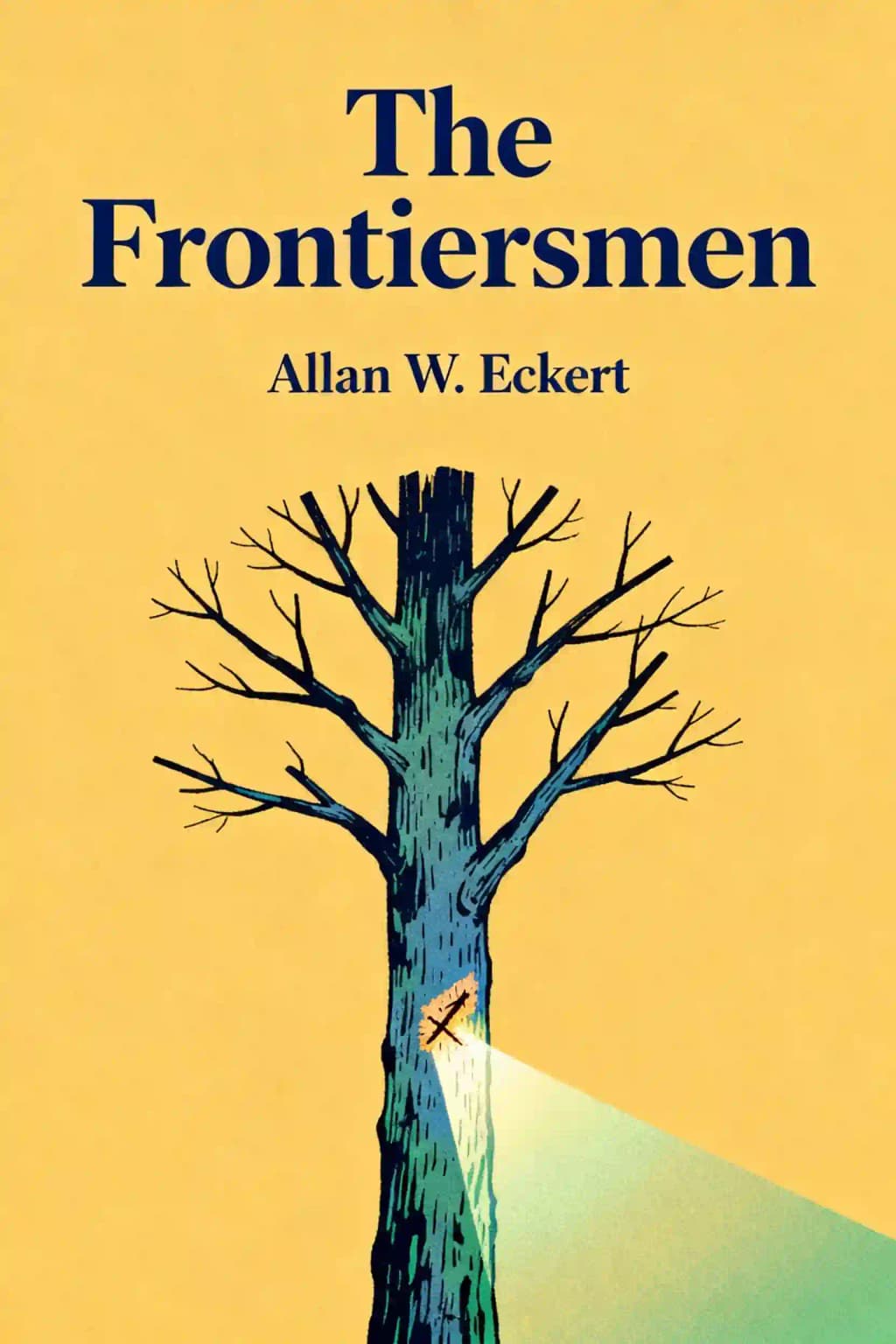
Discover the million-selling frontier epic where Simon Kenton and Tecumseh's intertwined fates shaped America. So compelling it earned dual literary prizes - unprecedented in 40 years - and inspired "Tecumseh!", the outdoor drama that captivated 2 million viewers since 1972.
Allan W. Eckert (1931–2011) is the acclaimed author of The Frontiersmen and a renowned historian and naturalist who specialized in American frontier history and natural history narratives. This historical narrative, the first in his celebrated six-book Winning of America series, chronicles the settlement of the Ohio Valley through meticulously researched accounts that blend historical accuracy with compelling storytelling.
Born in Buffalo, New York, Eckert authored more than 40 books and earned eight Pulitzer Prize nominations throughout his distinguished career. His expertise extended beyond writing to include 225 episodes for the Emmy Award-winning Mutual of Omaha's Wild Kingdom series.
He adapted The Frontiersmen into the outdoor drama Tecumseh!, which has been performed annually since 1972 at Chillicothe, Ohio, drawing over 2 million viewers. The Frontiersmen won the 1968 Ohioana Library Association Book of the Year Award, and his works have been translated into 13 languages worldwide.
The Frontiersmen is a historical narrative chronicling the settlement of America's Northwest Territory from 1755 to 1836. The book follows the parallel lives of Simon Kenton, a legendary frontiersman and scout, and Tecumseh, the brilliant Shawnee chief who united Native American tribes against westward expansion. Set across Kentucky, Ohio, Indiana, and surrounding regions, it depicts the brutal conflicts, survival challenges, and cultural clash that defined frontier America during this transformative period.
Allan W. Eckert (1931-2011) was an American historian, naturalist, novelist, and playwright who authored over 40 books during his career. He was nominated eight times for the Pulitzer Prize in literature, including for The Frontiersmen, and received honorary doctorates from Bowling Green State University and Wright State University. His works, translated into 13 foreign languages, specialized in bringing early American history to life through meticulously researched narrative storytelling that blended historical accuracy with dramatic literary technique.
The Frontiersmen appeals to readers fascinated by early American history, frontier life, and the complex dynamics between settlers and Native Americans. It's ideal for those who enjoy epic historical narratives spanning decades, military history enthusiasts interested in the Indian Wars, and anyone curious about lesser-known figures like Simon Kenton who shaped westward expansion. The book also suits readers seeking dual perspectives on American frontier history—both from pioneering settlers and indigenous resistance leaders.
The Frontiersmen offers a compelling, immersive journey through frontier America with vivid characterizations and extensive research spanning seven years. However, readers should approach it with awareness that Eckert employs narrative techniques that blur the line between strict historical fact and dramatized storytelling. The book excels at bringing forgotten historical figures to life and providing emotional connection to this era, making it valuable for those who appreciate narrative history over academic texts, despite ongoing debates about its factual accuracy.
The Frontiersmen centers primarily on Simon Kenton, a frontiersman whose contributions to opening the Northwest Territory rivaled those of his friend Daniel Boone. By age eighteen, Kenton had achieved frontier renown as a woodsman, fighter, and scout, known for his extraordinary physical strength, endurance, and tactical brilliance. The narrative equally explores Tecumseh's efforts to forge an Indian confederacy through intellect and charisma, creating a dual perspective that examines both the advancement of American settlement and the Native American struggle to preserve their lands.
Simon Kenton was a legendary American frontiersman and scout whose role in settling the Northwest Territory equaled or surpassed Daniel Boone's contributions. Originally fleeing North Carolina under the assumed name Simon Butler after believing he'd committed murder, Kenton became renowned for his incredible physical prowess, survival skills, and diplomatic relations with both settlers and Native Americans. His exploits during the Revolutionary War and subsequent decades exemplified the archetypal frontier hero—combining great dignity, innate kindness, and unmatched wilderness expertise.
The Frontiersmen presents Tecumseh as one of history's greatest leaders—a brilliant Shawnee chief who wielded intellect and charisma to unite diverse Native American tribes into a powerful confederacy. Eckert portrays Tecumseh as the paragon of his people's virtues, emphasizing both the grandeur of his vision and the tragedy of his doomed cause against inevitable westward expansion. The book reveals Tecumseh's strategic genius, moral character, and desperate attempt to preserve Native American sovereignty, providing readers with profound insight into indigenous resistance during this critical period.
The Frontiersmen features numerous legendary figures from early American history beyond its primary focus on Simon Kenton and Tecumseh. The narrative includes Daniel Boone, George Rogers Clark (Revolutionary War hero), Arthur St. Clair, Anthony Wayne (known as "Mad Anthony"), Simon Girty, and William Henry Harrison. The book also chronicles Blue Jacket (Marmaduke Van Swearingen), a white youth who was adopted by the Shawnee tribe and rose to become a respected chief and contemporary of Tecumseh.
The Frontiersmen presents a complex case regarding historical accuracy—while Eckert conducted seven years of research and claimed "this book is fact, not fiction," critics note it employs narrative techniques that dramatize events. The book functions as narrative history rather than academic scholarship, using literary devices like detailed dialogue and internal character thoughts that cannot be verified from historical records. Readers should appreciate it as meticulously researched historical storytelling that prioritizes emotional engagement and readability over strict documentary precision, blending verified facts with imaginative reconstruction.
The Frontiersmen spans approximately 81 years, beginning shortly after the French and Indian War in 1755 and concluding in 1836. This timeframe encompasses critical periods including the American Revolution, the Northwest Indian War, Tecumseh's confederacy formation, the War of 1812, and the subsequent decades of accelerated westward expansion. The narrative captures multiple generations of frontier life, showing how wilderness territories gradually transformed into settled states while Native American resistance ultimately succumbed to overwhelming demographic and military pressure.
The Winning of America series is Allan W. Eckert's multi-volume chronicle of American frontier expansion, with The Frontiersmen serving as the inaugural book published in 1967. The series uses narrative history to document territorial expansion across North America from colonial times through the 19th century. Other notable entries include Wilderness Empire, The Conquerors, and That Dark and Bloody River, each focusing on different regions, time periods, and key historical figures who shaped America's westward movement.
The Frontiersmen explores the brutal reality of frontier settlement, depicting how "rough and illiterate, sometimes brutal and vicious" pioneers transformed wilderness into civilization. Central themes include cultural collision between European settlers and Native Americans, survival against harsh environmental and human threats, and the moral complexity of westward expansion that brought both opportunity and destruction. The narrative examines heroism and tragedy on both sides, contrasting manifest destiny ideology with indigenous peoples' desperate defense of ancestral lands, while portraying the forgotten hardships of settlers during the Revolutionary War era.
Siente el libro a través de la voz del autor
Convierte el conocimiento en ideas atractivas y llenas de ejemplos
Captura ideas clave en un instante para un aprendizaje rápido
Disfruta el libro de una manera divertida y atractiva
Who is there to mourn for Logan? Not one.
Desglosa las ideas clave de Frontiersmen en puntos fáciles de entender para comprender cómo los equipos innovadores crean, colaboran y crecen.
Experimenta Frontiersmen a través de narraciones vívidas que convierten las lecciones de innovación en momentos que recordarás y aplicarás.
Pregunta cualquier cosa, elige tu estilo de aprendizaje y co-crea ideas que realmente resuenen contigo.

Creado por exalumnos de la Universidad de Columbia en San Francisco
"Instead of endless scrolling, I just hit play on BeFreed. It saves me so much time."
"I never knew where to start with nonfiction—BeFreed’s book lists turned into podcasts gave me a clear path."
"Perfect balance between learning and entertainment. Finished ‘Thinking, Fast and Slow’ on my commute this week."
"Crazy how much I learned while walking the dog. BeFreed = small habits → big gains."
"Reading used to feel like a chore. Now it’s just part of my lifestyle."
"Feels effortless compared to reading. I’ve finished 6 books this month already."
"BeFreed turned my guilty doomscrolling into something that feels productive and inspiring."
"BeFreed turned my commute into learning time. 20-min podcasts are perfect for finishing books I never had time for."
"BeFreed replaced my podcast queue. Imagine Spotify for books — that’s it. 🙌"
"It is great for me to learn something from the book without reading it."
"The themed book list podcasts help me connect ideas across authors—like a guided audio journey."
"Makes me feel smarter every time before going to work"
Creado por exalumnos de la Universidad de Columbia en San Francisco

Obtén el resumen de Frontiersmen como PDF o EPUB gratis. Imprímelo o léelo sin conexión en cualquier momento.
In 1771, sixteen-year-old Simon Kenton fled his Virginia home believing he had killed a man in a fight over a woman. Adopting the alias "Simon Butler," he plunged into the vast wilderness beyond the Appalachians-a world of breathtaking beauty and unforgiving danger. Meanwhile, in Shawnee territory, a remarkable child named Tecumseh was born as a meteor streaked across the night sky-a powerful omen for the boy destined to become the greatest Native American leader of his time. The American frontier in the late 18th century was not merely a geographical boundary but a complex zone where cultures collided and identities were forged in fire. Dense forests stretched endlessly westward, home to abundant wildlife and Native peoples who had inhabited these lands for generations. For European settlers pushing into this territory, the wilderness represented both opportunity and peril-a chance for a new life, but at tremendous risk. The collision between Native American and European cultures was already creating figures who straddled both worlds. Marmaduke Van Swearingen, captured by Shawnees, willingly adopted their ways and rose to become the war chief Blue Jacket. His transformation represented one path of cultural exchange, while most interactions between settlers and tribes were marked by misunderstanding and violence-like the murder of Chief Logan's family that transformed a friend of whites into an implacable enemy who vowed vengeance.
Frontier life existed under constant threat of capture, creating unexpected cultural exchanges. Simon Kenton's 1778 captivity exemplifies this reality. After stealing Shawnee horses, Kenton was captured while his companion was killed and scalped. His captors recognized him as "Bahd-ler," the frontiersman whose aim never missed. Kenton endured brutal treatment - tied spreadeagled overnight amid insects, then bound backward on an unbroken horse whipped through forest obstacles. At Chillicothe, he faced the gauntlet: a quarter-mile line of 400 people who beat him unconscious with clubs. Condemned to death and painted black, Kenton was saved by Simon Girty, a white man adopted by Senecas who recognized his old friend. Girty's plea and King Moluntha's mercy spared his life. These captivity experiences created vital cultural intermediaries. Girty later sided with British-Indian allies, becoming a "renegade" to Americans. Tecumseh gained English fluency through his friendship with captive Stephen Ruddell, enabling him to navigate both worlds and articulate Native grievances effectively.
While coastal Americans fought Britain for independence, frontier settlers battled British-allied Native tribes opposing colonial expansion. The Ohio country became a critical battlefield where individual courage often determined outcomes. George Rogers Clark emerged as the western theater's most important American commander. In 1778, with just 175 men, he captured the British outposts of Kaskaskia and Cahokia bloodlessly, then seized Vincennes after marching through frozen swamps. This campaign secured the vast territory between the Ohio River and Great Lakes for Virginia. Simon Kenton, Clark's chief scout, demonstrated exceptional woodcraft and stealth. His intelligence-gathering proved invaluable, prompting Clark to remark: "Simon Butler, you're either the bravest man or the biggest fool on the frontier." For the Shawnee, the war brought tragedy. At Fort Randolph, Chief Cornstalk, his son, and sub-chief Red Hawk were murdered under a flag of truce, while young Tecumseh suffered when his father died at the Battle of Point Pleasant.
Following American independence, conflict erupted in the Ohio Territory as settlers pushed west and Native tribes defended their lands in the Northwest Indian War. Under Little Turtle (Miami) and Blue Jacket (Shawnee), Native forces achieved stunning victories. They ambushed General Harmar in 1790, inflicting 109 American casualties. In 1791, they dealt an even greater blow to General St. Clair - 632 of his 920 soldiers were killed and 264 wounded, marking the worst defeat Native Americans ever inflicted on U.S. forces. President Washington appointed Anthony Wayne, whose trained Legion defeated the Indian confederacy at the Battle of Fallen Timbers in 1794, while nearby British forces abandoned their Native allies. The Treaty of Greenville (1795) established a boundary between Native and white territories, with the United States claiming about 25,000 square miles. Though declared "permanent," many warriors knew this peace would eventually crumble as white settlement expanded.
From defeat emerged Tecumseh, who refused to attend the Greenville negotiations and instead envisioned unifying all Native tribes into a confederacy to halt American expansion. Tecumseh developed a pan-Indian philosophy arguing that land belonged to all Indians collectively - no single tribe could cede territory without universal consent. This directly challenged America's divide-and-conquer land acquisition strategy. Handsome, eloquent, and courageous, Tecumseh earned respect across tribes. His opposition to torture demonstrated moral authority that impressed even enemies. His vision included cultural revival, urging Indians to return to traditional ways by rejecting European goods and alcohol, which he viewed as deliberately introduced poison. Tecumseh's message gained powerful amplification through his brother Tenskwatawa, whose accurate prediction of a solar eclipse fifty days in advance cemented his reputation as a prophet.
The fragile alliance between Tecumseh's confederacy and American authorities collapsed in 1811 during Tecumseh's southern recruitment journey. Tenskwatawa ignored instructions for peace, recklessly sending emissaries to Governor Harrison while secretly planning an attack and promising his followers bullet immunity. The Battle of Tippecanoe destroyed the Prophet's credibility and crippled Tecumseh's confederacy. Upon return, Tecumseh furiously confronted his brother, declaring him dishonored - no longer his brother, Shawnee, or even a man. Despite this setback, Tecumseh's predicted "great sign" manifested on December 16, 1811, when the New Madrid earthquake struck, drawing many warriors to his cause. When the War of 1812 erupted, Tecumseh allied with British forces, contributing to several victories including Detroit's capture. The tide turned after Commodore Perry gained control of Lake Erie in 1813, severing British supply lines. Disgusted by General Proctor's retreats, Tecumseh delivered a scathing speech comparing him to a frightened dog. Leaving burning Fort Malden, Tecumseh told his companions, "My brothers, I feel well assured that we shall never return."
The Battle of the Thames on October 5, 1813, marked the end of an era when Colonel Richard Johnson killed Tecumseh, collapsing the last significant Native American confederacy in the Old Northwest. For Simon Kenton, who witnessed the entire frontier saga, the transformation was bittersweet. By the 1830s, his wilderness had been settled. Despite earning extensive land claims, his lack of formal education led to property losses through legal complications and swindlers. In his later years, Kenton underwent a spiritual conversion at a Methodist camp meeting. After confessing his sins, the aging frontiersman abandoned his lifelong rifle for a staff - a transformation few expected from the legendary Indian fighter. The Native peoples faced devastating changes. The proud Shawnee nation was reduced to reservations, mostly relocated west of the Mississippi. Yet from Tecumseh's burial came their sacred tradition: Tecumseh will return, bringing nakude-fanwi udawa-"one town of towns"-ending tribal strife. Kenton died on April 29, 1836, at eighty-one. His final words: "I have fought the last battle and it has been the hardest of them all."