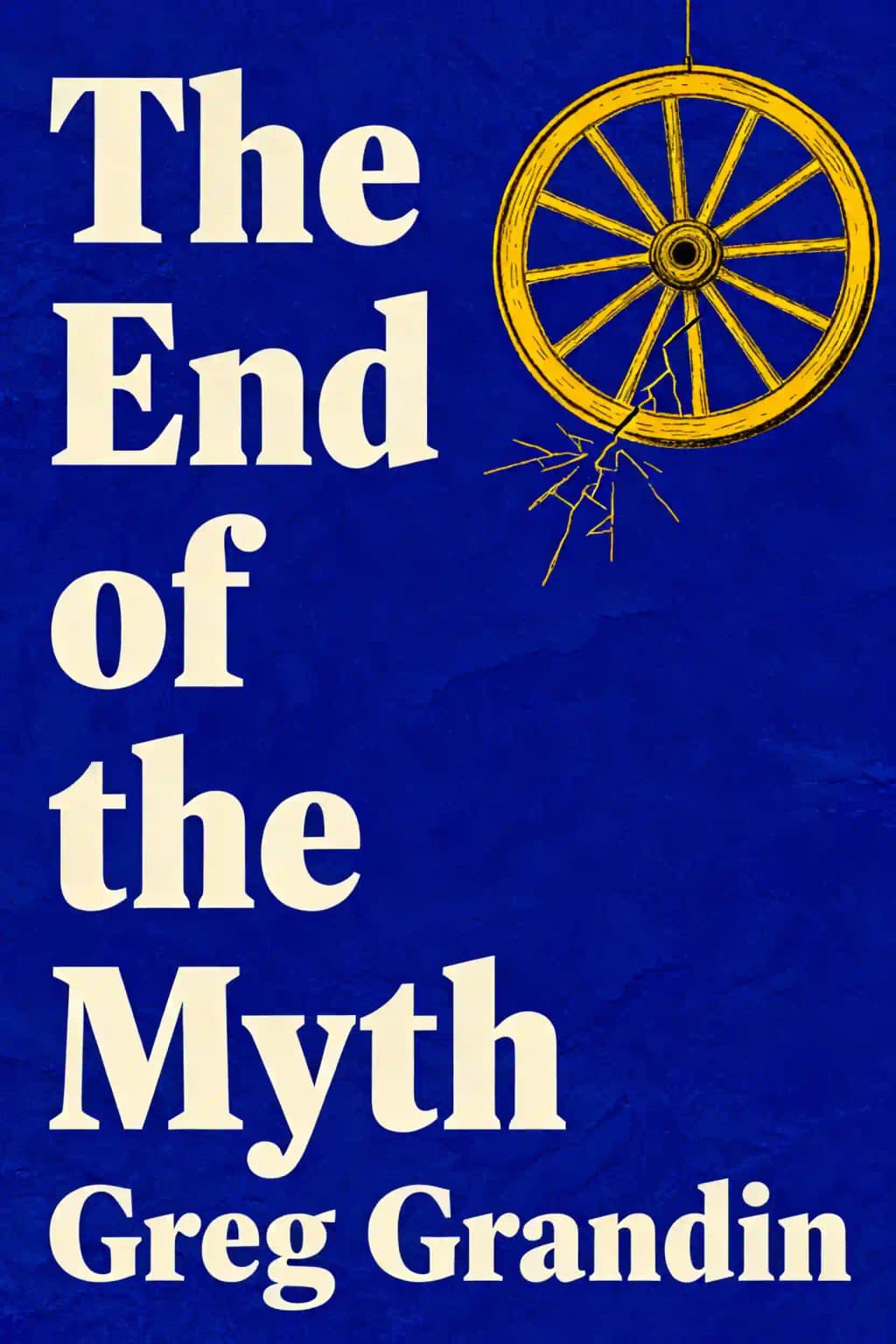
Grandin's award-worthy exploration shatters America's frontier mythology, revealing how border walls replaced endless horizons. Praised by historians for its penetrating insights on racism and expansionism, this 2019 masterpiece asks: What happens when a nation built on limitless growth finally hits its boundaries?
Greg Grandin, Pulitzer Prize-winning author of The End of the Myth: From the Frontier to the Border Wall in the Mind of America, is a renowned historian and professor of history at Yale University specializing in American empire, foreign policy, and Latin American studies.
His groundbreaking work explores how America’s frontier ideology shaped its identity and modern border politics, informed by decades of research into imperialism and social change.
A Guggenheim Fellow and Bancroft Award recipient, Grandin’s other acclaimed books include Fordlandia: The Rise and Fall of Henry Ford’s Forgotten Jungle City (Pulitzer finalist) and The Empire of Necessity (Beveridge Award winner), both examining capitalism’s global impacts.
A frequent contributor to The New York Times and The Nation, he has advised UN commissions on human rights and delivered lectures at institutions worldwide. The End of the Myth won the 2020 Pulitzer Prize in History and has been hailed as a defining analysis of U.S. nationalism.
The End of the Myth examines the concept of the American frontier as a symbol of limitless expansion and progress, arguing that its collapse has fueled modern political divisions. Greg Grandin traces how this myth justified imperialism, globalization, and systemic inequality while masking domestic conflicts. The book connects historical frontier ideologies to contemporary debates over border walls and nationalism, offering a critique of American exceptionalism.
This book is ideal for readers interested in U.S. history, political theory, or socio-cultural analysis. Historians, policymakers, and students of American studies will gain insights into how frontier narratives shaped national identity. It also appeals to those exploring themes like nationalism, globalization, and the roots of modern political polarization.
Grandin posits that the frontier myth allowed America to externalize its conflicts through expansion, avoiding reckoning with issues like slavery and inequality. He links the myth’s decline to a turn toward isolationism and xenophobia, symbolized by border walls. The book also critiques how “exemptionalism” replaced exceptionalism, divorcing the U.S. from historical accountability.
Grandin argues that the closure of the literal frontier in the 19th century led to metaphorical expansions through imperialism and globalization. When these too reached limits, the U.S. shifted inward, manifesting in policies like border militarization. This trajectory, he claims, explains contemporary crises like Trump-era nationalism.
The book won the 2020 Pulitzer Prize for General Nonfiction and was a finalist in the history category. It has been praised for its timely analysis and scholarly rigor, cementing Grandin’s reputation as a leading historian of American ideology.
He dismantles exceptionalism by showing how the frontier myth obscured violence, racism, and exploitation—both domestically and abroad. Grandin highlights how expansionism served as an “escape valve” for social tensions, delaying confrontations with systemic injustice.
The book spans four centuries, citing:
Like Fordlandia and Empire of Necessity, this book explores capitalism and power dynamics, but with a sharper focus on mythmaking. It expands on themes from Empire’s Workshop, linking U.S. foreign policy in Latin America to broader ideological shifts.
Some scholars argue Grandin oversimplifies early colonial history by omitting pre-Columbian demographics and disease impacts. Others note the book’s bleak tone but acknowledge its relevance to understanding modern populism.
He views the wall as a physical manifestation of the frontier myth’s failure—a desperate attempt to restore clarity in an era of perceived limitlessness. It represents a shift from outward expansion to defensive nationalism.
As debates over immigration, climate limits, and global instability persist, Grandin’s analysis offers a framework for understanding how nations confront—or avoid—existential challenges. Its insights remain critical for decoding ongoing political and cultural divides.
Siente el libro a través de la voz del autor
Convierte el conocimiento en ideas atractivas y llenas de ejemplos
Captura ideas clave en un instante para un aprendizaje rápido
Disfruta el libro de una manera divertida y atractiva
America was simultaneously an aspiration, errand, and obligation.
Native Americans were obstacles to be removed.
Expansion became America's universal solution.
We have only to shut our hand to crush them.
The greater the expansion, the greater the advantage.
Desglosa las ideas clave de End of the Myth en puntos fáciles de entender para comprender cómo los equipos innovadores crean, colaboran y crecen.
Destila End of the Myth en pistas de memoria rápidas que resaltan los principios clave de franqueza, trabajo en equipo y resiliencia creativa.

Experimenta End of the Myth a través de narraciones vívidas que convierten las lecciones de innovación en momentos que recordarás y aplicarás.
Pregunta lo que quieras, elige la voz y co-crea ideas que realmente resuenen contigo.

Creado por exalumnos de la Universidad de Columbia en San Francisco
"Instead of endless scrolling, I just hit play on BeFreed. It saves me so much time."
"I never knew where to start with nonfiction—BeFreed’s book lists turned into podcasts gave me a clear path."
"Perfect balance between learning and entertainment. Finished ‘Thinking, Fast and Slow’ on my commute this week."
"Crazy how much I learned while walking the dog. BeFreed = small habits → big gains."
"Reading used to feel like a chore. Now it’s just part of my lifestyle."
"Feels effortless compared to reading. I’ve finished 6 books this month already."
"BeFreed turned my guilty doomscrolling into something that feels productive and inspiring."
"BeFreed turned my commute into learning time. 20-min podcasts are perfect for finishing books I never had time for."
"BeFreed replaced my podcast queue. Imagine Spotify for books — that’s it. 🙌"
"It is great for me to learn something from the book without reading it."
"The themed book list podcasts help me connect ideas across authors—like a guided audio journey."
"Makes me feel smarter every time before going to work"
Creado por exalumnos de la Universidad de Columbia en San Francisco

Obtén el resumen de End of the Myth como PDF o EPUB gratis. Imprímelo o léelo sin conexión en cualquier momento.
What if a nation's entire identity rested on a single belief-that there would always be more land, more resources, more room to run? For over a century, America operated on this exact premise. The frontier wasn't just geography; it was a promise that any social problem could be solved by moving west, that any conflict could be defused by expansion, that limits simply didn't apply. Frederick Jackson Turner's 1893 thesis crystallized this into national mythology: America's uniqueness stemmed from "free land" stretching endlessly westward, creating political equality and rugged individualism. Presidents from Jefferson to Kennedy invoked pioneering spirits to justify everything from Indian removal to foreign wars. But what happens when the frontier closes? When a nation built on endless growth hits a wall-literal and metaphorical-it faces a reckoning with all the problems it spent centuries avoiding.